
June 8 – Delft
Today, I’m headed to Delft. Luckily, the tram that I use to get around Den Hague also goes to Delft so I’m confident that even my poor navigational skills will be enough to ensure success. The forecast includes a chance of showers so I’ve packed my trusty poncho and I’m off for a day of exploring. My “plan” is to do a walk along the “Ceramic Route” to check out a number of installations in Delft that pay homage to the happy blue and white pottery Delft is famous for, explore the Vermeer Museum, visit the old and new churches and then see what else I want to do.
(Wo)Man plans and God laughs! is the translation of an old Yiddish adage and today God must have been peeing his pants!
I managed get to Delft without incident but as soon as we’d arrived the promised “showers” started and it rained incessantly for the entire time I was there. Apparently the rain was really needed as the dykes were very dry and at risk of cracking with the resulting flooding. Oh well, I didn’t melt in the rain but my plan was a bit of wash out! Nonetheless I had a great soggy day in Delft with some surprises.
Miraculously the first tram stop in Delft was at Princenhof Museum which was also the start of the planned Ceramics Route.
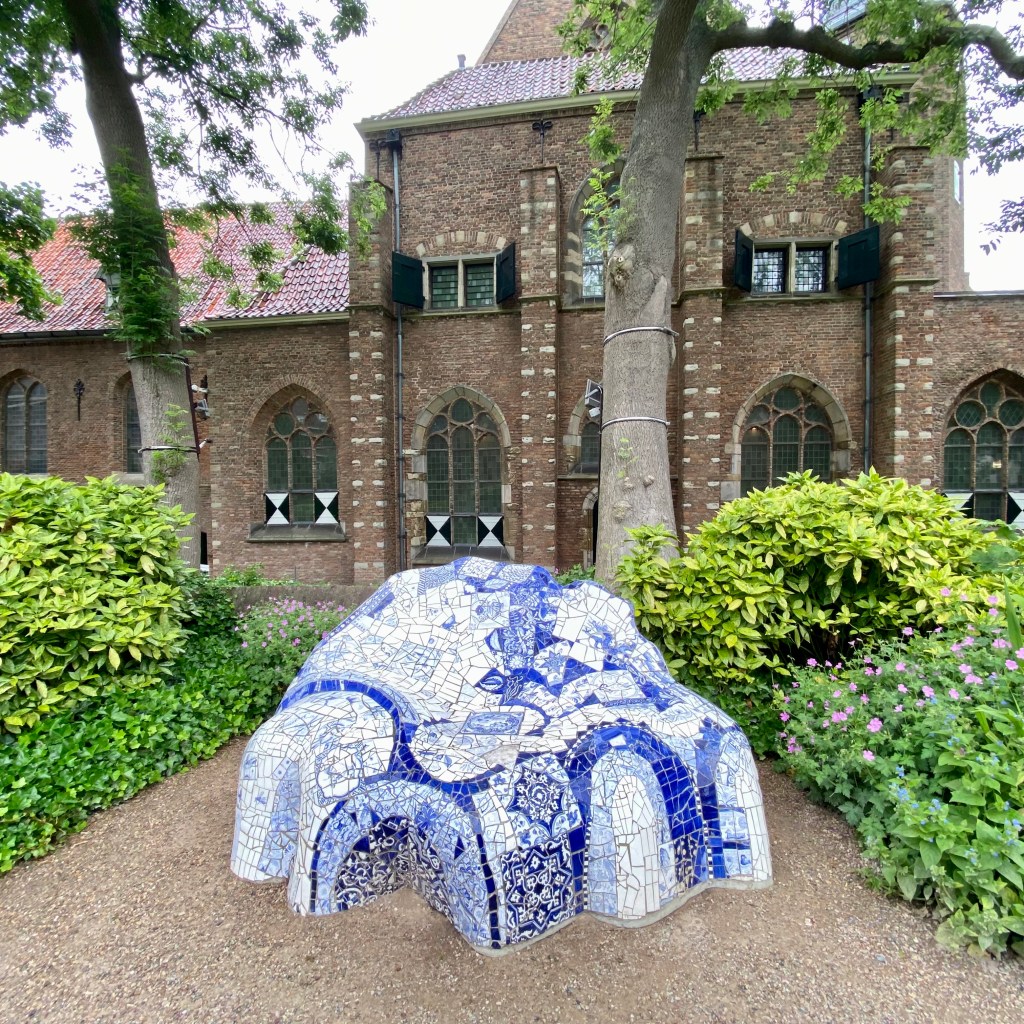
The first installation, Homage to Gaudi; a ceramic Delft blue sofa designed by Marianne Burger’s, is in the Prinsenhof Garden. Delft artist Chris Dagradi created the tiles especially for this sofa which was unveiled in 1988.
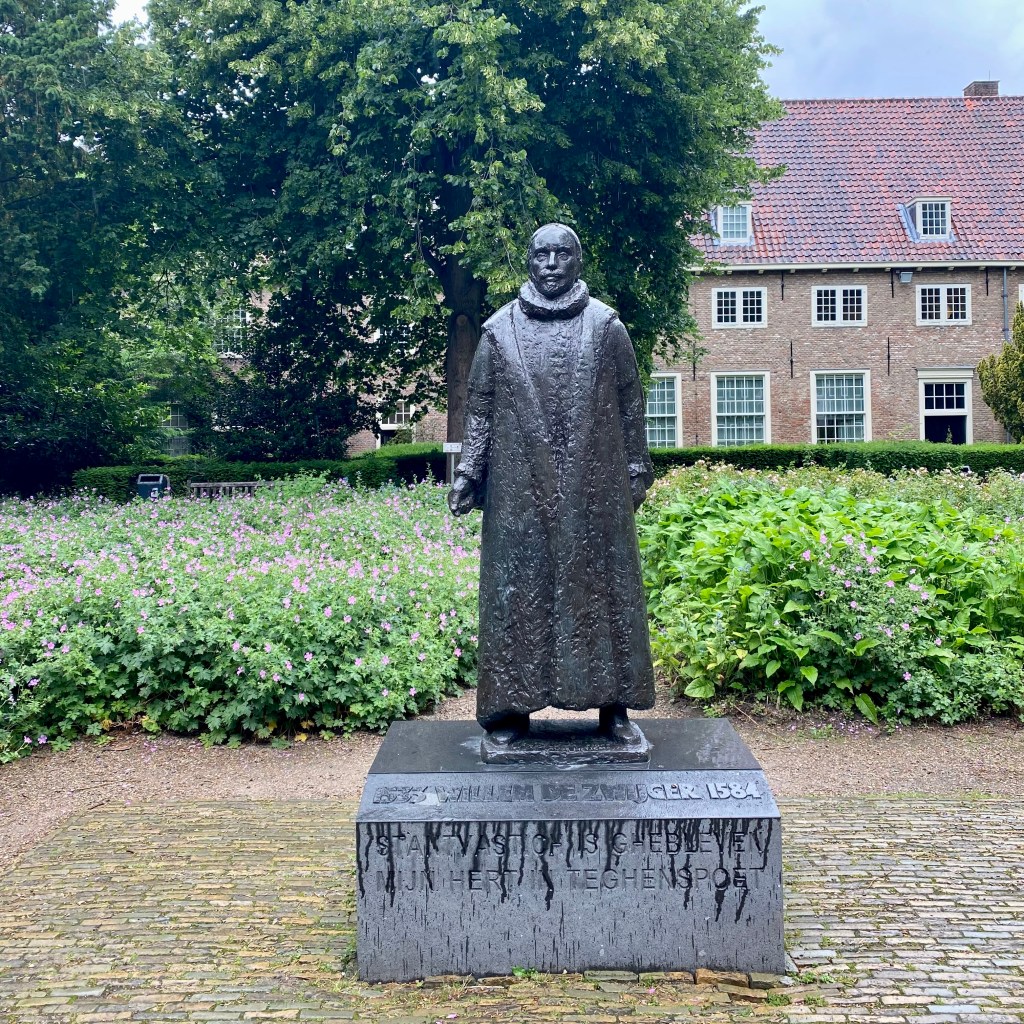
In the same garden is a statue of William the Silent aka Prince William of Orange who spent much of his life in Delft. From 1572 to 1584 he and his court regularly stayed at the then St. Agatha convent. Because of this, the complex has since been known as “Prinsenhof”.
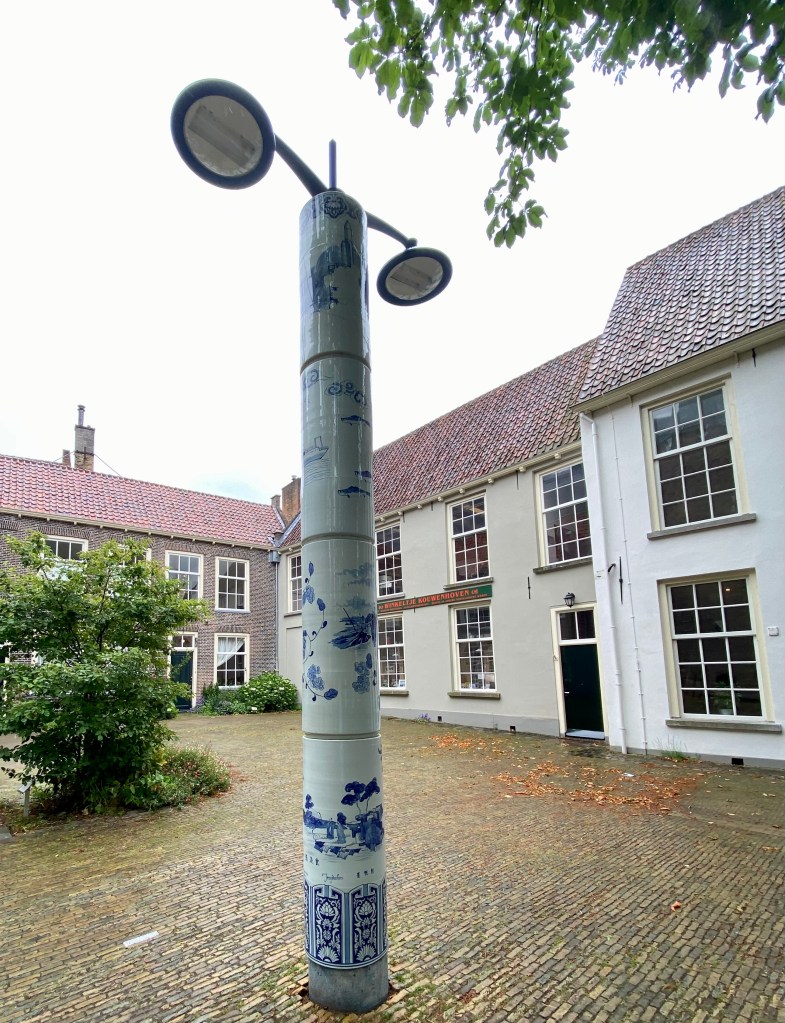
Next up also in the museum courtyard (aka Sint Agathaplein) a trio of beautiful porcelain lampposts are nestled among the old chestnut trees. The lampposts feature paintings by Wendy Steenks and Chinese artist Zhang Ling Yun combining traditional Chinese and Dutch motifs with contemporary forms. These porcelain lampposts were made in the Chinese ceramics city of Jingdezhen, a sister city of Delft and the cradle of Chinese porcelain from which Delft blue originated.


Passing the Oude Kerk on the way to the Centrum, I came across a statue of Geertruyt van Oosten. After being dumped by her fiancé she was said to have lead a very pious life She was considered very holy and manifested miraculous stigmata. She’s not part of the Ceramics Route but here she is!

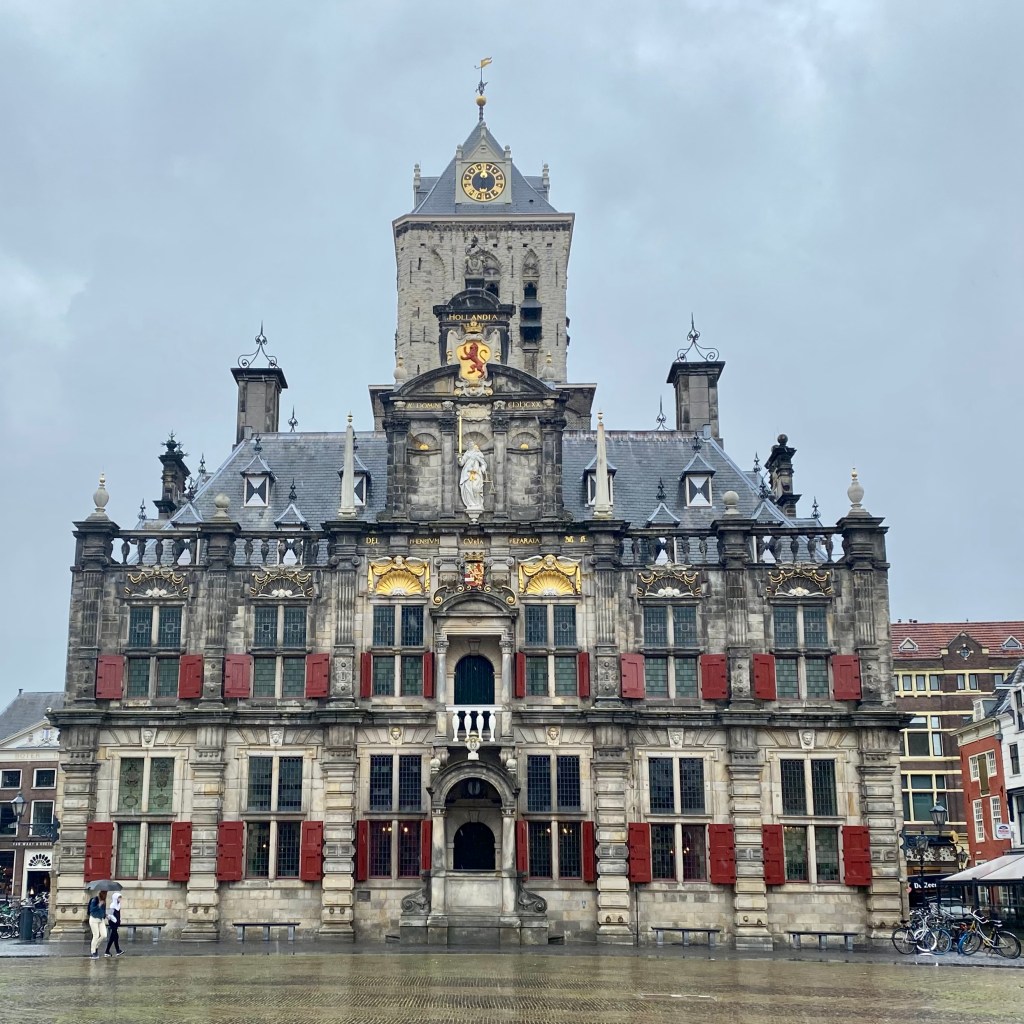
The next stop on the Ceramics Route was to have been The ‘Ceramic Map’; a map of Delft from the 17th century, made of ceramic and mosaic. Sadly, my lack of navigational skills and a dearth of natives, frolicking in the rain who knew what I was talking about, scuppered that part of my plan. In the meantime, i snapped a pic of the beautiful City Hall.

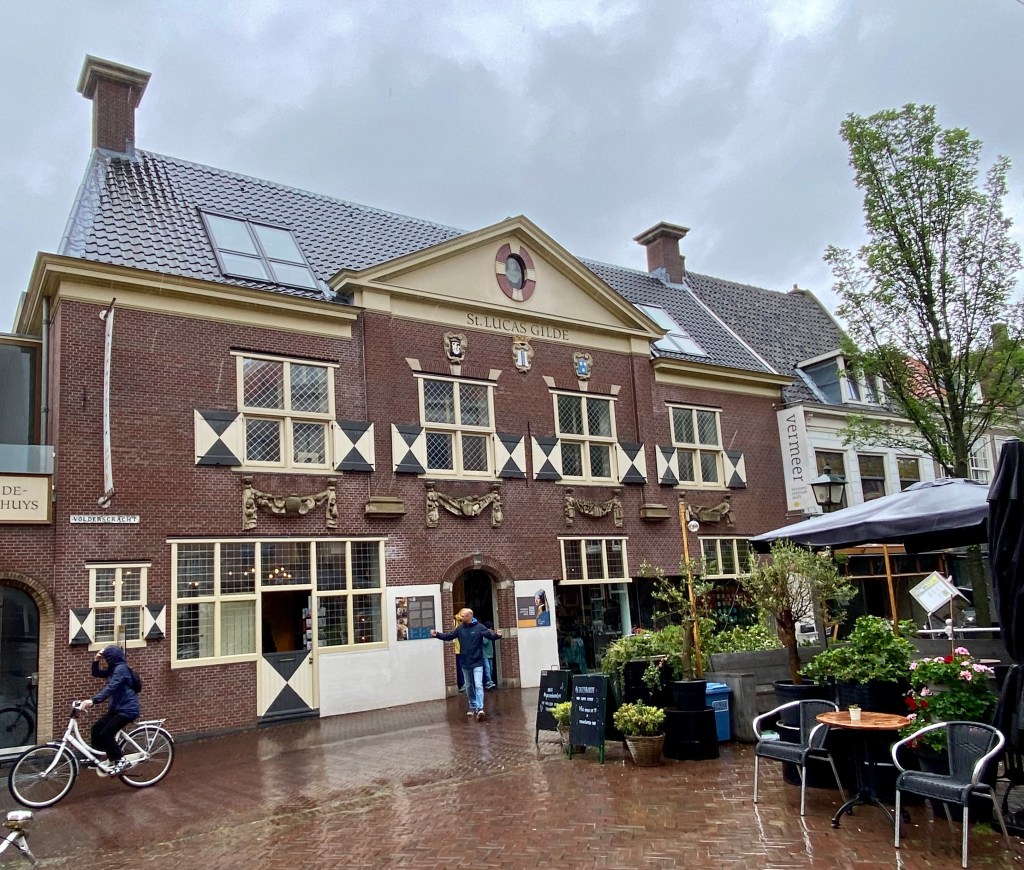
By now, I’m getting drenched and decide an inside activity is in order so I head to the Vermeer Centrum. Johannes Vermeer of Girl with a Pearl Earring fame lived and worked in Delft his whole life. The museum provides some insights to Vermeer’s life, family and work. There are true-size reproductions of all his works but sadly none of the originals are in his home town. Not sure it’s a must do but it was a nice respite from the rain, lol! I did really enjoy Girls with Pearls by Carolien Sikkenk so I’ve inserted that below.

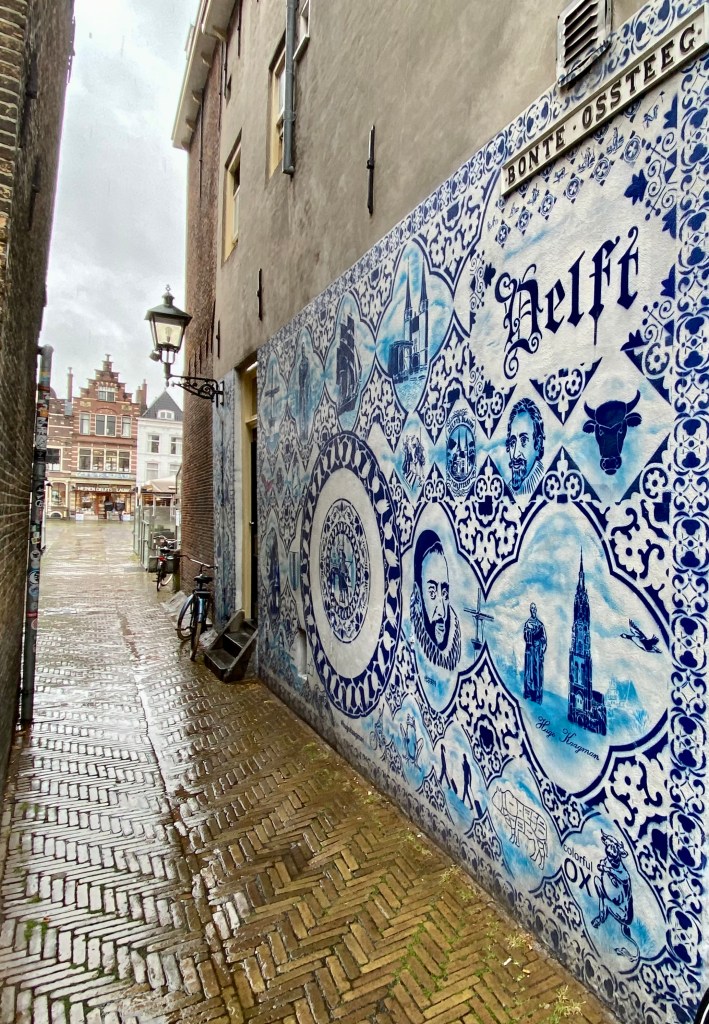
Braving the rain again at least momentarily, I’m off to Bonte Ossteeg to check out Hugo Kaagman’s mural commissioned by the municipality of Delft in 2013. This artwork was inspired by Delft blue motifs with patterns and colours reminiscent of Delft blue tiles. The images in the mural show Delft through the ages.

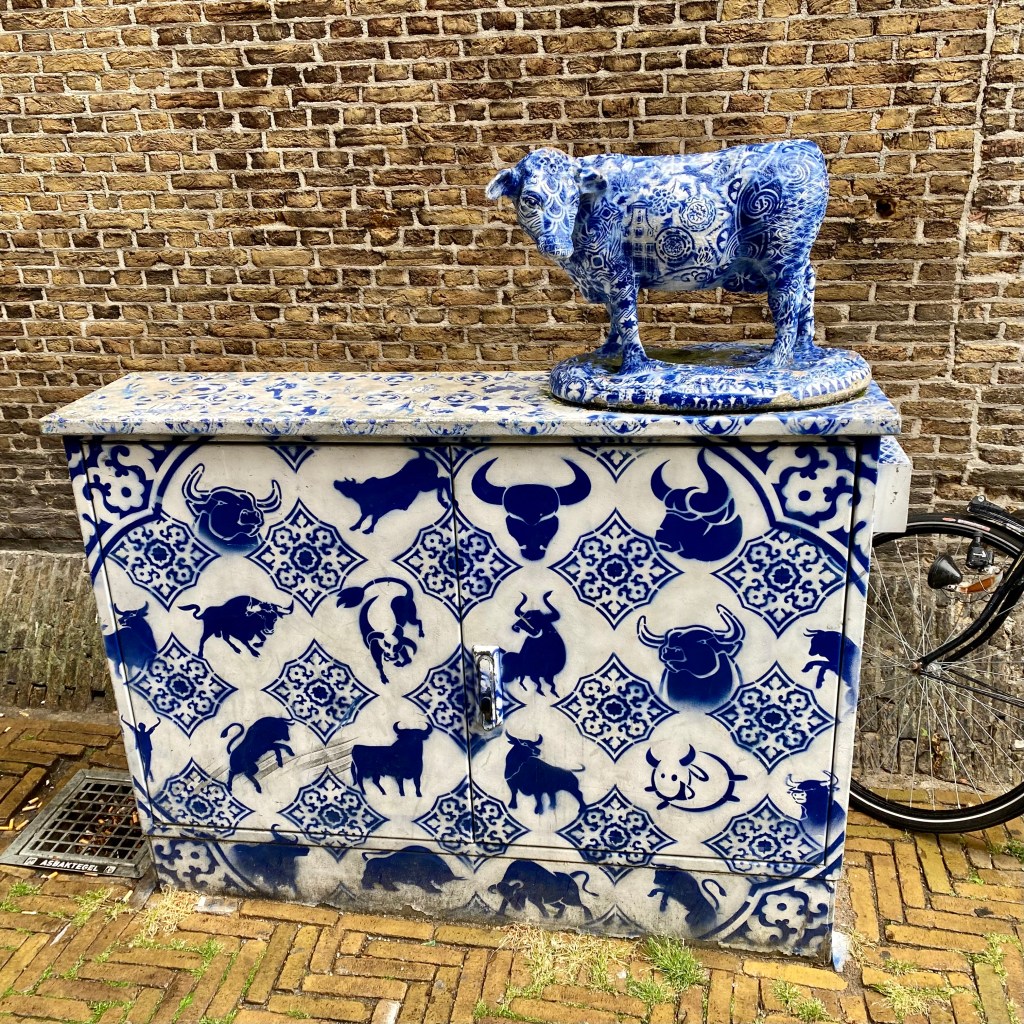
Opposite the Delft blue mural is a transformer box painted in blue and white, topped with “The Colourful Ox”. The striking artwork is by Amsterdam sculptor/street artist Hugo Kaagman.
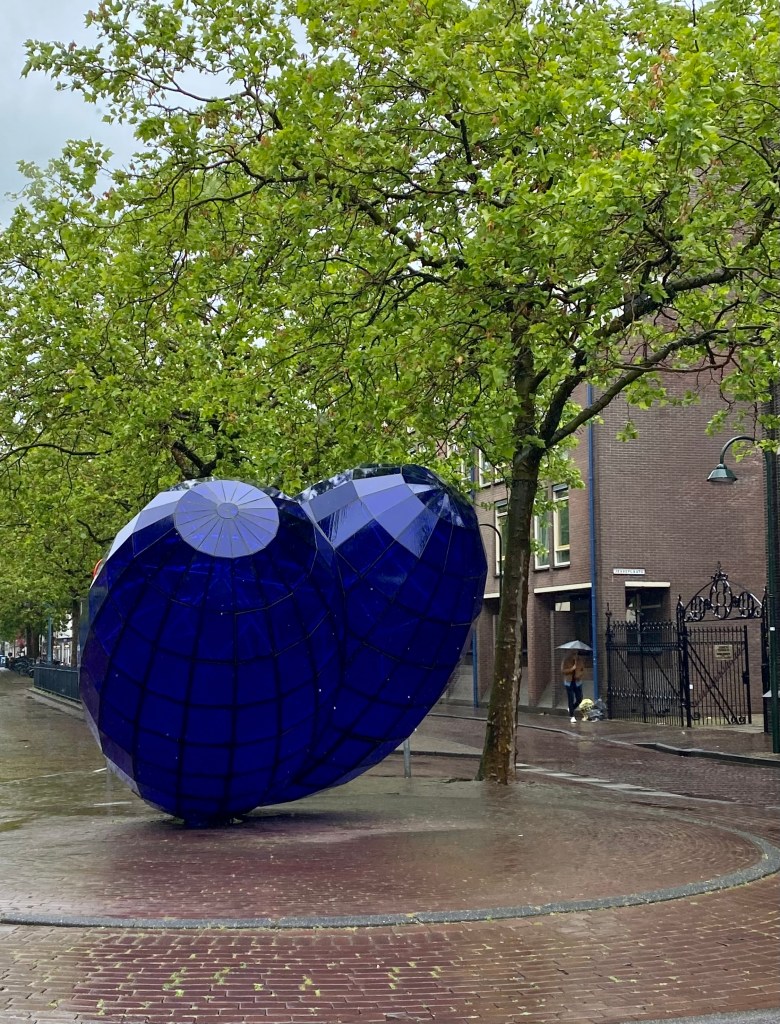
On Oude Langendijk, I found a large delft blue glass heart. Apparently, the sculpture is lit from within at night as an homage to the stained glass of the churches in Delft.
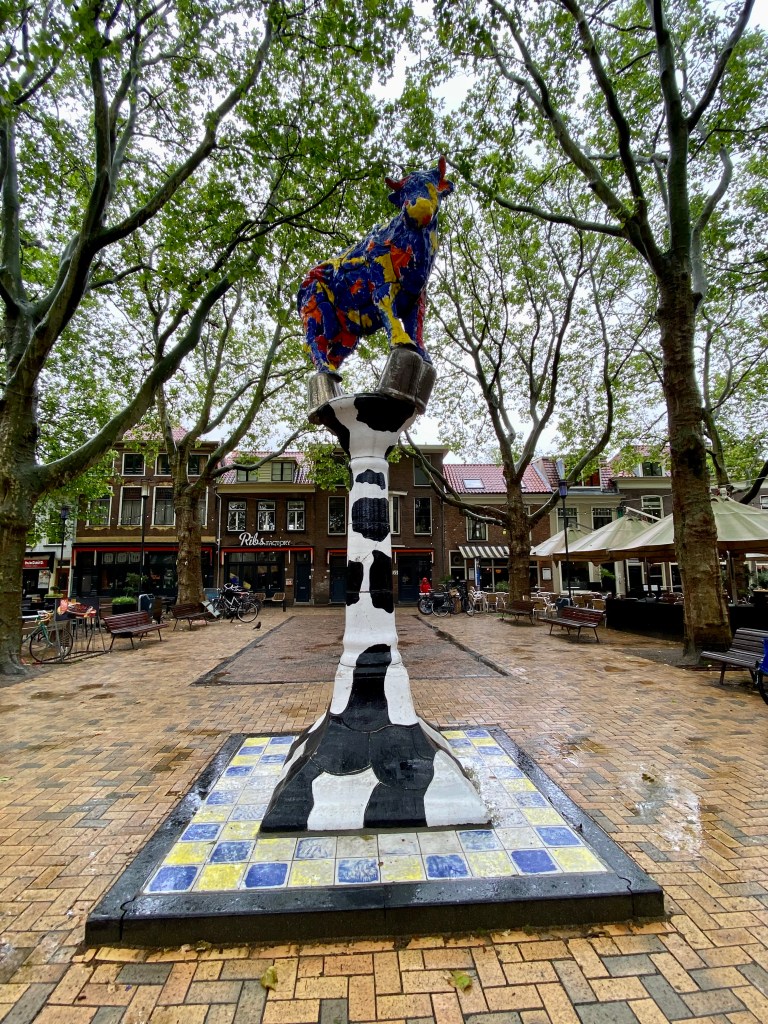
The Beestenmarkt was used as a cattle market from the sixteenth century until 1972. The ‘Delft Cow’ (although some call it a bull) is a reminder of this time. Painted in red, blue and yellow, the cow stands on inverted silver thimbles on a tall column that is white with black spots a reference to the colours of the typical Dutch cow.
Fed up with the rain, I’m abandoning the Ceramic Route and heading to the New Church. This is a day better suited to inside activities! on my way i passed a few more gems!

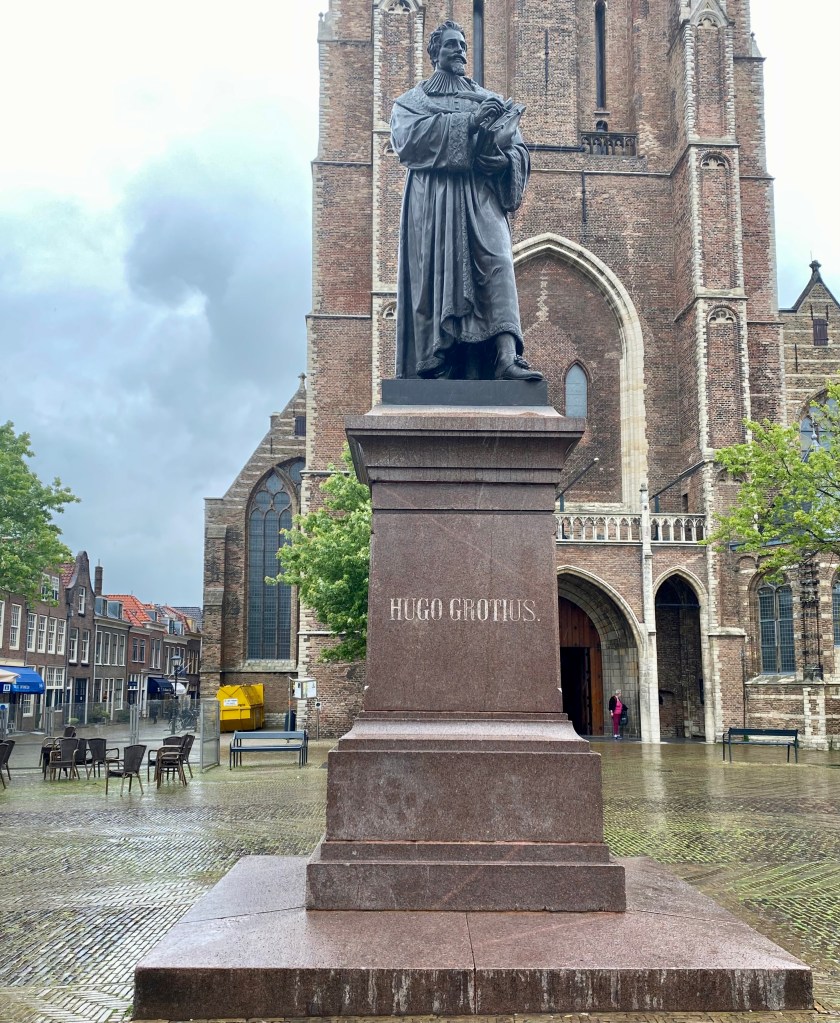
In front of the Nieuwe Kerk is a bronze statue depicting Hugo de De Groot in his role as a jurist. He wears a gown and holds a law book in his hand. He is one of the most famous figures in Dutch history and is considered one of the greatest jurists ever. He is buried in the Nieuwe Kerk in Delft right next to those of his archenemy Prince Maurice.
The New Church is the largest basilica in Delft and it’s construction is linked to visions of a golden church on the markt by two residents of Delft in the middle of the 14th century. This impressive building features a memorial to William of Orange and is home to the royal family’s private crypt which is currently being expanded. There’s also a beautiful pipe organ and fabulous stained glass windows.
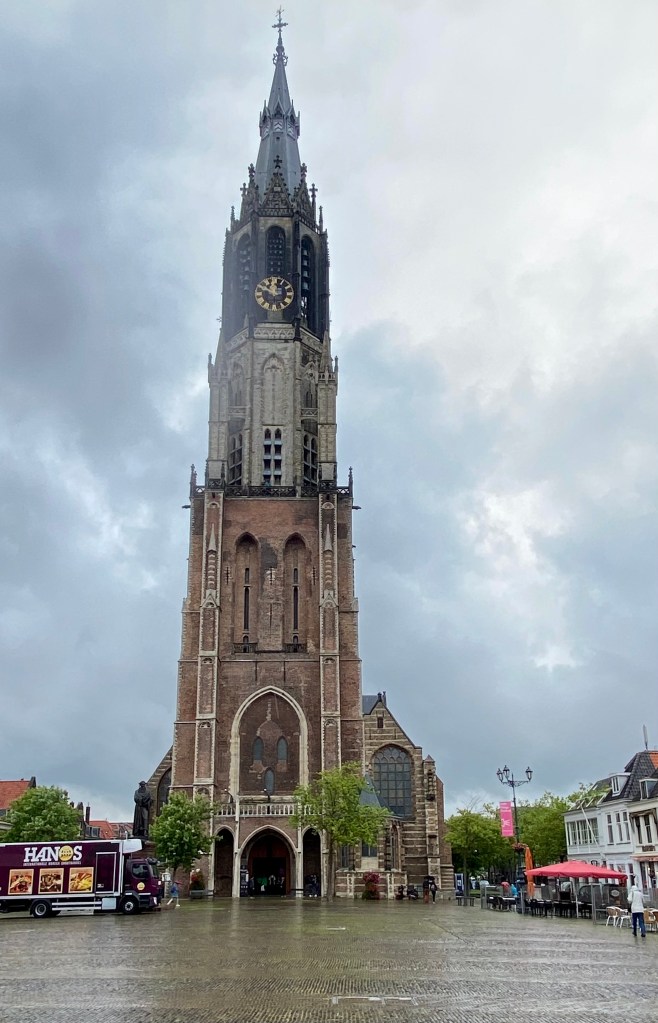


The old church is the final resting place of four hundred well known and less well known Dutch people. Some have fabulous mausoleums and some a simple headstones. Vermeer had no money when he died so he doesn’t have a fancy stone but is laid to rest in his mother-in-law’s crypt. After his paintings became more well known the Dutch government added a headstone.
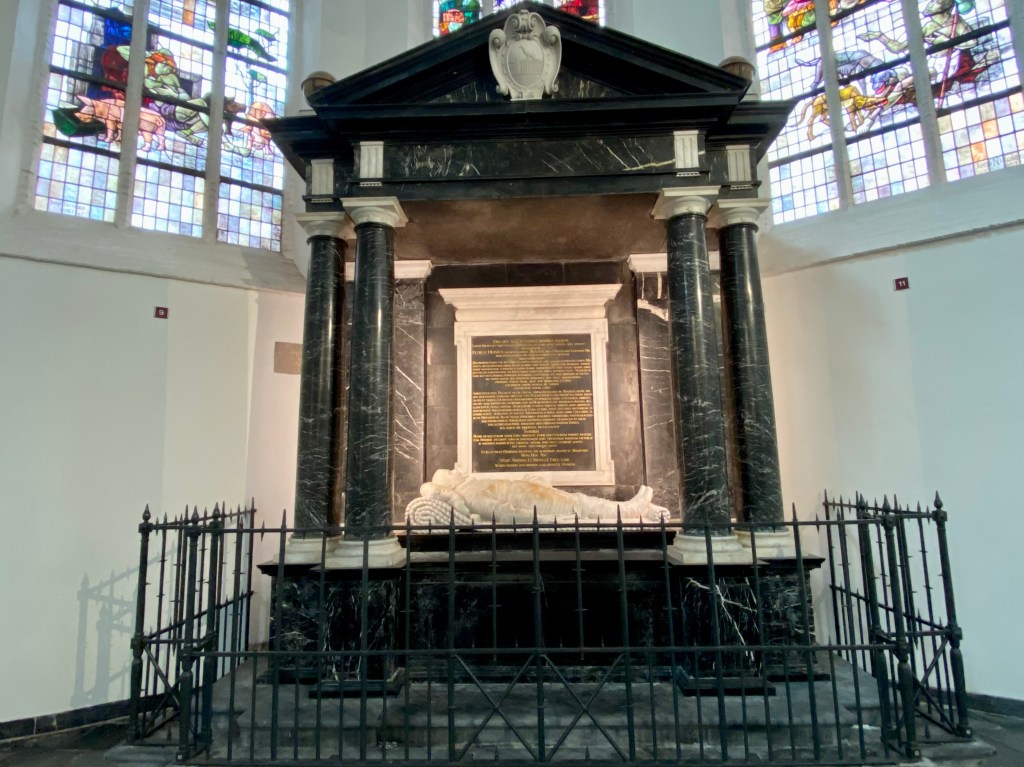
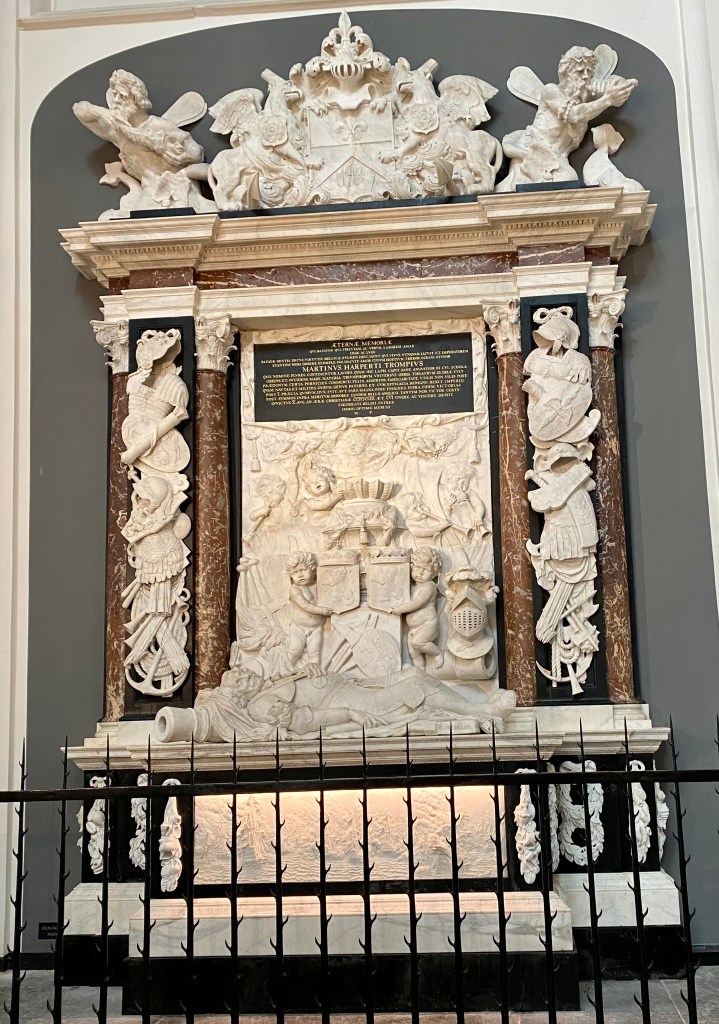

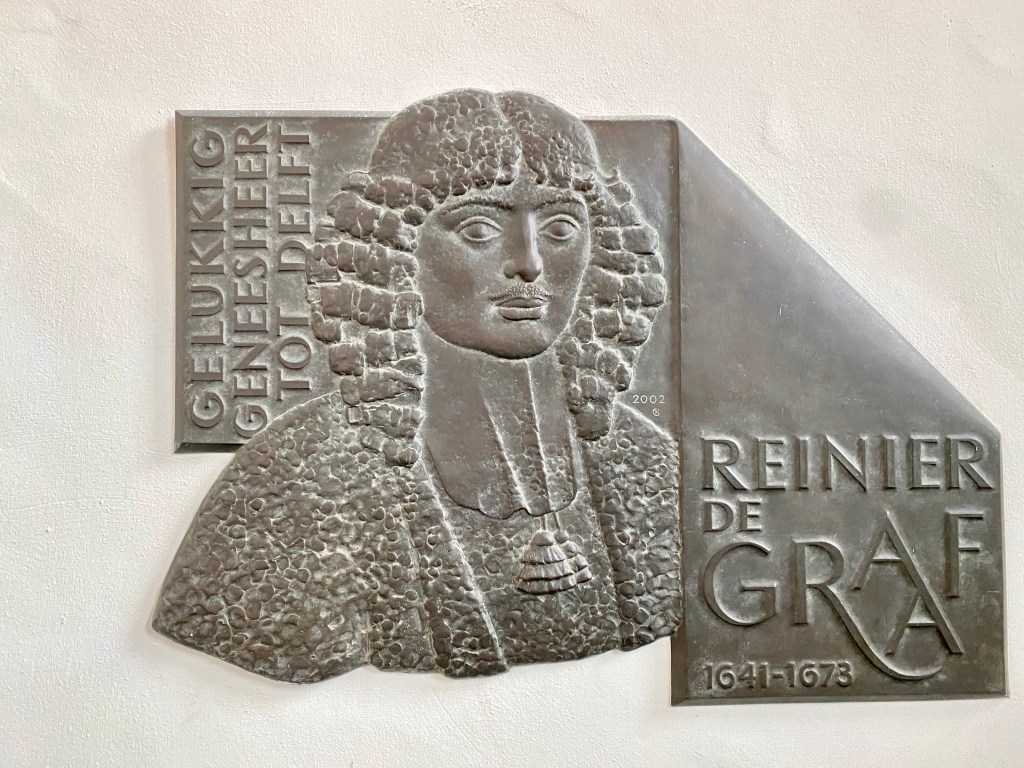
Time to call it a day. Stopped at a bakery, meat market and cheese store to pick up a few things for a charcuterie plate tonight and I’m back to Den Hague. It finally stops raining when I get back to my hotel. Lol, tomorrow is another day and I’m off to Gouda for the weekly cheese market.
 Judy’s Rambles
another eventful day.We have visited that area twice and both times it rained……..
LikeLike