The time has come for us to disembark but not before one final hearty breakfast and saying thank you to the marvellous crew for our wonderful journey. What a week it’s been!
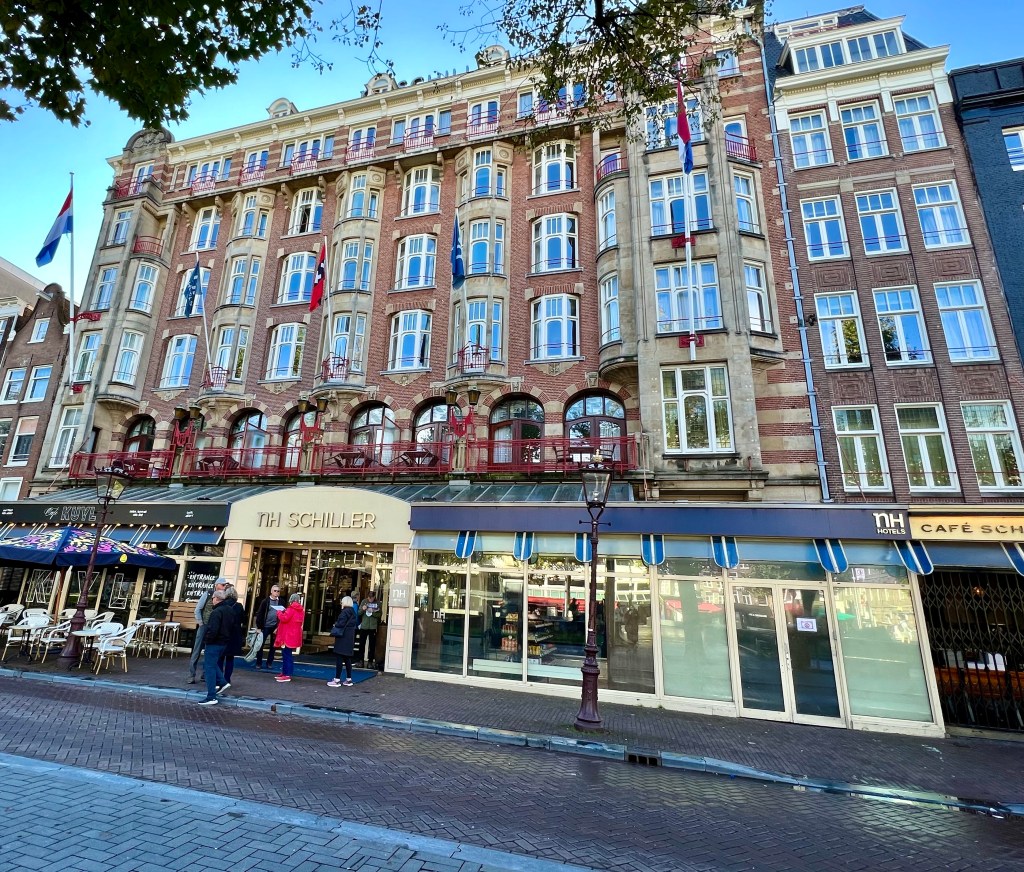
After a bit of time patiently waiting in the lounge, the cabs are arriving and we’re heading to our hotel on Rembrandtplein for a few nights. Too early for check in, so we drop off our bags and head out to explore the area. I’m with a group headed to a local market and, after that, the Rijksmuseum to stroll through history with the Dutch Masters.
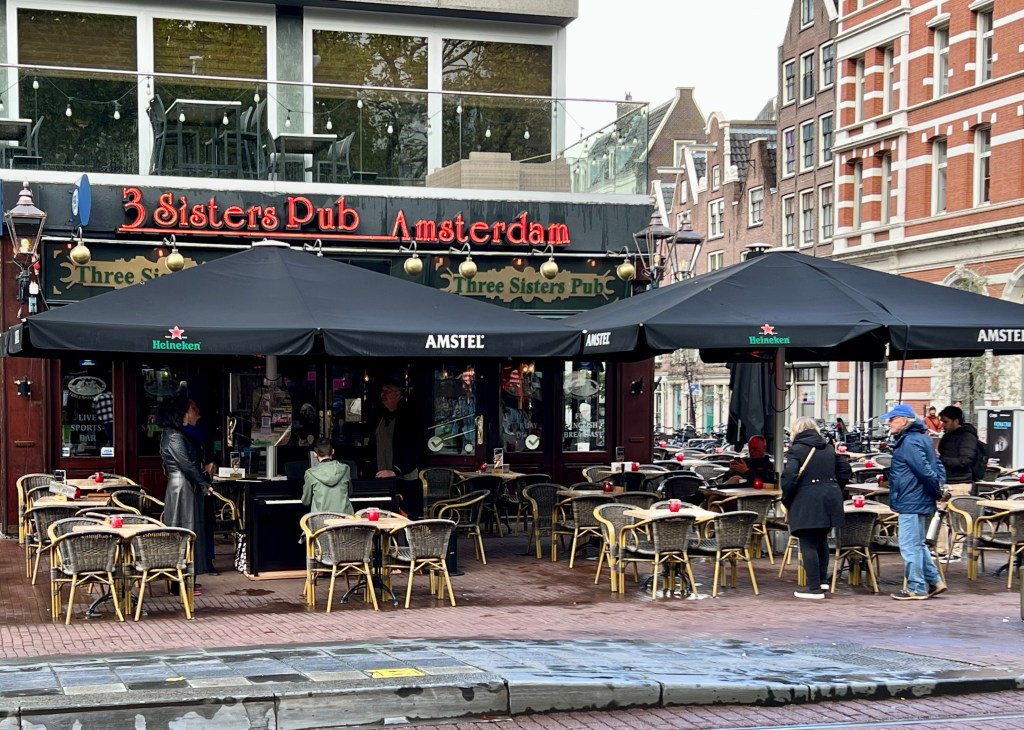
Himself in RembrandtpleinOur digs for a few days – Rooms on the front are noisy into the night …Heather and Robyn, this might be our pub?Canal view
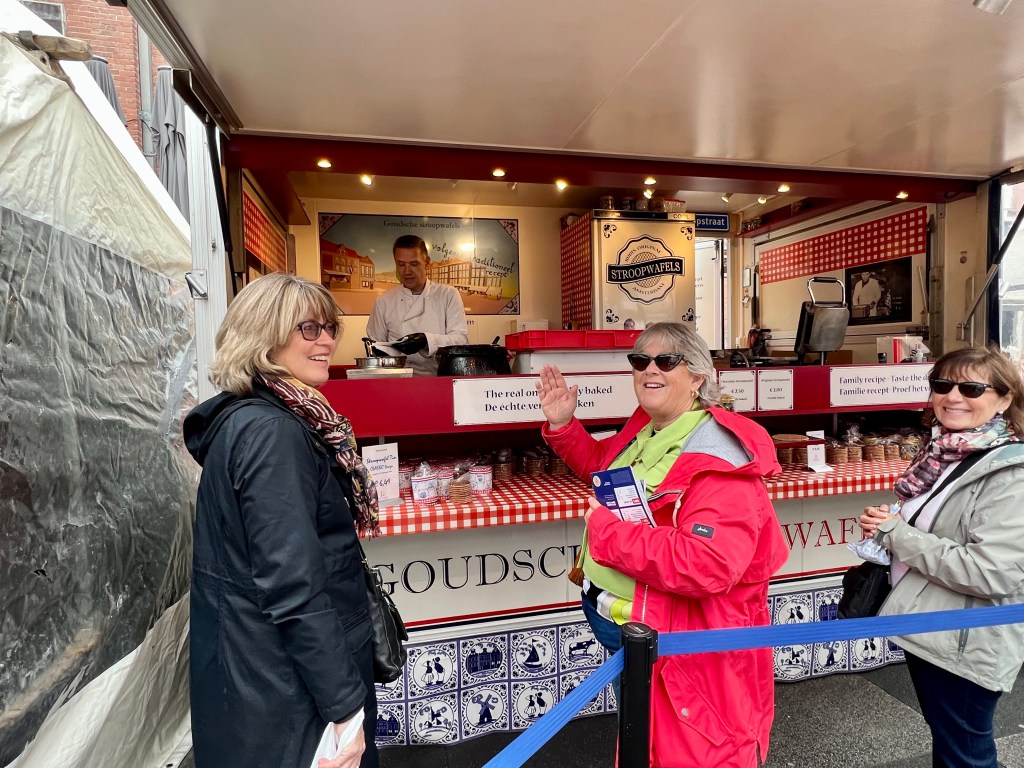
The market has lots of bargains and I even find a pair of Birkenstocks to replace the sandals that died on me in Croatia. I don’t “need” them but they’re a great deal so I can’t resist. One minute we’re strolling through the market checking out the deals and street food and the next, the skies open up and everyone is buying umbrellas! It’s raining cats and dogs, so we duck under cover and look for a local eatery to have lunch. Luckily, the rain lets up enough for us to get to the local brasserie where we enjoy a lovely lunch and dry up a bit.
StroopwaffelsErotic Chocolates
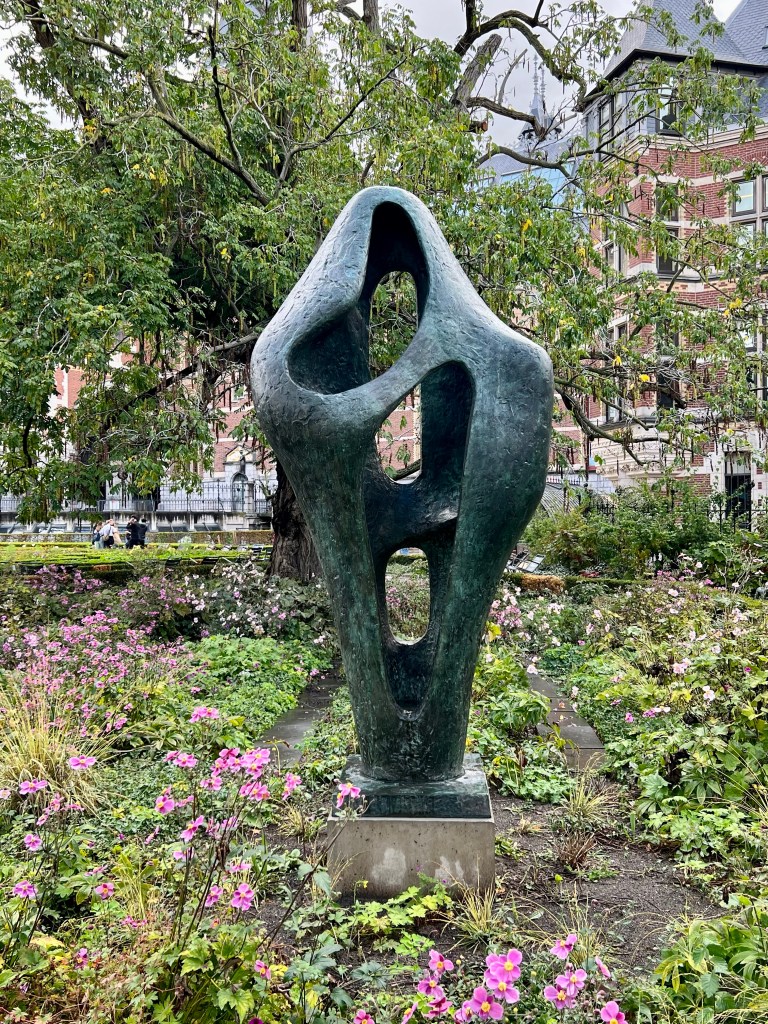
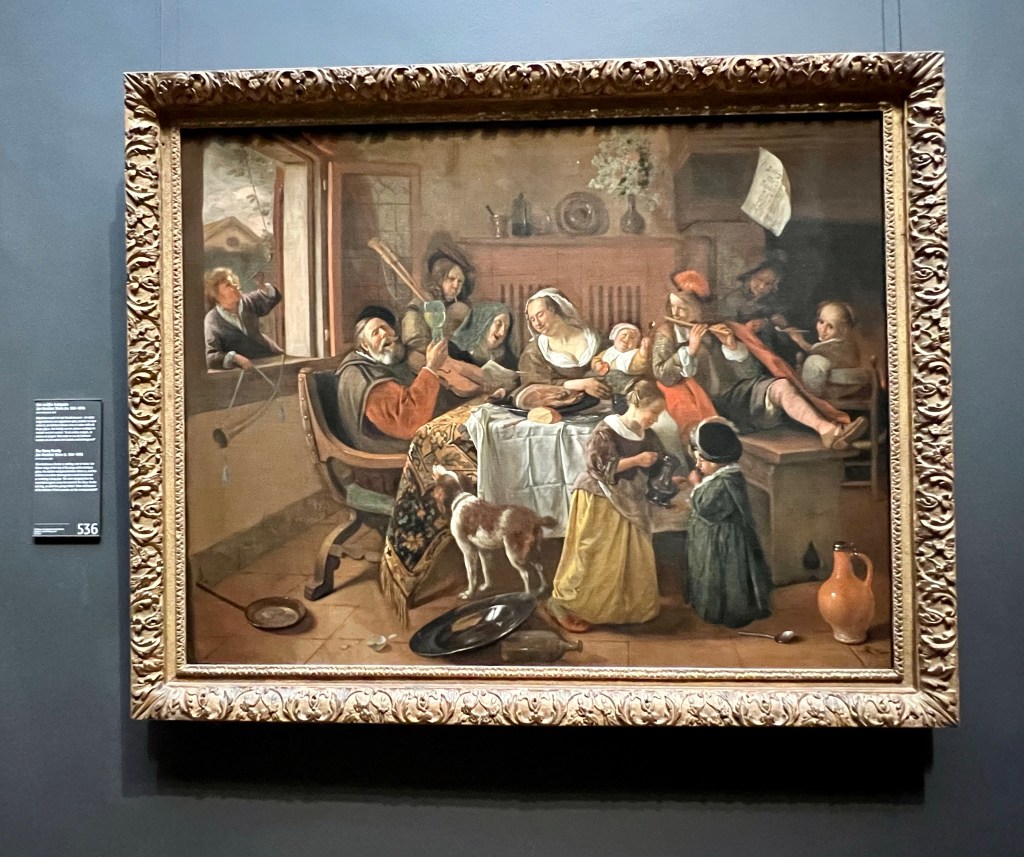
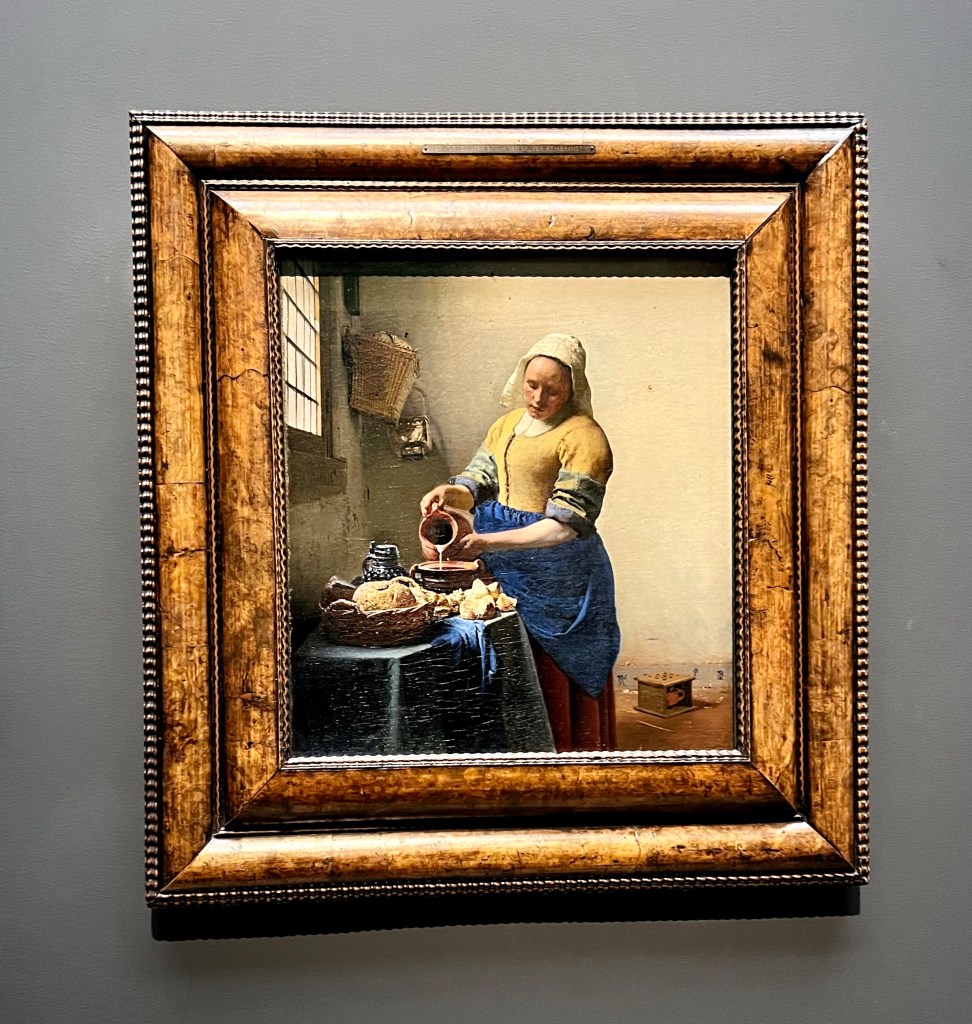
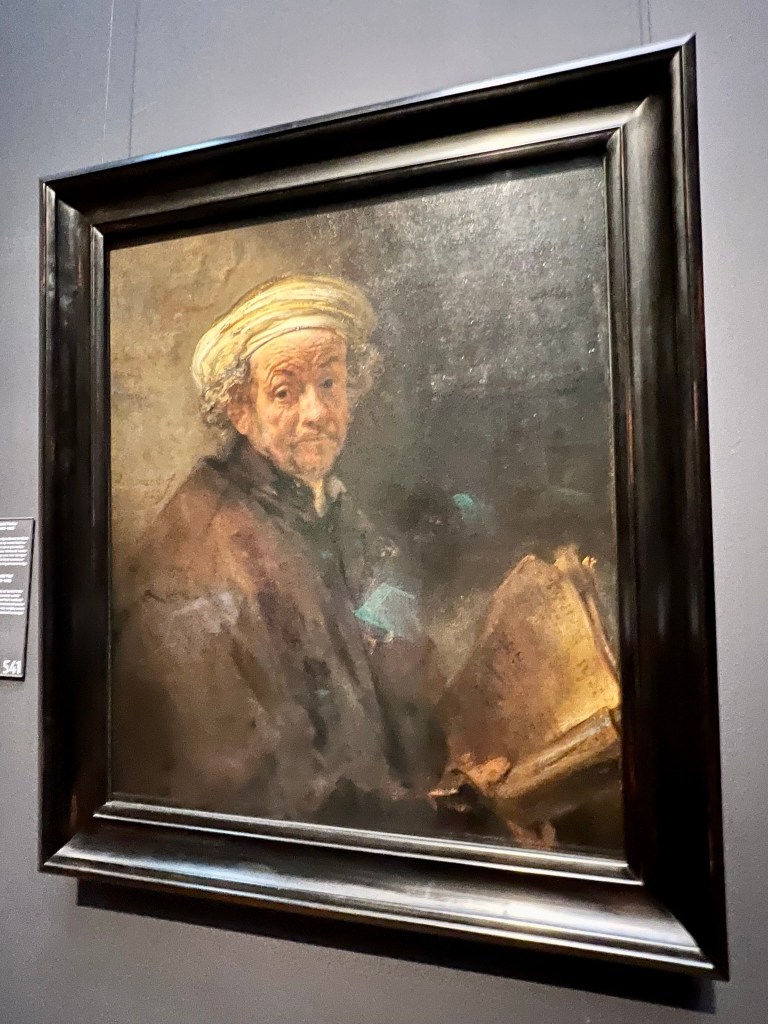
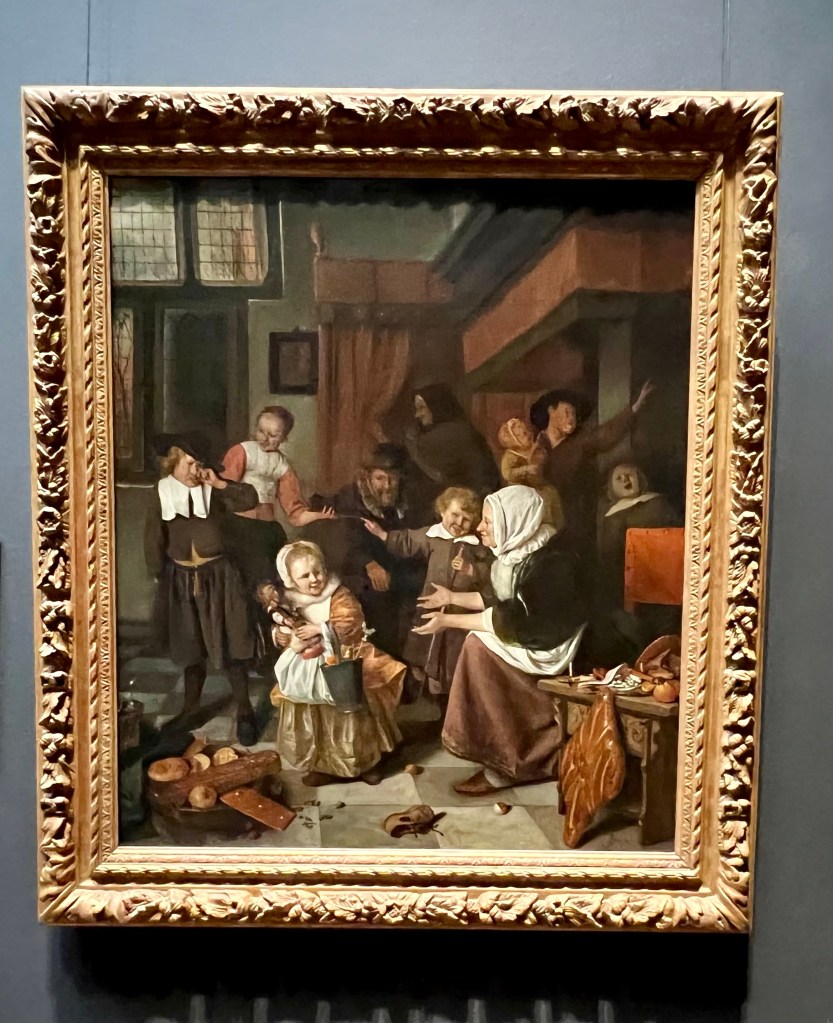
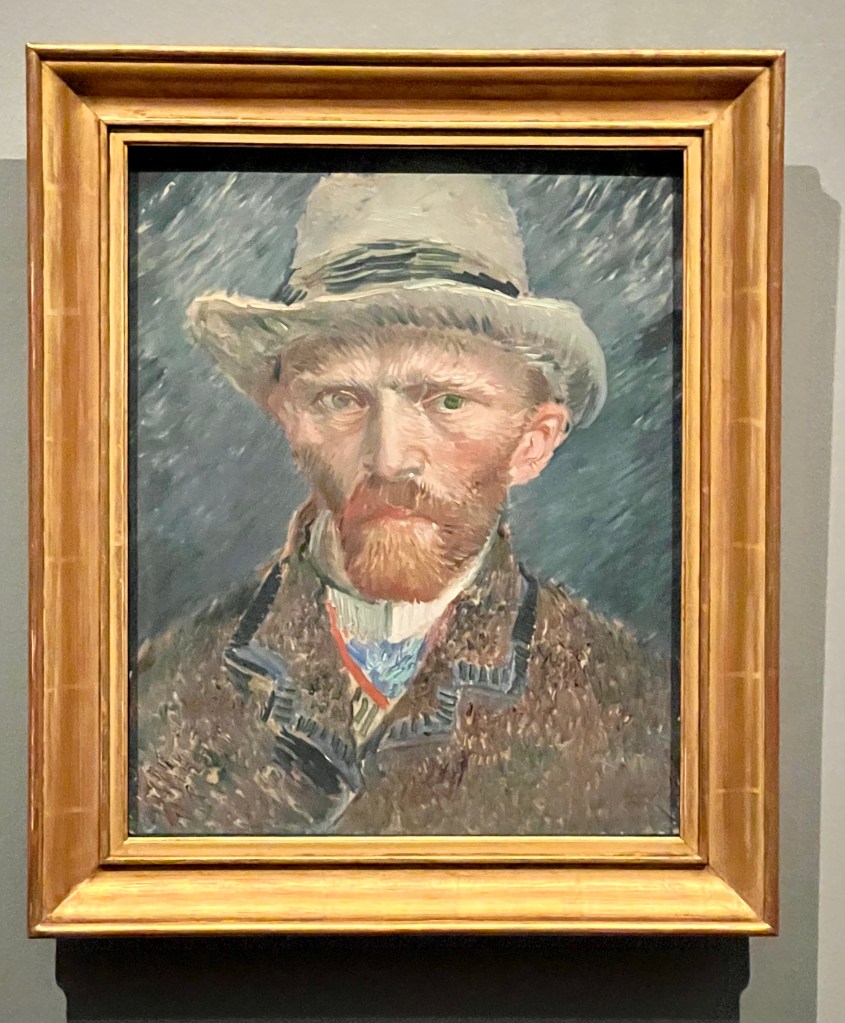
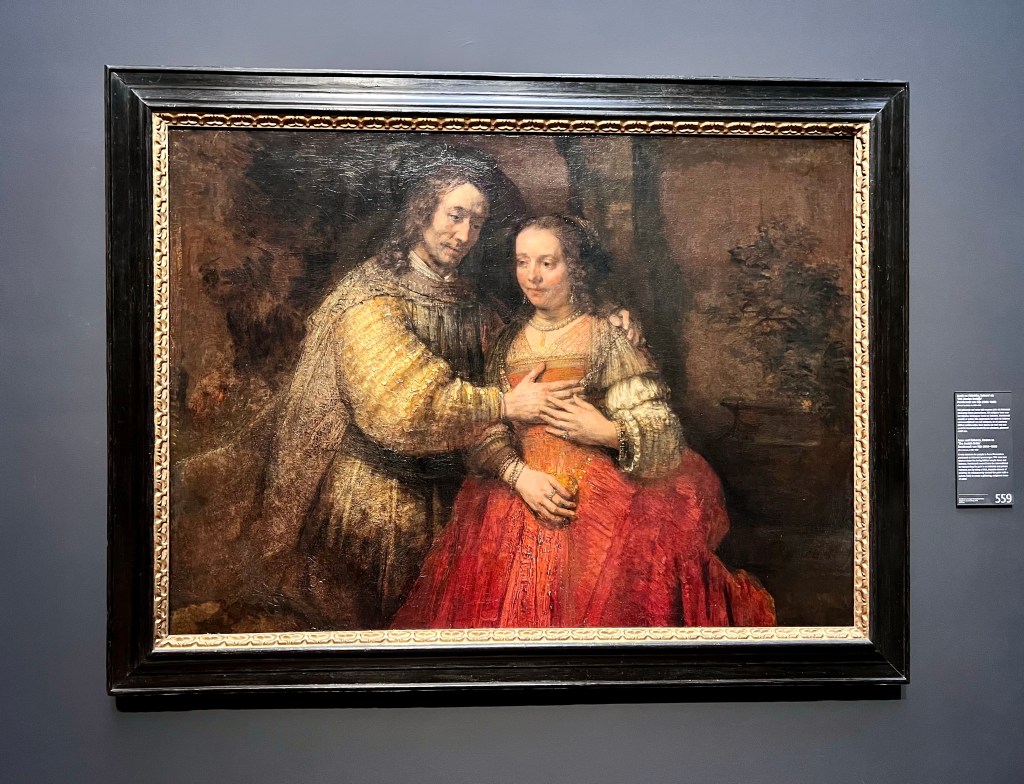
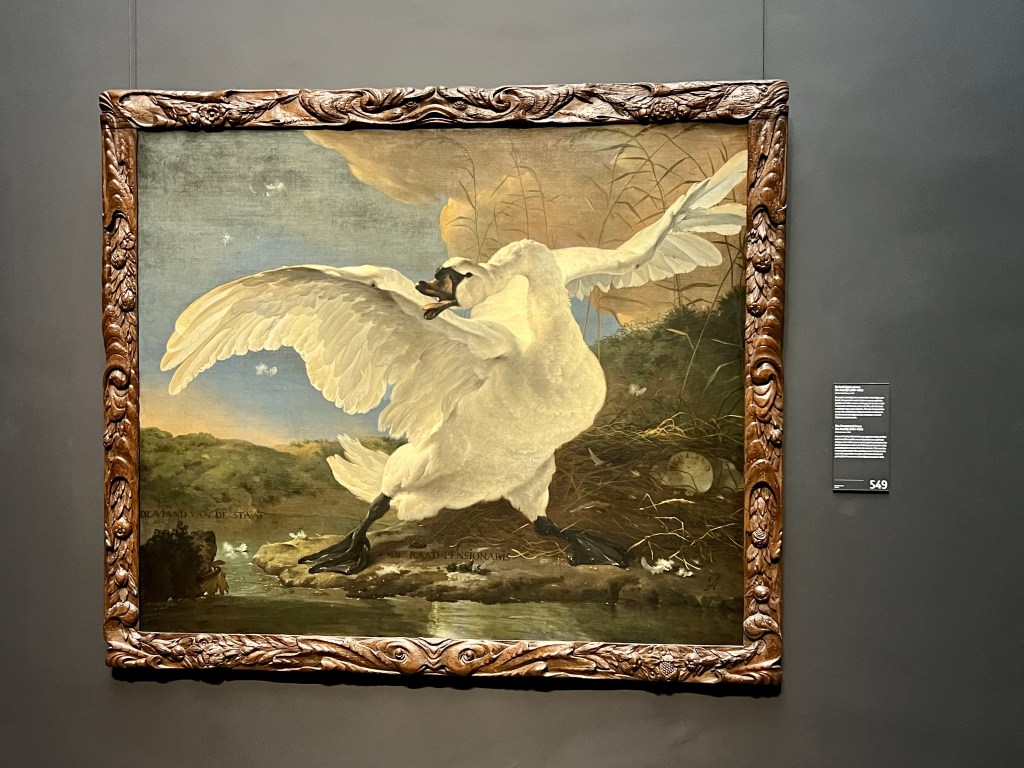
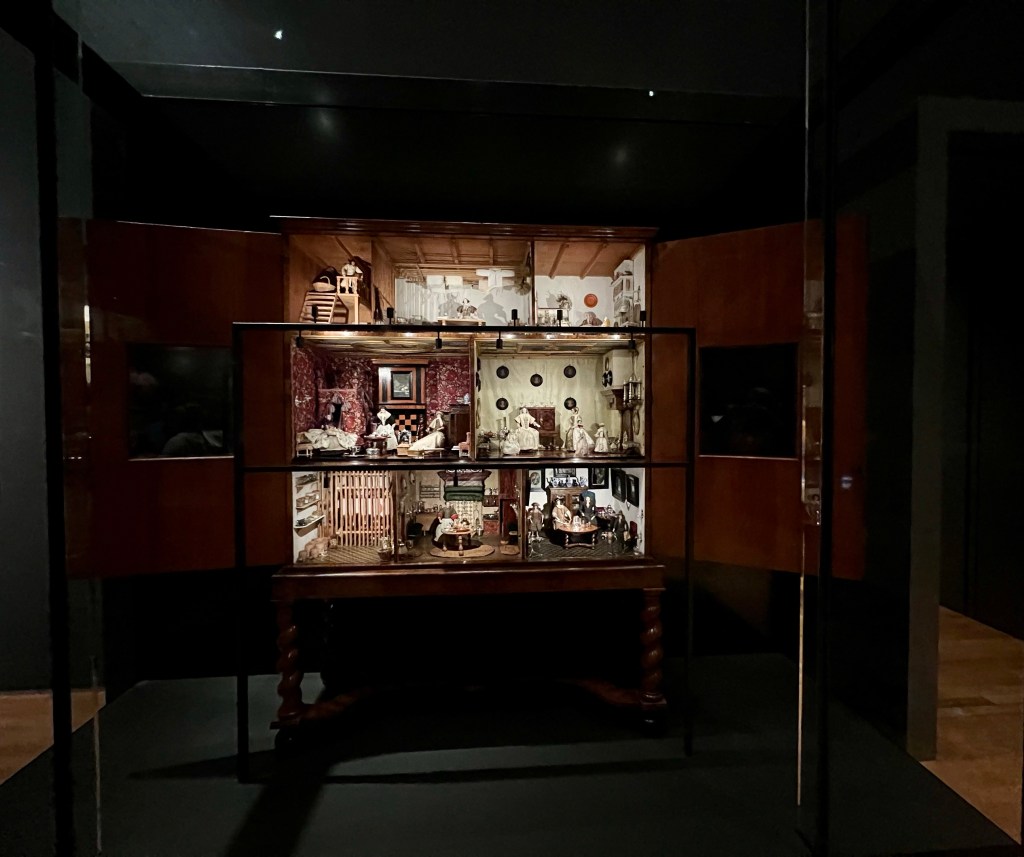
After lunch, a few of us carry on to the Rijksmuseum with the aid of the helpful signs that are everywhere (at least today!). We manage to get there without any additional rain and spend a lovely couple hours perusing the masterpieces and cultural gems in this spectacular building with the help of the audio guide. The museum does not disappoint and I’d recommend it to anyone heading to Amsterdam.
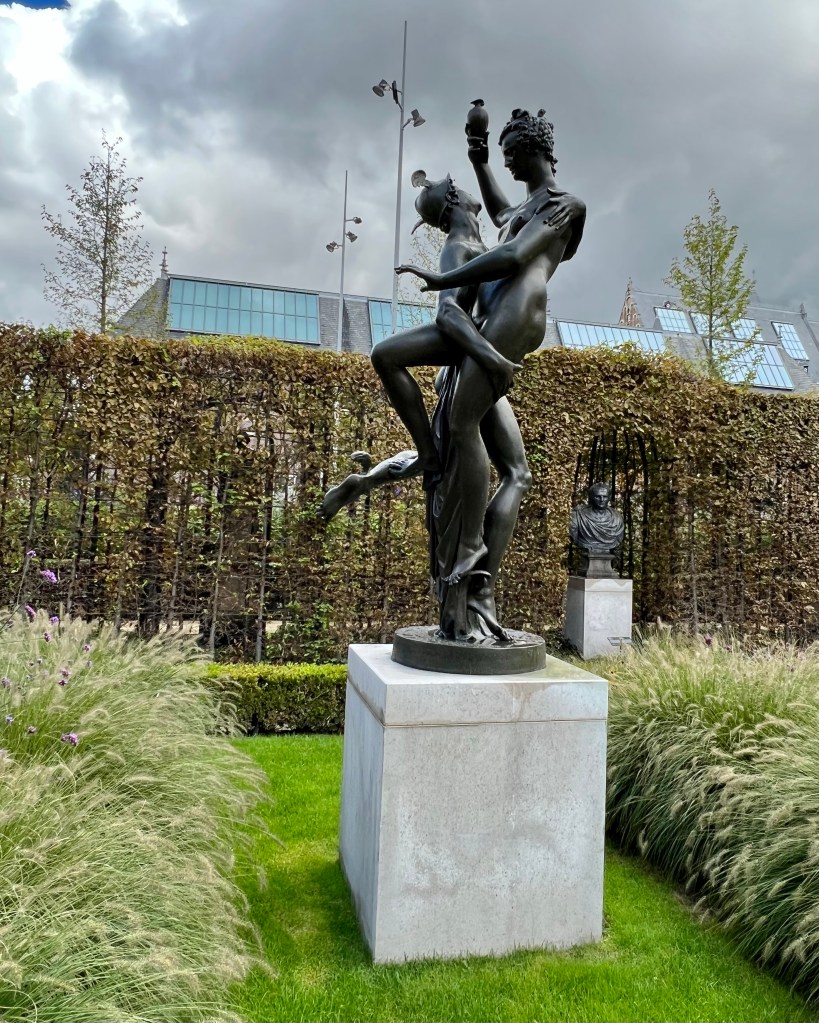
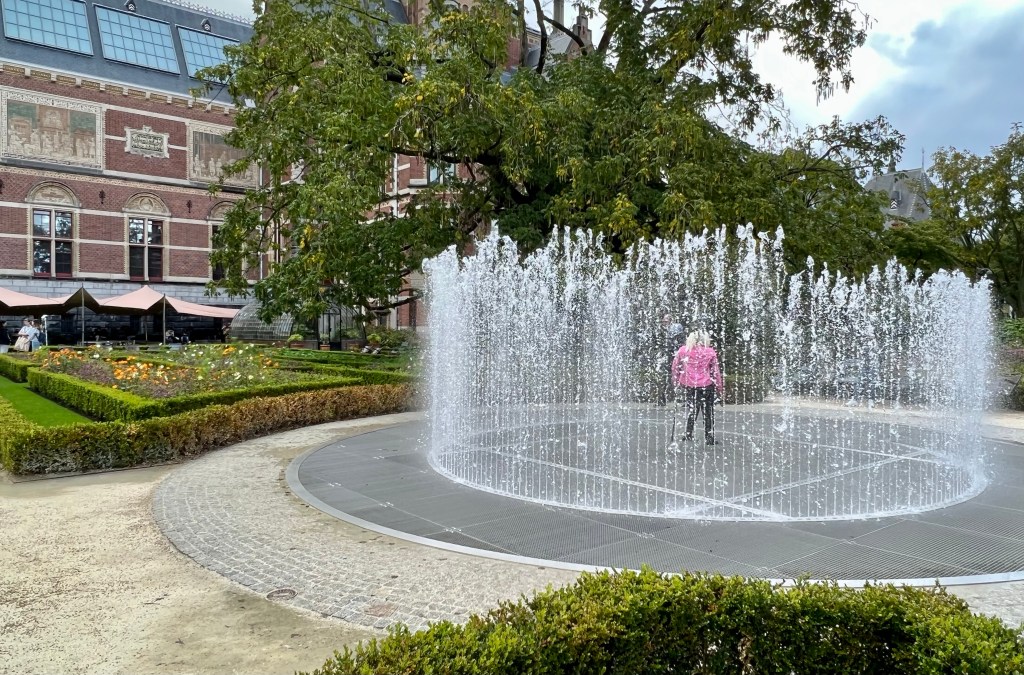
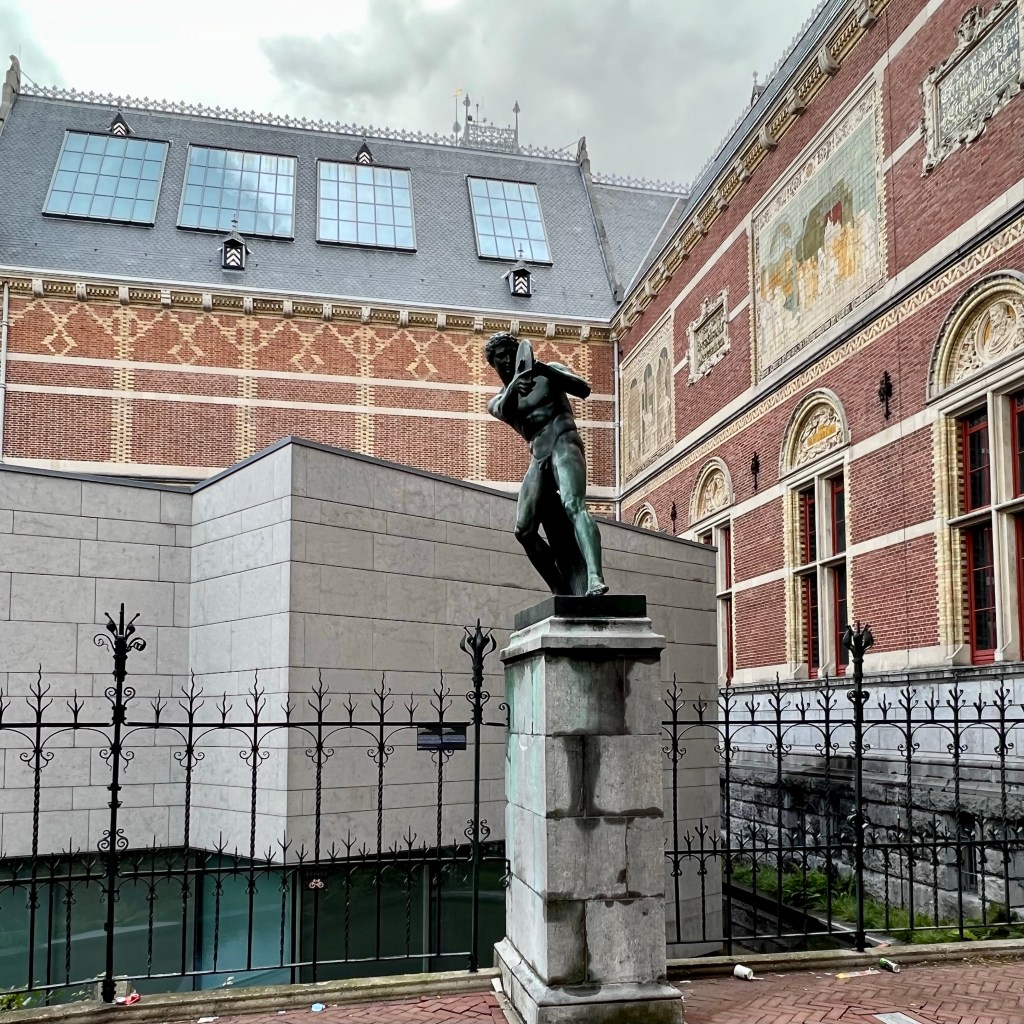
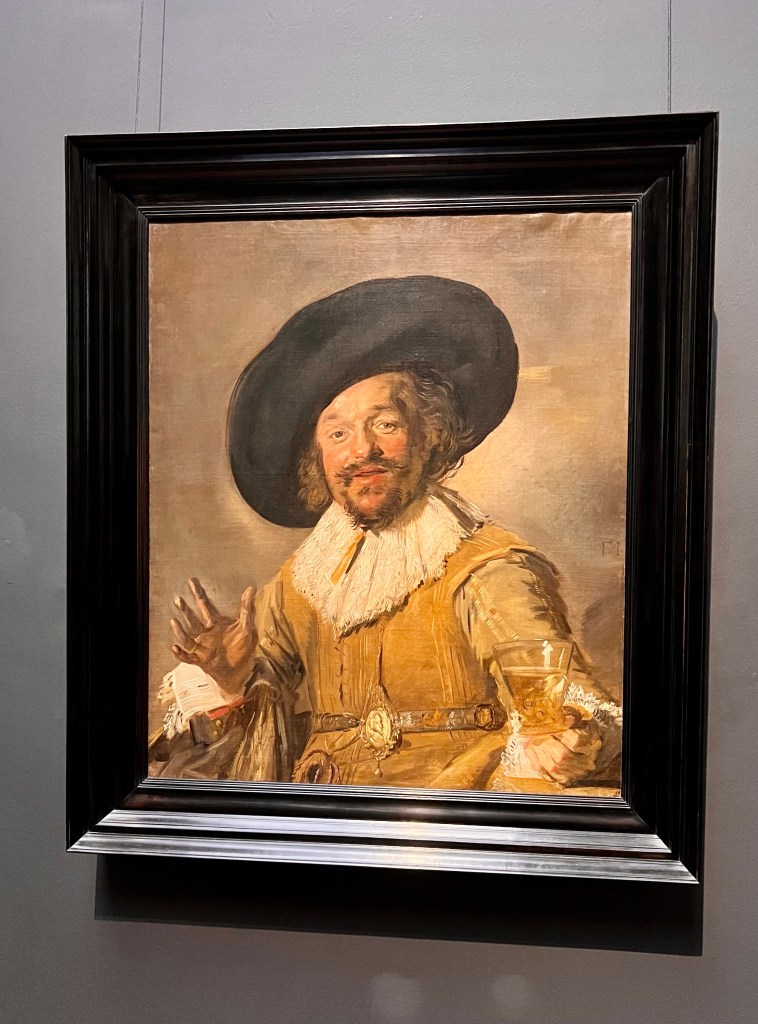
Garden Art Outside the Rijksmuseum A Militiaman Holding a Berkemeyer, Known as the ‘Merry Drinker’ Frans Hals (C. 1582-1666) Oil on canvas, C 1628-1630The Merry Family Jan Havicksz Steen (C. 1625-1679) oil on canvas, 1668The Milkmaid Johannes Vermeer (1632-1675) oil on canvas, e. 1660 Self Portrait as the Apostle Paul Rembrandt van Rijn(1606-1669) oil on canvas, 1661The Feast of St Nicholas Jan Havicksz Steen (C. 1625-1679) oil on canvas, 1665-1668 Self-portrait Vincent van Gogh (1853-1890) oil on cardboard, 1887Isaac and Rebecca, Known as ‘The Jewish Bride’ Rembrandt van Rijn (1606-1669) oll on canvas, c. 1665-1669The Threatened Swan Jan Asselijn (1610-1652) oil on canvas c. 1650The Night Watch Rembrandt van Rijn (1606-1669) oll on canvas, c. 1642The Singel Bridge at the Paleisstraat in Amsterdam George Hendrik Breitner (1857-1923) oil on canvas, 1896; reworked 1898The library – also a work of art!Dolls’ house of Petronella Dunois Amsterdam, c. 1676 oak cabinet, veneered with walnut, cedar and ebonyThe Resurrection and the Three Maries at the Tomb Southern Netherlands, c.1460 oak The Holy Kinship workshop of Geertgen tot Sint-Jans (C.1455/65-1485/95) Haarlem, C. 1495 oil on panelShiva Nataraja India, Tamal Nadu Chola Style, 12th Century Bronze
Back to the hotel to check in and squeeze our luggage into the tiny rooms. It seems that not everyone was as lucky with the weather as we were as those that opted for the free walking tour were treated to torrential rain and sideways hail several times over the course of two plus hours! Yikes, I’m glad to have missed most of that.
After folks are settled and somewhat dry, there are drinks in the hotel bar followed by dinner for many of us who didn’t feel like another soaking. Time for an early night.
Tomorrow is another day. Adventures await …
September 29, 2022
I’m on my own today as much of the crew is headed to Floriade and/or exploring museums that I’ve already visited. No problem, it just means a day at my own pace which ends up being very relaxed both because I’ve been here recently and done extensive sightseeing and I’m tired of being a tourist.
I did manage to head downtown and walk around the older part of time. I was sort of looking for the Our Lord in the Attic Museum (a secret Catholic Church after the Reformation) but hadn’t researched the address well enough and didn’t stumble upon it.
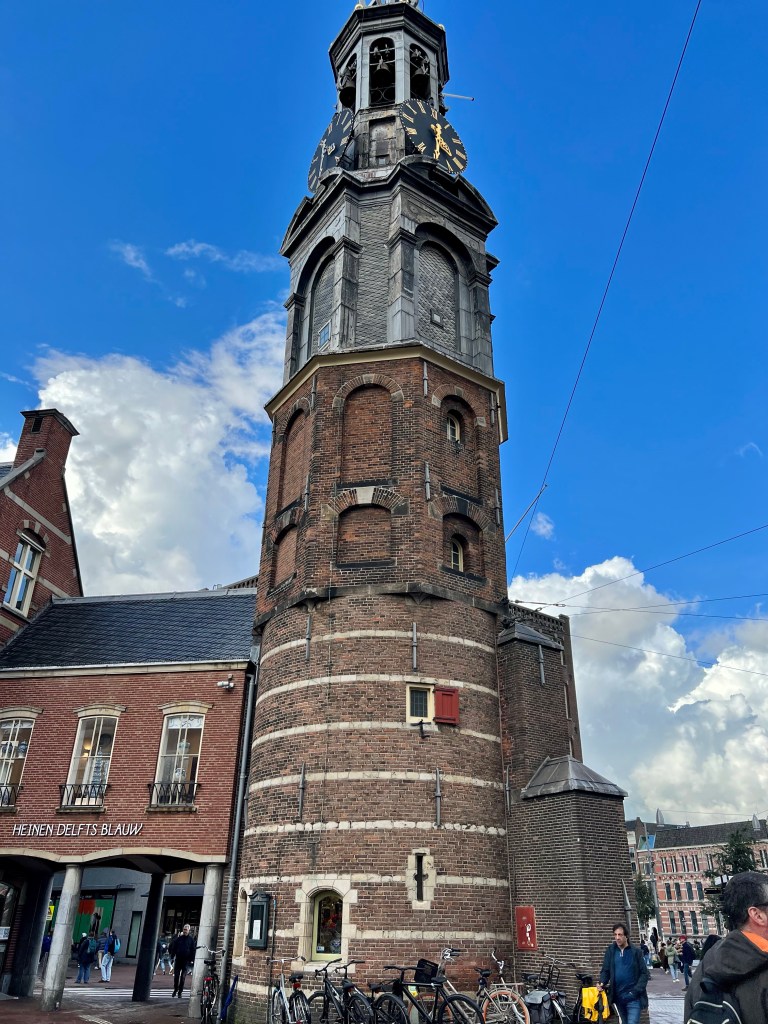
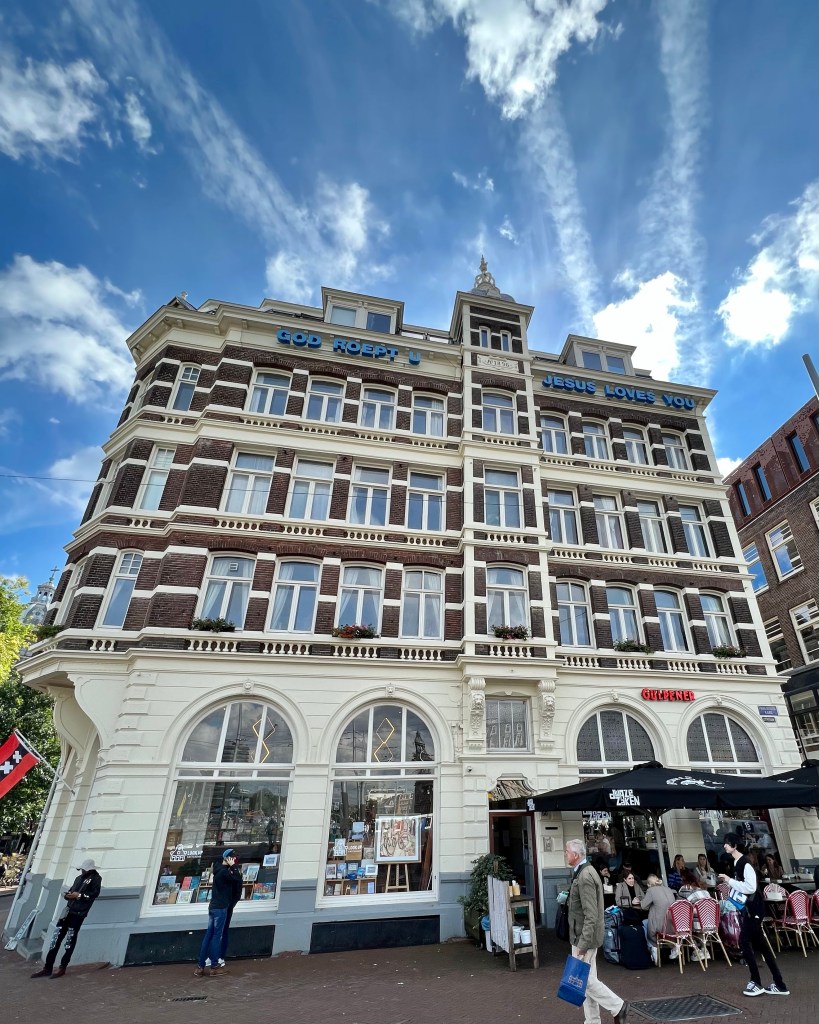
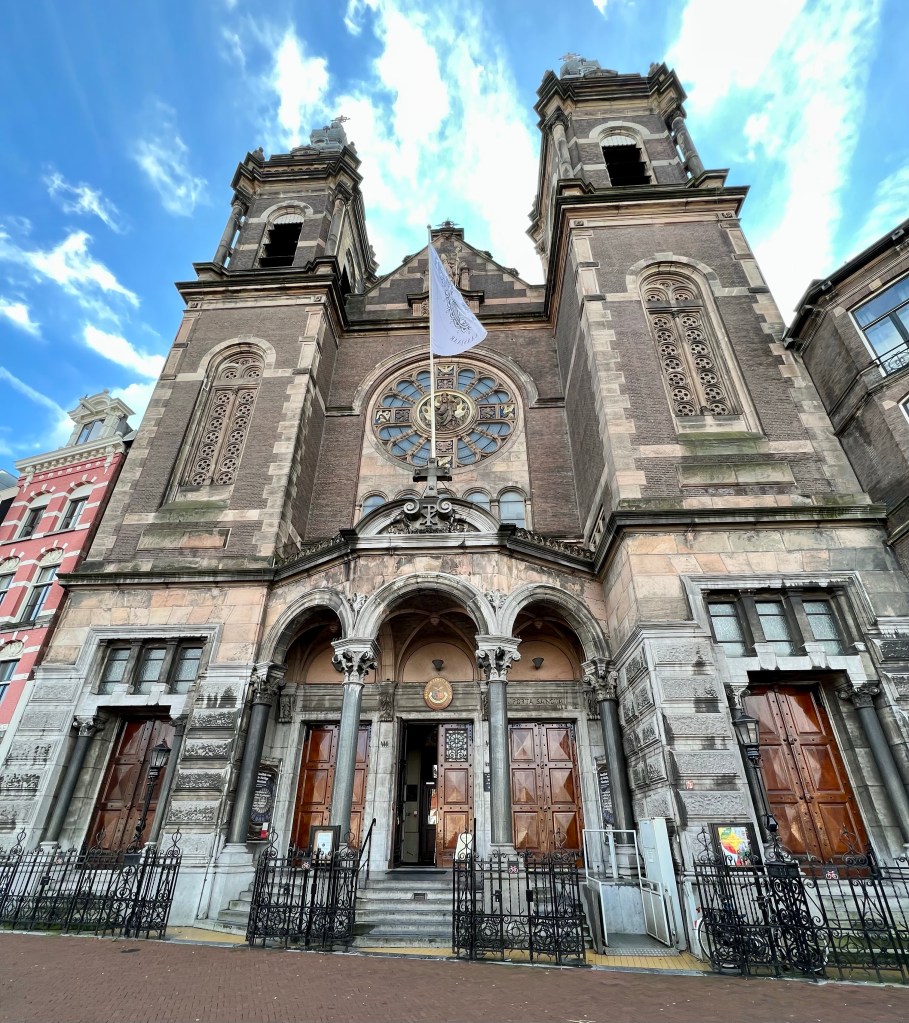
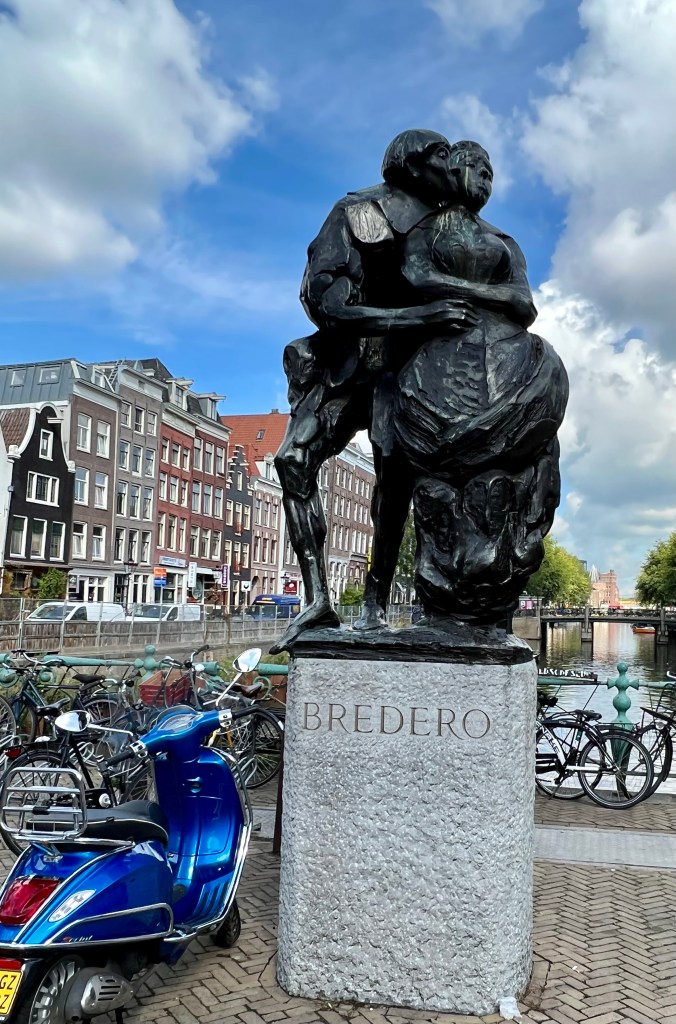
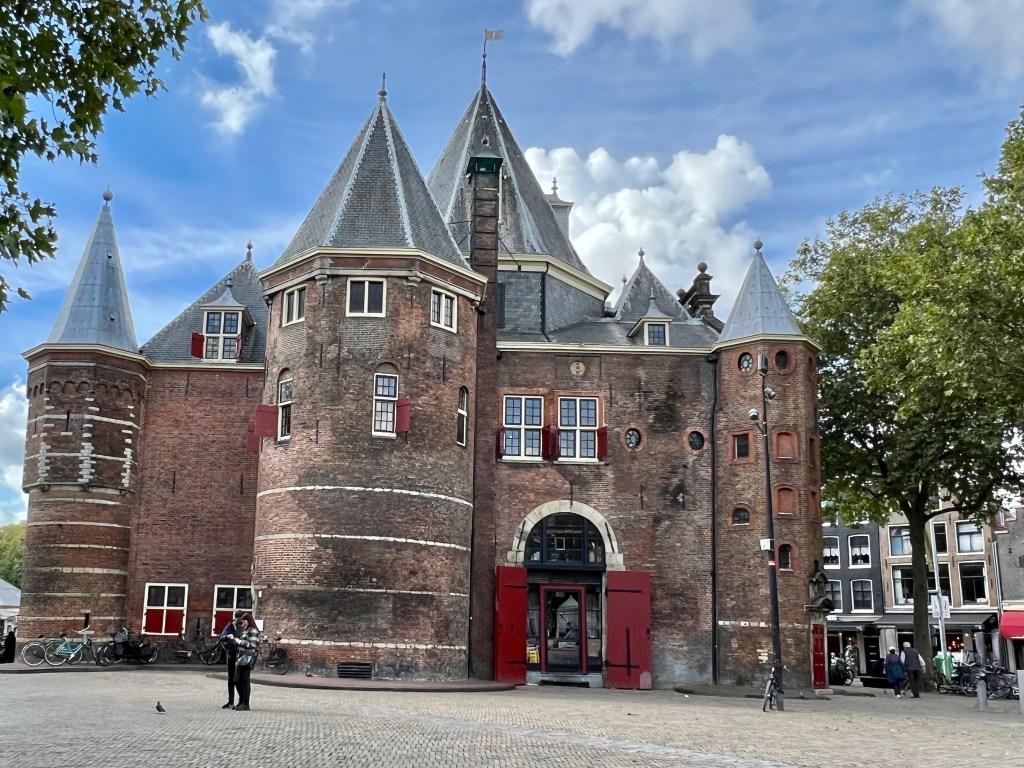
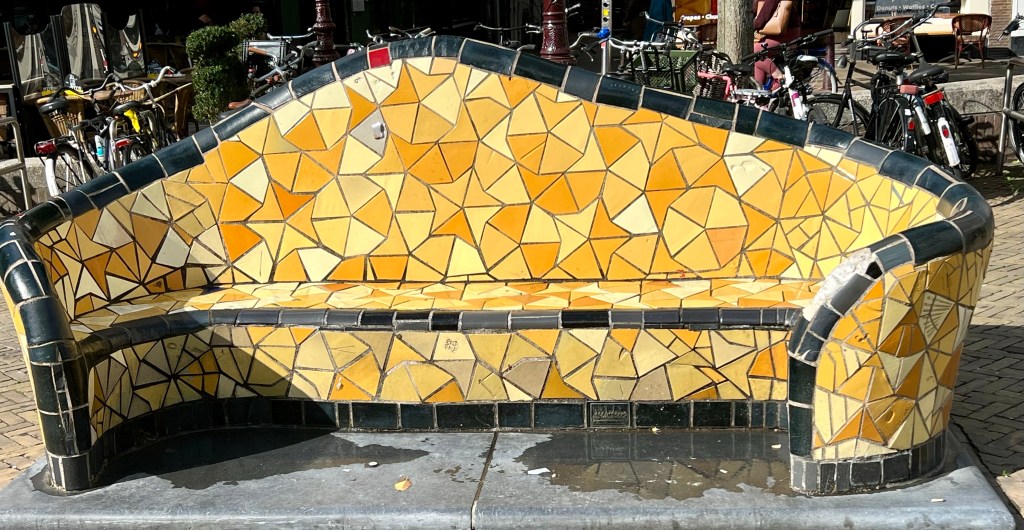
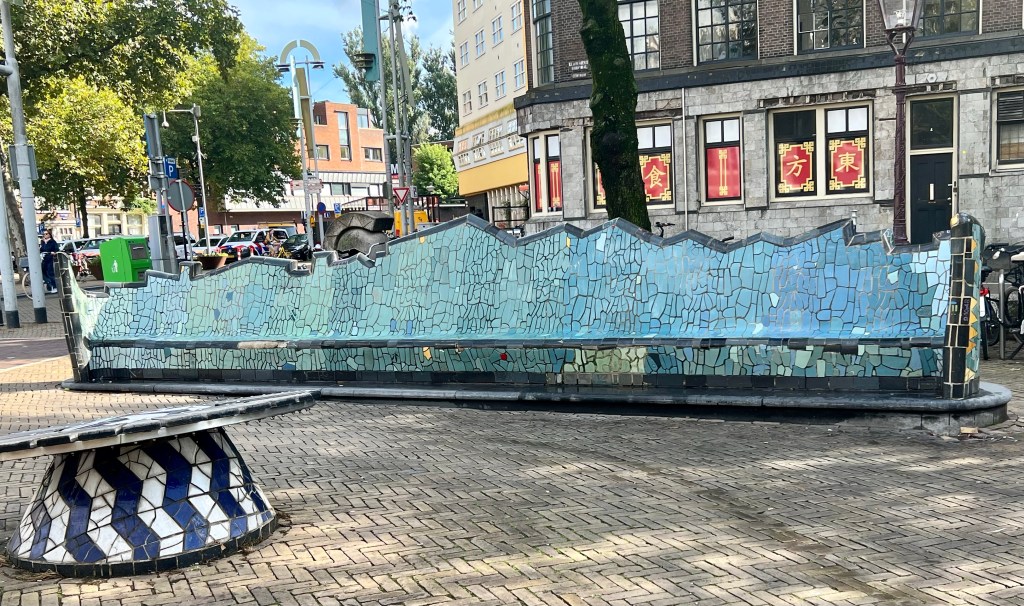
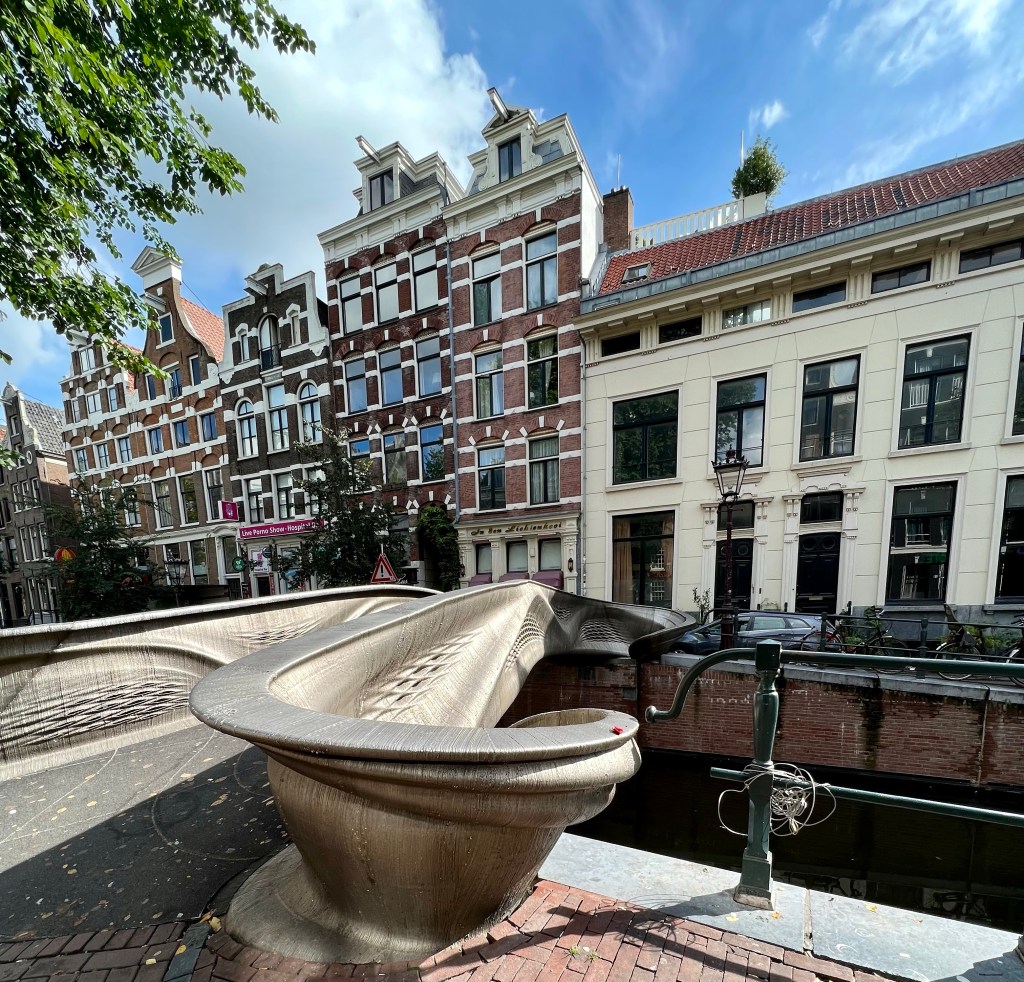
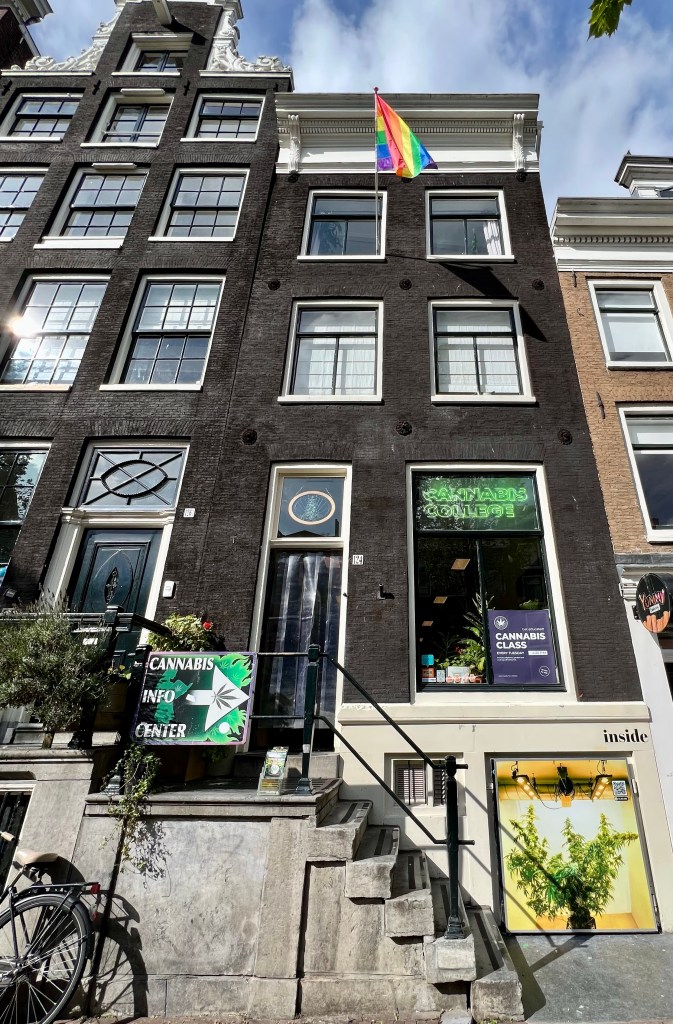
Leap FrogTowerJesus Loves YouAmsterdam Flag – Sex and Drugs and Rock and Roll!Old Church Back of Old ChurchFunky BuildingBredero MonumentDe WaalSmall mosaic bench in Red Light DistrictBig enough for the whole gang!Cool bridge across a canalCannabis class anyone?Rubber ducky lots of fun!
After a bit, I gave up on my “plan” and grabbed a salad to bring back to the hotel. Would have been a perfect day for sitting in a café with drinks and people watching but I hate drinking alone! Definitely missed Ken today.
We’ve collected quite a bit of wine and decided that pre-dinner drinks in a room were needed to quaff these rotted grapes rather than lug them across the Atlantic. We descended on John and Deb’s microscopic room with bottles, glasses, chairs and a corkscrew and made a good dent in our collective acquisitions. One last group dinner for the crew leaving tomorrow. Great fish and chips (fresh cod really was spectacular) and a lovely salad.
Early morning tomorrow so after hugs and bidding adieu to old friends, off to the room to get some zzzs. Tomorrow is another day. Travel adventures await …
September 30, 2022
We were advised to be at the airport four hours before our 12:15 flight so it’s an early breakfast and then loading the six of us into a van at 07:30 for the trip to the airport. Checkin, security and border control take less than two hours so we have time to do some last minute shopping. Sadly, the duty free here is not too exciting so I’m bringing Euros home!
We board out flight late, wait an hour or so after we board for a ground crew to get the luggage loaded so we’re around two hours late leaving. Not too bad, I guess. I haven’t flown cattle class from Europe in awhile as I usually try to use points and fly business. The bulkhead seat has plenty of leg room but that’s the best thing about the experience. Watched a couple movies and read a bit for the eight hour flight.
We were met at the gate with new boarding passes and $10 meal vouchers – look out steak dinner! The customs process is simple since I have a Nexus card and we’re in the domestic terminal less than 1/2 hour after landing. A drink and a bag of Cheetos later (dinner of champions!) and we’re on our flight to Ottawa. Miracle of miracles, our bags are on the plane! Life is good when the travel Gods smile on you! Taxi home for a night in my own bed.
It’s a wrap! Tomorrow is another day. Laundry awaits, lol. Until the next adventure …
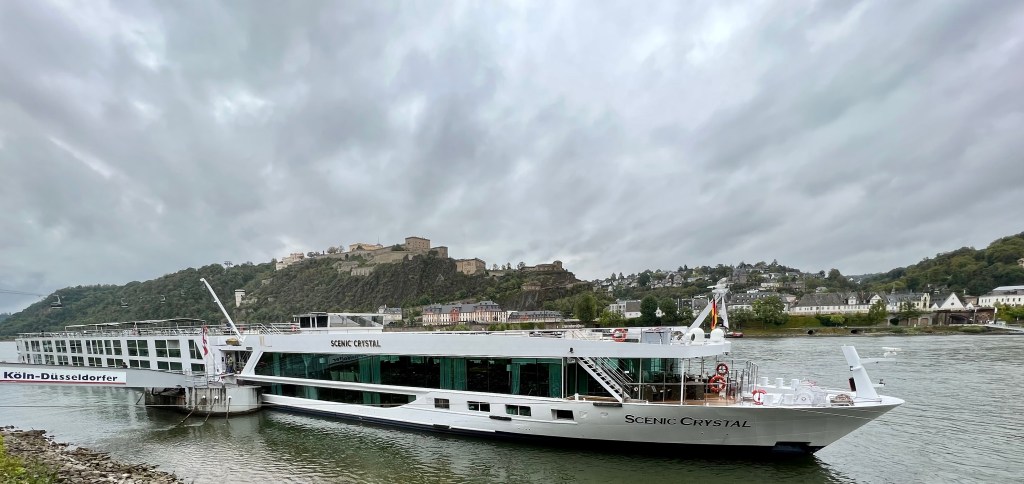
This morning, our floating palace is docked in Amsterdam; the last stop on our river cruise. We’re here for the night so we have a day to explore the area before bidding adieu to the Scenic Crystal.
I’d just been in Sin City in June and had hit most of the touristy spots then so I’ve already experienced the three available excursions. Not wanting to miss out, I opted for the Edam and Volendam bus which most of my Aggie friends were on.
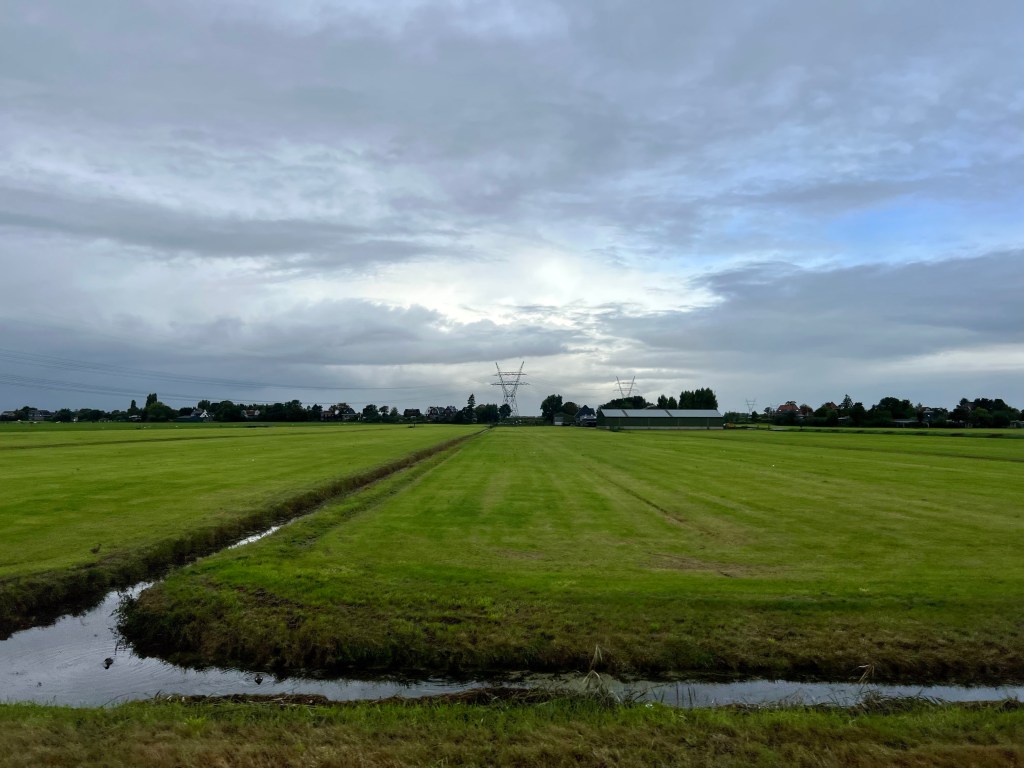
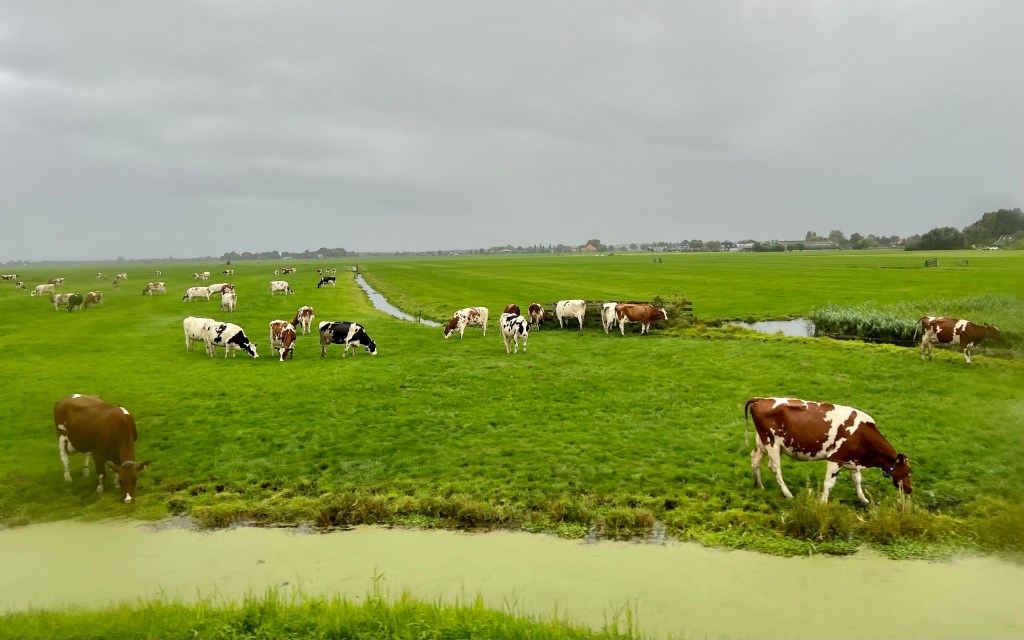
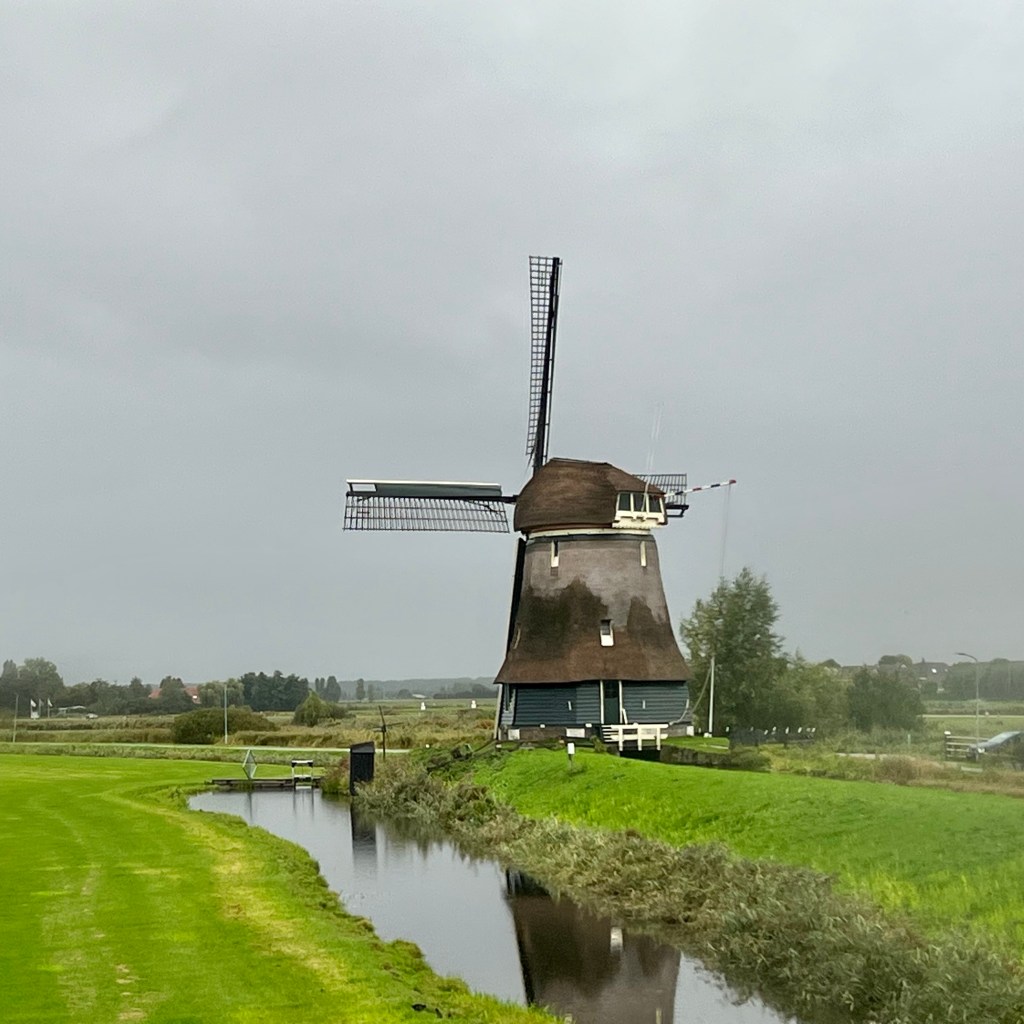
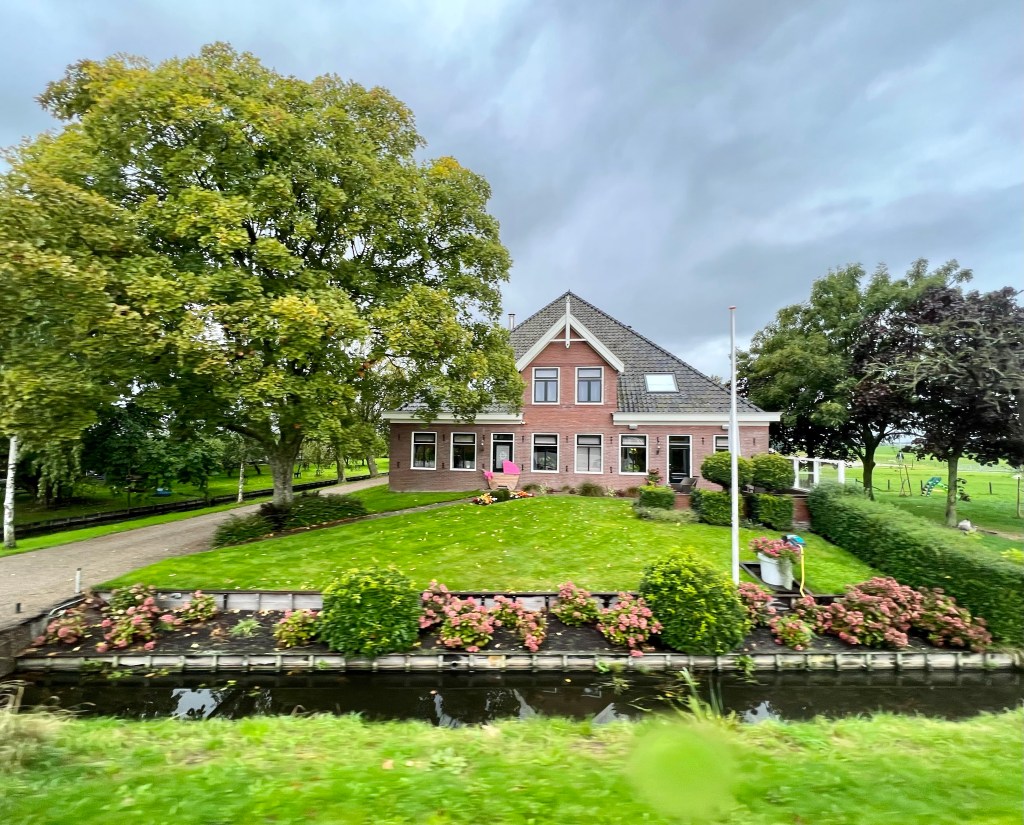
Reclaimed landCows in the mistWindmill
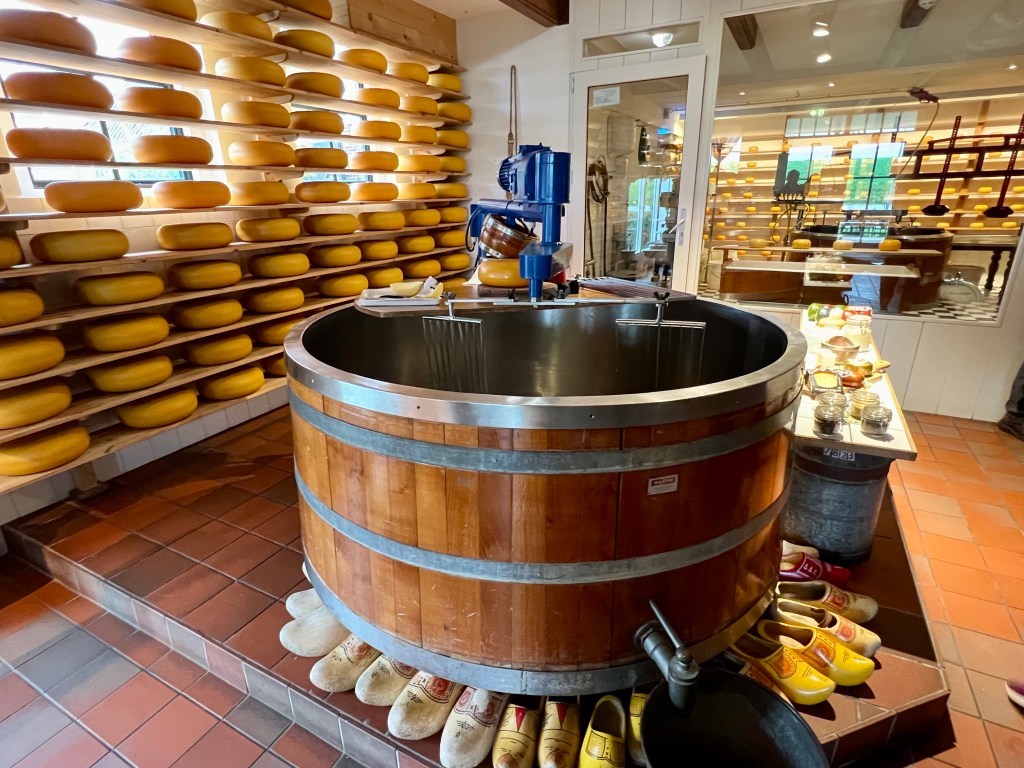
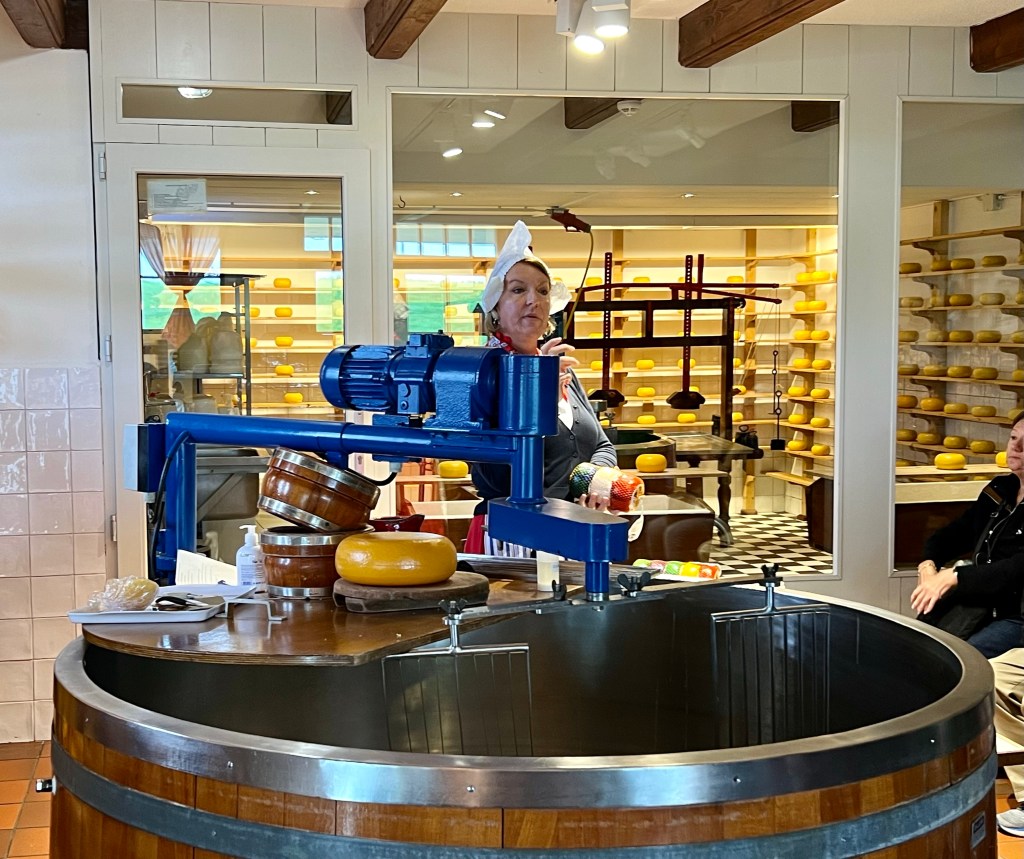
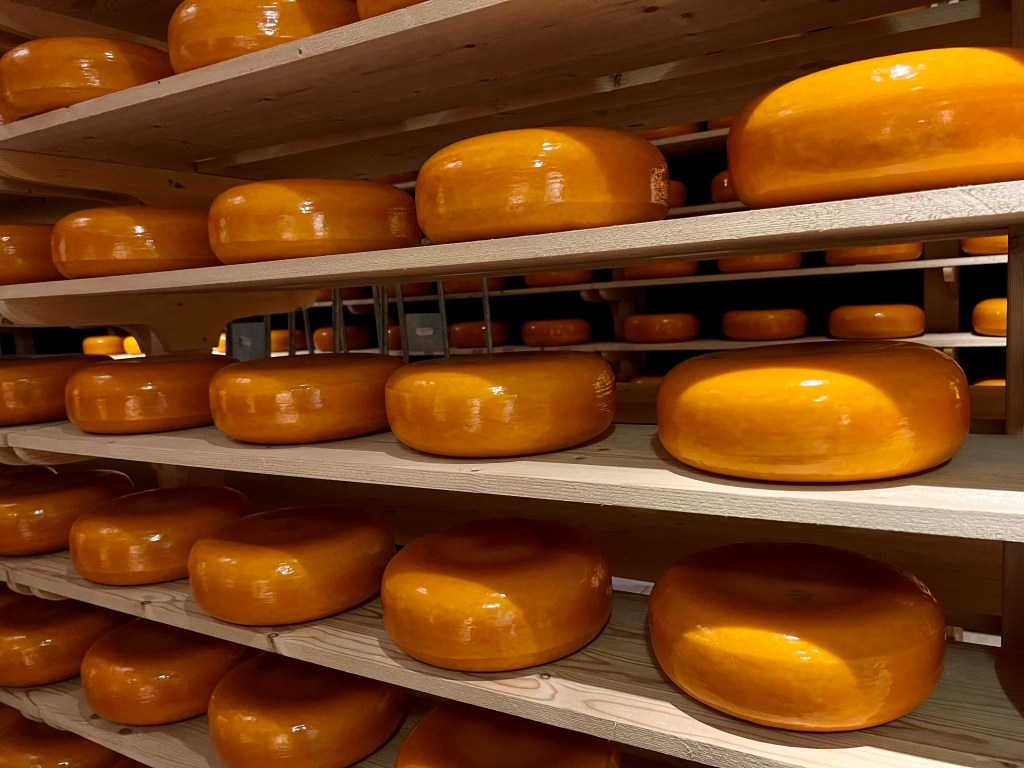
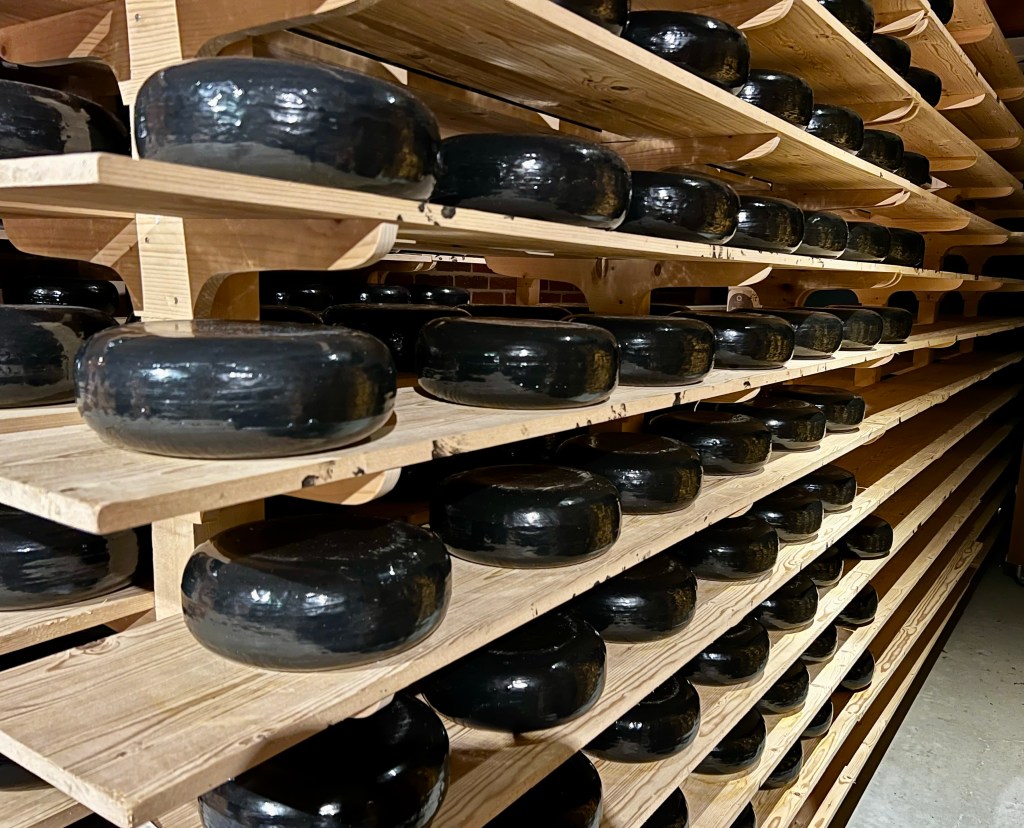
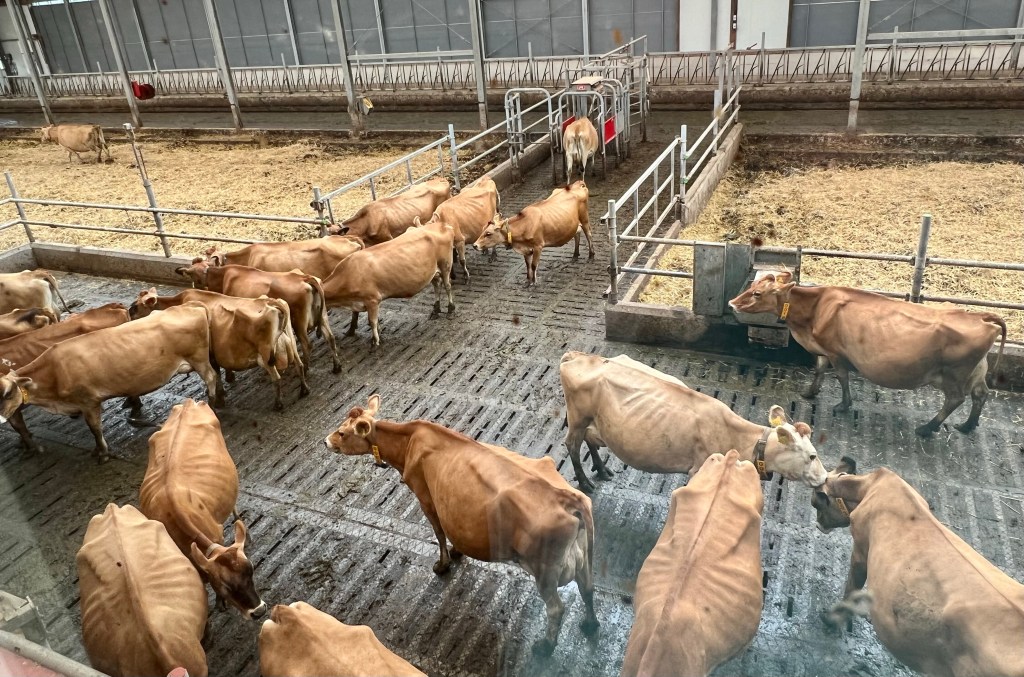
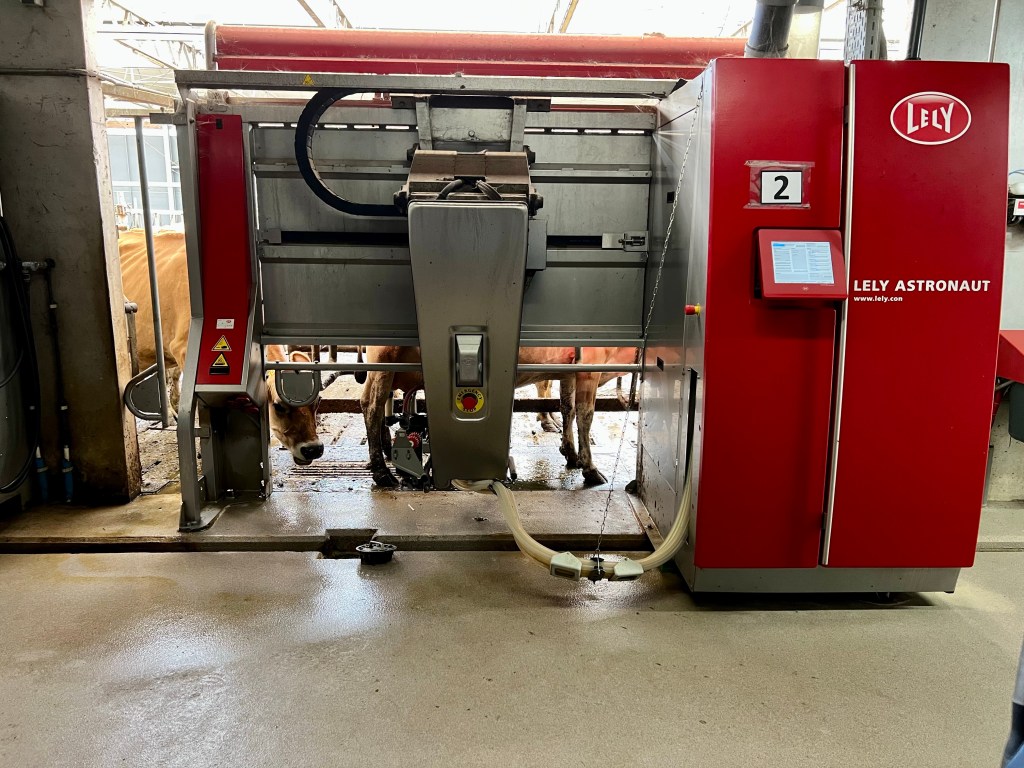
Fittingly enough, the first stop on the tour was a Henri Willig farm tour. After a demonstration of how they make their cheese, there was a cheese tasting and a visit to their store. We also had a chance to check out the cows, the barn and their modern robotic milking system. Our very own Udder Health Specialist, Don Anderson, was in big demand explaining how all of this new fangled equipment worked.
The cheese making roomDutch cheese ladyCheeseMore cheeseHiding out from the rainThe girlsThe robotic milker – girls are lined up for snacks and relief
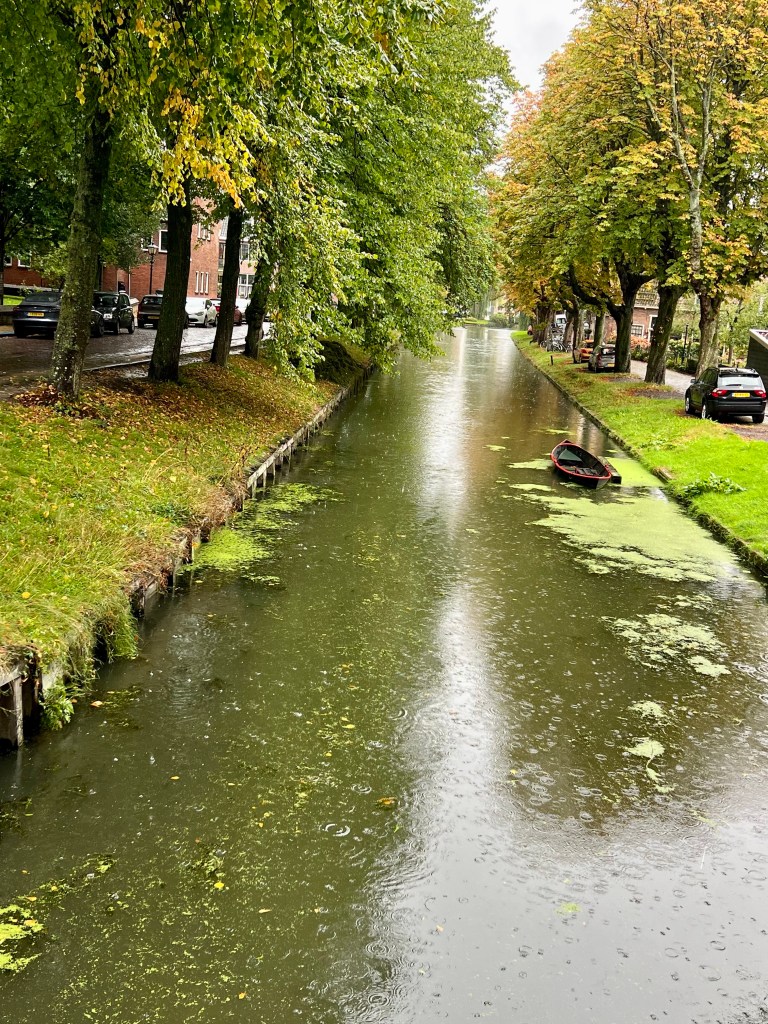
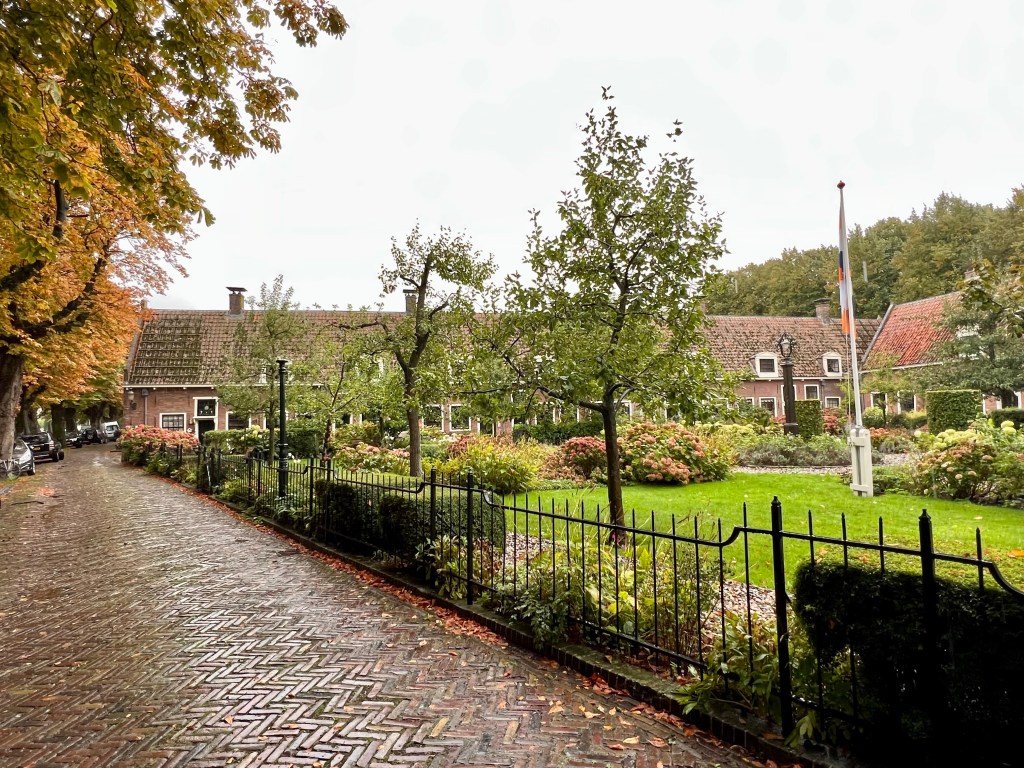
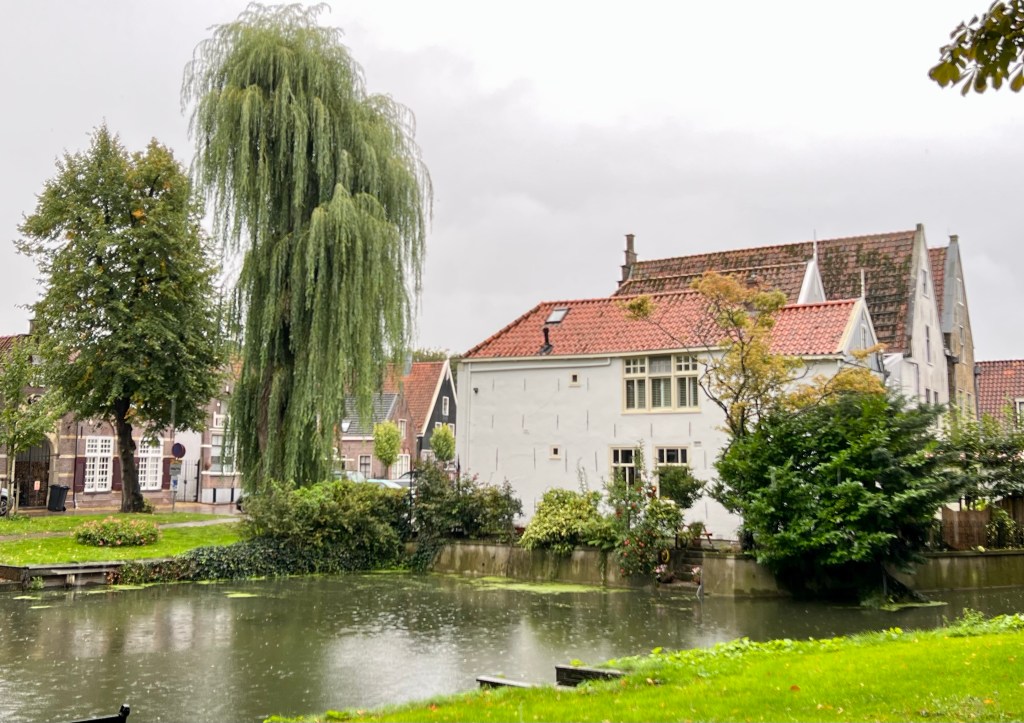
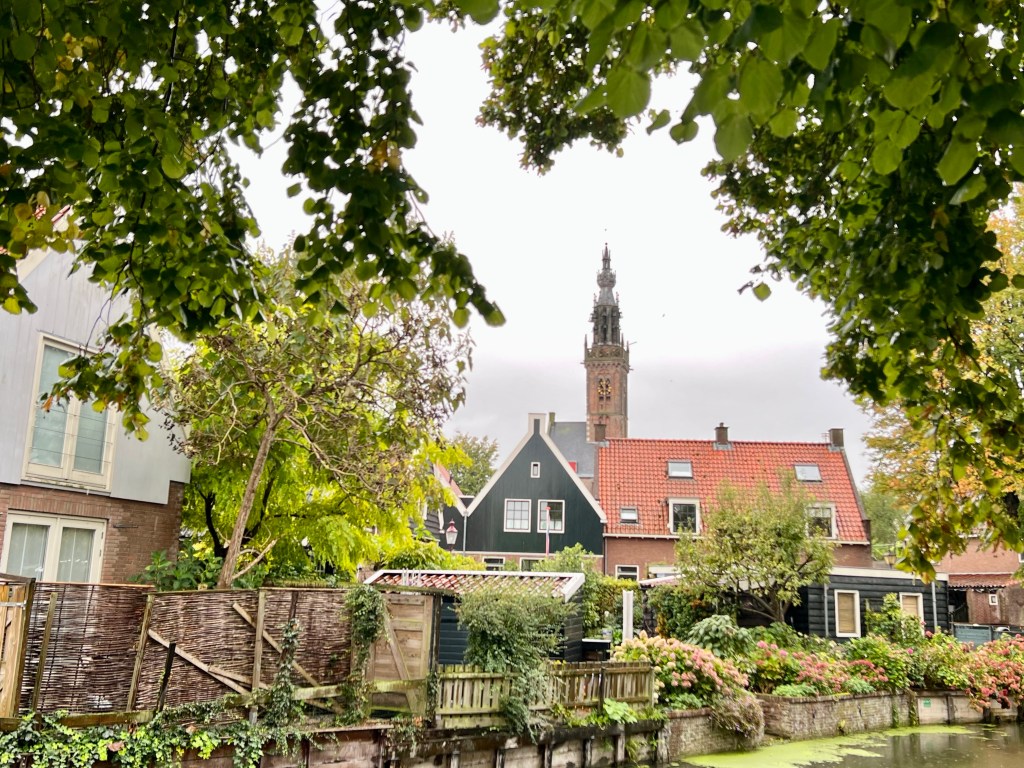
Our next stop is Edam, a quaint village with around 7000 inhabitants on the shore of IJsselmeer lake. The town of Edam dates back to the 12th century and has a lot more going for it than cheese (though that is pretty good as well!). Edam is always shipped from Edam but not necessarily produced here.
E River – EdamFormerly housing for less fortunate- now condosEdamViews of EdamShop in Edam
In the 12th-century, farmers and fishermen built shacks on the banks of the IJ river. This simple village evolved into the city of Edam, which continuously grew in prosperity until the late 17th century. In addition to cheese, shipbuilding and trade also contributed to Edam’s development. It once was one of the most important trading cities in Holland.
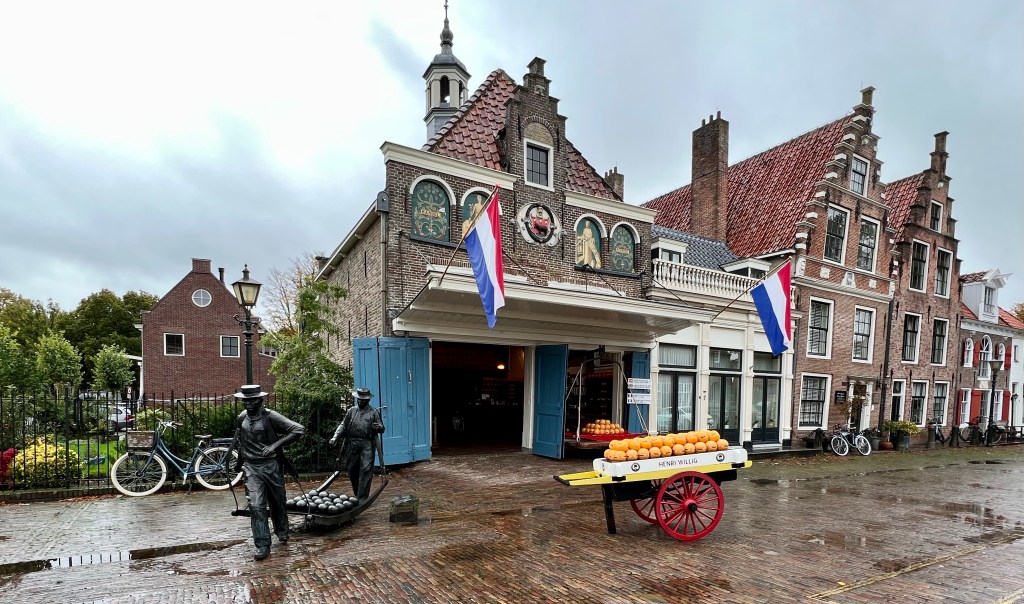
Edam Cheese Weighing HouseThe scales
Next up is Volendam. Volendam used to be the poor cousin of Edam though today the two are joined as a municipality and Volendam is bigger and just as prosperous or maybe more so.
Pyramid roof in farm houses used to store forage there
Volendam is first and foremost a fishing village on IJsselmeer lake. IJsselmeer lake used to be an inland sea but because of frequent flooding an enclosing dyke was built in 1932 to prevent the salt water from the north sea from entering the former inland sea. So now, it’s pretty much a freshwater lake.
It was raining again and I’d been to a Volendam and explored this coastal gem so rather than wandering in the rain getting soaked, I opted for a hot chocolate
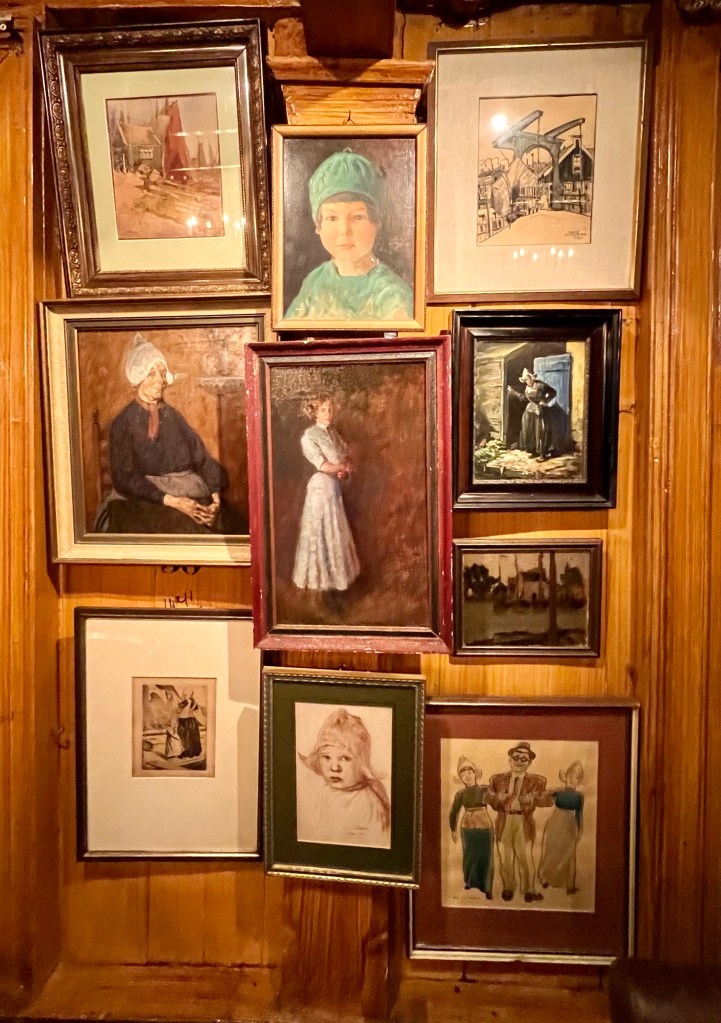
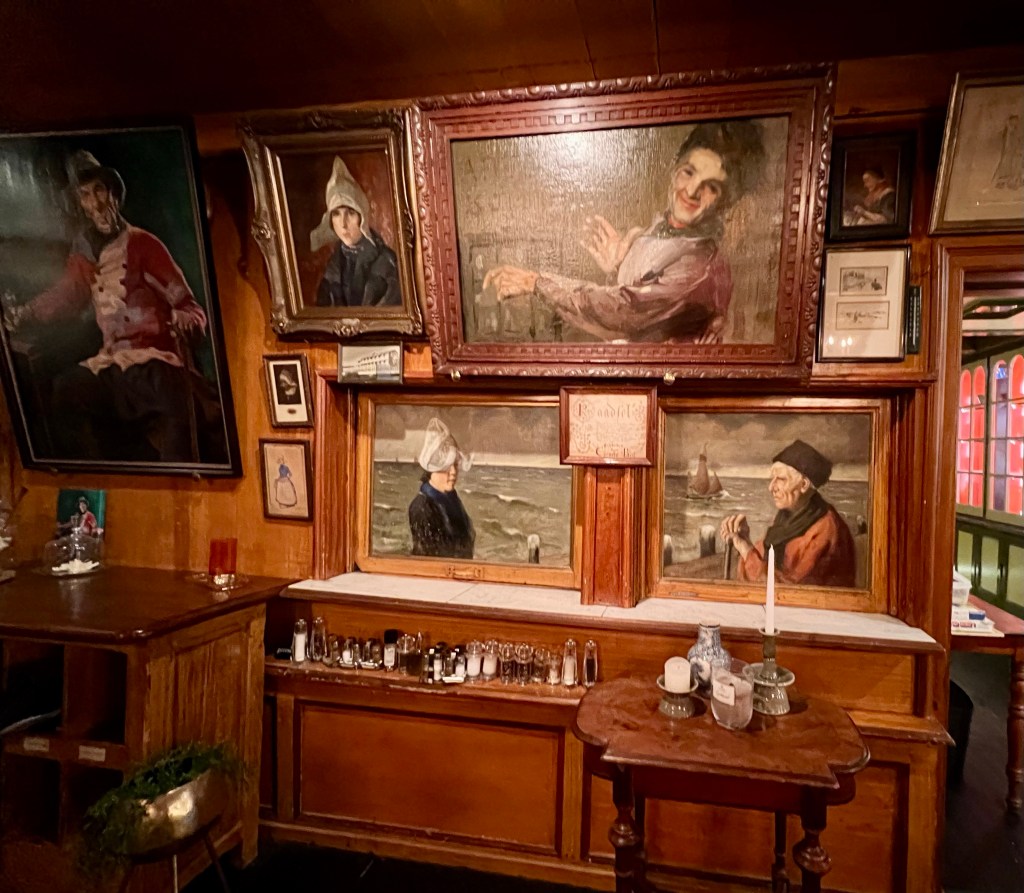
At the funky Hotel Spaander. Originally opened as a café, in 1881, the new owners opened up to house some of the acquaintances they had gained from traveling overseas. What’s unique about the public areas if the hotel is the artwork. The walls of the bar and reception area are covered with art gifted by artists who stayed there but had no money to pay. This gives the place a real quirky charm.
Bar in the Hotel Spaander – Walls are covered in ArtBar in the Hotel Spaander – Walls are covered in ArtBar in the Hotel Spaander – Walls are covered in ArtBar in the Hotel Spaander – Walls are covered in ArtDraft please
Back in the bus and headed back to town. After a nice lunch, it was time to see whether all the bits and bobs could be coaxed into my steamer trunk and carryon bags. Luckily I haven’t done any shopping to speak of so with a bit of effort, it all fits!
Time for a nap and a shower before our last dinner onboard. Sated we’re back to the lounge for after dinner drinks and a performance by a local trio. They were great but quite restrained; I think the crew wants to send us off to bed so we’ll be up and at ‘em early tomorrow. It works, lol.
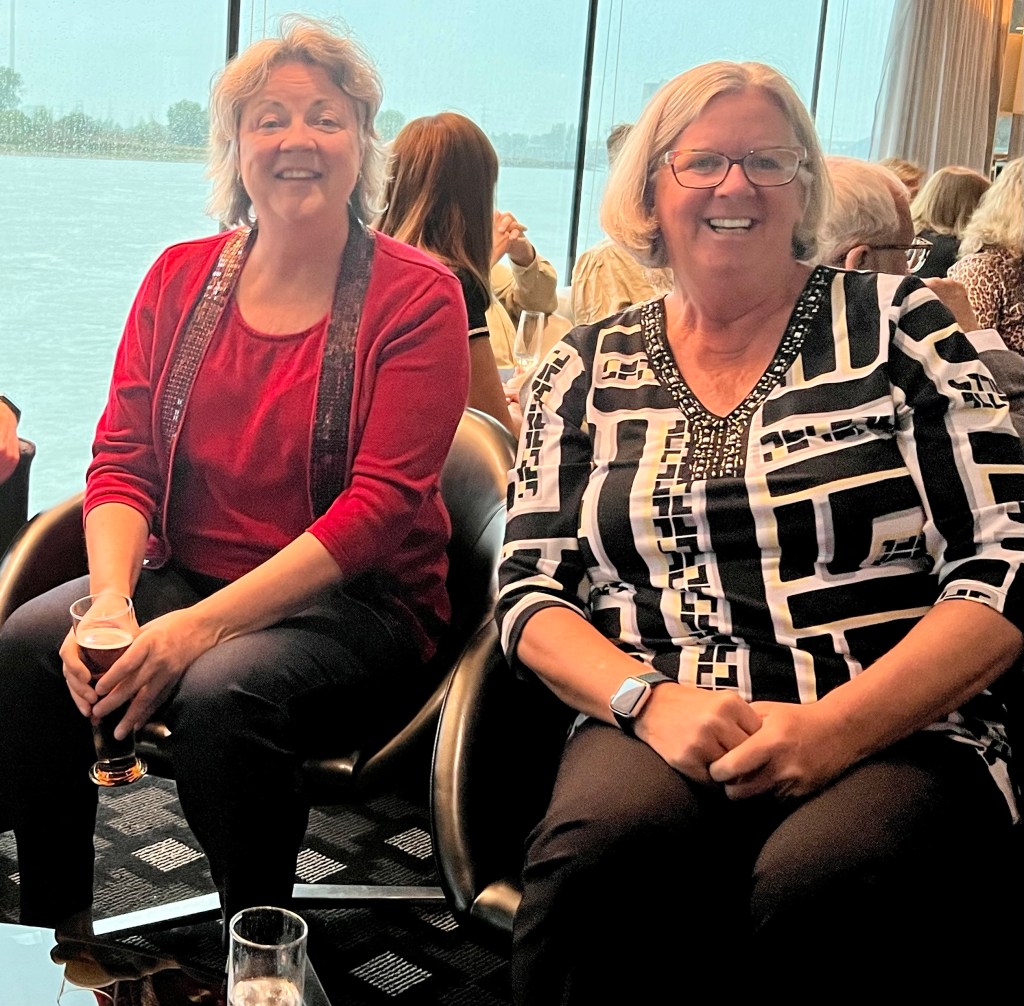
Lounging before dinnerCan I have another please?We’re not done yet!
Today we’re docked in Cologne and though I’d signed up for another castle tour, I opted to stay in town and do a walking tour instead.
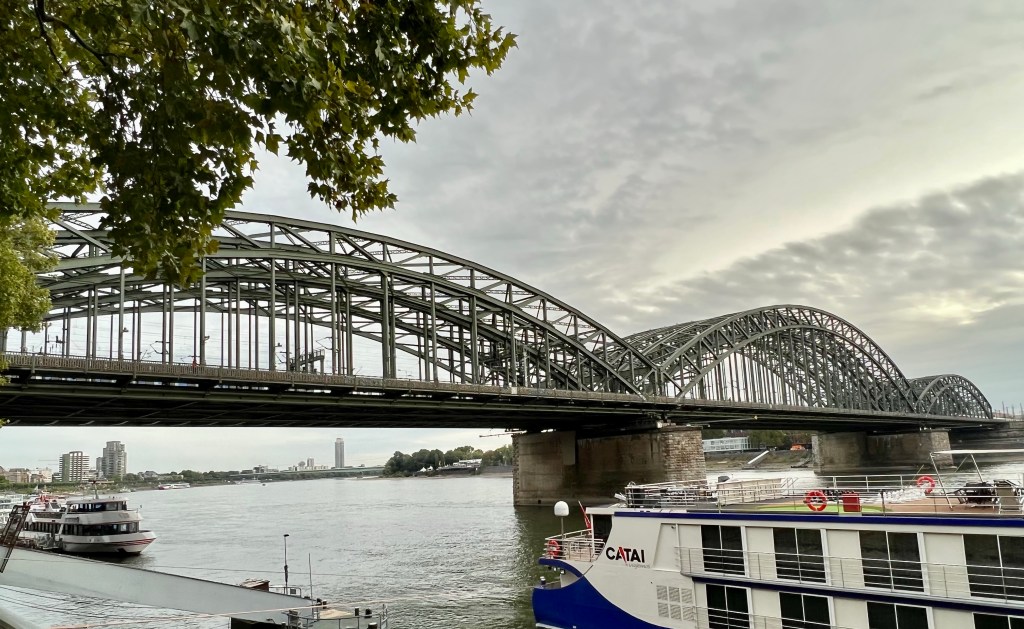
Our guide was very tongue in cheek and his super power was to walk backwards most of the tour with the odd warning of upcoming obstacles from the crowd. Apparently Cologne was one of the most bombed areas during World War II. As a result there are lots of hybrid buildings where the ruins of the original buildings have been built upon. The Cathedral survived bombing as did some of the bridge. They are still finding bombs from WWII.
Bridge in Cologne
Apparently the citizens of Cologne have an interesting sense of humour – for instance, there is a building that we passed that is referred to as blue trash bag building a very easy landmark for us to find on our way back
“Blue Trash Bag” Building
Cologne also has the reputation as the most flooded city in Europe. In an attempt to protect themselves from the floodwaters there’s an 11 meter wall along the river and they also have additional safeguards in place. Often not enough.
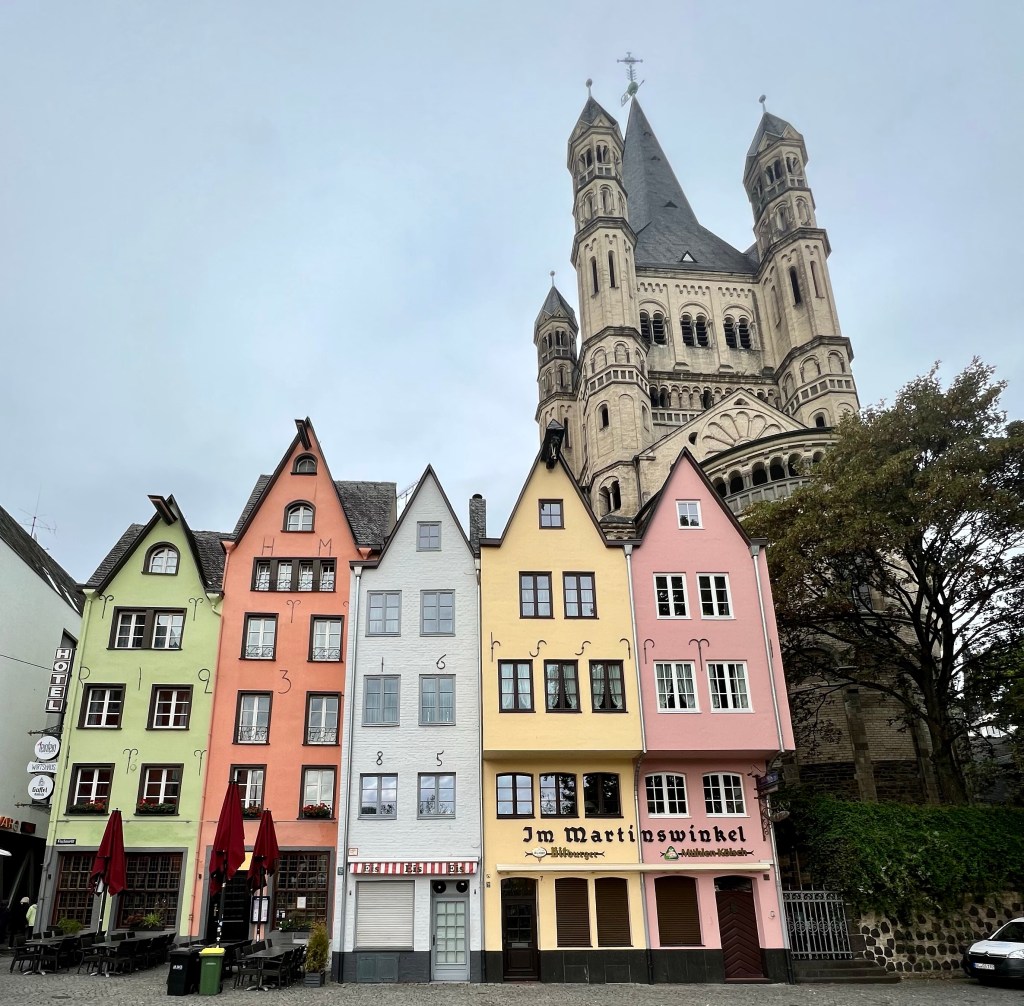
On the little houses in the square, there are letters which are initials of the names of the owners, numbers which are the years when the foundation was built and symbols to identify whether or not the occupants had paid their fire insurance. I guess if you had a fire and hadn’t paid, you’d be hooped!
Breaking the Code
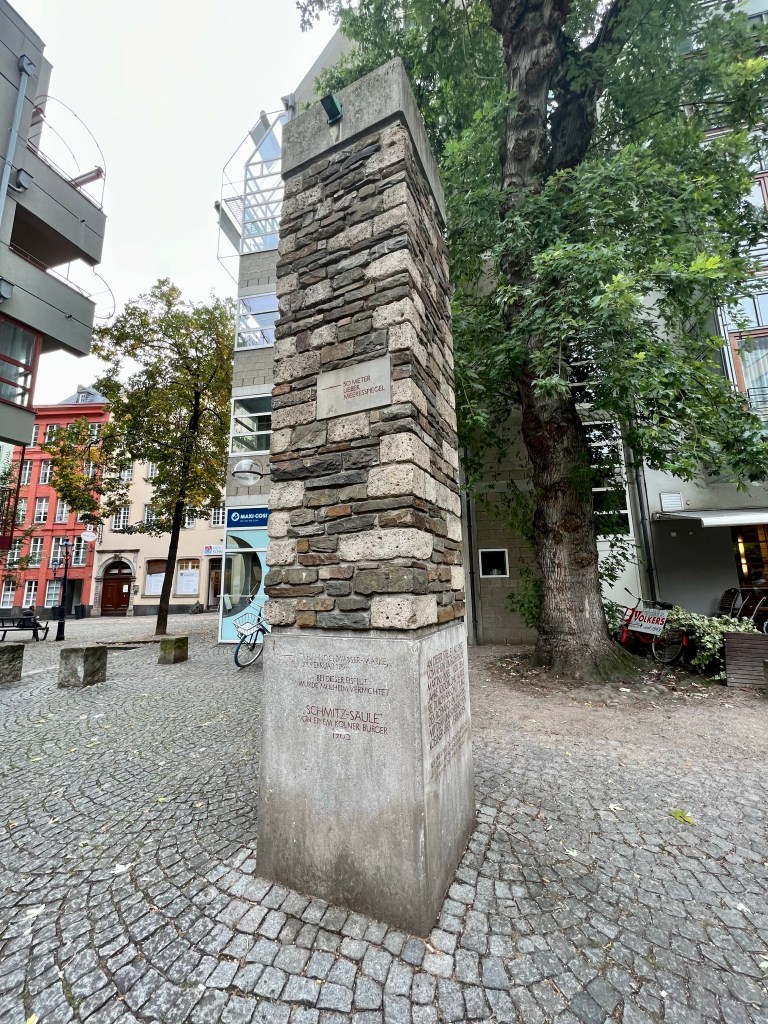
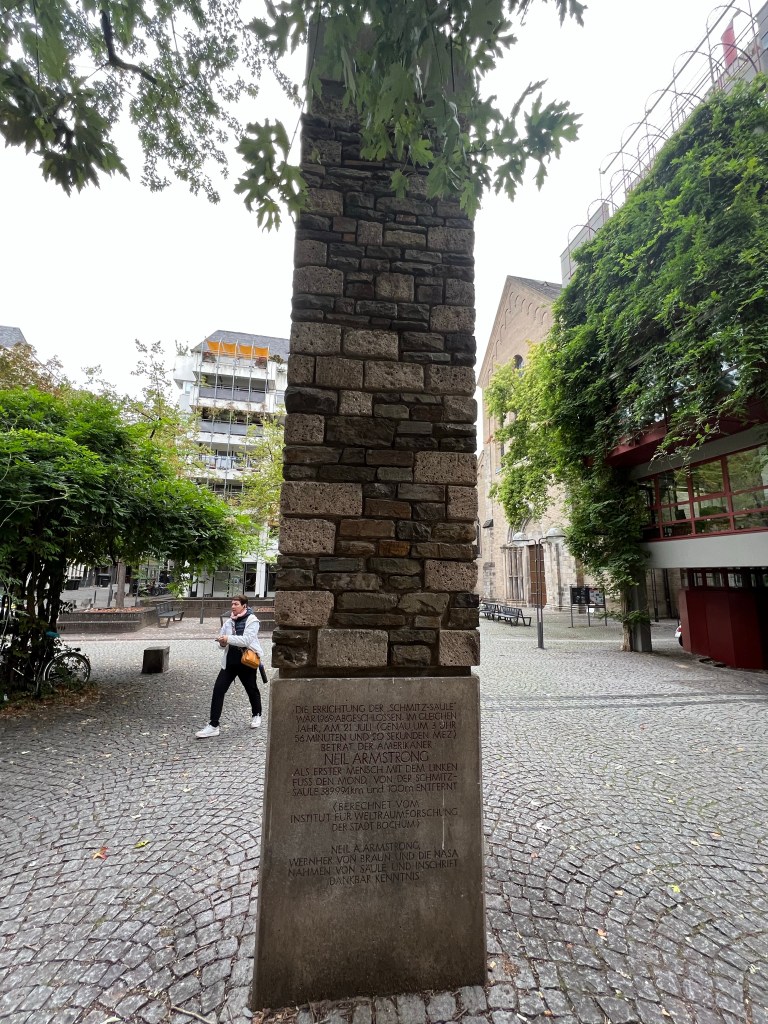
Our next whistle stop is the Schmitz Column; an homage to the most common name in Cologne. One story is that the ancient Roman legionaries would meet there with their local blonde Germanic girls. Their offspring were named Schmitz and are the ancestors of the Schmitz of Cologne. On the back of the column is a nod to Neil Armstrong’s walk on the moon.
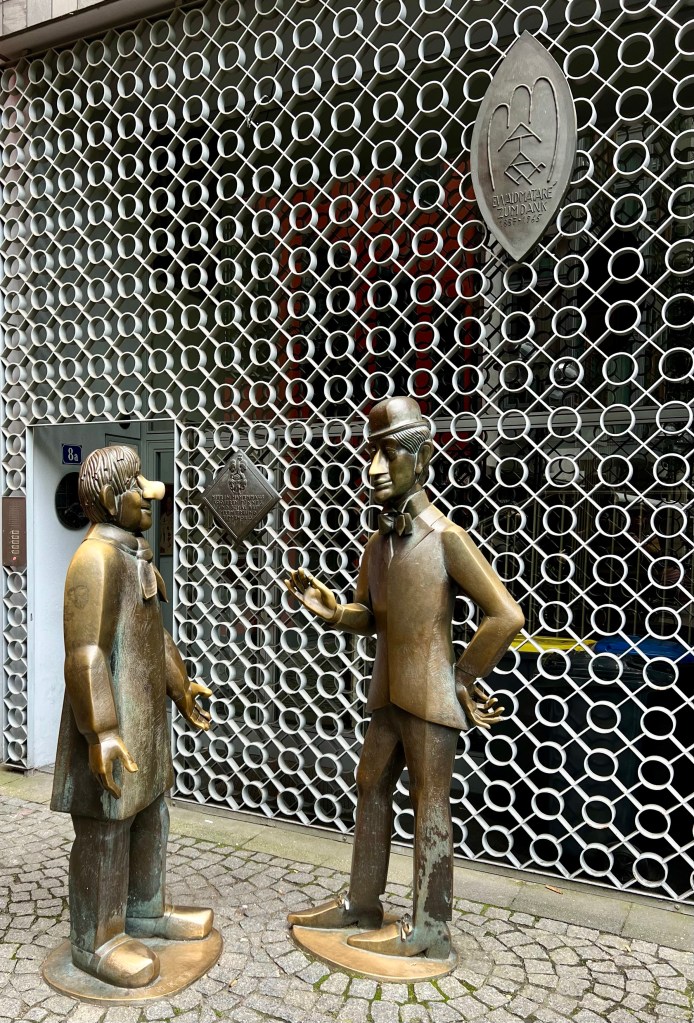
Tünnee and Schäl are popular puppets representing fictional characters who embody typical traits of people from Cologne. The name Tünnes is Rheinish for Anthony or Antonius so maybe a bit of poking firm at the Romans. Tünnes is good natured and has a rural, farmer-type of common sense and cleverness. Schäl means two-faced in the Kölsch dialect.
Tünnee and Schäl
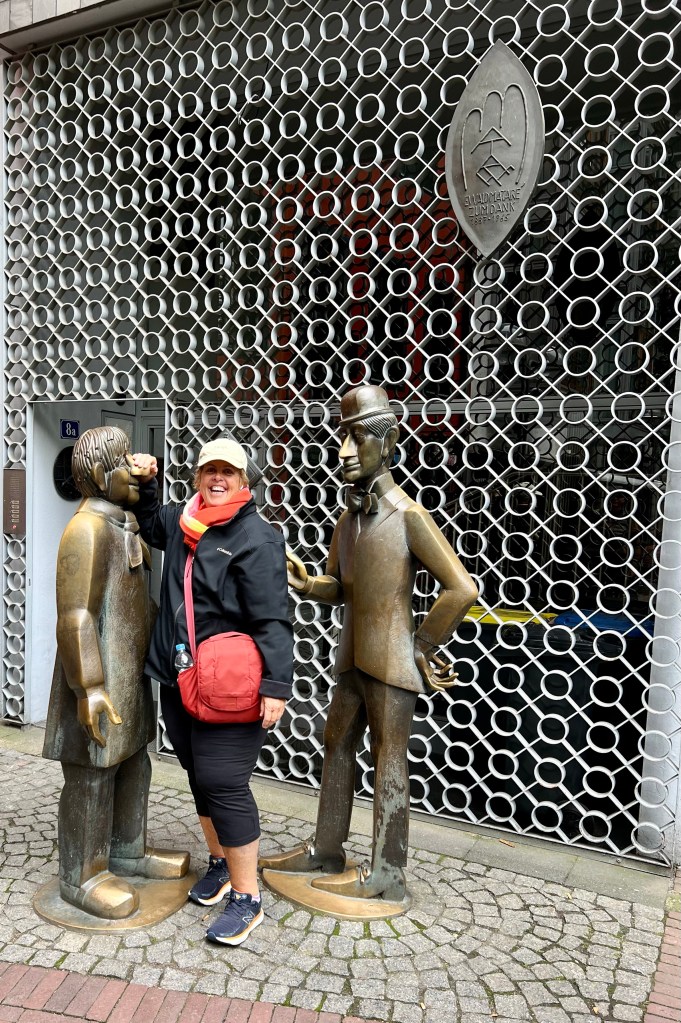
The bronze monument of these two Cologne originals stands opposite a Romanesque church. Rub the thick nose of Tünnes for luck. Can’t hurt!
Rub Tünnee’s nose for luck
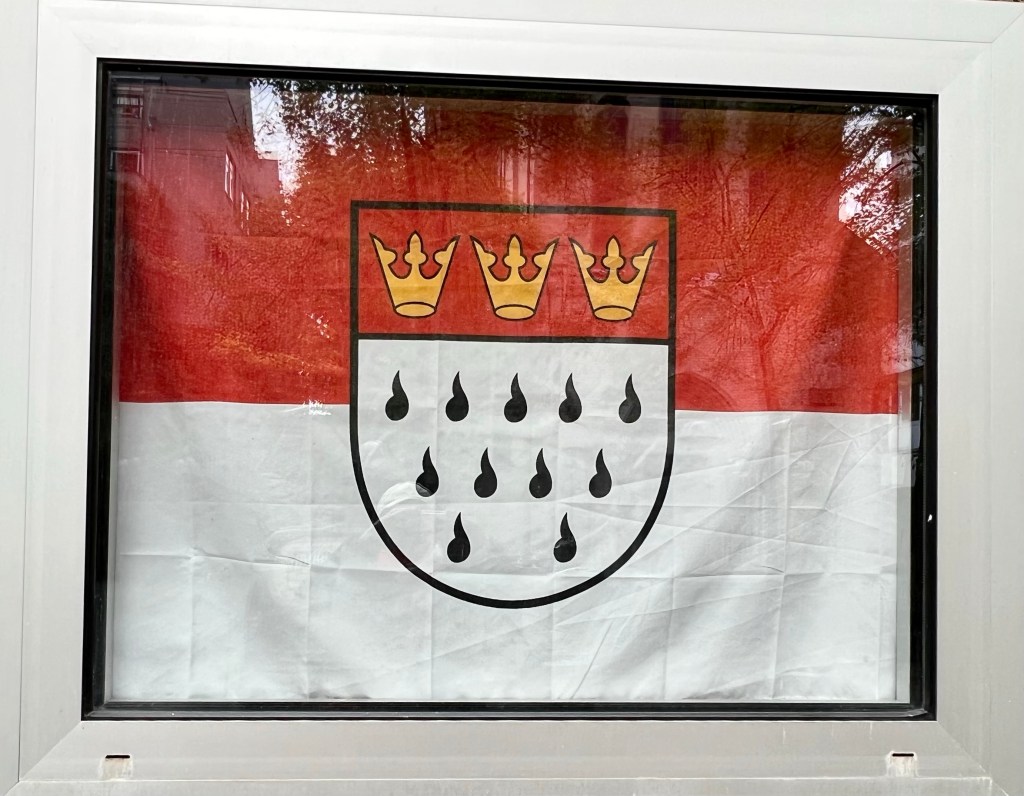
Next stop is a spot bearing the flag of Cologne. On the top are three crowns, representing the three holy kings (Kaspar, Melchior and Balthasar) who are buried in the Cologne cathedral. There are also 11 ermine tails, symbolising the 11.000 virgins of Saint Ursula.
Flag of Cologne
According to a medieval legend, St Ursula and her 11 or maybe it was 11,000! virginal companions returned to Cologne from their pilgrimage to Rome just as the Huns were besieging the city. As soon as they disembarked, the Huns leapt upon them with savage cries and the massacre began. The leader of the Huns was willing to stop the massacre if Ursula would consent to marry him but she, of course, refuses and is martyred together with her companions.
Yummmm
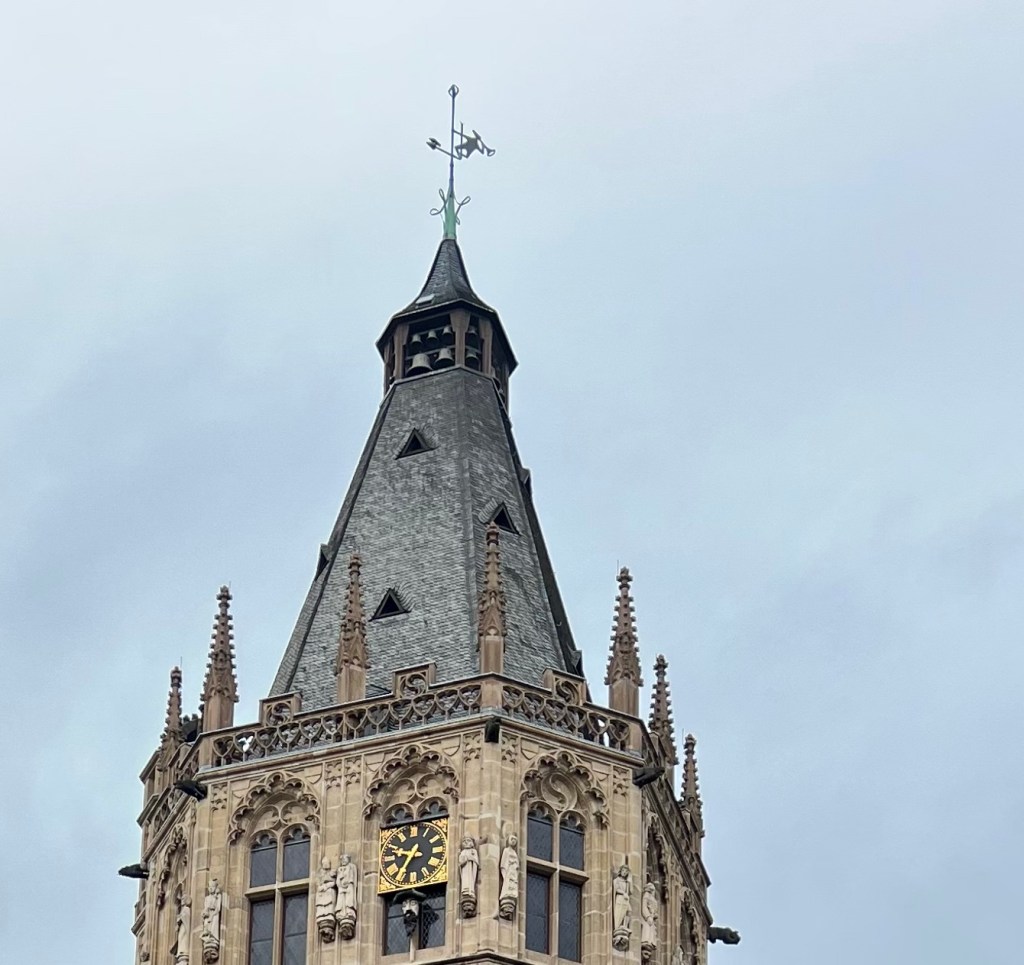
We reach Market Square and City Hall. The clock here is unique. Under the clock is a face who’s tongue sticks out every hour. This was intended as an insult to the aristocracy. The clock tower was also important as a firewatch over the city.
City HallClock with Face Beneath
Across from City Hall is a building famous for an argument between the roofer and the architect. The roofer was too lazy to come down to use the toilet and so he defecated in the rain gutter. The ass statue on the building is a homage to that boorish behaviour.
Kiss my grits!
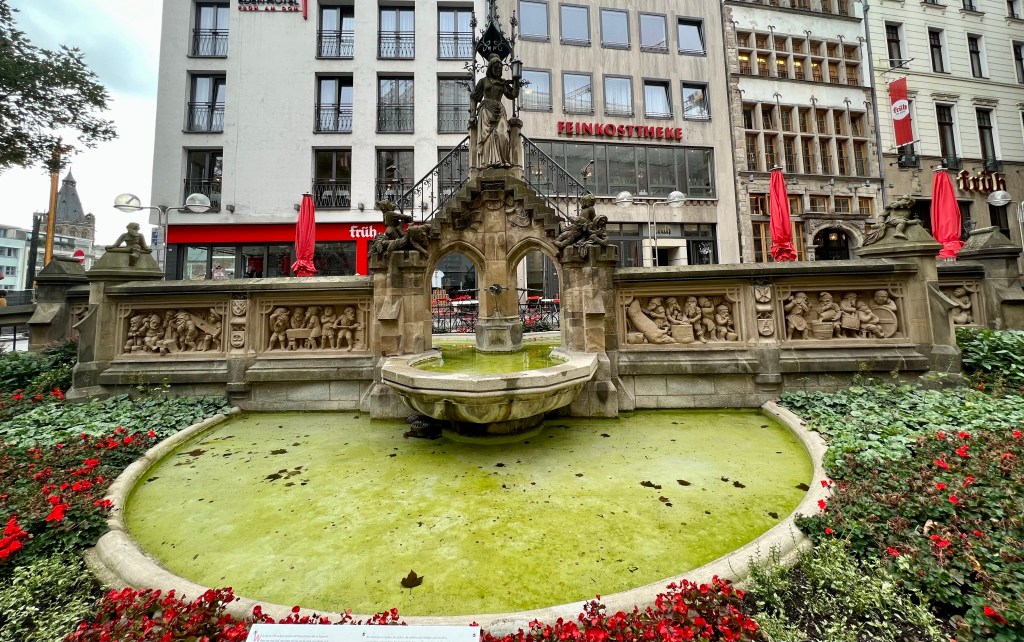
We also stopped at an ornate 19th-century fountain with sculptures commemorating a local legend about house gnomes; Heinzelmännchen. Legend says these hard-working helpers relieved every citizen of the city of a piece of tedious work overnight but they were very shy. One lady wanted to catch them working and put peas on the steps so she could hear them come, shone her lantern on them and they disappeared forever. I guess you shouldn’t look a gift horse in the mouth!
Heinzelmännchen FountainThe Heinzelmännchen at Work
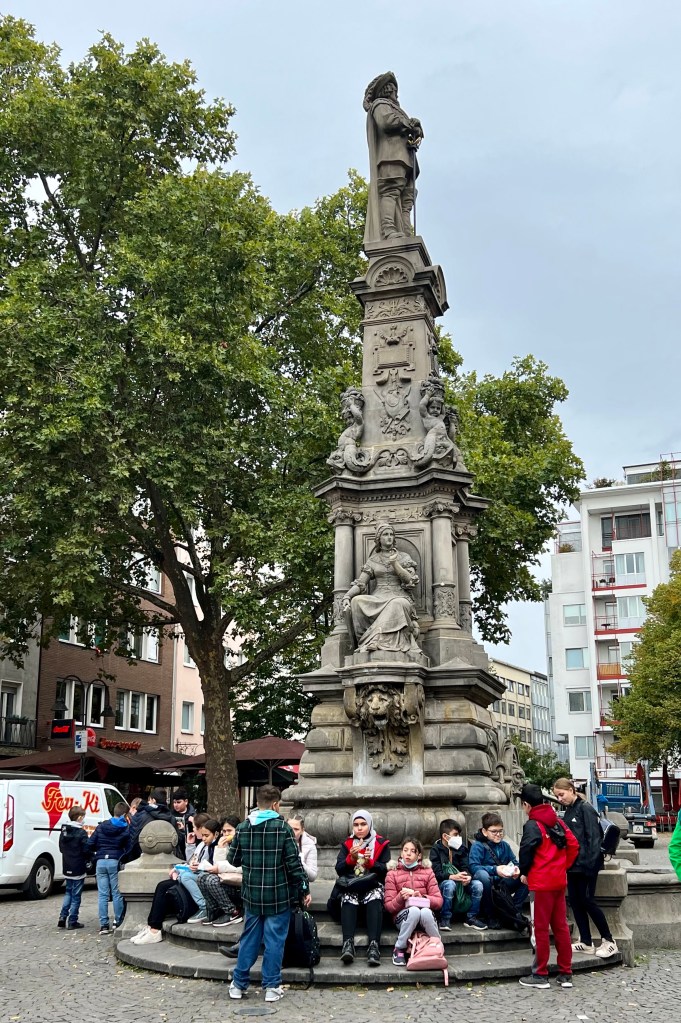
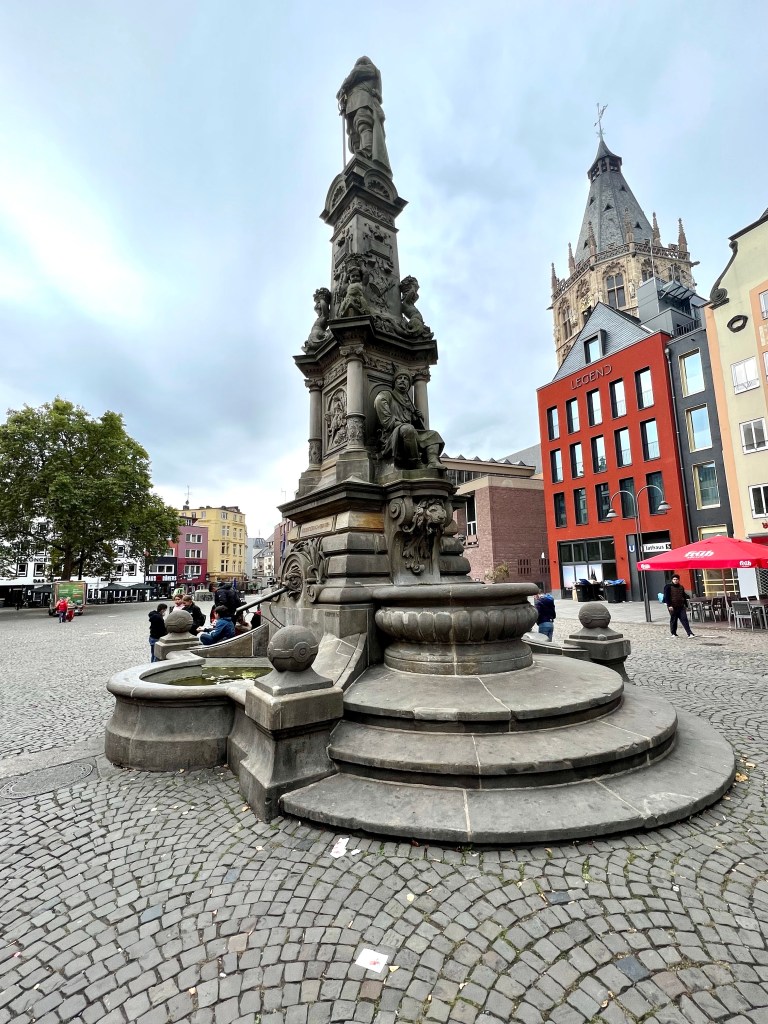
We also passed a fountain with a statue of Jan von Werth in Market Square that dates to 1884. In the well-known story of Jan and Griet, the young and beautiful Griet rejects the servant (Jan) wooing her as a bad match. The latter then goes off to the Thirty Years’ War and becomes a successful general. On his return to Cologne, he marches triumphantly through town with his army where he sees his former great love, Griet, on the market. He takes off his hat and says, “Griet, who would have anybody!” and she answered him, “Jan, who could have known”. He gets on his horse and rides on.
GrietJan the Victorious
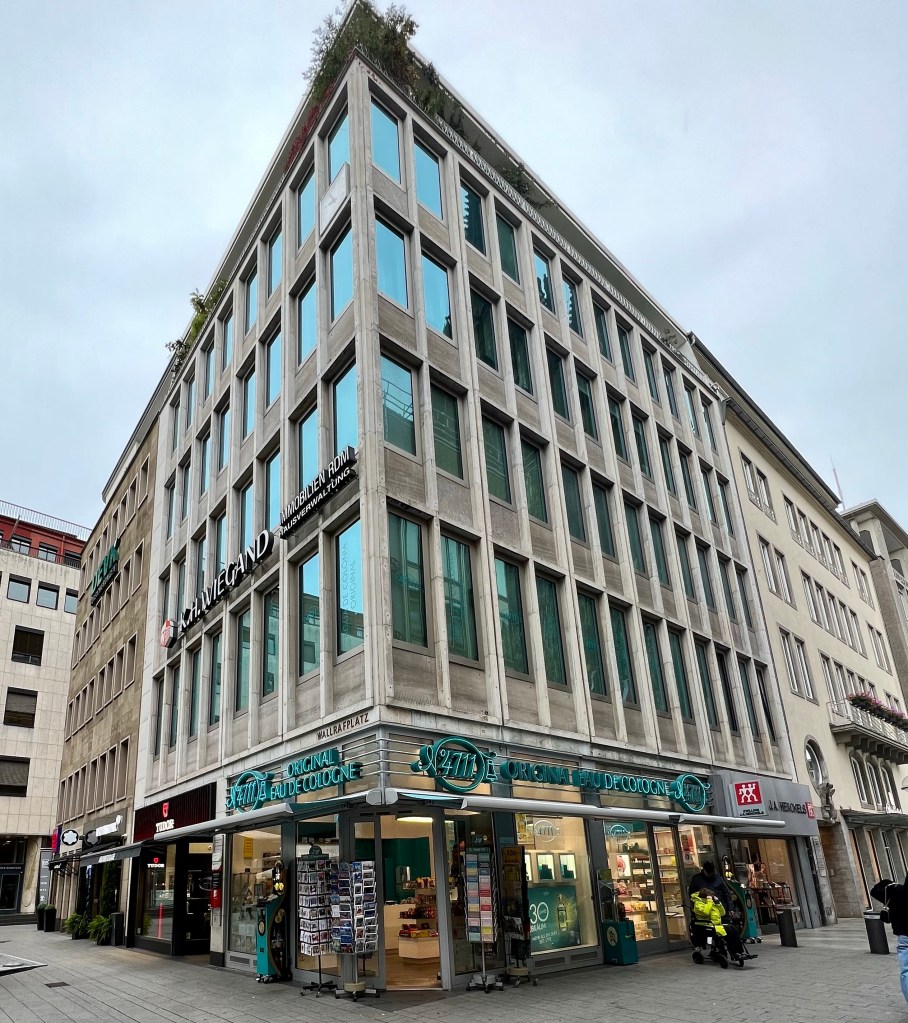
We pass 4711 Eau de Cologne. Originally, eau de cologne was meant to be drank as a medicine. When the Code Napoleon was introduced if you sold something for ingestion you were required to put all the ingredients on label. Since the formula was a secret, they decided to promote it for topical use.
4711 Eau de Cologne
Our guide pointed out an old friend; a 10 sq cm brass plaque embedded in the cobblestones underfoot. There are now more than 70,000 memorial blocks aka “tripping stones” laid in more than 1,200 cities and towns across Europe. Each commemorates a victim outside their last-known freely chosen residence.
The inscription on each stone begins “Here lived”, followed by the victim’s name, date of birth, and fate: internment, suicide, exile or, in the vast majority of cases, deportation and murder. The plaques are all hand made in contrast to industrial killing machine of the Nazis. People adopt the stones to keep them repaired and clean.
Stumbling Stones
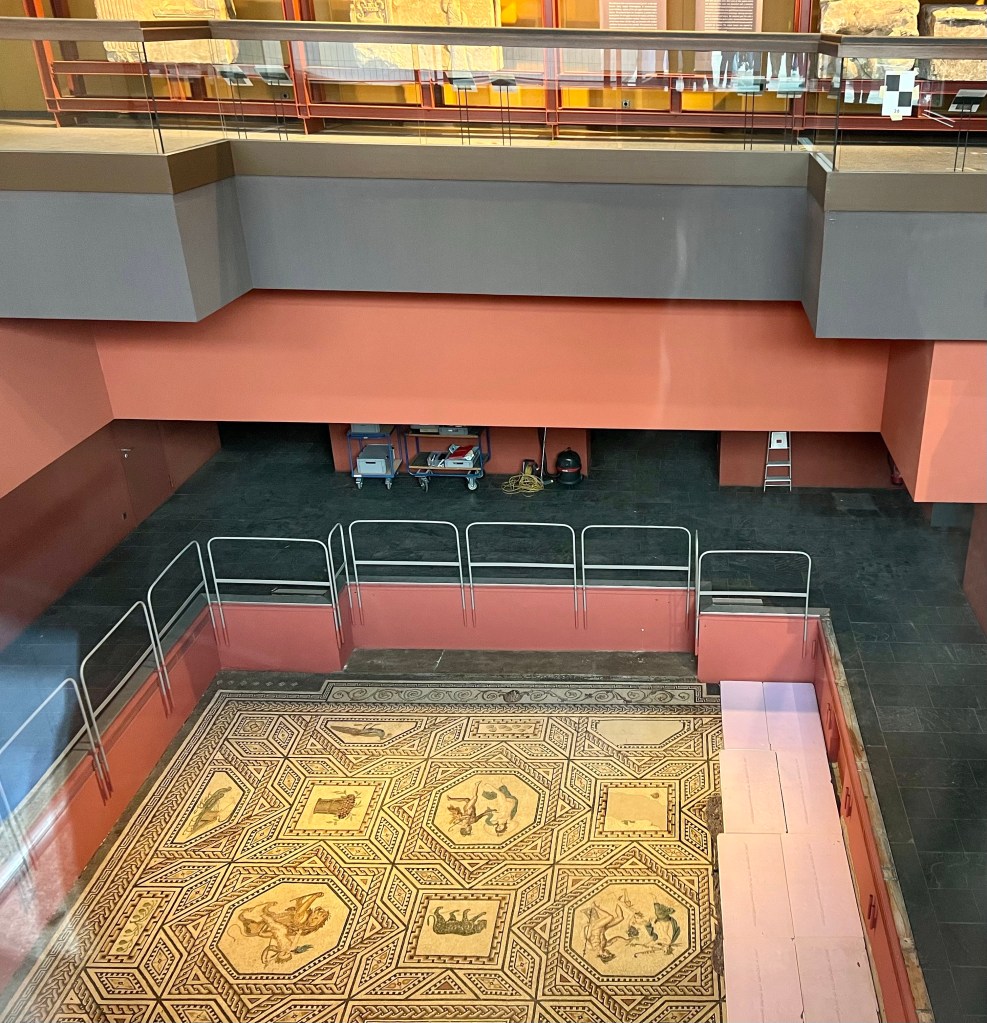
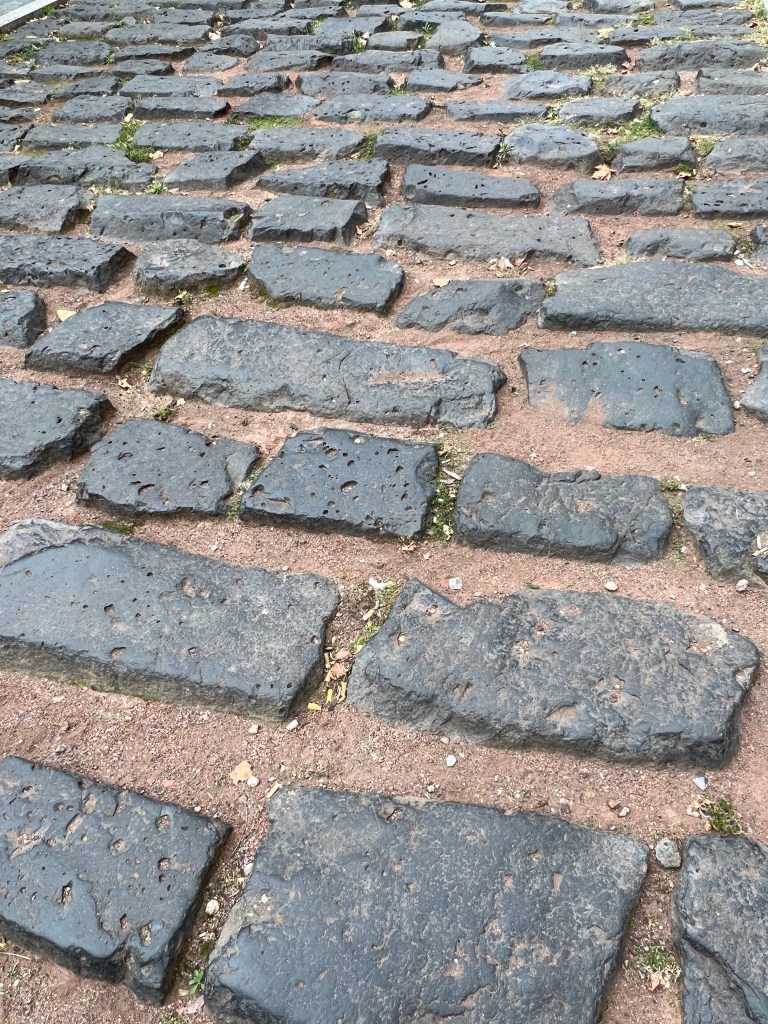
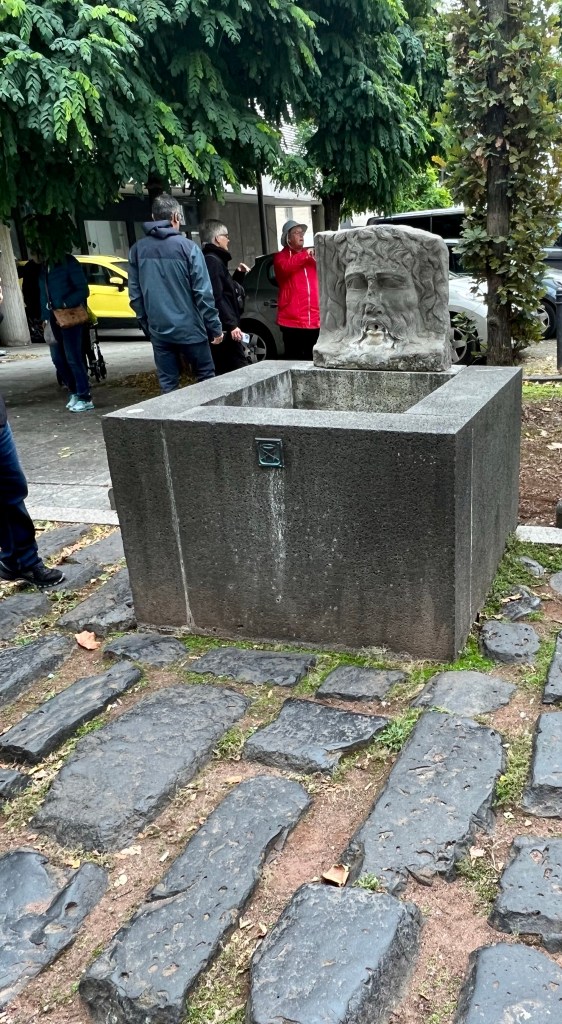
Cologne is also home to some Roman artifacts including a road which was rebuilt (but not as well!), a wall and a 2000 mosaic in the museum here.
MosaicRoad built using orI gi Al stonesWellRoman Wall
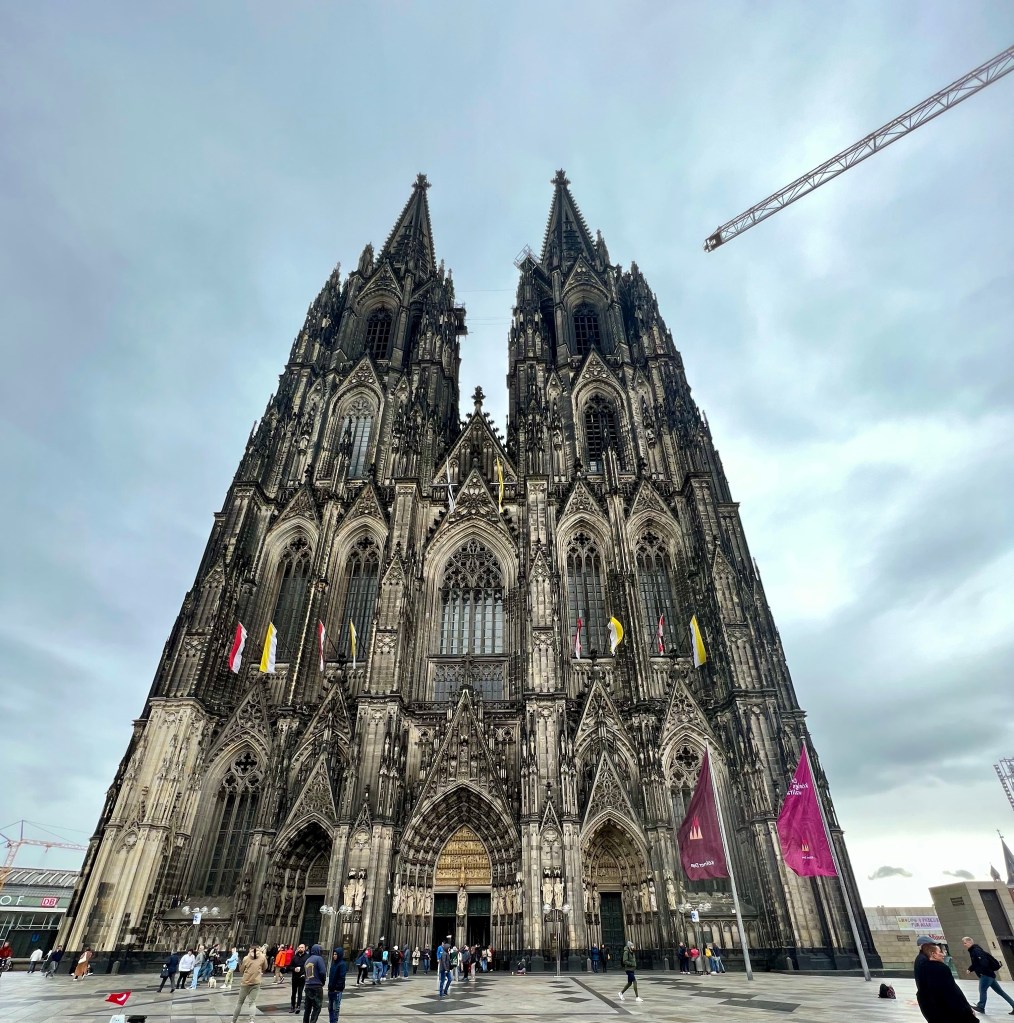
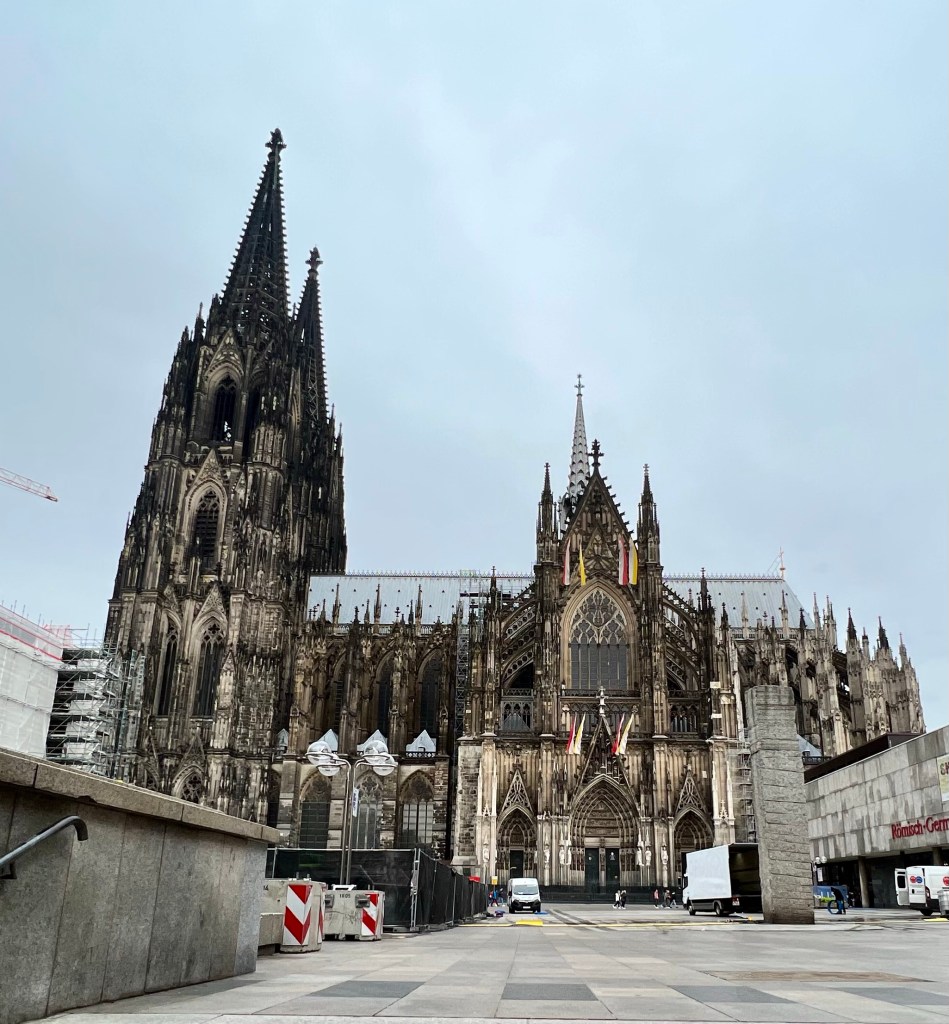
The piece de resistance of the tour was the Cologne Cathedral (Cathedral Church of St. Peter) which opened in 1880 and was for a short time (4 years) the highest building in the world. Being close to the railway station, it was hit by 14 bombs during WWII but wasn’t totally destroyed because of some design features. Some fun facts about the Cathedral; Napoleon used it for storage and stables for horses. St. Peter’s bell rings only eight times a year on Christian holidays.
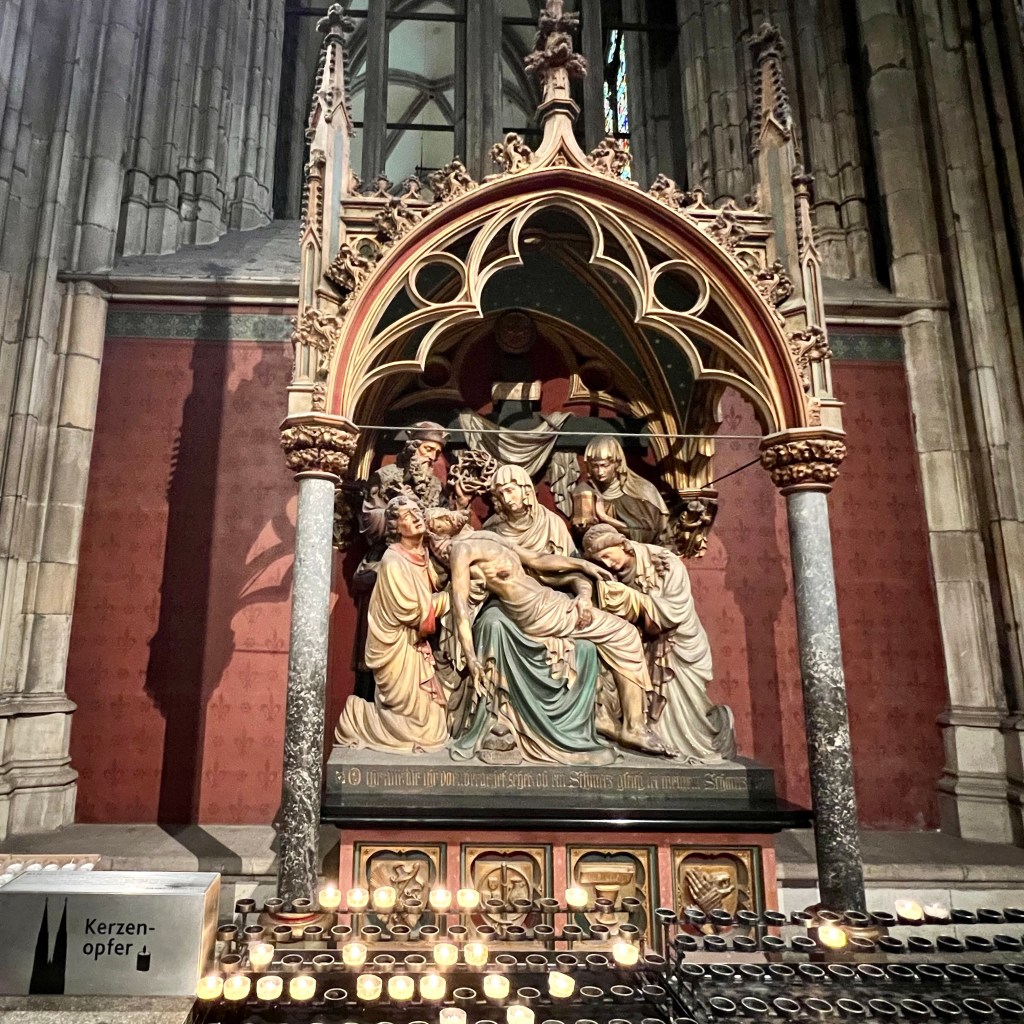
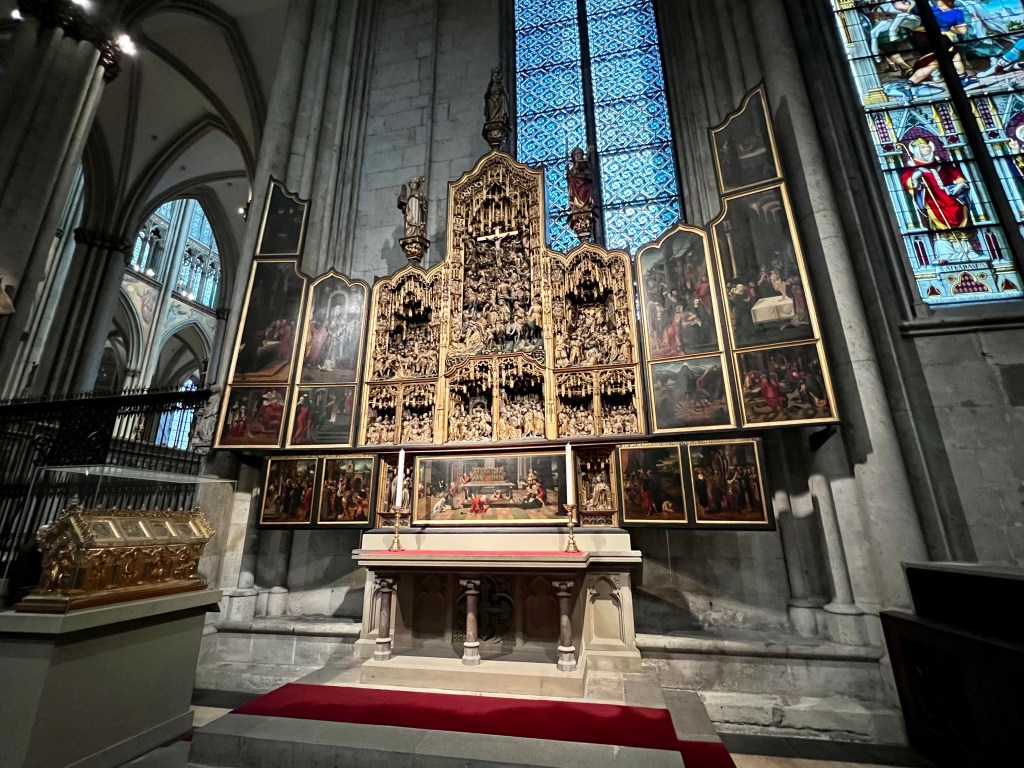
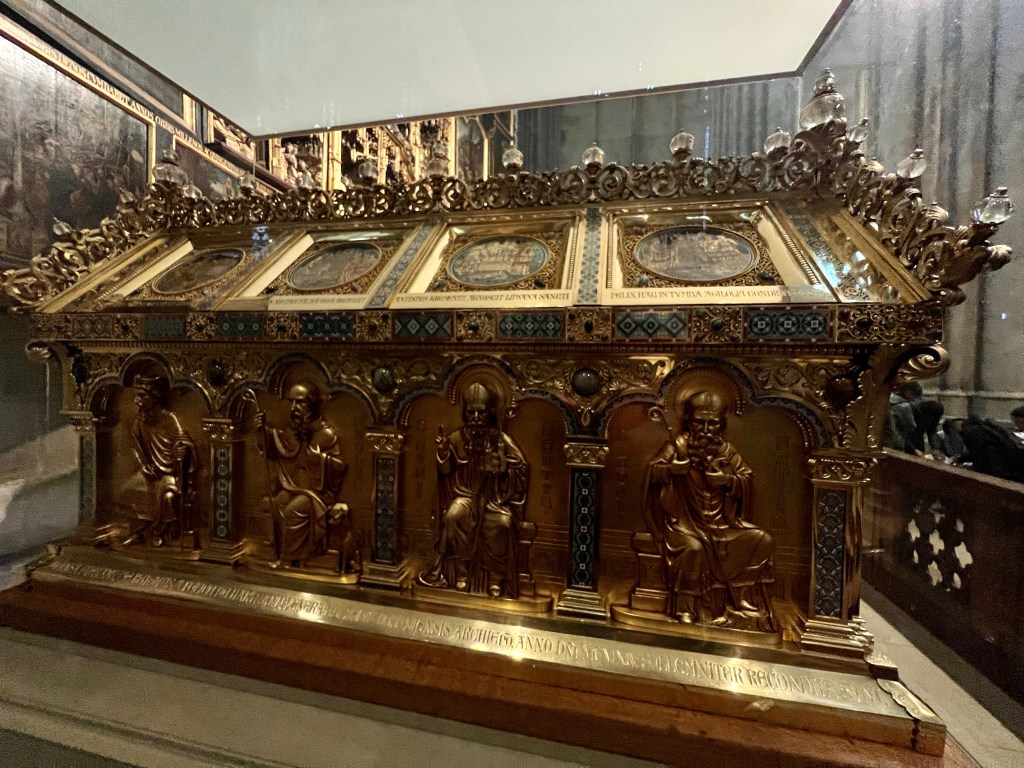
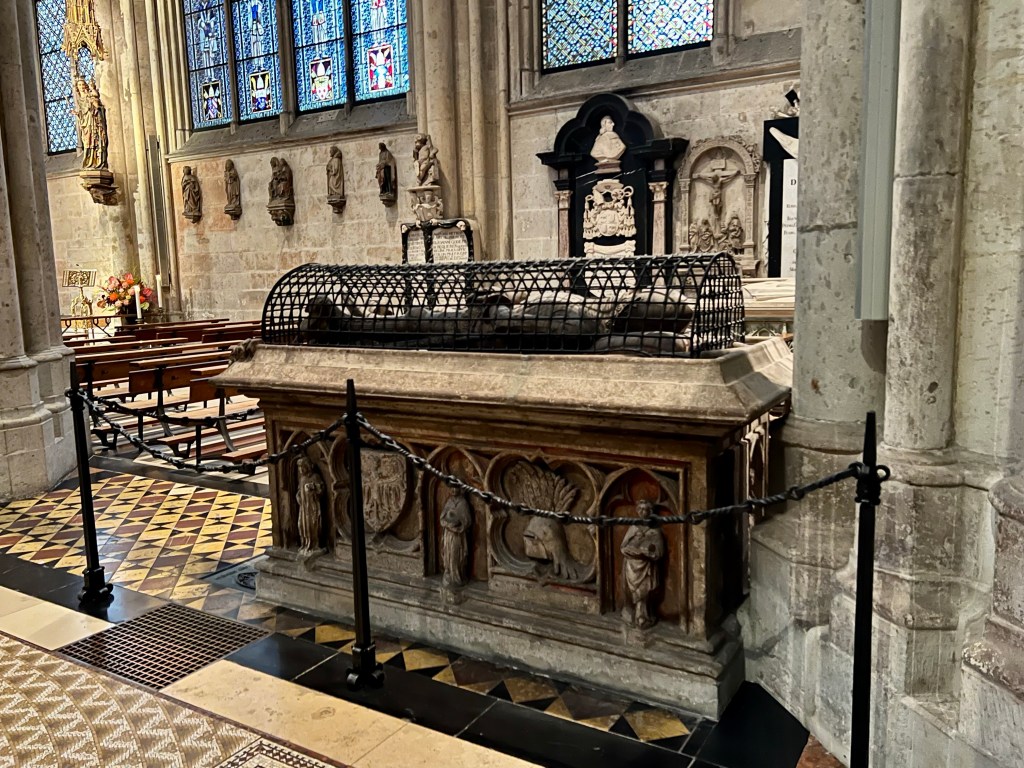
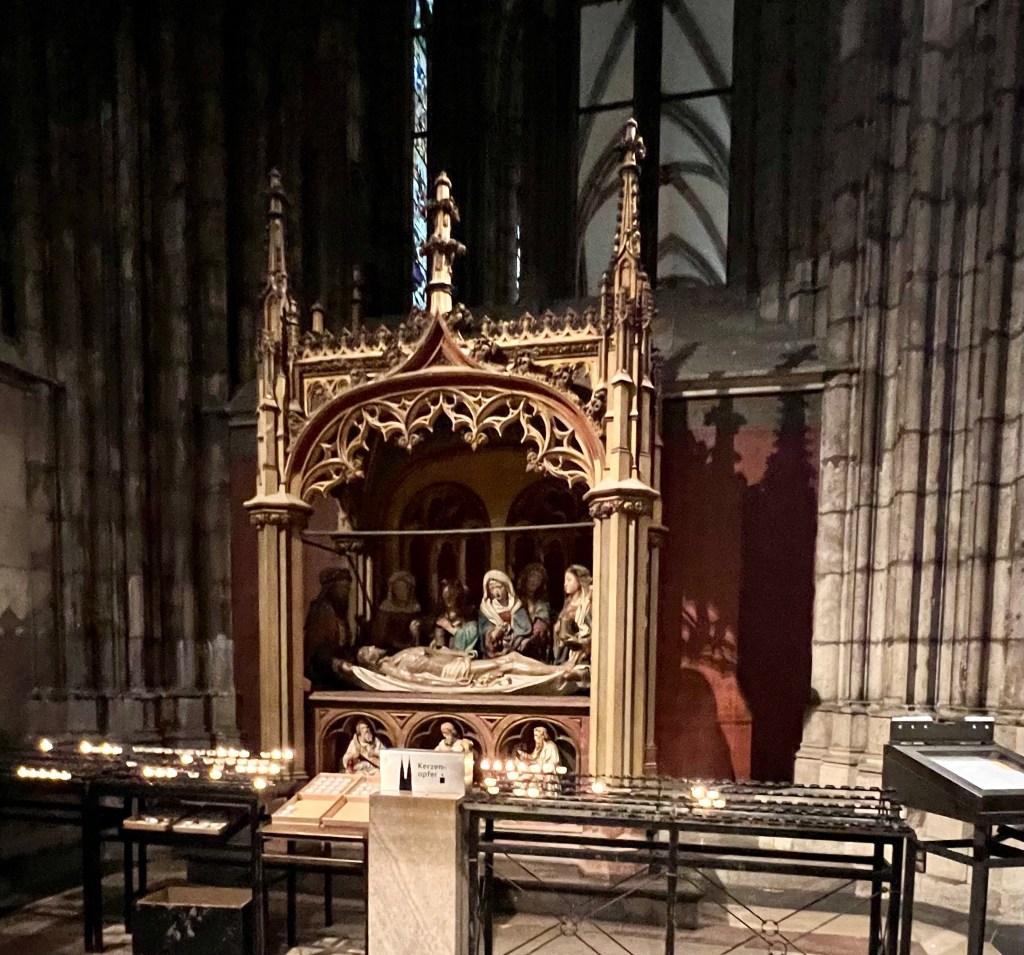
Cologne Cathedral Cologne CathedralBronze Relief of Pope John Paul II and Pope Benedict XVITaubenbrunnen Fountain No set fee but donations welcomeShrineStained Glass16th Century Agilolphus AltarReliquary ShrineTombAnother tombBeautiful AltarShrine
After looking around the church some folks opted for shopping and snacks while the rest of us headed back to the boat.
Hopping a lift!
After a few games of cards, we headed to lunch before nap time.
Dinner was again a scrumptious feast and then we headed back to the lounge for more drinking and debauchery. We even managed to share the bottle of local melon liquor that we’d won playing movie trivia earlier in the week. My liver needs a vacation!
Time to crash. Tomorrow is another day. Luxurious adventures await…
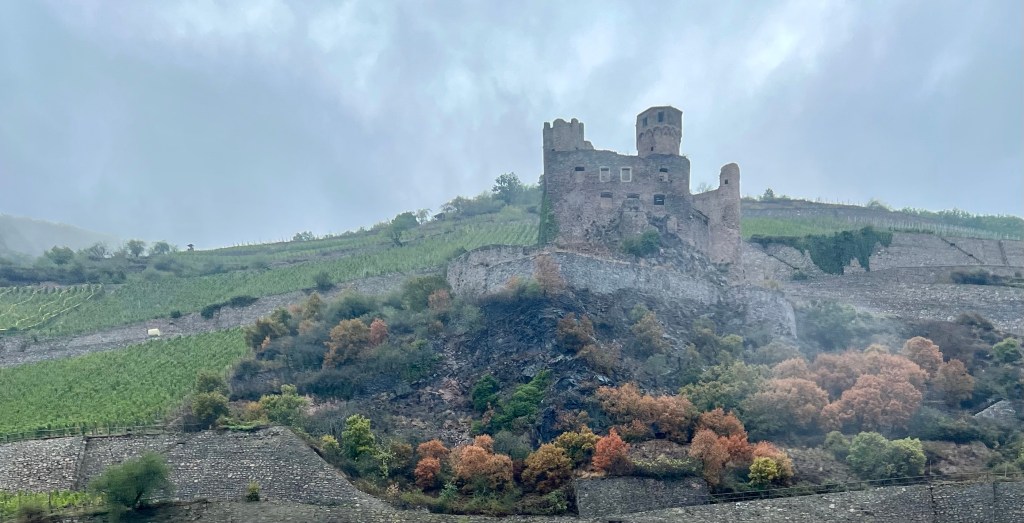
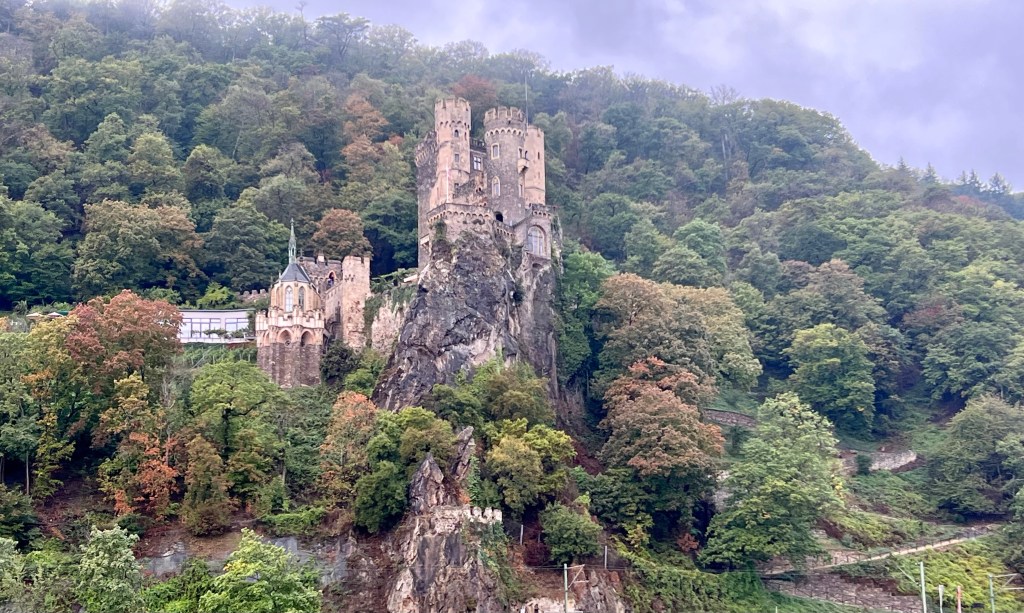
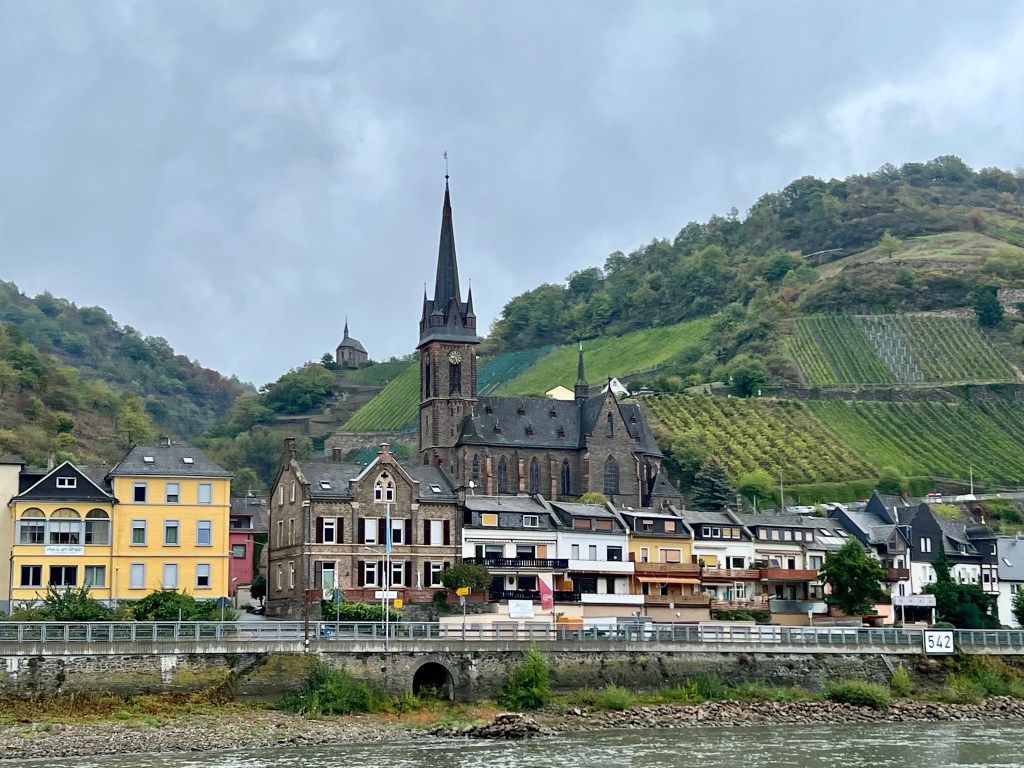
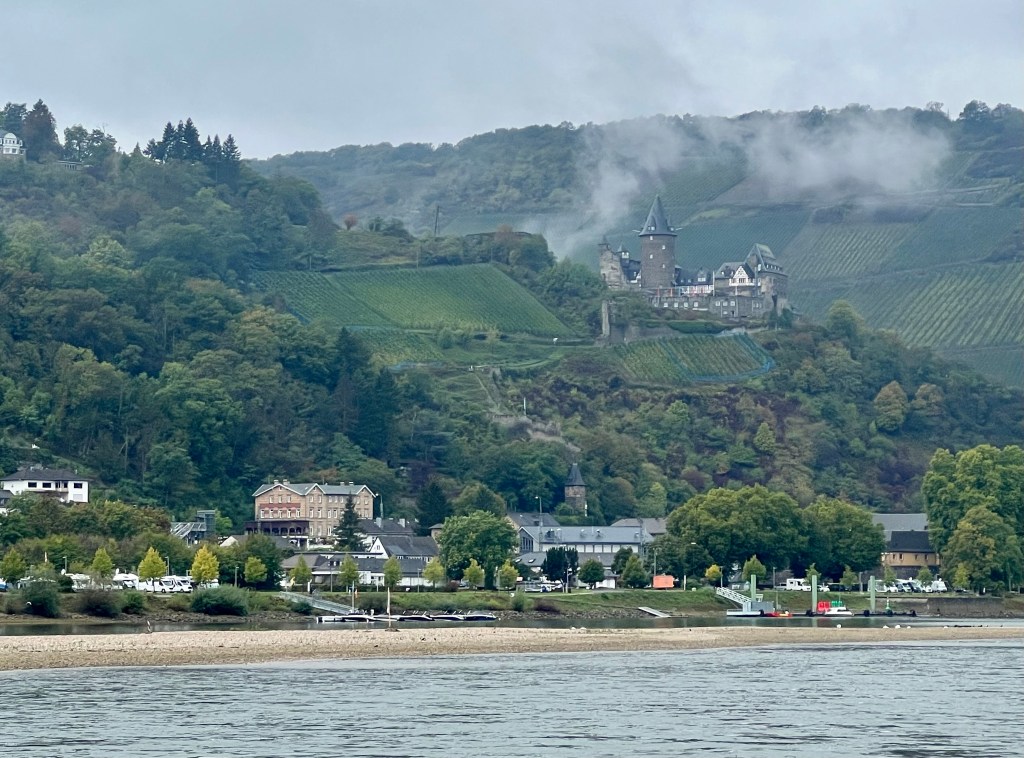
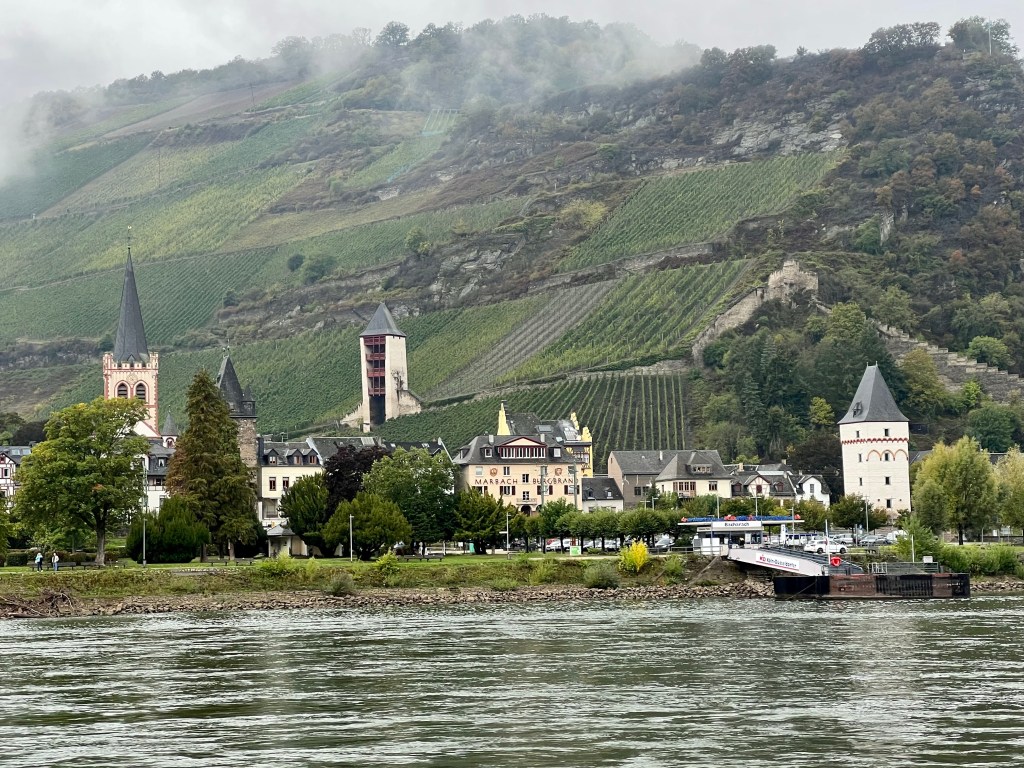
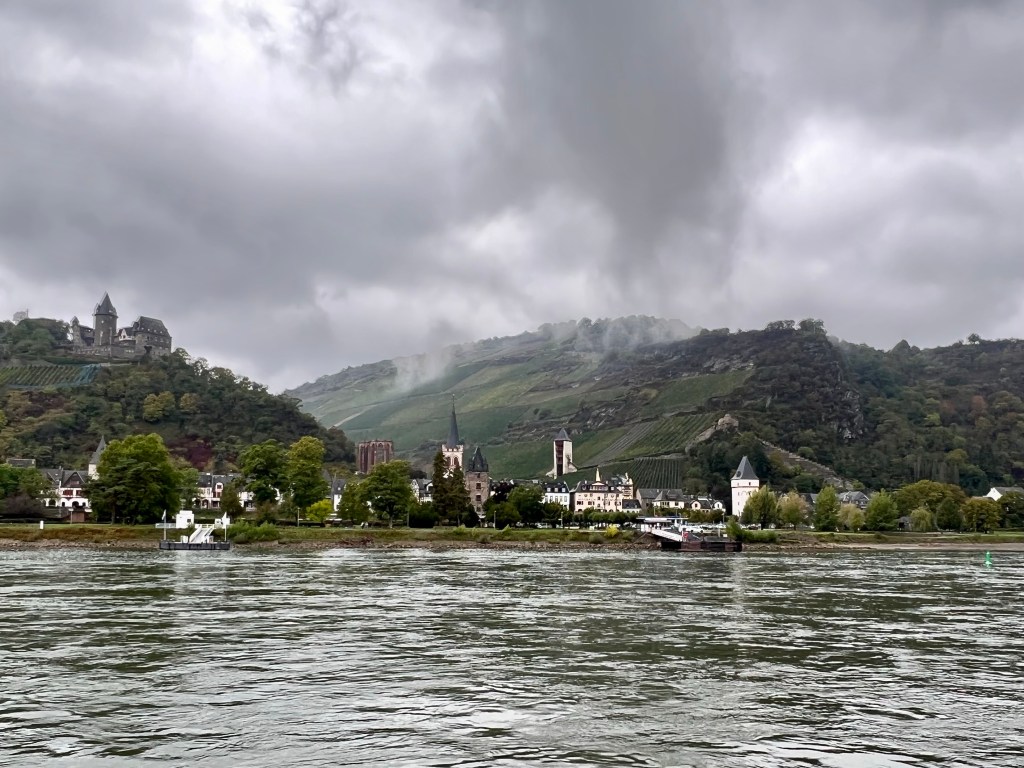
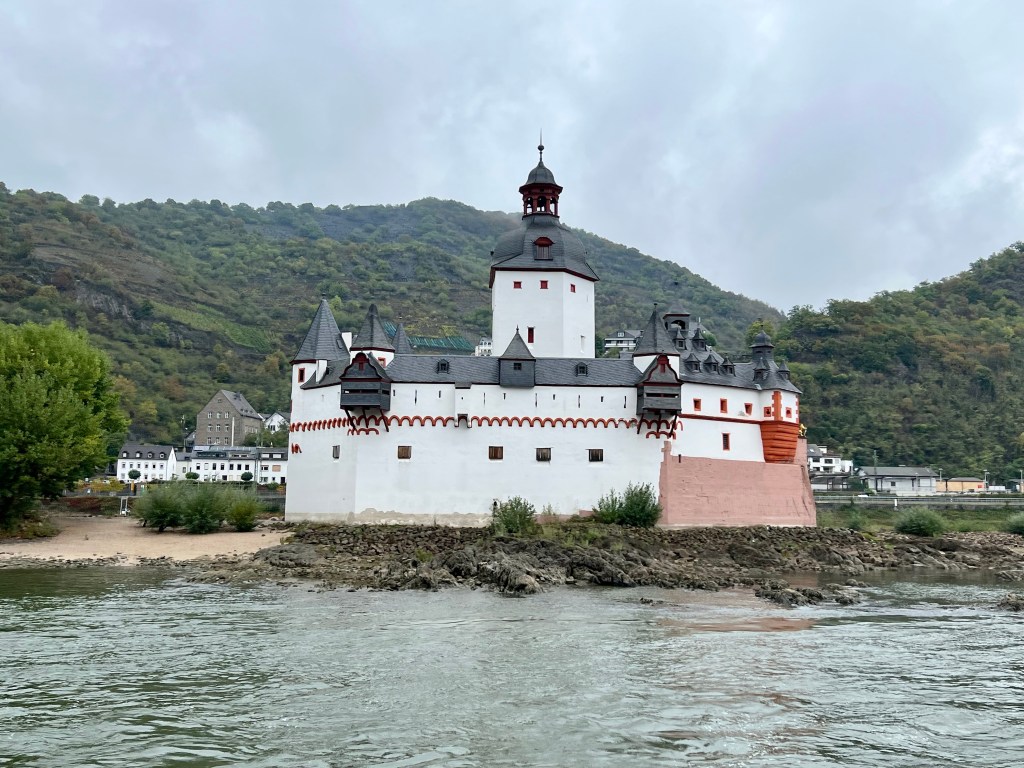
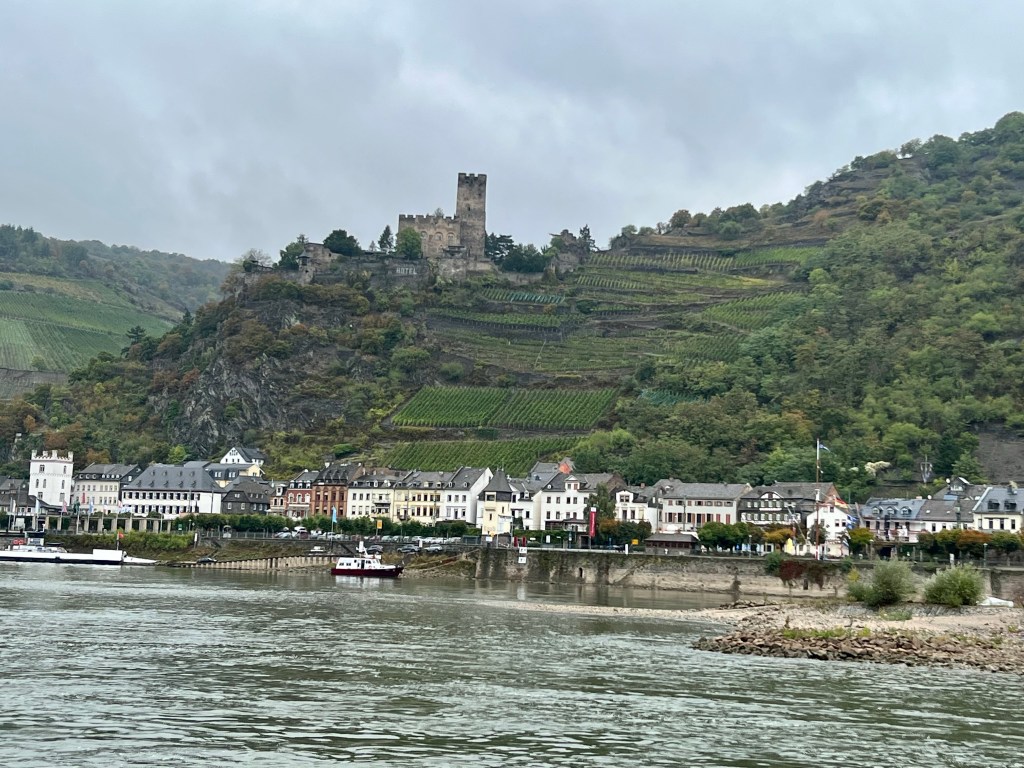
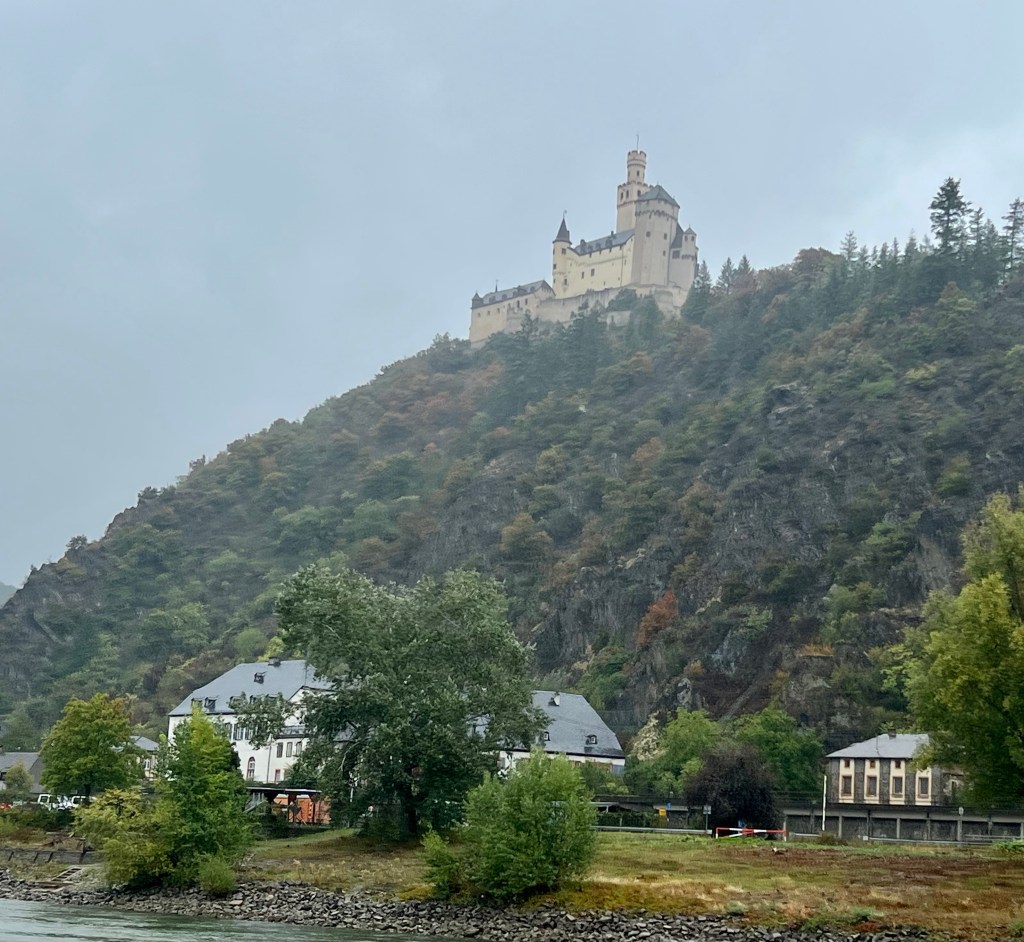
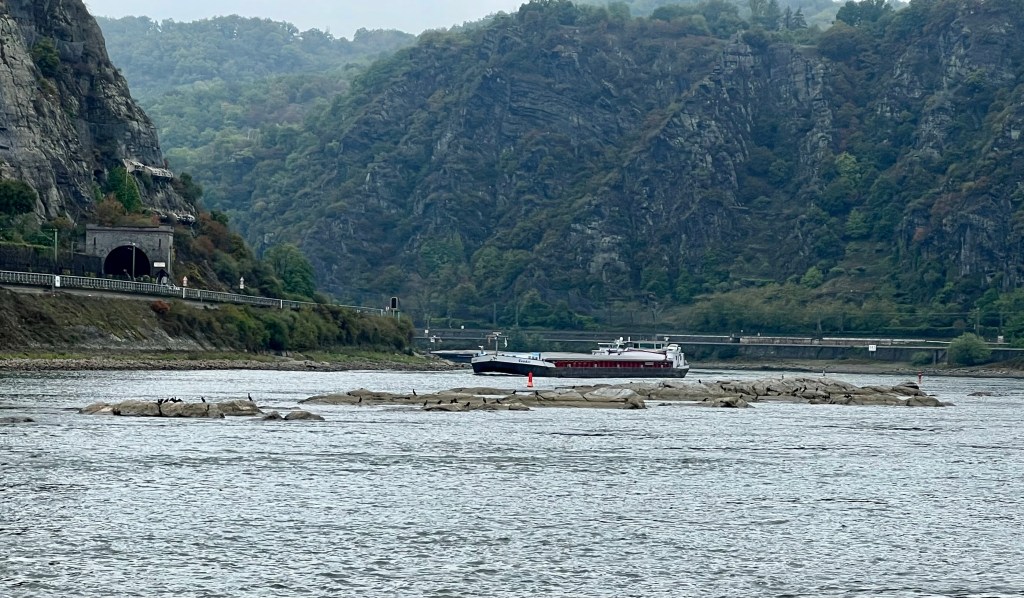
This morning after breakfast we’re cruising through The Rhine Gorge aka the Upper Middle Rhine Valley; a visually stunning 65 km section of the Rhine between Rüdesheim and Koblenz. For a few rainy hours we were treated to rolling vine-clad hills crowned by medieval castles and fortresses, historic villages. The river not to be outdone also features rock formations steeped in legends. This is where the Rhine really shows off its magnificent beauty and, in 2002, the Upper Middle Rhine earned UNESCO World Heritage status as a result.
I wish I’d had time to keep track of which castle was which but they were coming fast and furious so I listened to the audio guide and then ran out both sides of the boat to snap pics in the rain, lol! Either way, I think the beauty does speak for itself.
CastleCastle and VinyardCute TownCastle!Castle and ChurchBig Friggin Castle!The fall coloursAnother cute townAnother CastleMore beautyStill more …ChurchCastle Stunning landscapeCastle on a hillAnother castle on a hillLast one, I promise!
I did however manage to capture/retrieve the stories of the legendary rock formations; the Seven Sisters and Lorelei.
The seven sisters were renowned for their beauty and their wild behaviour; they used to ride out hunting and hawking, threw many magnificent banquets and their beauty, riches, and their gay and joyous lives attracted knights from near and far. Many suitors were shunned by the sisters but eventually they gave in and agreed to marry or at least appeared to! When the appointed hour arrived they had boarded a boat and set sail laughing at their erstwhile suitors. The rejected suitors stood speechless on the shore shamed and angry. A terrible storm arose with waves rushing over the boat, burying it and the seven sisters in the depths below. On on the spot where these stony-hearted maidens met their deaths, seven pointed rocks appear above the surface of the water as a warning to other sassy women!
The Seven Sisters
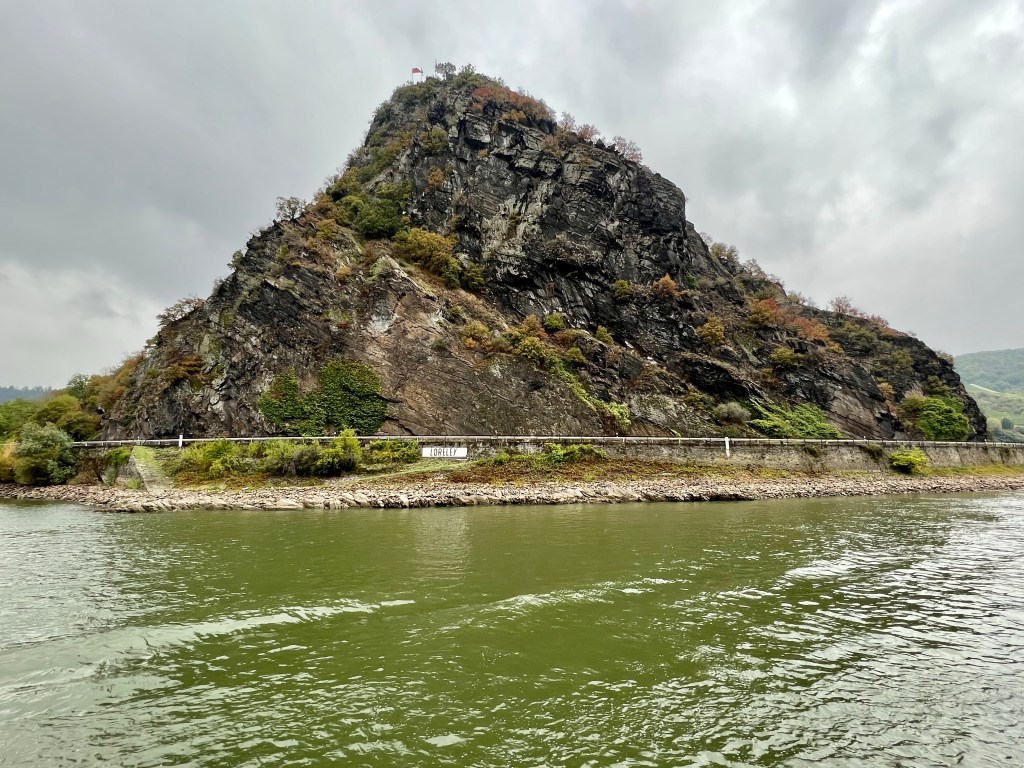
Further along, we met the iconic Lorelei rock formation; a 132-metre-high, steep slate rock on the right bank of the Rhine. This legend also features a beautiful maiden but it’s not her that drowns but her suitors. Legend has it that she sat atop the cliff and serenaded sailors with her voice. Hypnotised by her singing and determined to reach the beauty, sailors would crash on the treacherous rocks and drown.
Loreley
After we were castled out, we grab a nice lunch and then head out on our excursion for the day. I’m headed to Cochem, a city on the Mosel River to see (you guessed it!) its famous castle, Reichsburg Castle and tour the town.
Our guide this afternoon is Elmar and his melodious voice regales us with the history of the area and simultaneously lulls us off to sleep.
Koblenz is a very old town built by the Romans in 7 AD on the banks of the Rhine and Mosel Rivers. The Romans also brought grapes and agricultural knowledge to the area. The Legions drank 1.5 litres per day. The water was bad so … wines in those days was lower in alcohol more like beer at 5-6%.
Typical vineyard terraces produce better wine when the sun hits the slopes at 90 degree angle. Grow the vines in vertical lines where machines can go and in horizontal lines where machines can’t go. In these cases there are steep walls and staircases and elevators to move the grapes.
Our “ride” for the weekView from busView from bus
There are 18 locks in the Mosel to account for the 500 foot change in sea level. The locks were a joint project between France and Germany in 1964. Navigable year round the river is important to both countries and, historically, has caused friction and many wars between the two countries.
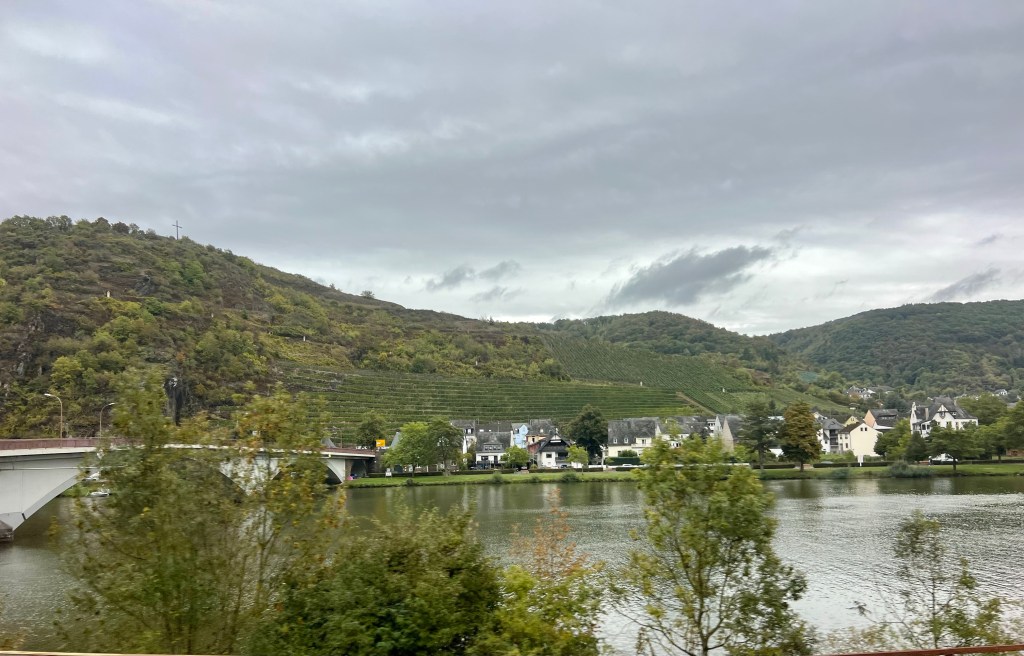
The scenery along the Mosel is spectacular though pictures taken from bus windows can never do it justice. A little less than an hour later we arrive in Cochem; a town of 5000 inhabitants, famous for its wine, produced in some of the steepest vineyards in the world.
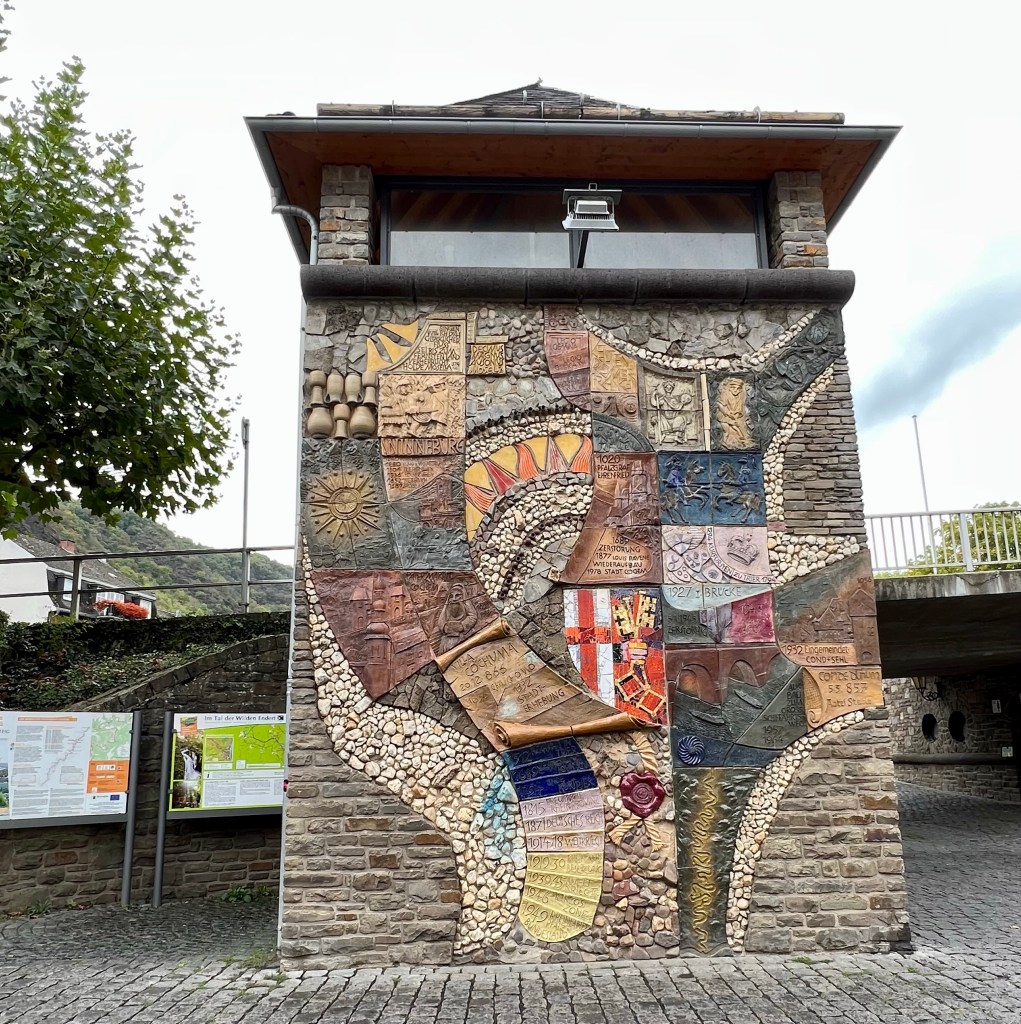
We leave the bus in Cochem town and head through the town with our new guide, Joachim, for a quick tour of the town. Our first stop is a wall on the old bridge that portrays the history of the town.
The history wall in Cochem
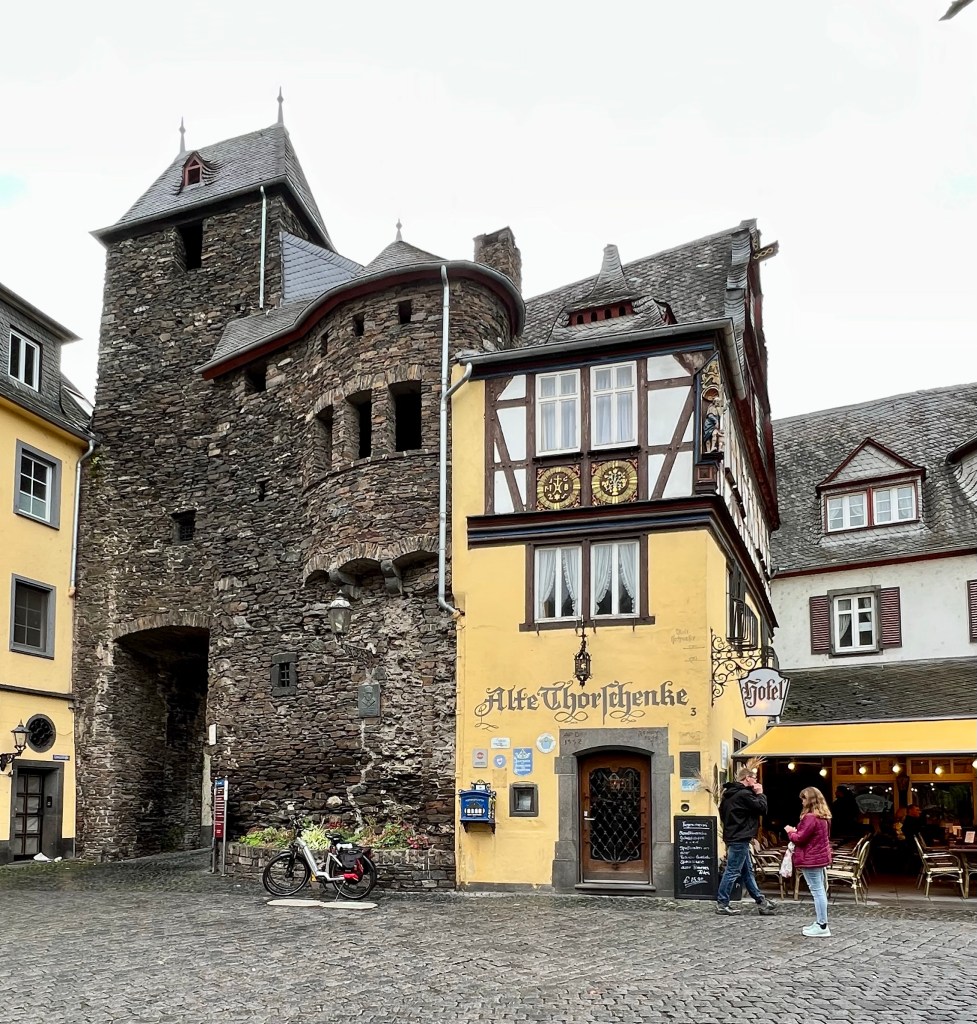
Then we’re off to Endatt Gate which originally had a prison above. Guards for the gate and prison same people and there was also a house in the town wall for the gate manager; very practical people.
Endatt gate and Prison
Next stop was a white building showing the water levels during the centuries. Flooding is a real thing!
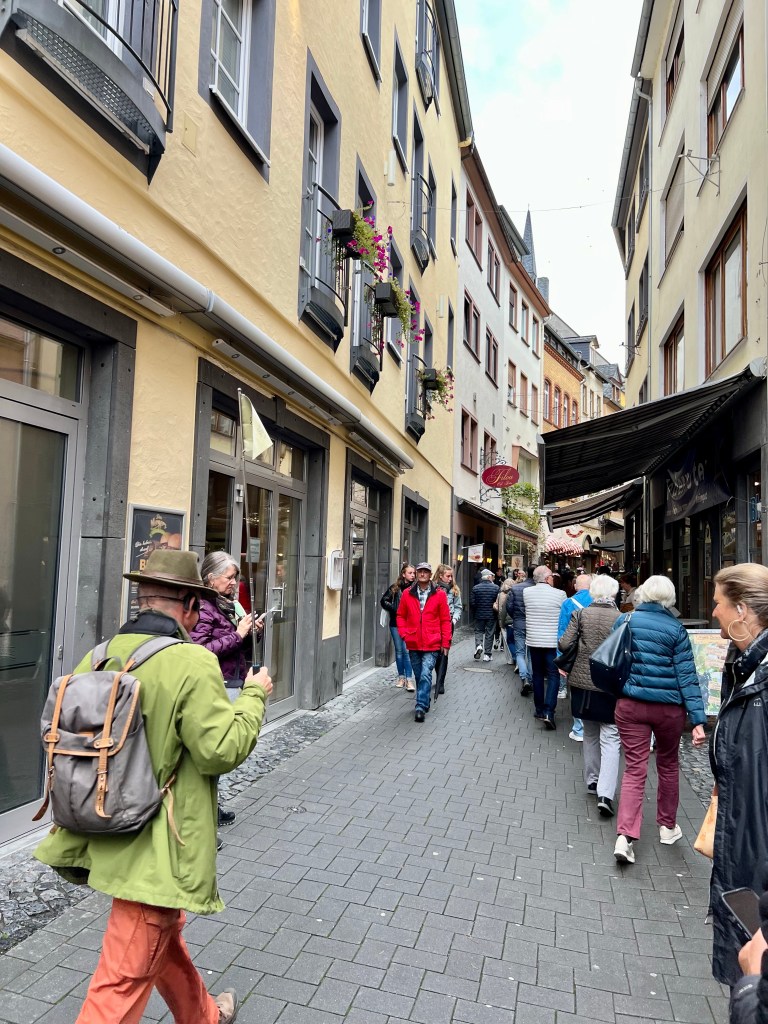
Flood levelsStreet in CochemTower in Cochem
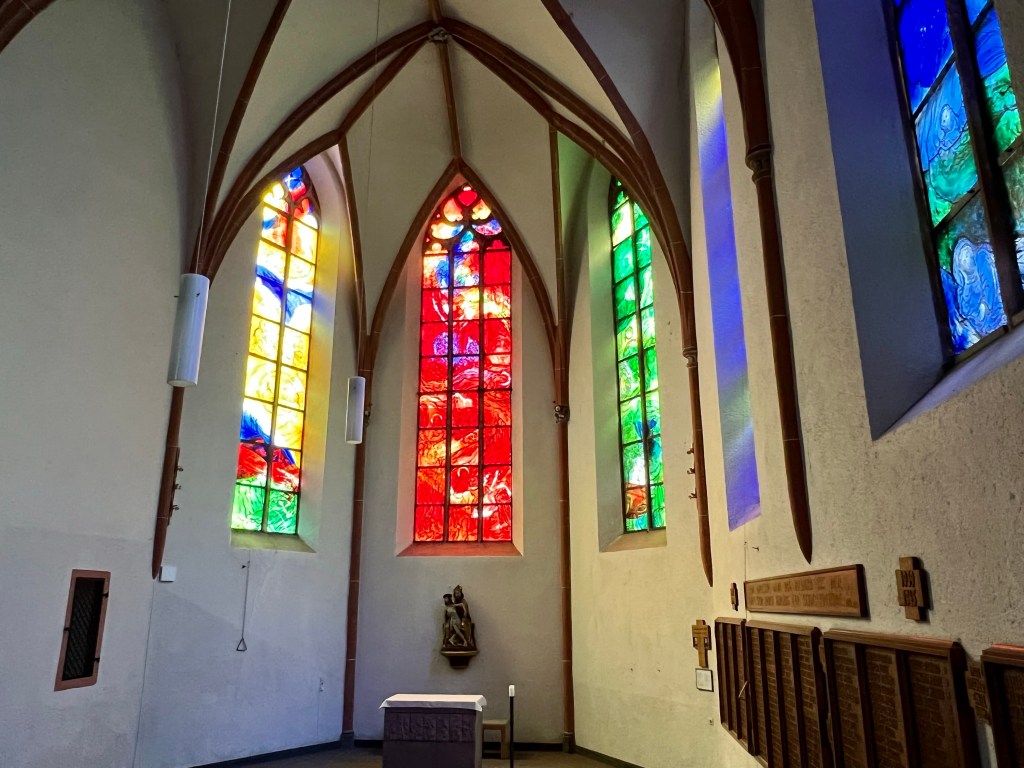
We ducked into Saint Martin’s Church for a look at the beautiful stained glass windows by Graham Jones that illuminate the church.
Stained Glass in St Martin’s Church
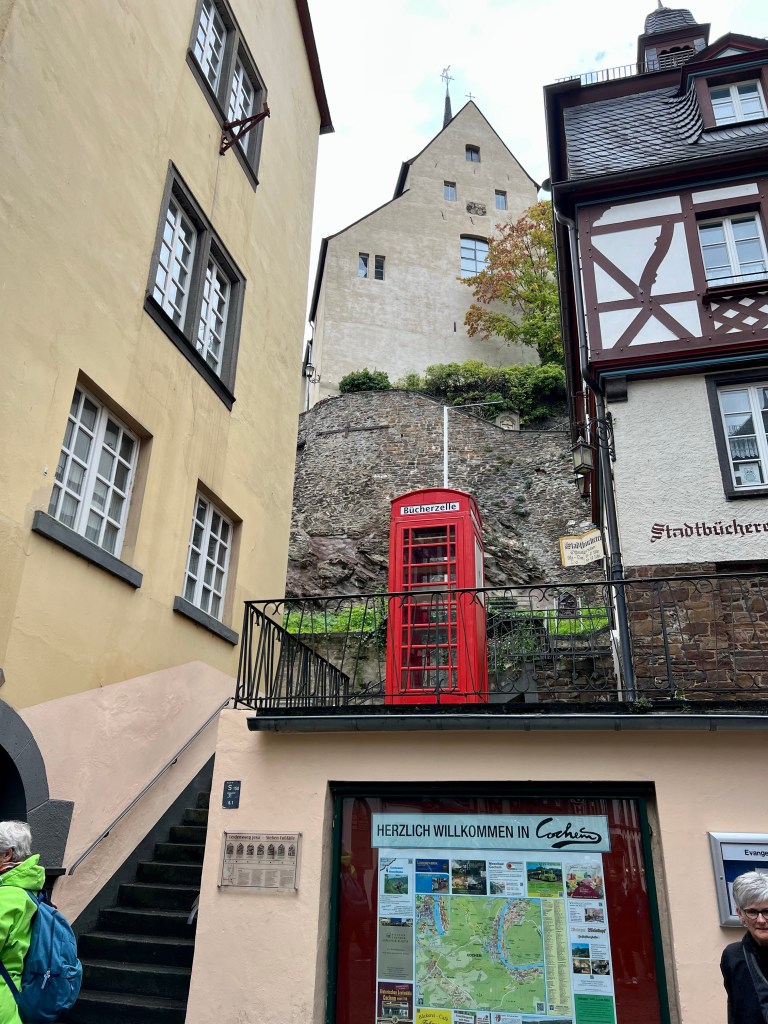
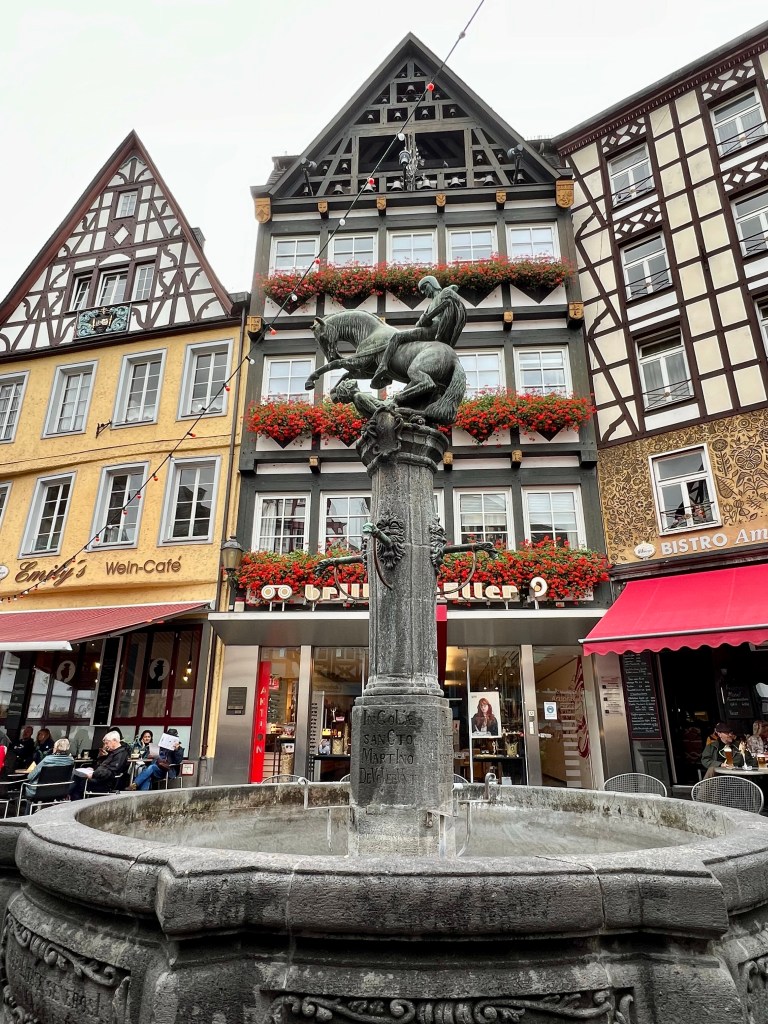
In the square, we see a statue of Saint Martin, the patron saint of the town. He was a warrior in the Roman legion and converted to Christianity. The statue depicts him saving an old man that later was thought to have been Jesus testing his faith. He cut his coat in half and gave half to old man. This coat was a relic used by Charlemagne in many a battle.
Telephone boothAnother streetSt Martin’s Monument
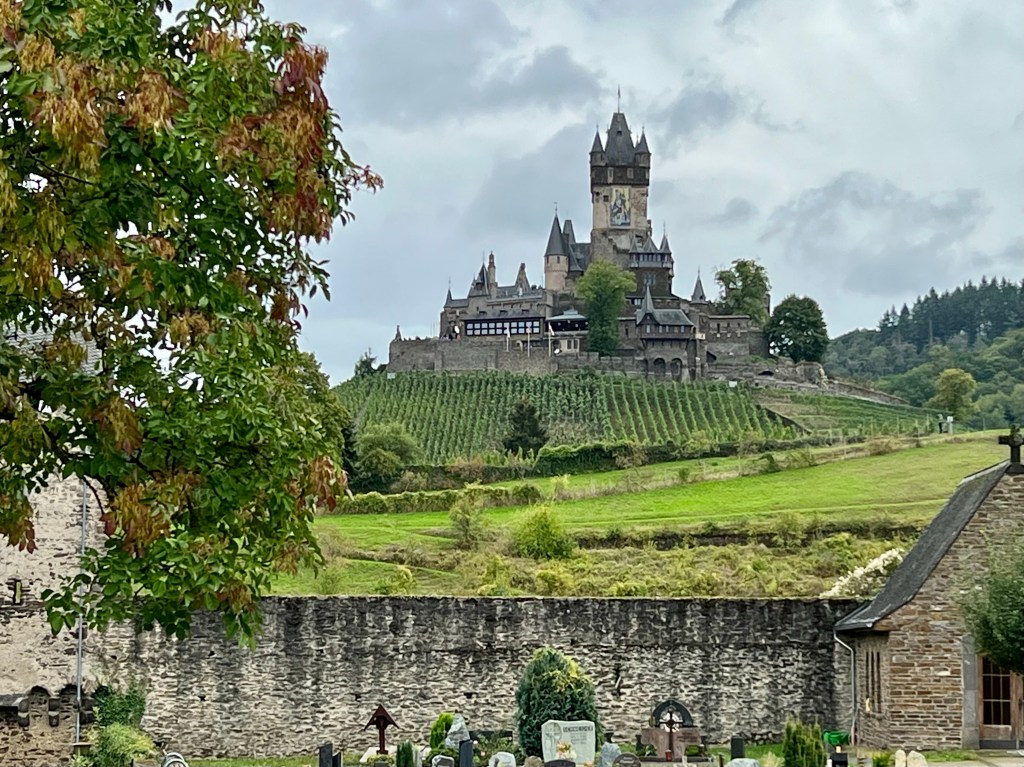
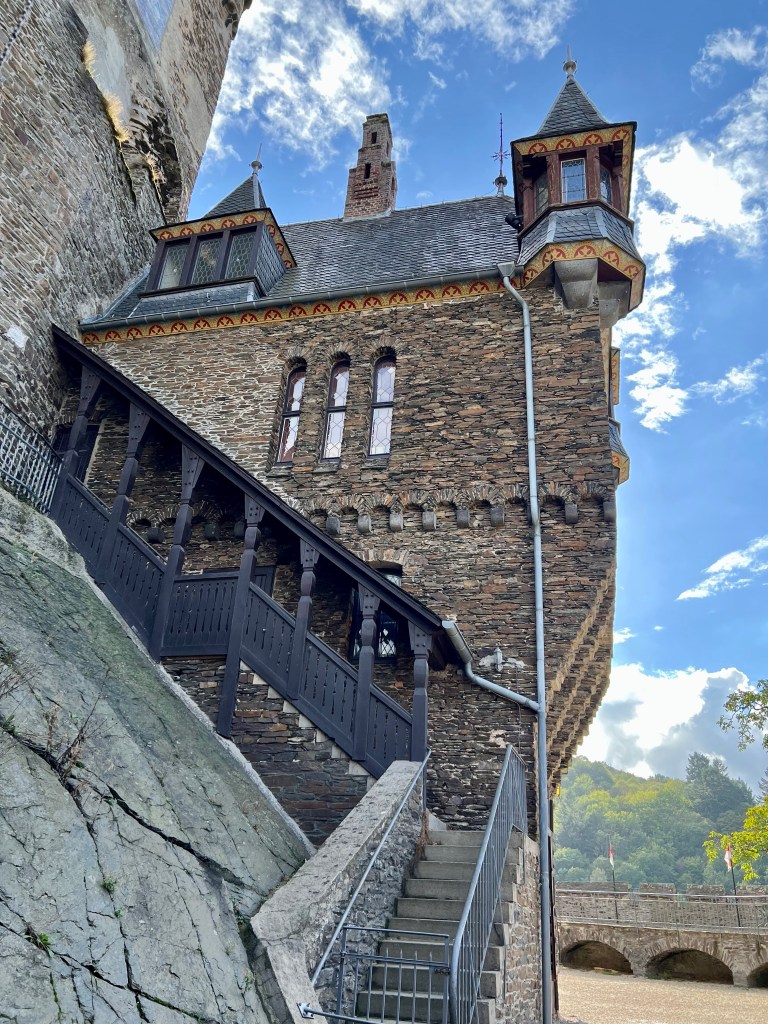
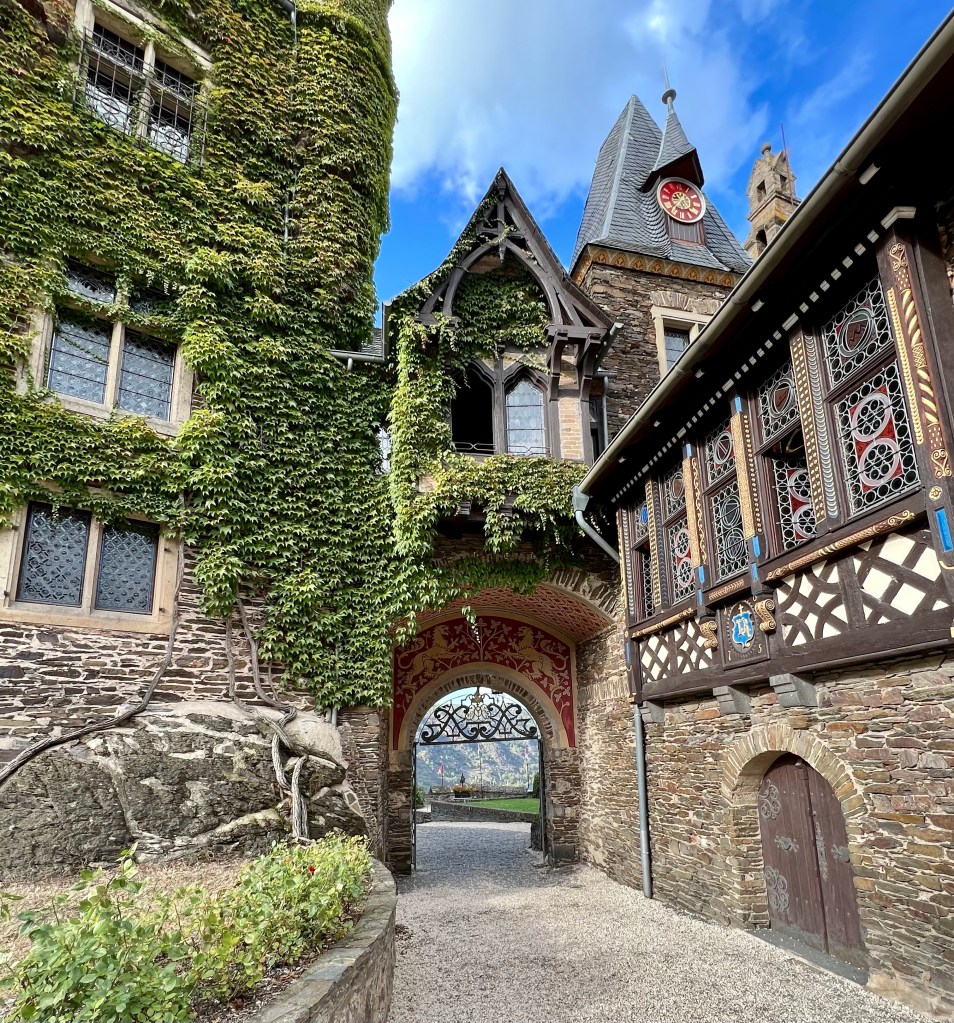
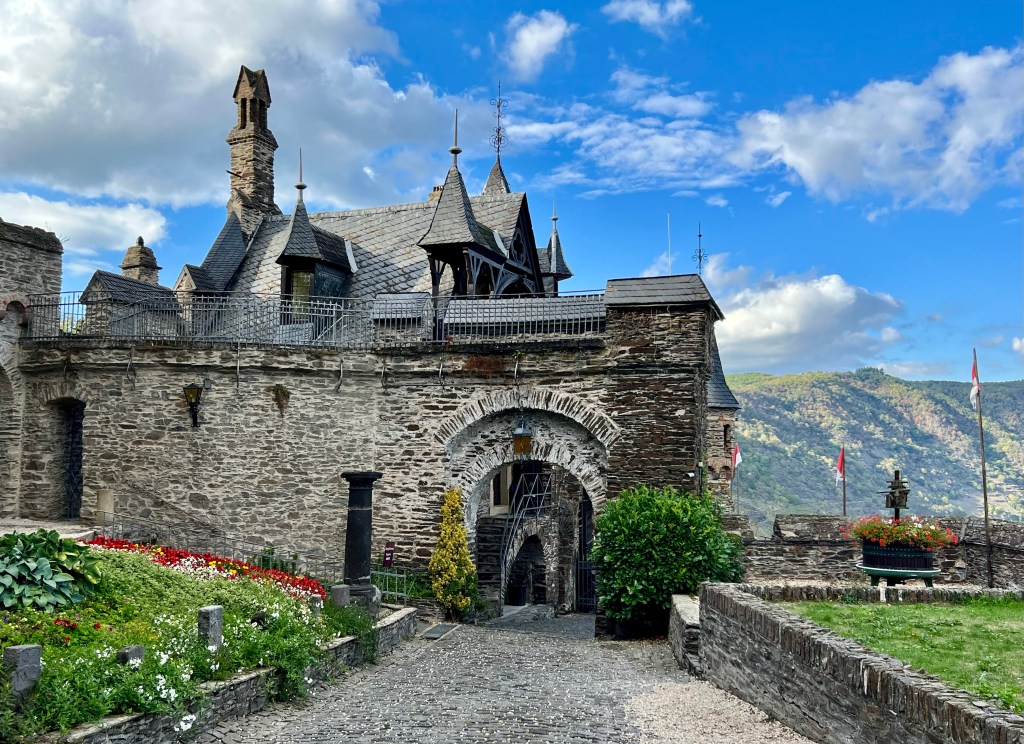
Next, its up several flights of stairs and then a steep short ride by mini bus to Reichsburg castle. Being a bit castled out I didn’t really pay too much attention to the blah blah from our third guide of the day but it was a beautiful building ripe with legend and folklore.
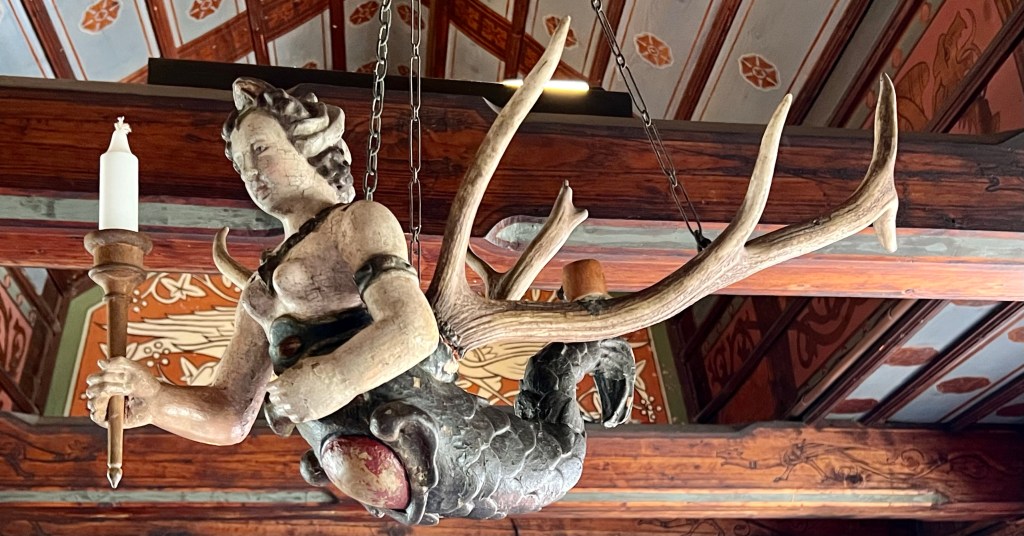
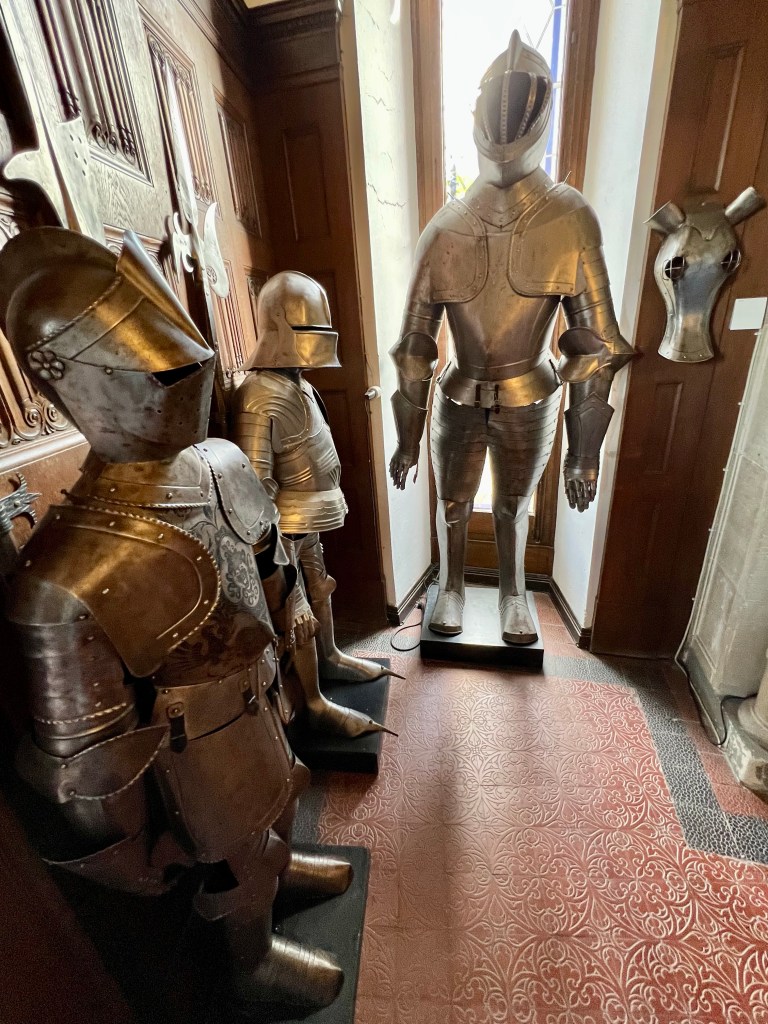
Up the stairs to the busReichsburg CastleNot a frog – a lion representing strength guarding the castleLion’s GateInside the castle wallSide viewThe WellCool Glass WindowsMermaid – Stand under her and make a wishDaily ration of wineArmourLion’s Gate ExitInside the wallsPat enjoying his free time in Cochem24 hr Ice Cream DispenserFleurs
Back to the boat again with more sleeping that listening on the return journey. There’s just enough time to clean up before our special dinner at Portobellos. The food and service are fantastic and there’s a special cake for Joan’s birthday so its a magical evening. We can hear and see the soloist in the lounge from our perch so we enjoy her dulcet tones with yet another glass of fabulous wine.
Time to hit the hay. Tomorrow is another day. Luxurious adventures await…
We docked today in Mannheim; a city located at the confluence of the Rhine and Neckar rivers in the Upper Rhine Plain, Germany’s warmest region. We’re not stopping here but our guide, Isabella from Brazil, gives us a bit of a history primer.
Mannheim is famous for its School of Music. In 1977, Mozart 1777 applied and was rejected. I’m guessing they regretted that decision many times. Mannheim is also one of the 15th most inventive cities in the world; credited with inventions such as bicycles, motor bikes and cars. In 1885, Carl Benz used the money from his wife’s dowry to build motor wagon number 3; the first car. His wife, Bertha, took their two sons on the first road trip from Mannheim to Pforzheim in 1888, showing the world what he husband’s invention could do!
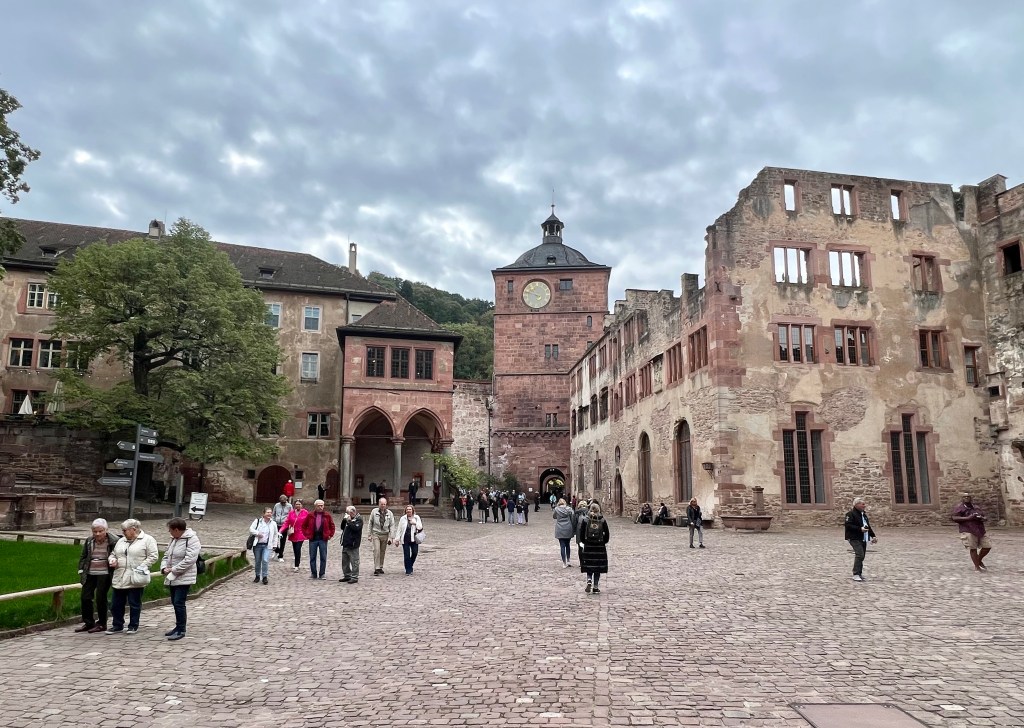
Our bus continues on past Mannheim; we’re on our way to Heidelberg, a town on the Neckar River in southwestern Germany. Heidelberg is home to Heidelberg University; founded in 1386 and Germany’s oldest university and the red-sandstone ruins of Heidelberg Castle, built in the 1400s, which stands on Königstuhl hill, the Philosophers’ Walk, and the Baroque old town.
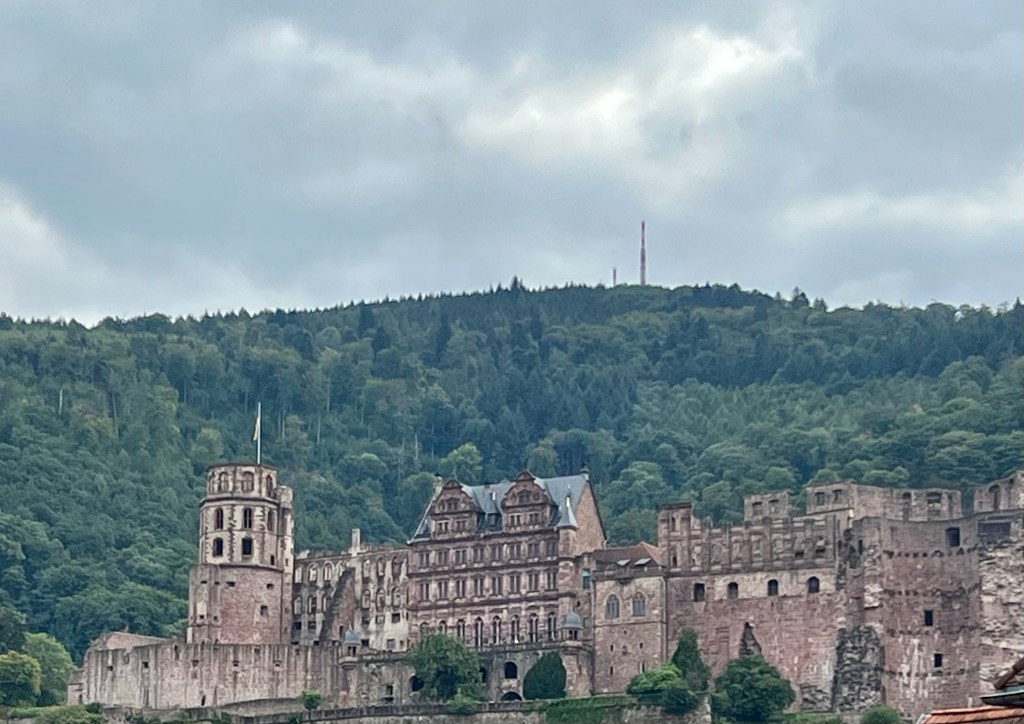
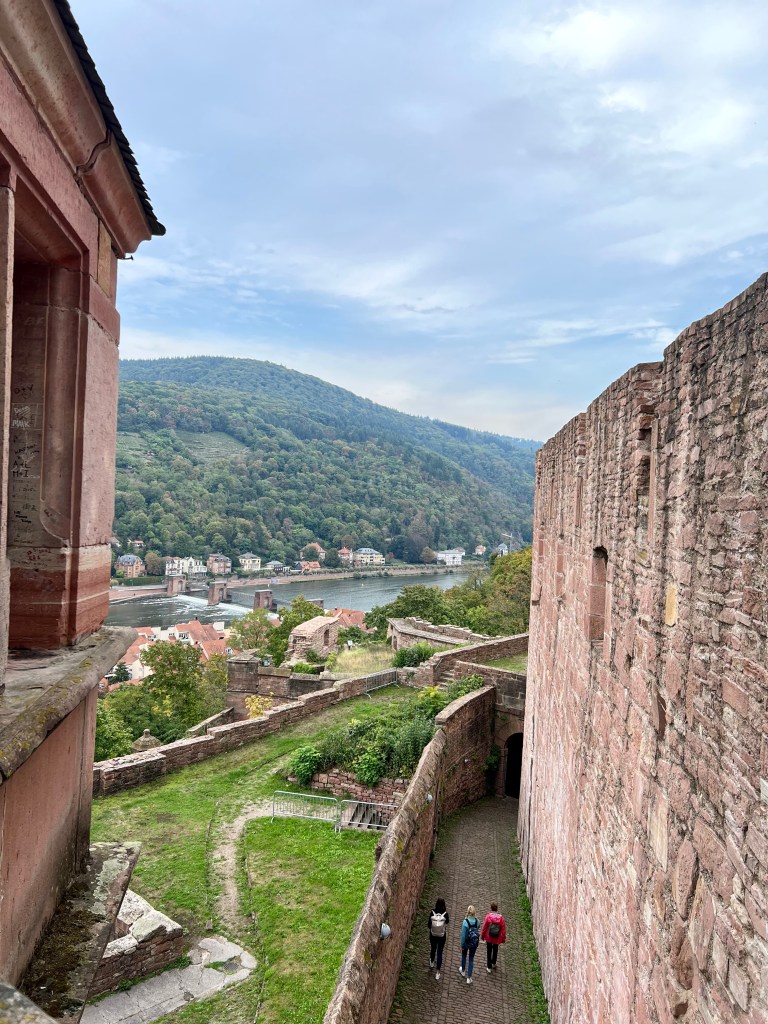
Heidelberg Castle
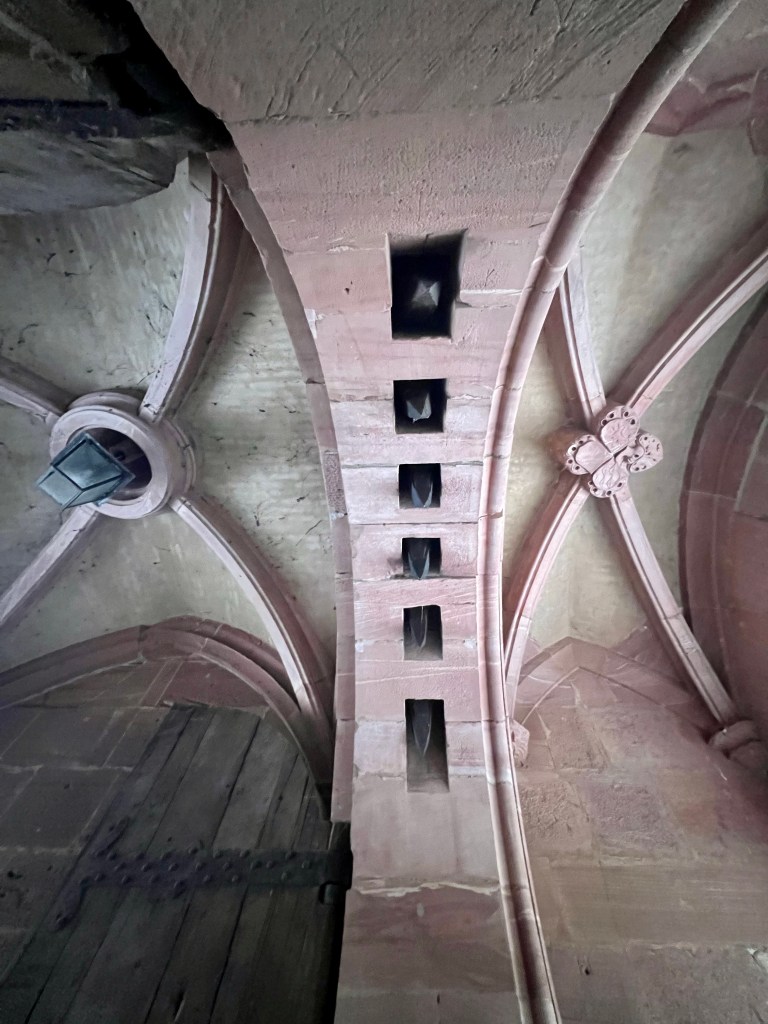
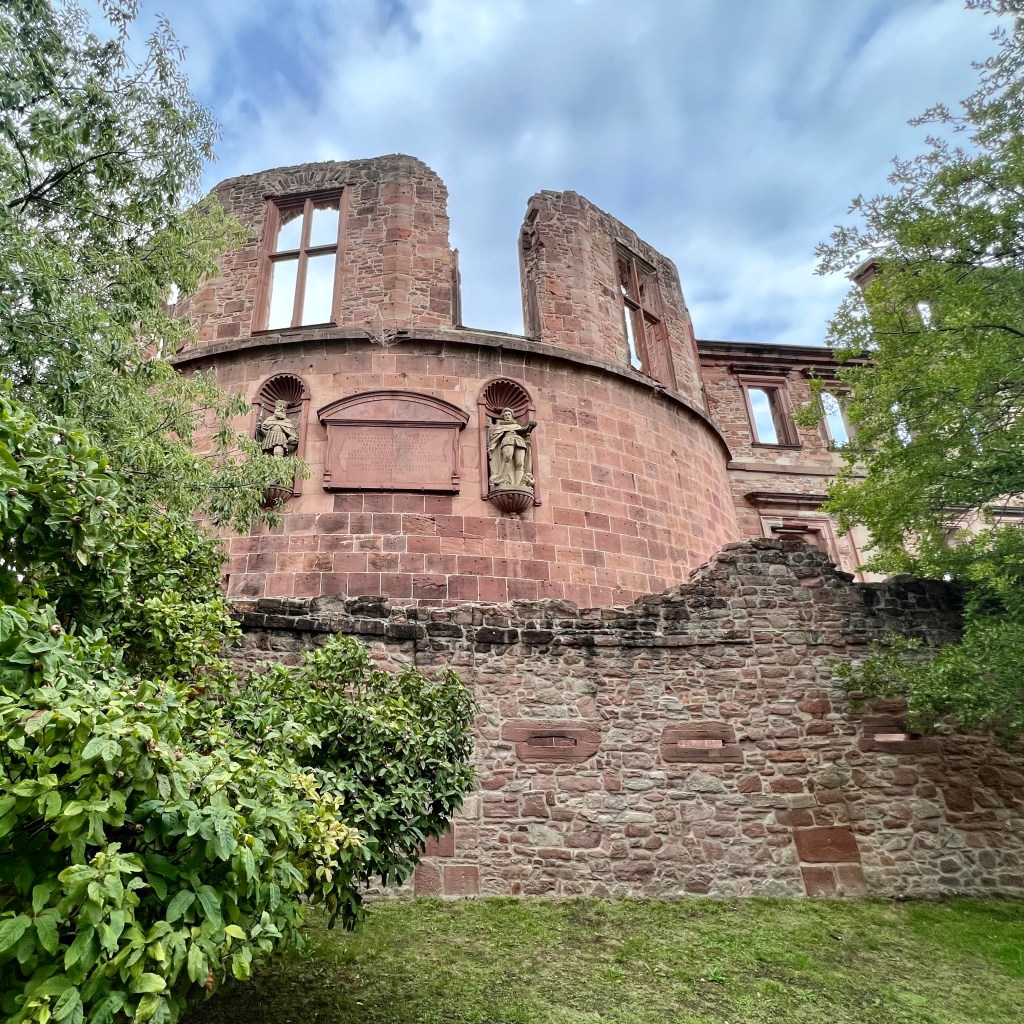
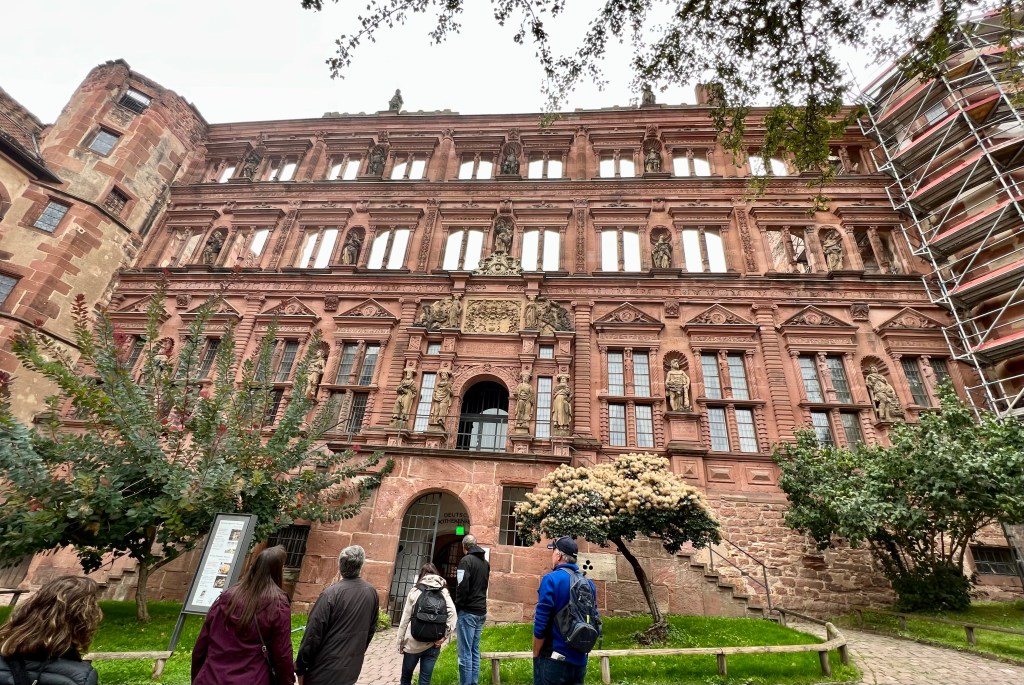
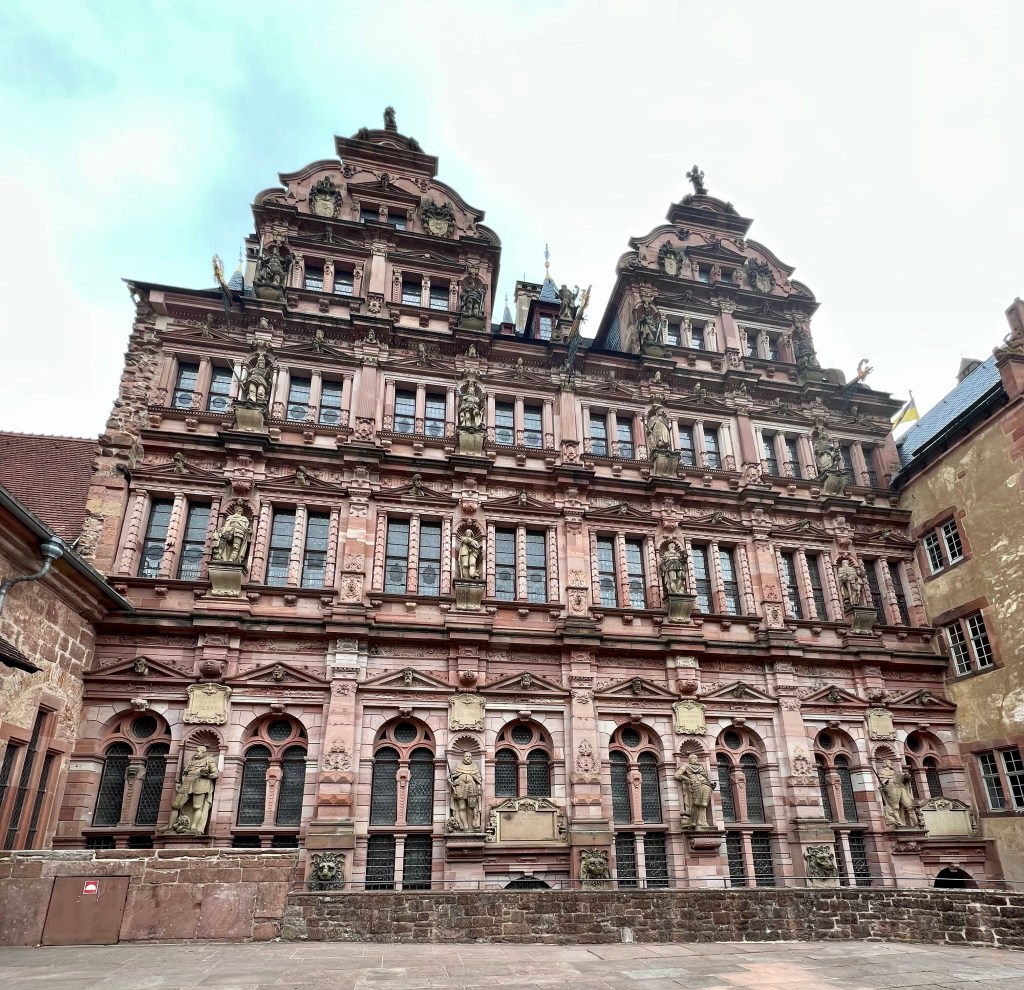
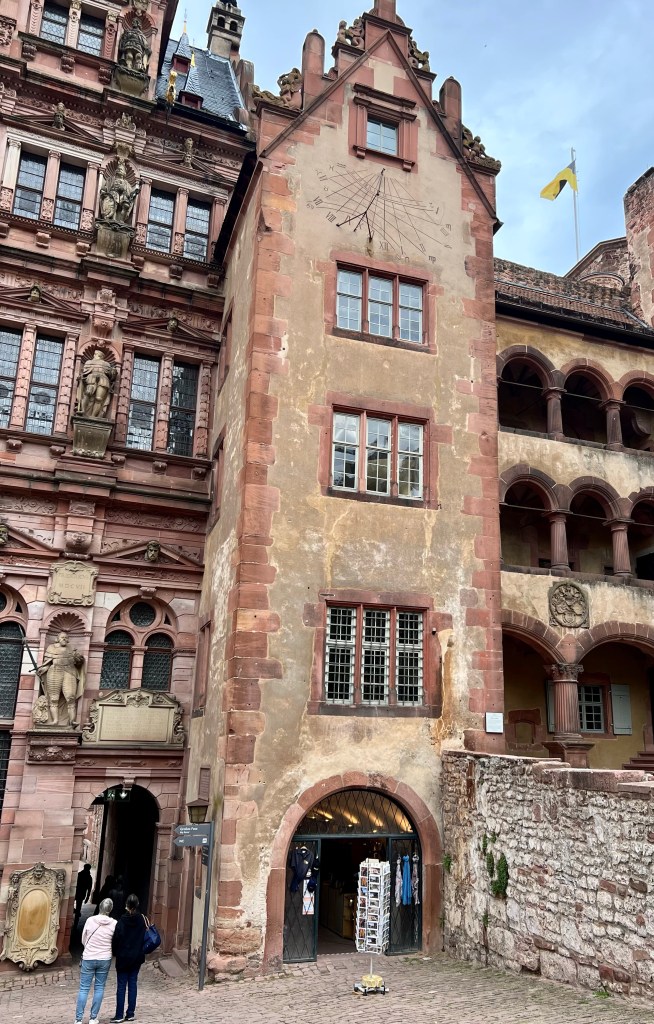
Our first stop is the Castle which has been expanded, restored, hit by lightning, set afire and damaged by wars but still stands. The ruins of the Heidelberg castle ruins are one of the most important Renaissance structures north of the Alps.
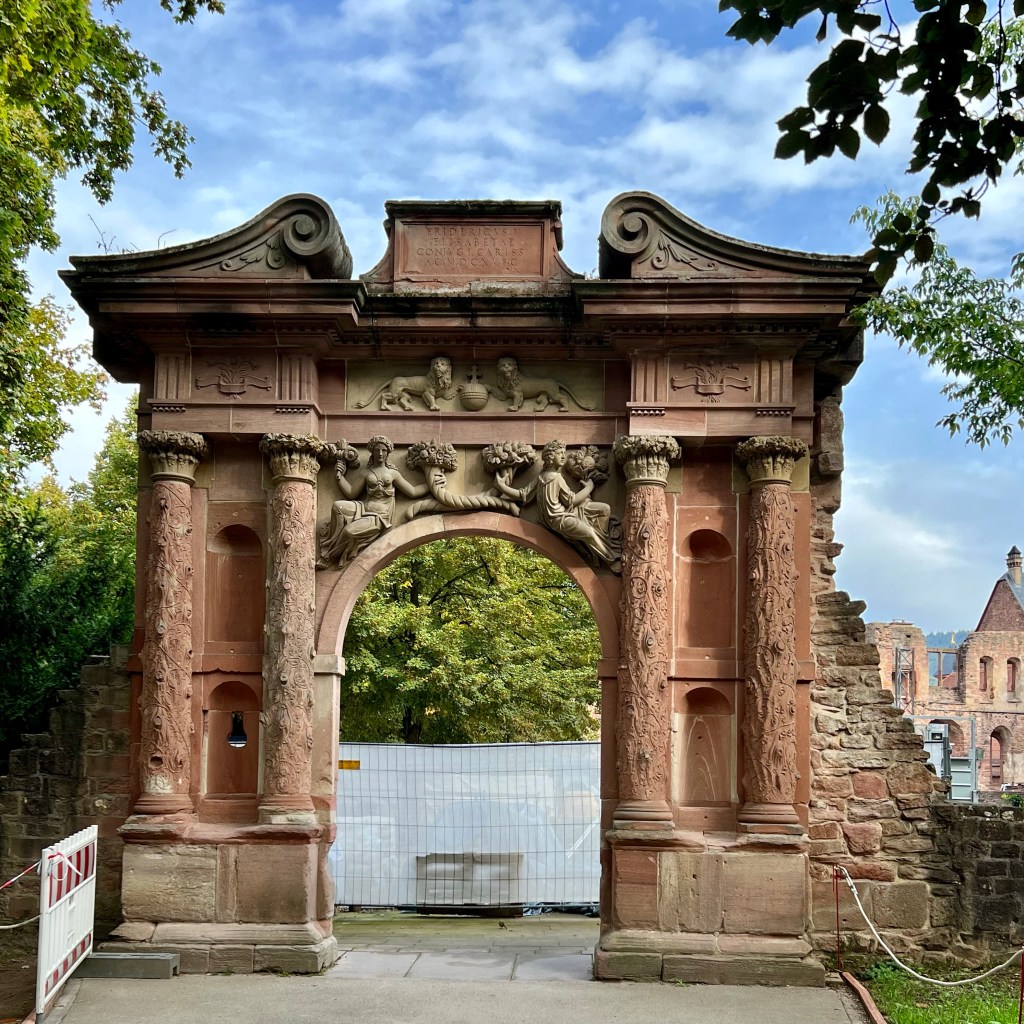
Our tour starts at Elisabeth’s Gate. Elisabeth’s Gate is part of the love story of Prince, Palatine Elector and King Frederick V von der Pfalz and Elizabeth Stuart daughter of King James I of Scotland & VI of England. Legend has it that the gate was carved and created in pieces and then assembled in the garden overnight to surprise Elizabeth on her 19th birthday; a very romantic gesture indeed.
Elisabeth’s Gate
Frederick and Elisabeth were rulers of Bohemia for one year but the Catholic country didn’t accept them because they are Protestants. They are exiled after they lose the Battle of White Mountain in 1619 a year after accepting the crown. The couple had a total of 13 children though not all lived to adulthood. Her large family of children included Princes and Princesses as well as the mother of King George I.
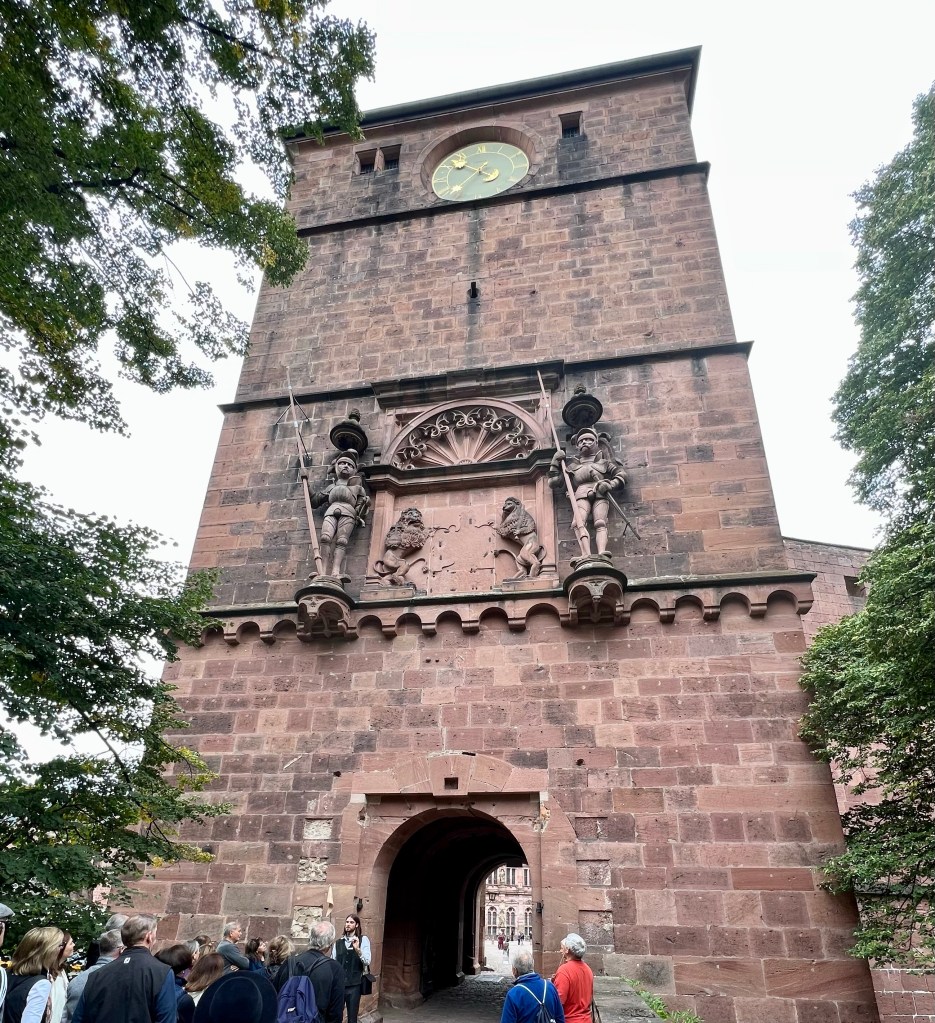
Isabella told us lots more stories about the various castle buildings but sadly my brain is full so I have some lovely pictures to share but not much else! I do remember one story about the ring as you enter the castle gates; if you could break it, you would be the new king or queen. So far the ring is still intact.
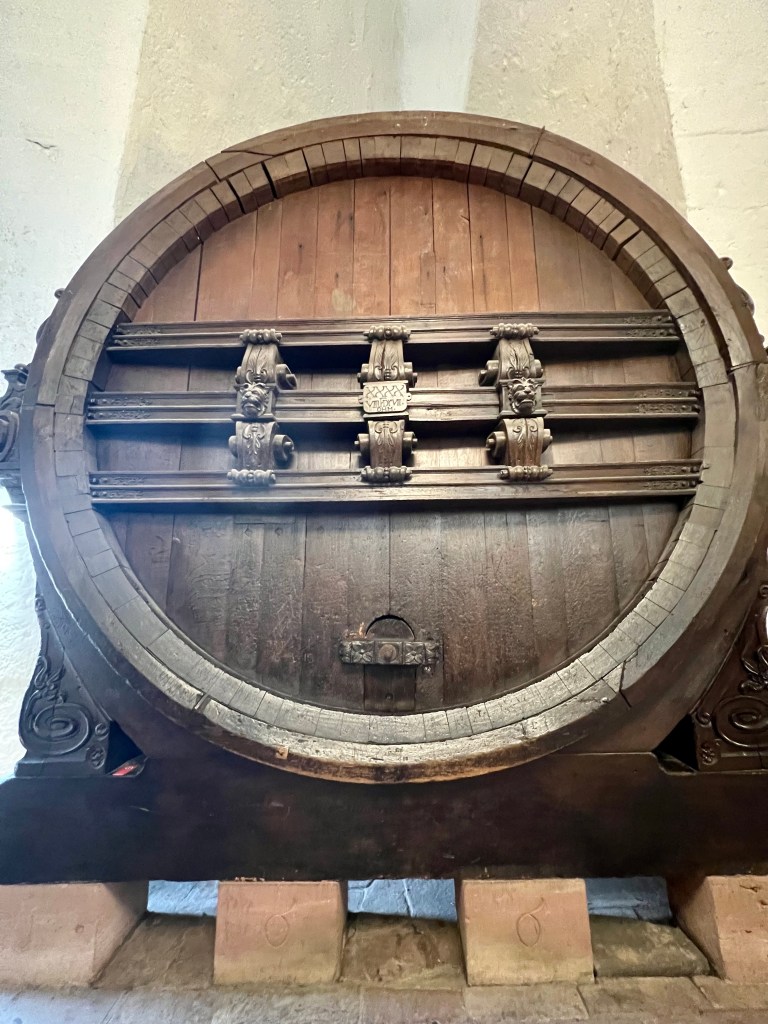
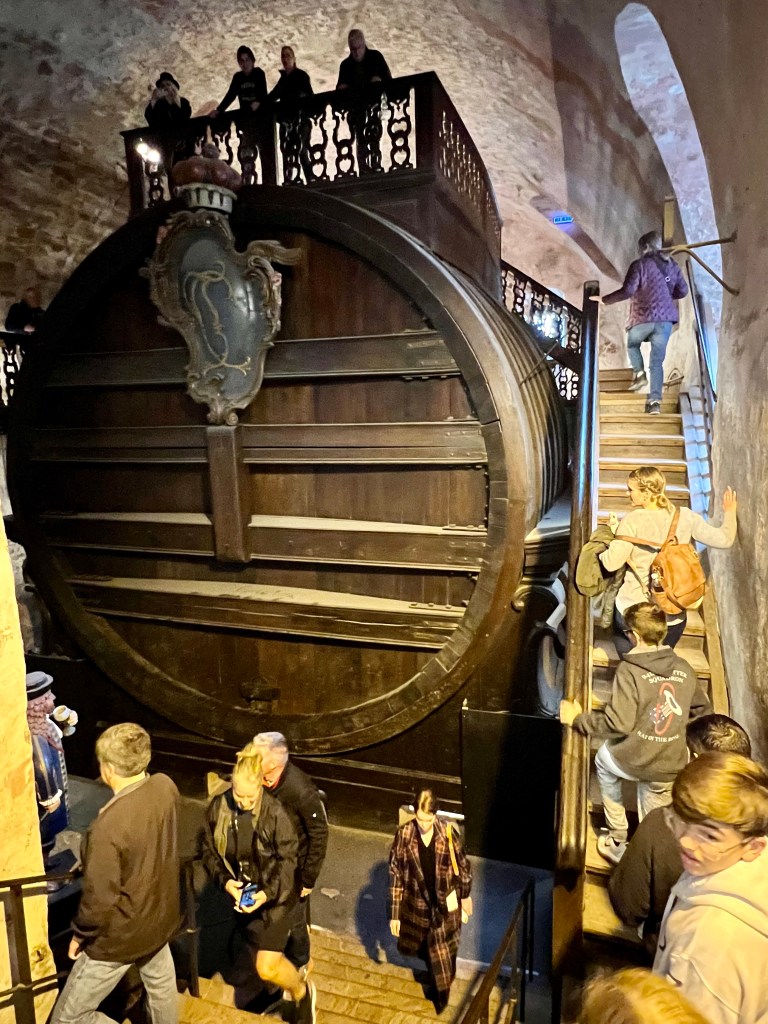
Castle GateThat gate has teeth!Break the Ring to be a King (or Queen)Fountain at the CastleSundial/Astrological ClockThe not so big barrelThe BIG Barrel
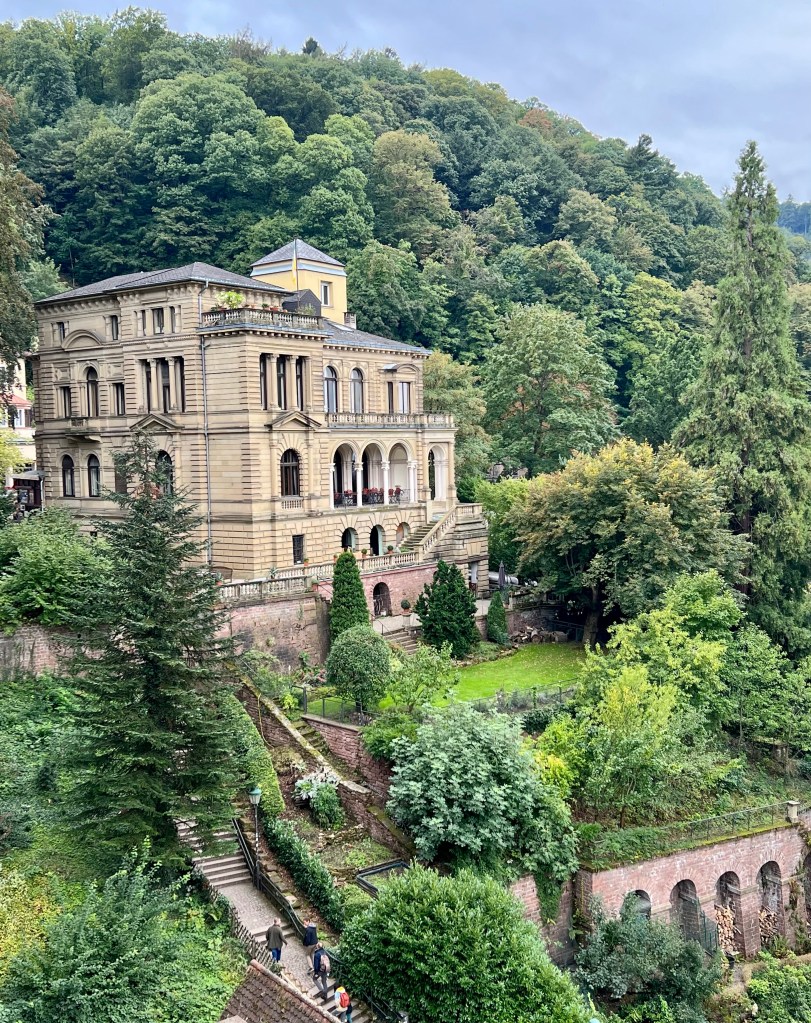
Across from the castle on the Holy Hill (named by the early Celts) is Philosopher’s Walk. During the Romantic Period, many professors and philosophers of Heidelberg enjoyed the path for its solitude, natural beauty, and great views of the town. Today, this path is still there, and remains a favourite place for reflection.
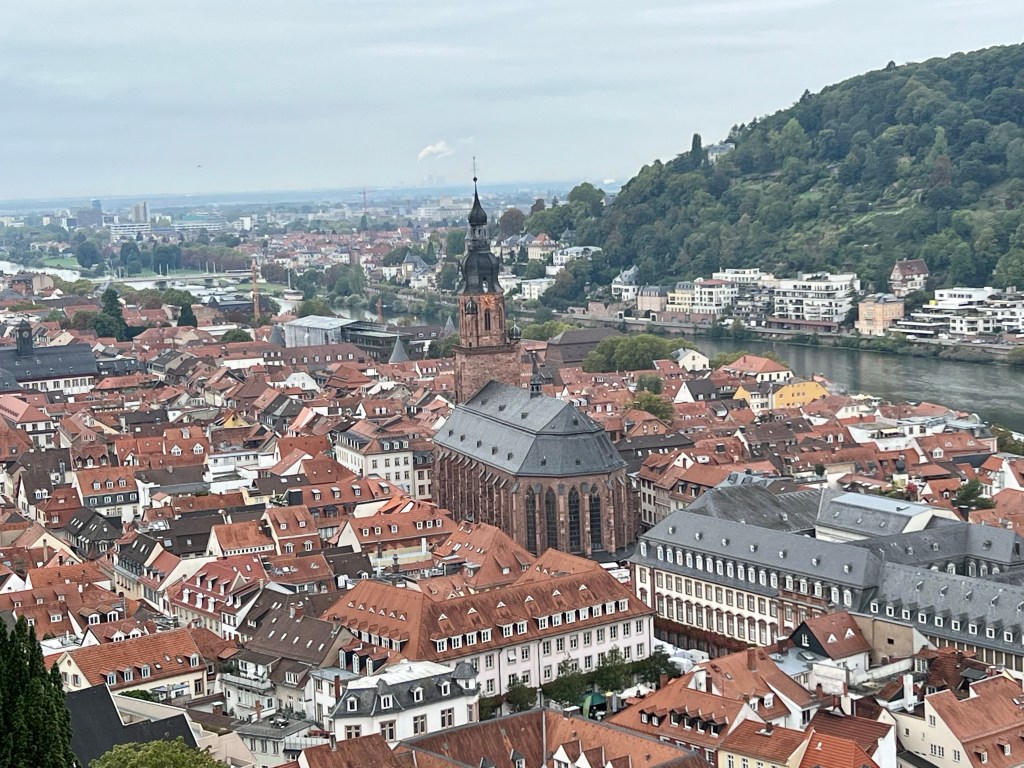
View from the Balcony Holy Hill and Philosopher’s WalkView across the river from the BalconyCity ViewCity View
Near the castle there is a fraternity building, one of many in the city. In the past, the fraternity hazing included sword fights where getting a scar on face was a right of passage. These antic by the rich boys elicited lots of complaints from city inhabitants so the university built a prison! The boys used their money to bribe the guards and had big parties in their cells. Soon enough it became a badge of honour to be sent to the university prison so they actually paid to go to prison! The prison was closed in 1912.
Afrania House
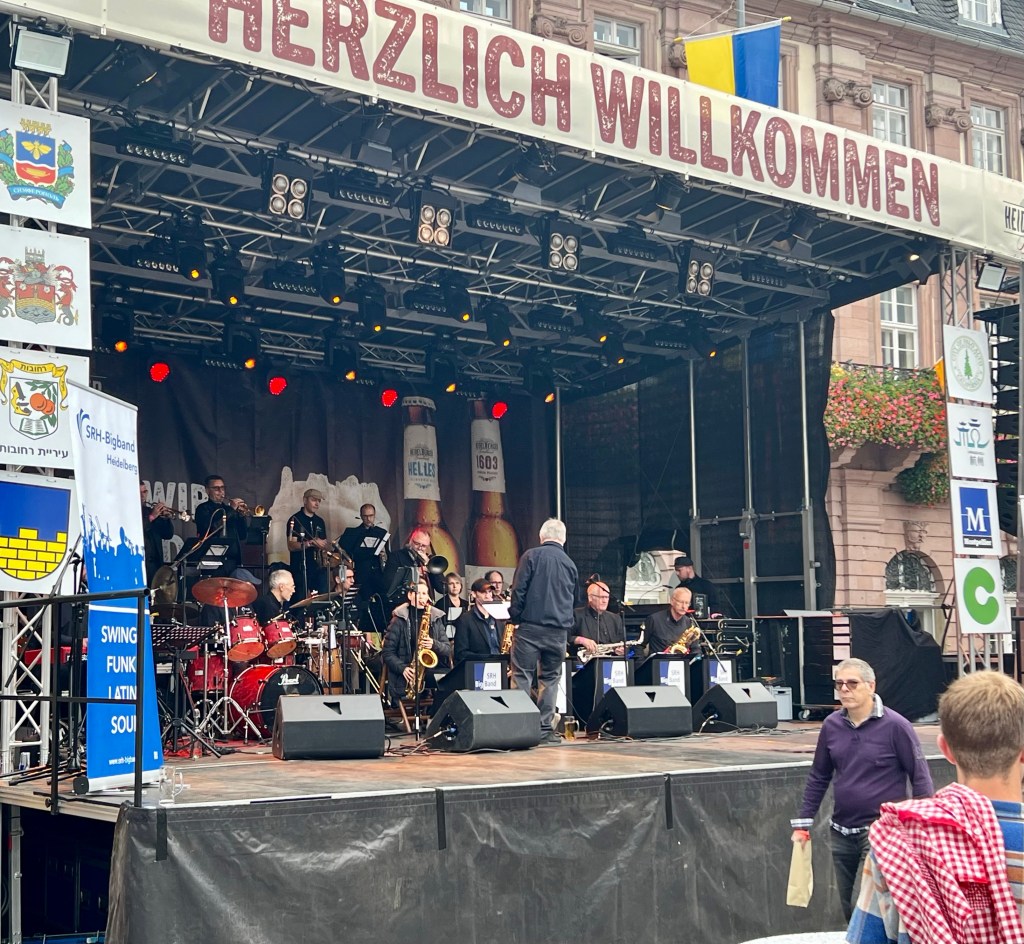
After our thorough tour of the castle, we reboard the busses to head to the old city. We’re lucky enough to be in town for the Autumn Festival; the last big festival before Christmas markets. There are bandstands set around the city and lots of folks milling about.
Autumn Festival Entertainment
Before setting us loose, Isabella points out some of the highlights.
There is, of course, a church in the Center of old town. The rooster on top of church means it’s a Protestant Church. The rooster is an admonition of Peter who denied Jesus three times before the cock crowed. The Church has two entrances one for Catholics and one for Protestants.
Church of the Holy Spirit
Another highlight is the bakery where the student kiss chocolate was “invented”. Back in the day, girls always had chaperones so a boy would give them the special chocolate to judge her interest. If the girl ate the chocolate kiss, it meant yes to a first date.
Student Kiss Chocolate
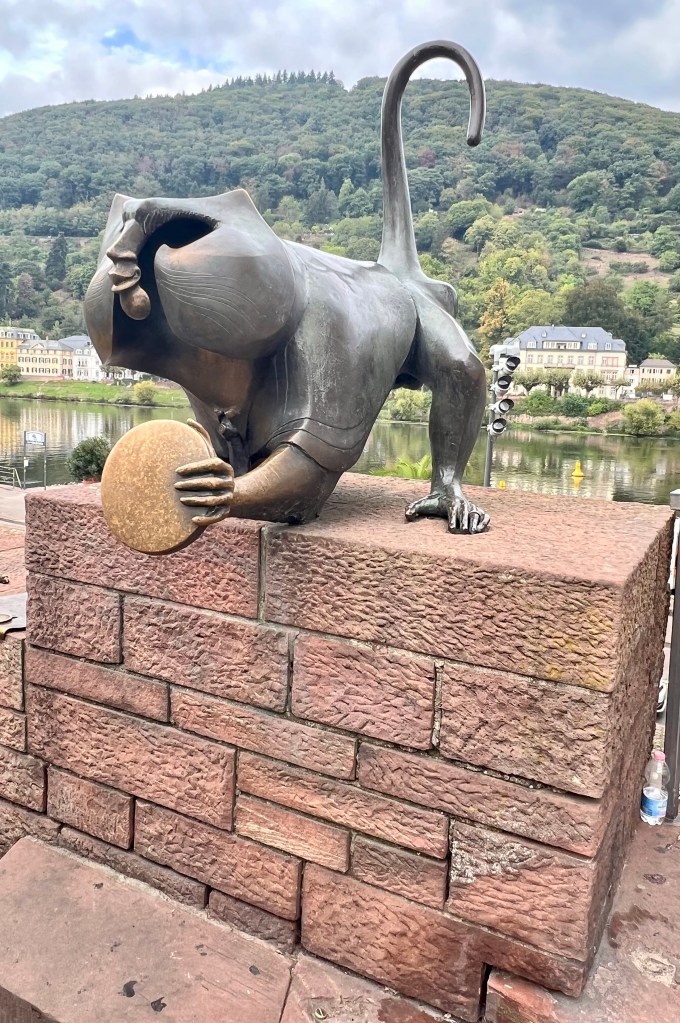
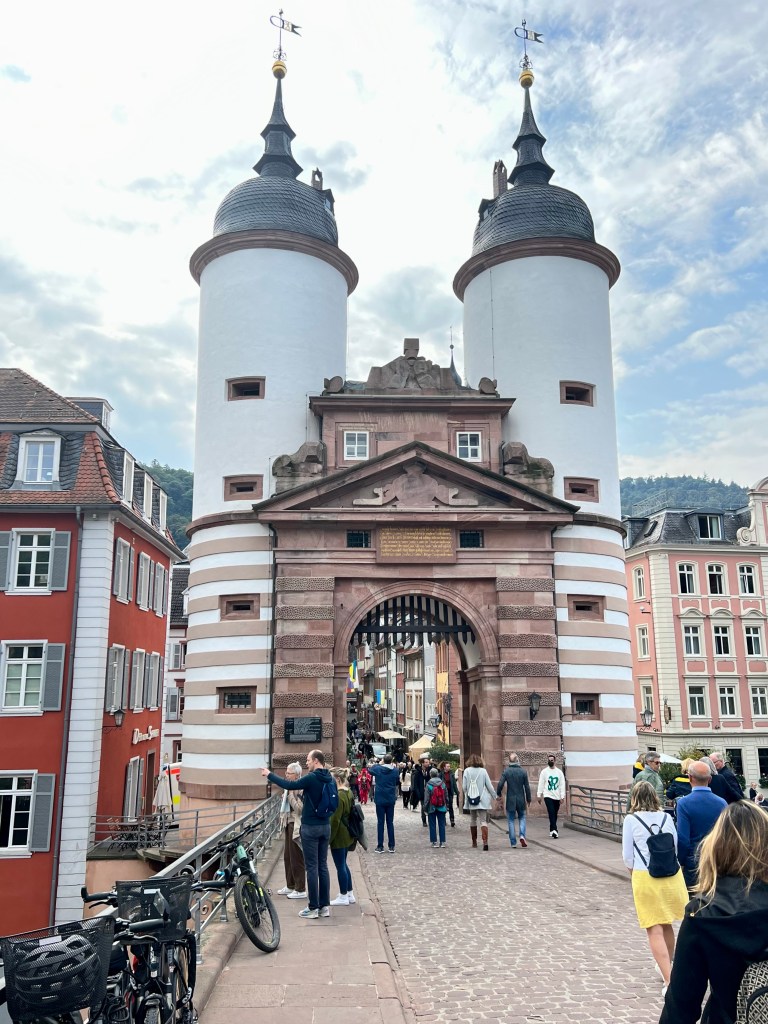
Another interesting site is a statue of a monkey holding a mirror next to the restored old bridge; the original old bridge was destroyed by Nazis in a failed attempt to keep the Allies out. But I digress …
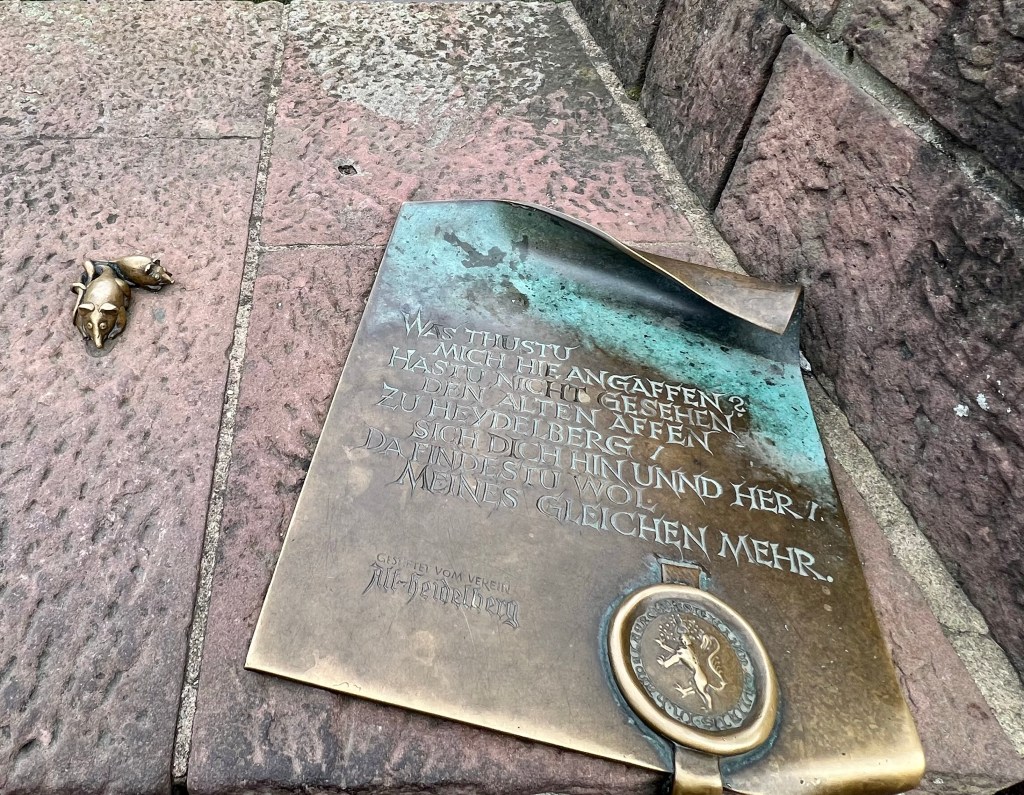
The current statue has been around since only 1979, though the bridge has featured a monkey on this spot since the 15th century. The monkey is said to be good luck. Rubbing the mirror will bring you money; rubbing his fingers will ensure your return to Heidelberg; and rubbing the little bronze mice nearby will bring you fertility. Needless to say, I didn’t touch those mice though I doubt their power over old ladies! The backside of the monkey points toward town of Mainz which was situated opposite the river bank and intended for the Bishops of Mainz to demonstrate that they had no power over them; the Heidelberg way of flipping the bird I guess.
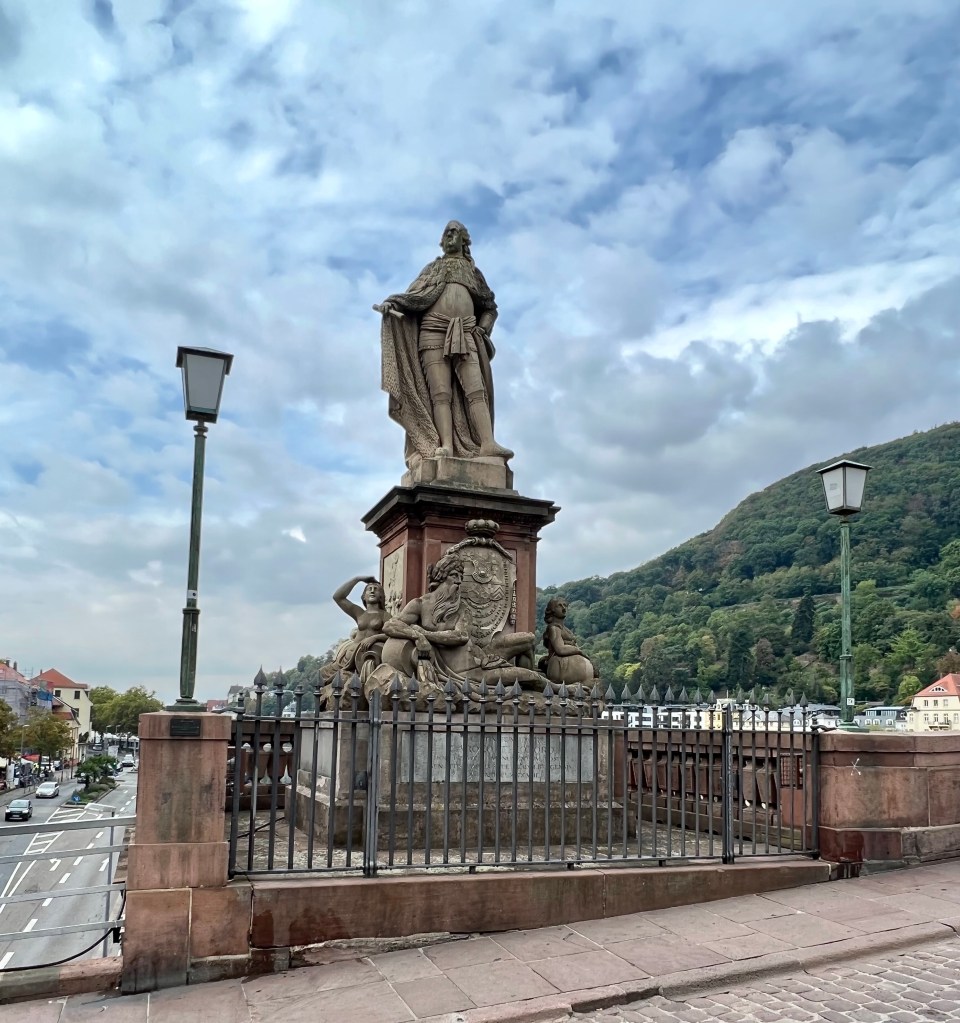
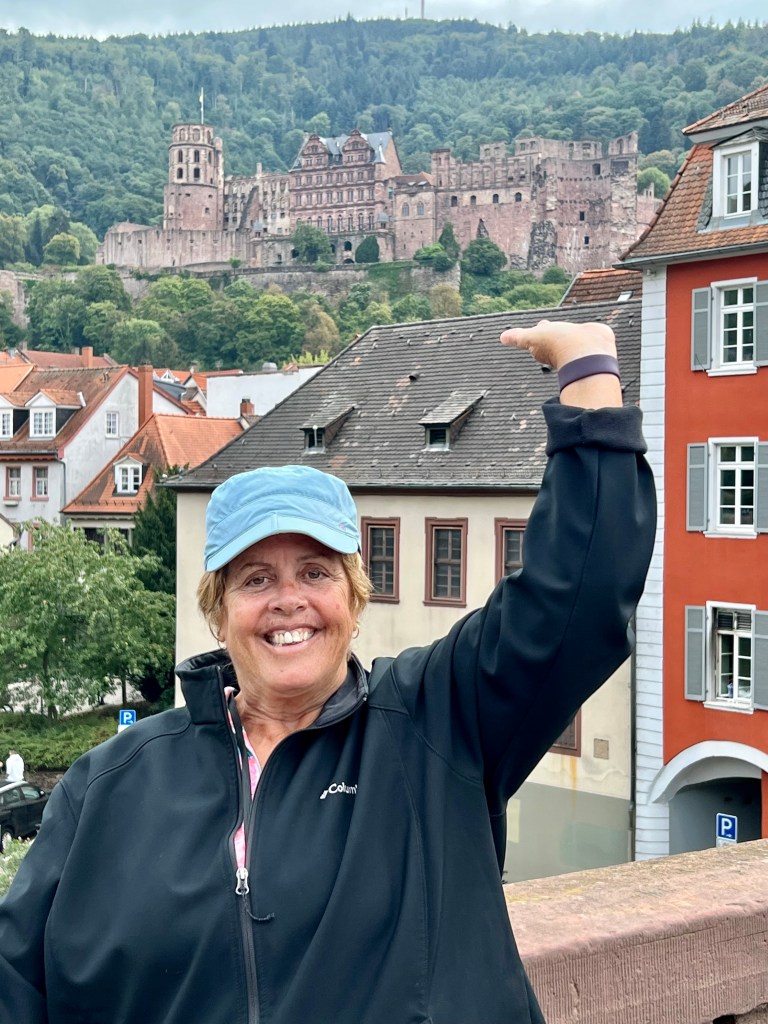
The Monkey holding the MirrorThis is the side the town shows the Bishops of MainzA Monkey??The fertility mice!The Old BridgeOld BridgeView from the bridgeHolding up the Castle
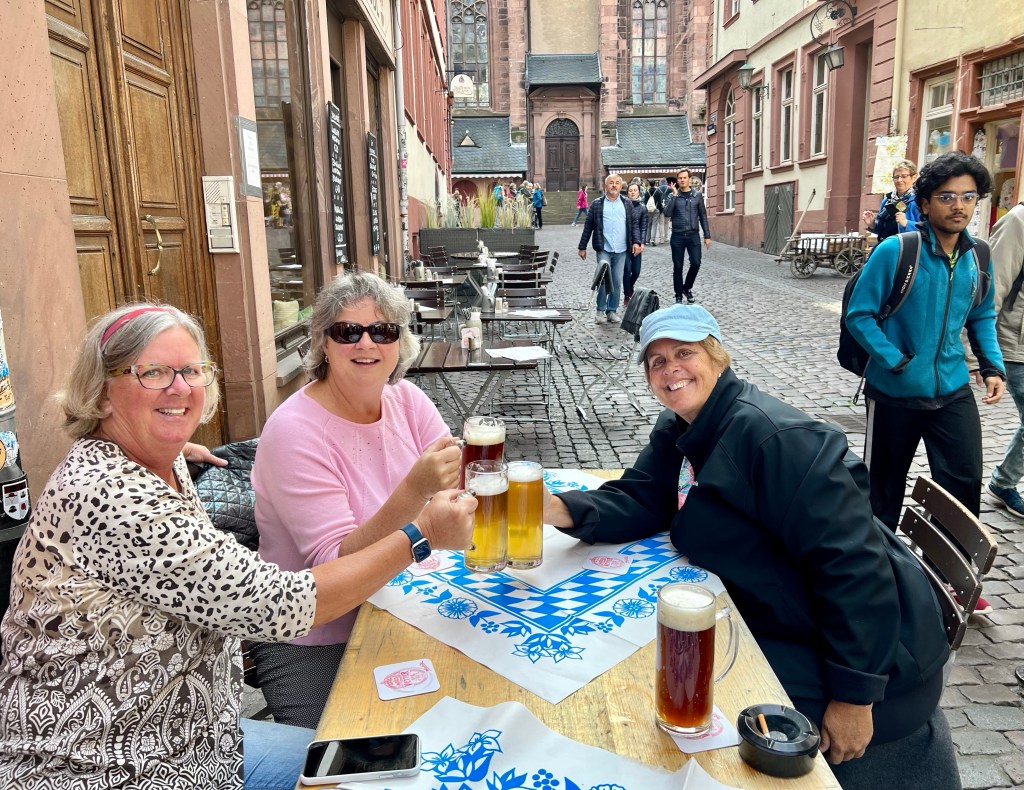
Having had a quick tour of the city, we headed out to one of the local brew pubs to sample their offerings and enjoy a bit of people-watching before heading back to the bus and then the boat for lunch.
Pints at VettersGoodbye Heidelberg
Tonight we are having a Gala Dinner, so after a quick nap, it’s time to get gussied up for pre dinner cocktails.
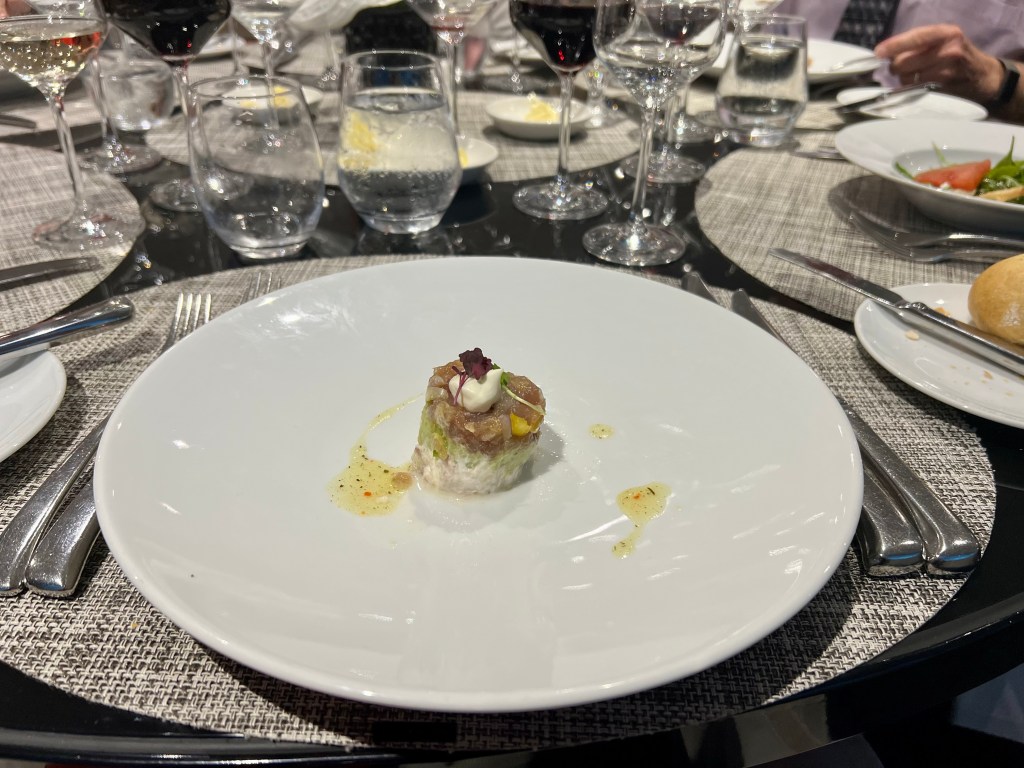
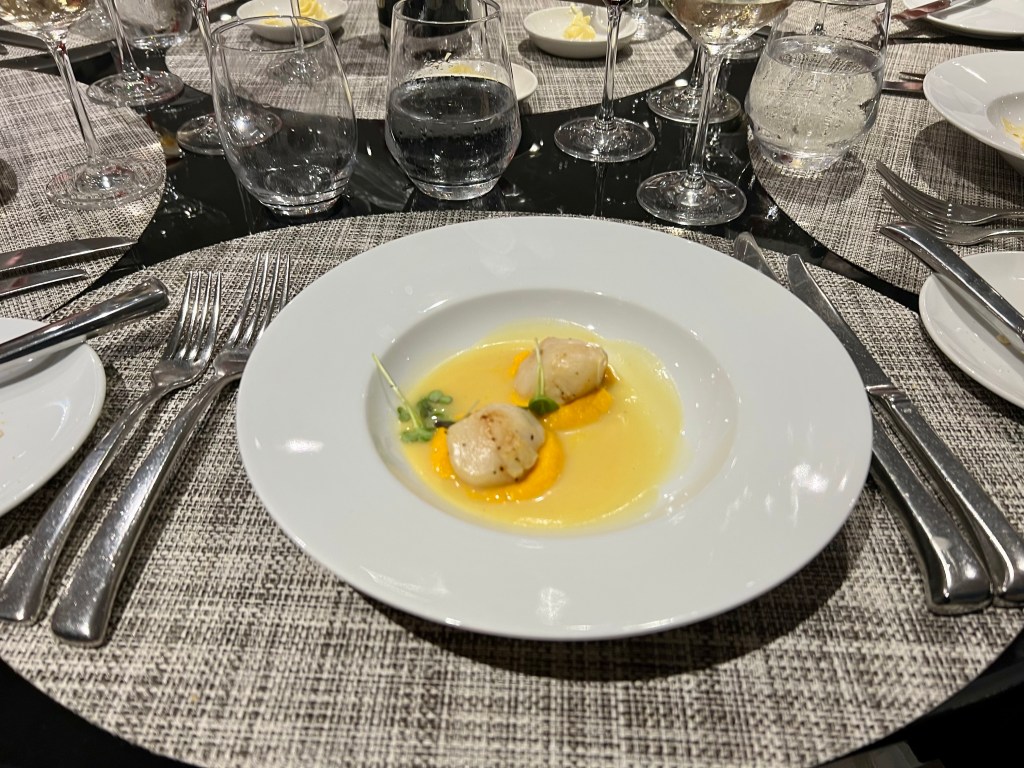
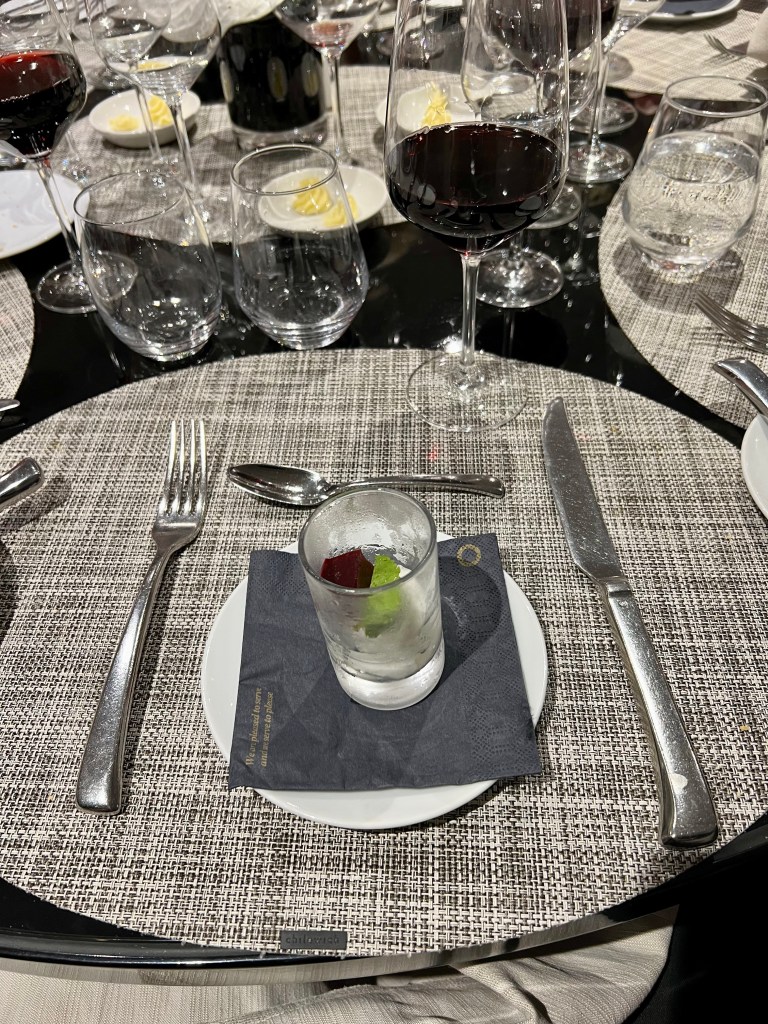
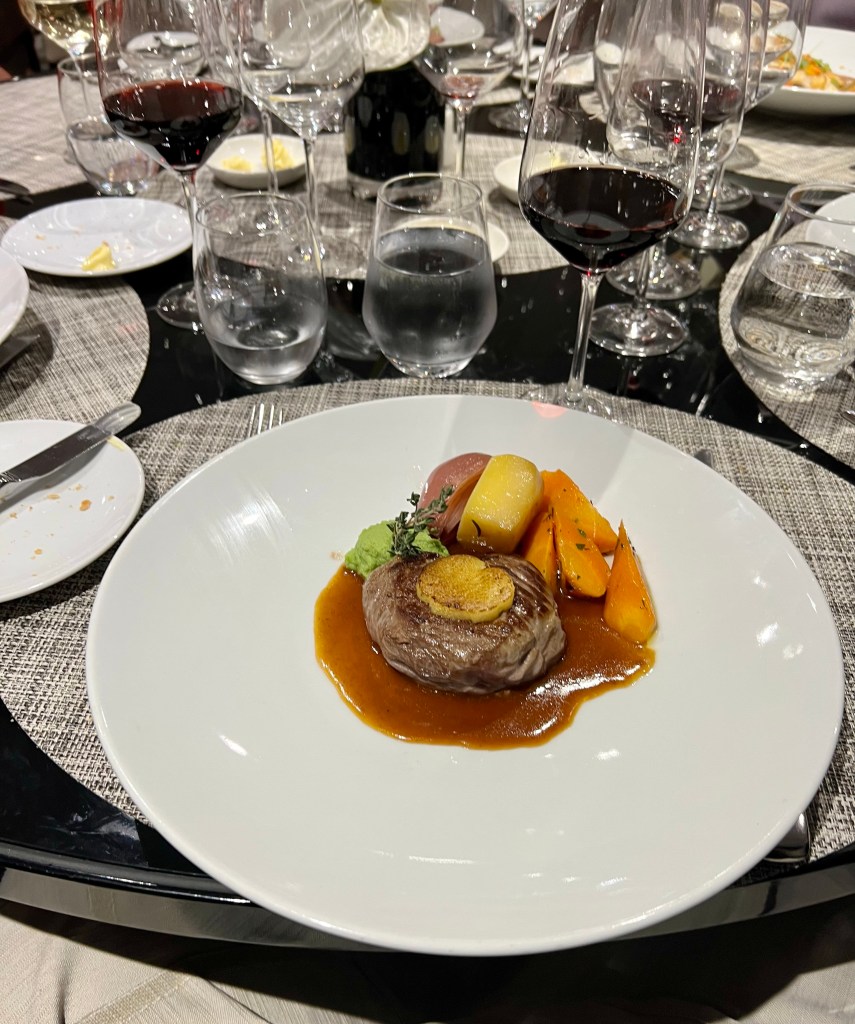
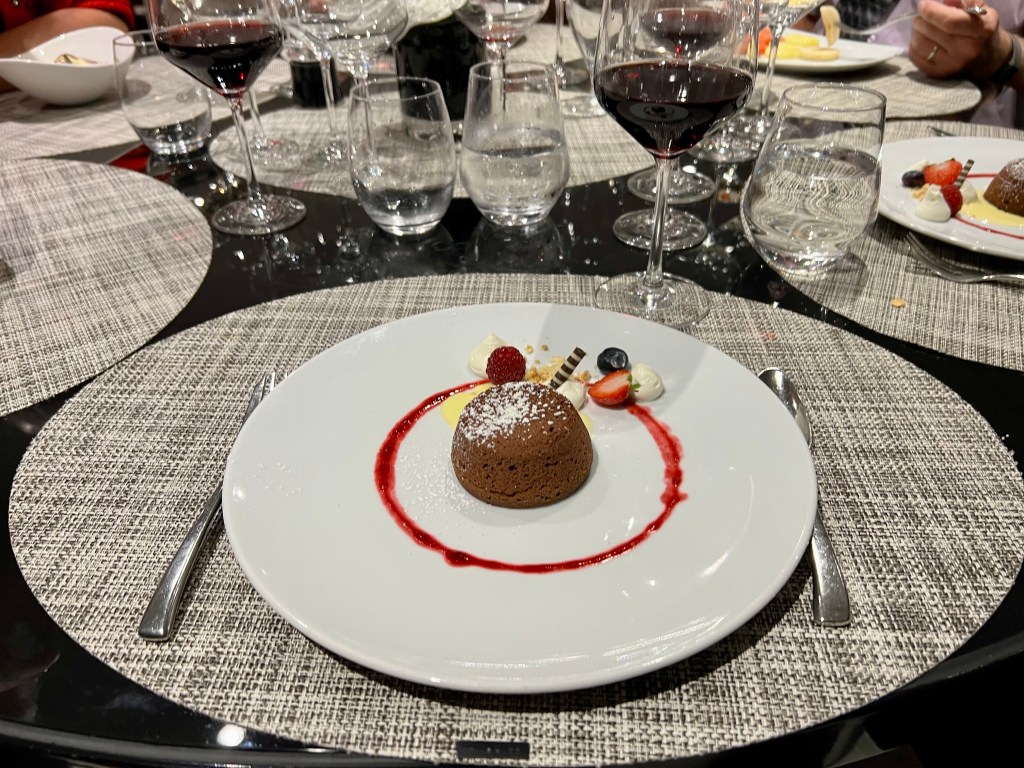
Dinner was fabulous indeed, see pics below and served with plenty of scrumptious wine.
Tuna and Crab Tartar with Avocado and Lemon Crème FraicheScallop and Orange Coconut Jus with Carrot Purée Lemon Sorbet and Cassis Gelè with Sparkling WineBeef Filet with Black Truffle CrustChocolate Fondant
After dinner, there was more wine and some dancing before hitting the hay for sweet dreams. Tomorrow is another day. Luxurious adventures await …
Today we’re headed to Baden Baden for a spa experience. Baden means bath so Baden Baden is bath bath; so nice you need to name it twice! I’m guessing the folks that live there are clean clean!
After a hearty breakfast, it’s time to board the busses for our chosen excursions. On the way our guide regales us with some history and fun facts about the area most of which was immediately forgotten. My brain may or may not be exploding with useless information.
In the 19th century the Roman baths were rediscovered and it became a summer capital of Europe with all the movers and shakers of the time coming for the healing waters. The town has 50,000 inhabitants with lots of glamorous activities like theatre, horse racing and other things to do often not found in such small cities.
Sadly the historic spa above the Roman baths that has been closed in recognition of its UNESCO status but the thermal pools, aromatic steam room and fiery hot and icy cold plunge pools work their magic nonetheless.
After returning to the boat, we had a nice lunch followed by some down time before an early dinner; there’s a lot of drinking and eating on this cruise! Tonight we are having a private concert at the Baroque Palace of Rastatt, one of the most magnificent historic venues in the region so it’s back on the bus for the short ride to the castle.
This palace is oldest baroque residence in the Rhine Valley built between 1700 and 1705 in the style of Versailles; the home of the Margraves – famous warlords. The town of Rastatt (currently 50,000 residents) was built around the same time with the palace in the middle. All streets lead to the palace.
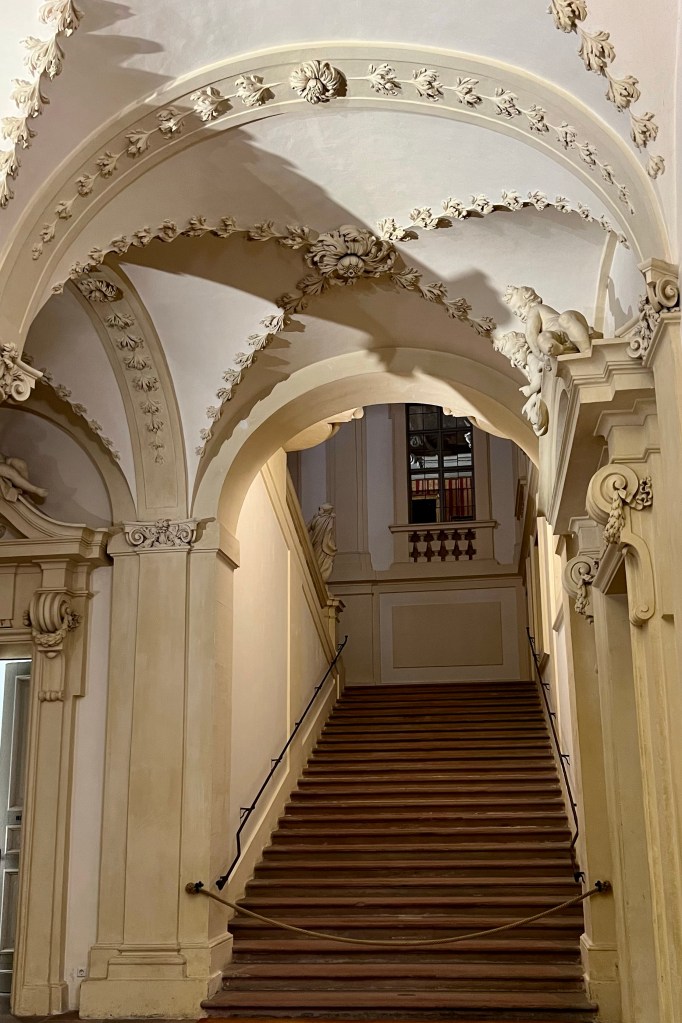
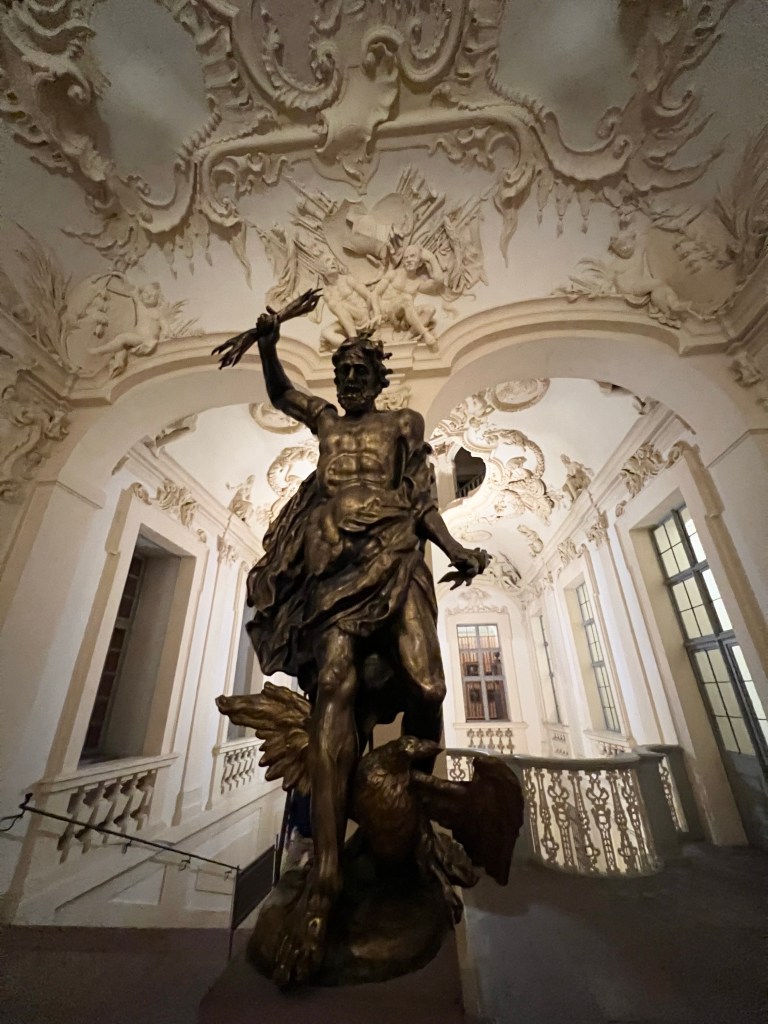
The castle is built along the same pattern as Versailles with a big courtyard and beautiful sweeping staircases. Commissioned Italian architect and craftsmen to build the brick palace painted rose. Sadly it was dark when we arrived so we couldn’t get a good sense of the exterior or see the golden statue of Jupiter throwing lightning bolts at French neighbours on top of palace is (a copy on the roof/original inside).
Guarding the entrance
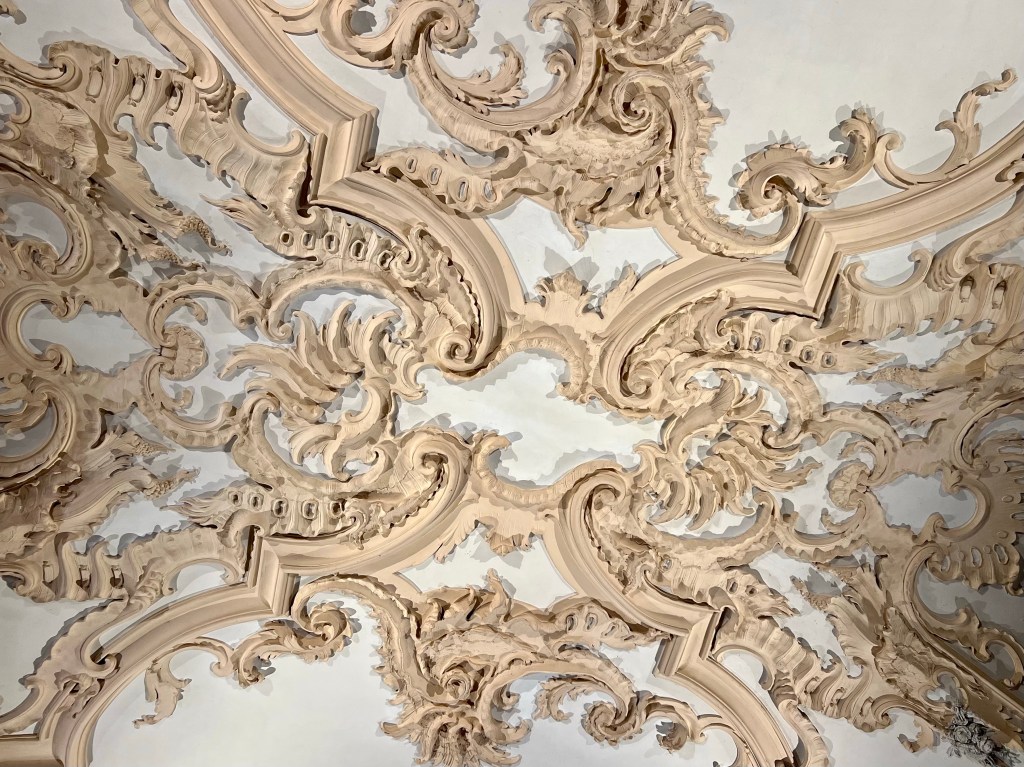
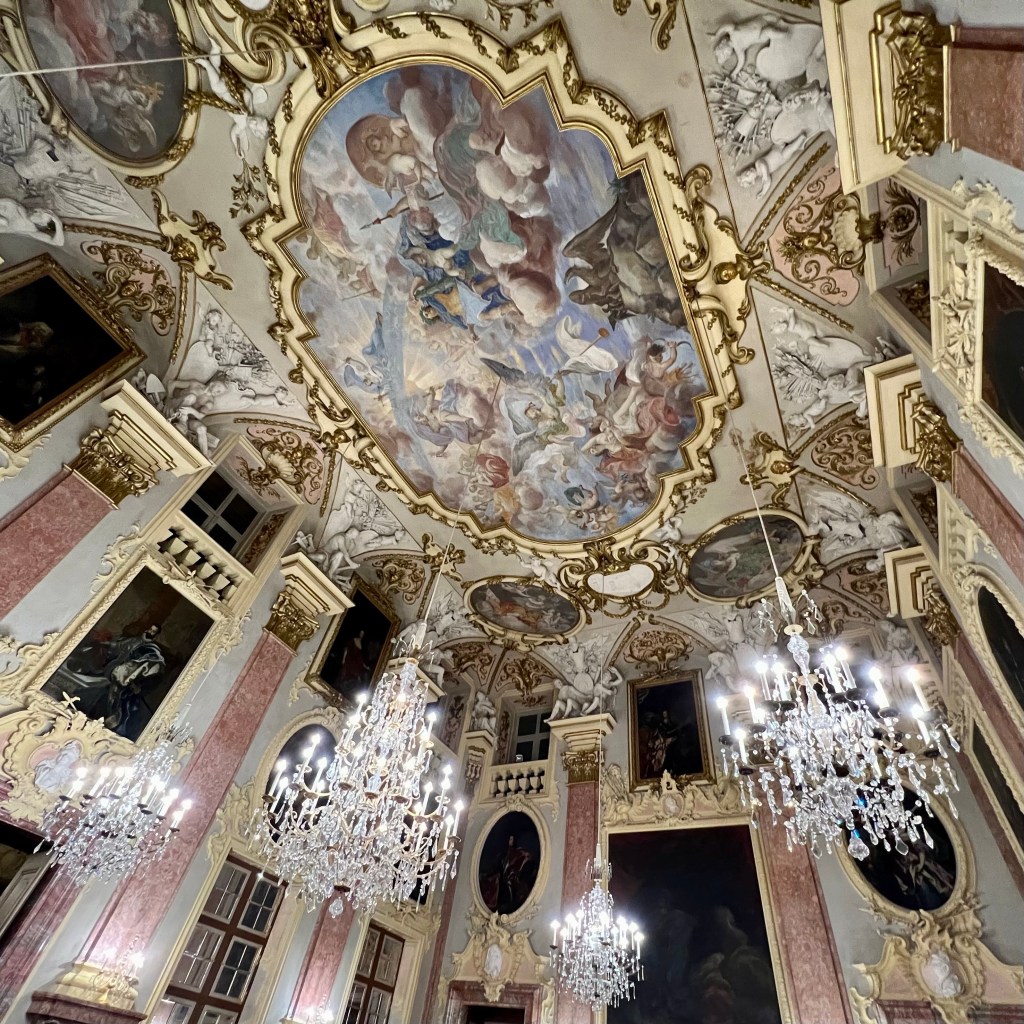
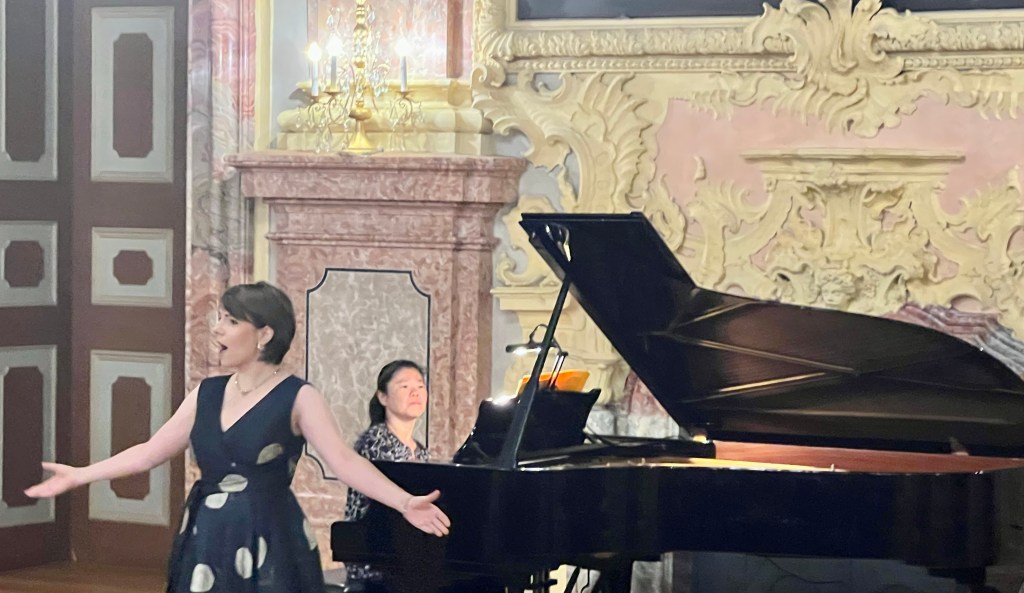
We headed into the Garden Hall for a welcome drink and we’re then set loose for a bit to explore the palace and the beautiful state apartments before taking our seats in the big hall for our concert. The Palace has remarkable stucco and frescos.
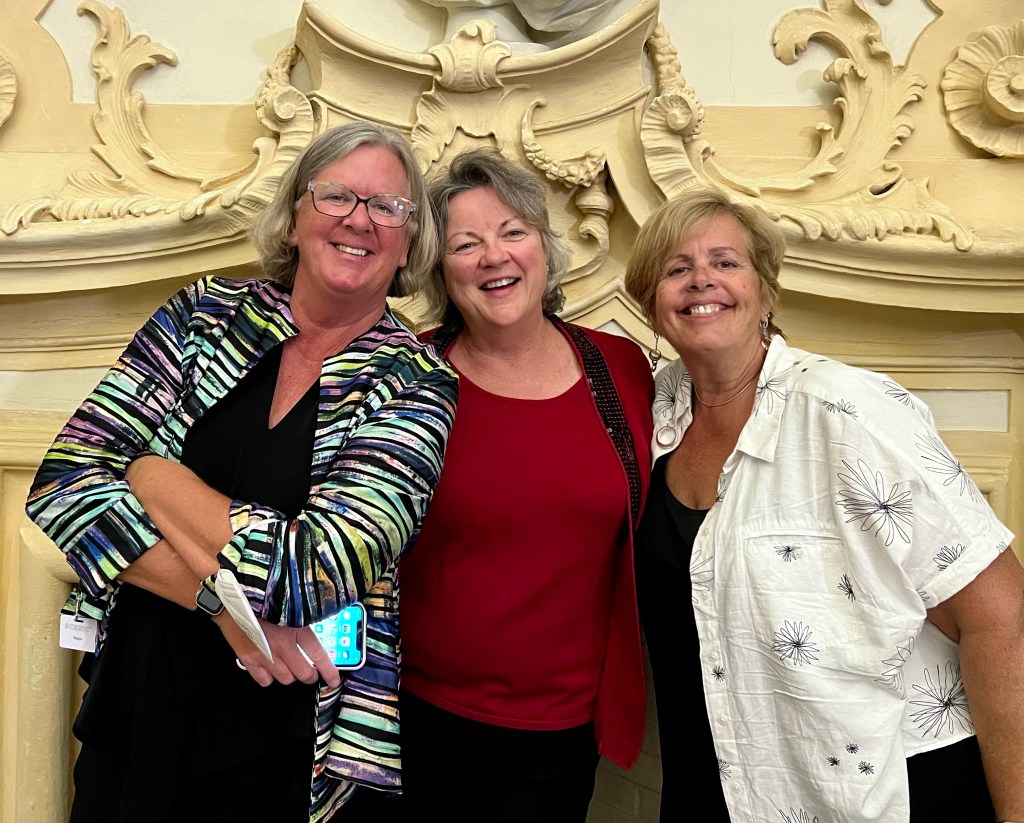
The ceiling in the Garden HallRobyn, Joan and IHamming it up with the University CrewSweeping staircaseWindowJupiter It the entertainment for the night
The two operatic singers gave fantastic performances especially the female lead which was amazingly expressive. A beautiful evening in a fabulous setting.
Back to the bus and the boat for an early ish night.
Tomorrow is another day. Luxurious adventures await …
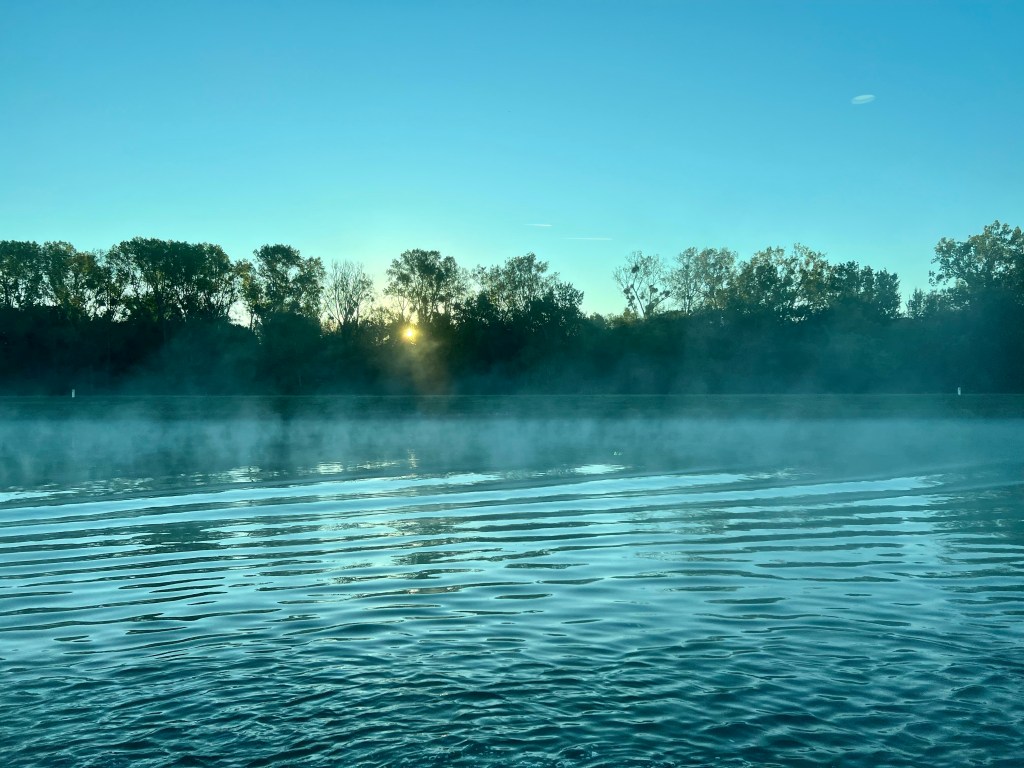
Woke up to the soft sound of the boat swishing through the misty waters of the Danube. The brisk morning air was balanced by blue skies and sunshine signalling another beautiful day to be on tour.
Good morning from the Rhine
We dock on the German side of the river in Kehl (as the guide later described it – in the middle of nowhere). We enjoyed a beautiful breakfast and a then lovely lunch. Mostly been having breakfast and dinner only so going to need to eat less breakfast if we’re going to have lunch as well.
After lunch we board busses for the excursion of choice. Options were a walking tour of Strasbourg, a visit to the Black Forest followed by the cake of the same name or a winery tour. A difficult choice indeed but, of course, the winery tour was my choice. People from our extended group are going on all three tours so I can compare notes tonight.
Our boat is docked beside another boat so after swiping out of our boat we walk through the other boat and then up their gangway to the dock. Soon enough our bus headed over the nearby bridge across the Rhine into France and the city of Strasbourg.
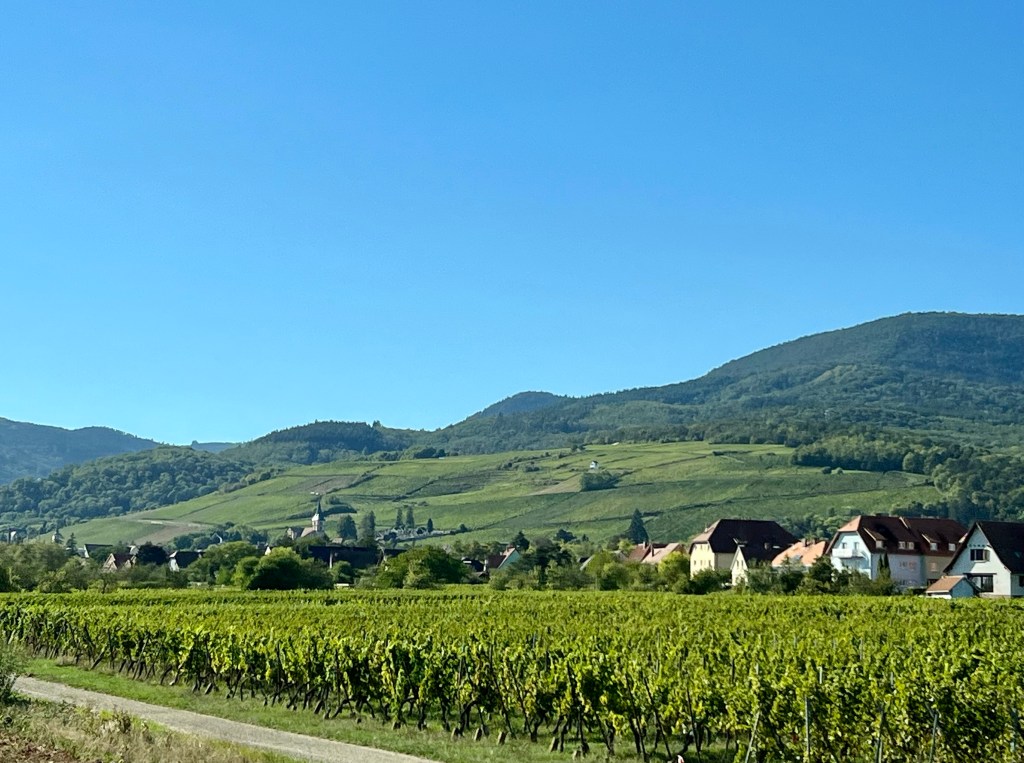
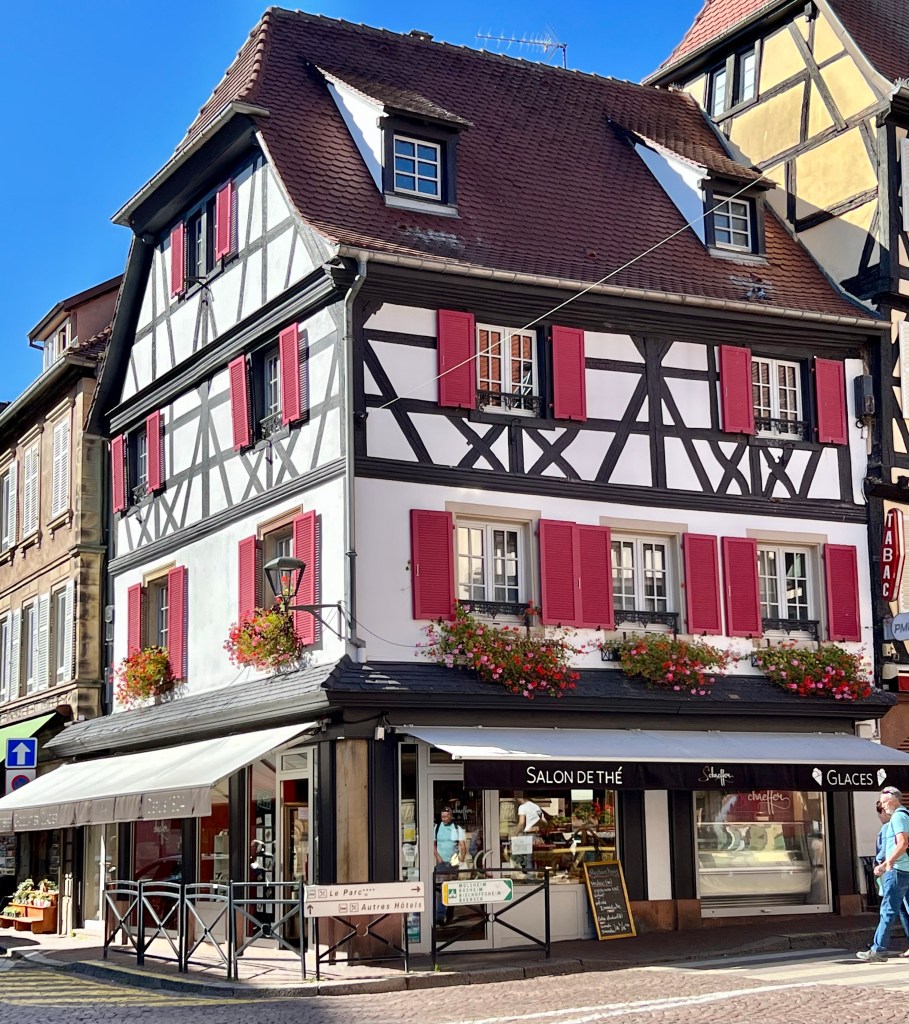
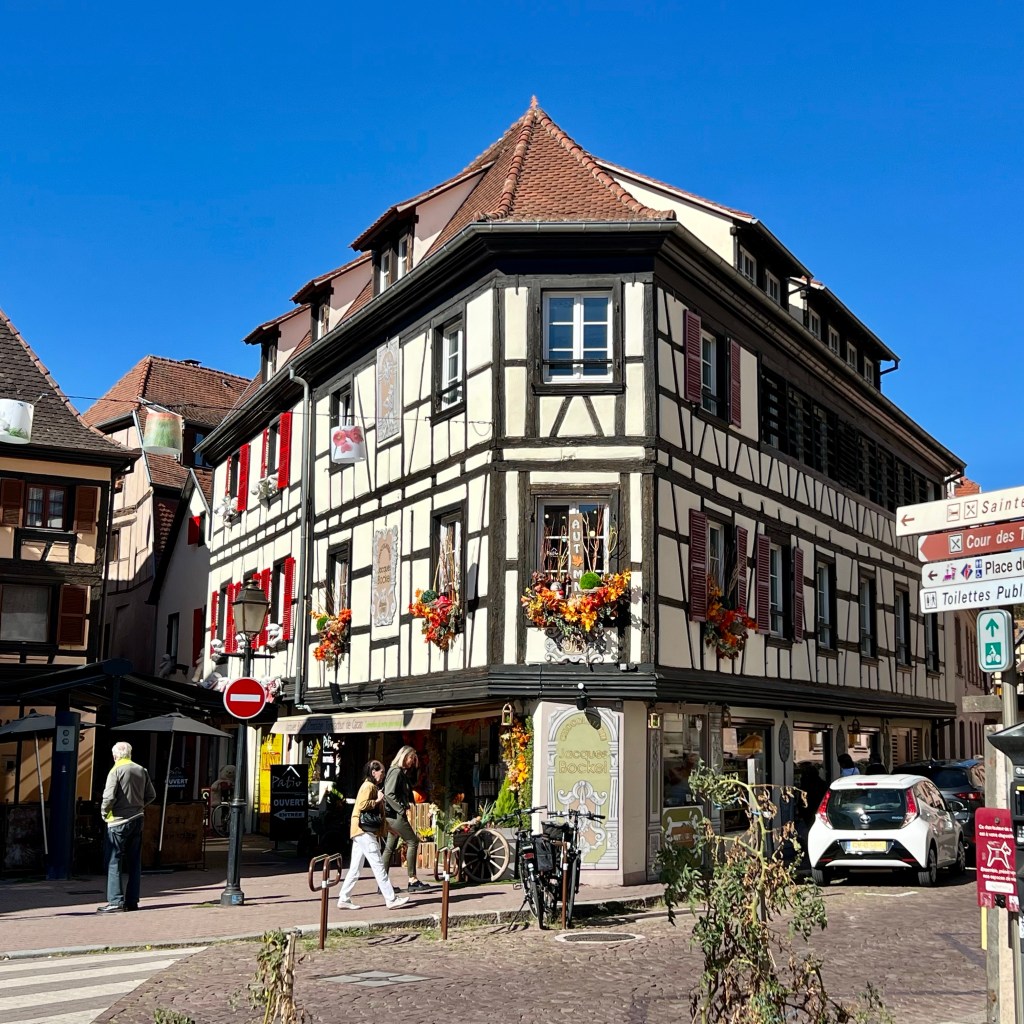
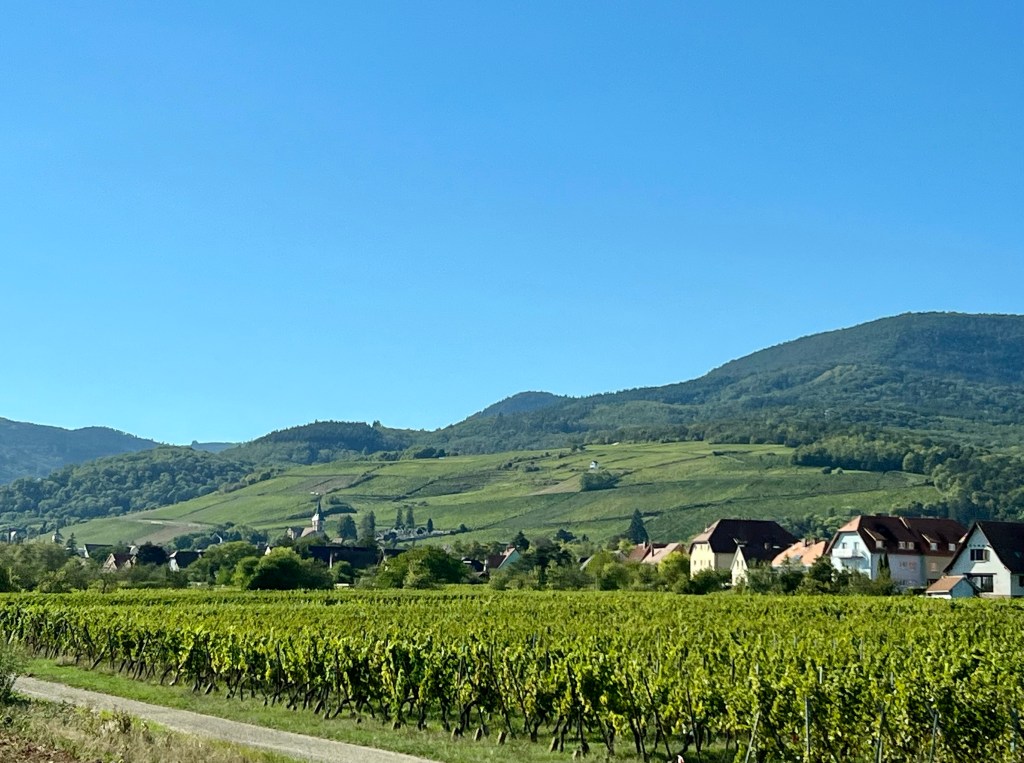
Our gargantuan bus is taking us to the winery via the Alsace Wine Route. Officially launched as a tourist trail in 1953, the Alsace Wine Route winds its way through 170 km of hills and vineyards dotted with medieval castles 70 quaint villages with their half-timbered houses, flower-laden windowsills and cobblestone lanes.
Along the Alsace Wine Route
The wine area of Alsace is the smallest in France boasting almost 1000 wineries. Wines from Alsace are named in accordance with the type of wine while other parts of France name their wines after the location.
The Alsace region was originally mountain tops that collapsed leaving a rich mosaic of high quality soils. These terroirs provide many opportunities for high quality wines.
In Alsace, the wineries are not typically found in the middle of the vines because their acreages are spread over the area to take advantage of the various types of soil. Most grapes are harvested by hand because hills don’t allow for machinery. Individual wineries harvest when their grapes are ready.
Since 1973, only seven types of grapes can be used to make Alsatian wines; six for white wines and one for red. Sylvaner is intended for pairing with simple foods such pickles, sausages, etc. Pinot Blanc is a more aromatic wine which pairs nicely with goat’s cheese. Riesling is the king of Alsace and it pairs well with all local delicacies. Muscat produces an aromatic fruity dry wine which is easy to drink on its own or in the spring with white asparagus. Pinot gris is one of the easiest wines to drink as it pairs well with everything. Gewürztraminer means spicy and is great with spicier foods. The sole red wine made in the area is a light and fruity Pinot Noir; brought to Alsace by monks from Burgundy many years ago. They also make Cremant; sparking wine made from Pinot Noir grapes using the champagne method that can be pink, rosé or white depending on whether and how long the skins are left with the grapes during fermentation. Last but not least, they make some late harvest wines from grapes picked in late September/early October.
Views from the Bus
In the little villages the colour of house was used to identify the type of trade/craftsmen living there; bakers had yellow houses, fishermen lived in blue houses, butchers in red houses, etc. as many people were illiterate.
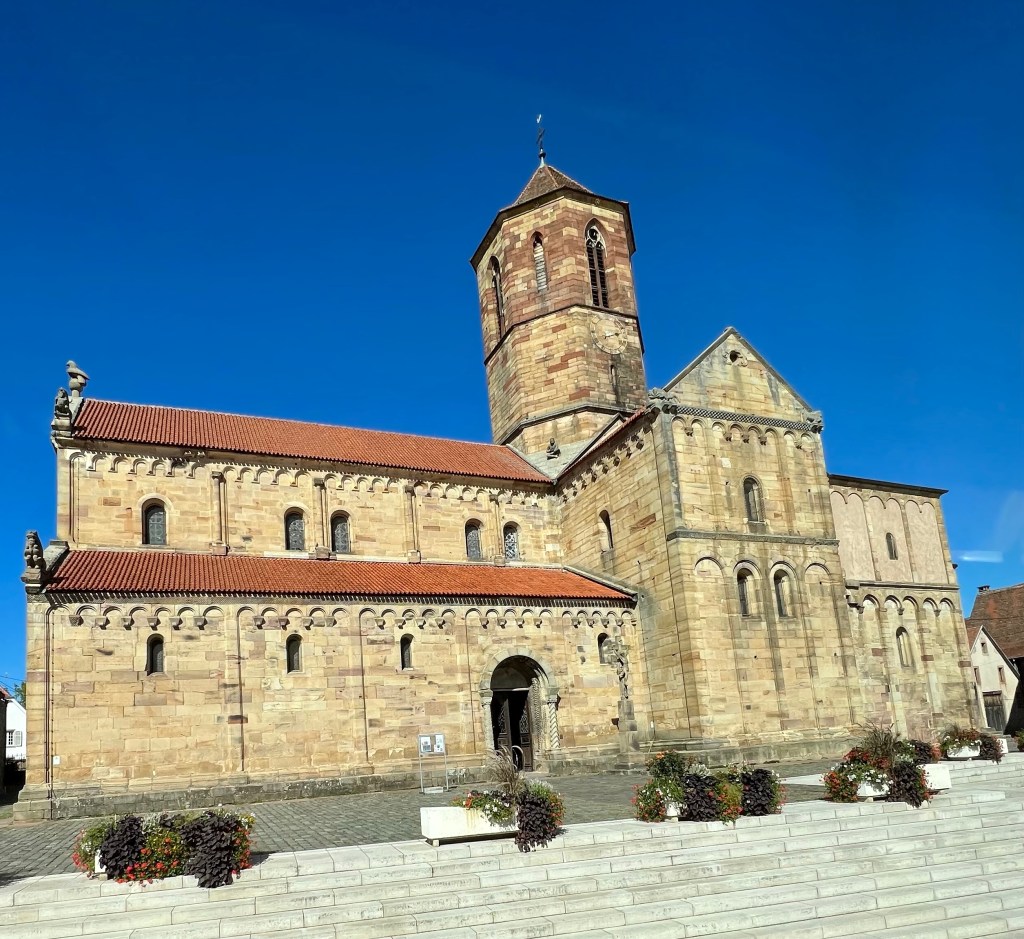
Rosheim village was the first town we drive through; a one street village that was originally a gated town and home to the oldest stone house in Alsace. It’s a two church town! We had a good view of St. Peter and St. Paul Roman Catholic church; man sitting on the roof on left side of bell tower is architect. The second was the neoclassical St Stephen Roman Catholic church built in 18th century.
Romanesque St. Peter and St. Paul Church
Our first stop along the Route is Obernai town. This village was not damaged during WWII as it had no strategic importance. Later in the war, Nazis conscripted 19-23 year olds from the town (220) and the region (130,000+) most of which never came home. There is a memorial in Obernai to that lost generation.
The tunnel into town
The eastern side of the wall around the city is more fortified to protect against invaders from Germany; two thick walls with water in between. The western side had a thinner wall but this side also had the natural “wall” provided by the hills.
The wall around the city
The traditional kougelhopf bakery is just inside the gates as is the synagogue. The Nazis use the synagogue as slaughterhouse during WWII exclusively for pigs so it had to be cleaned and reconsecrated before being reopened after Nazis were defeated.
Synagogue
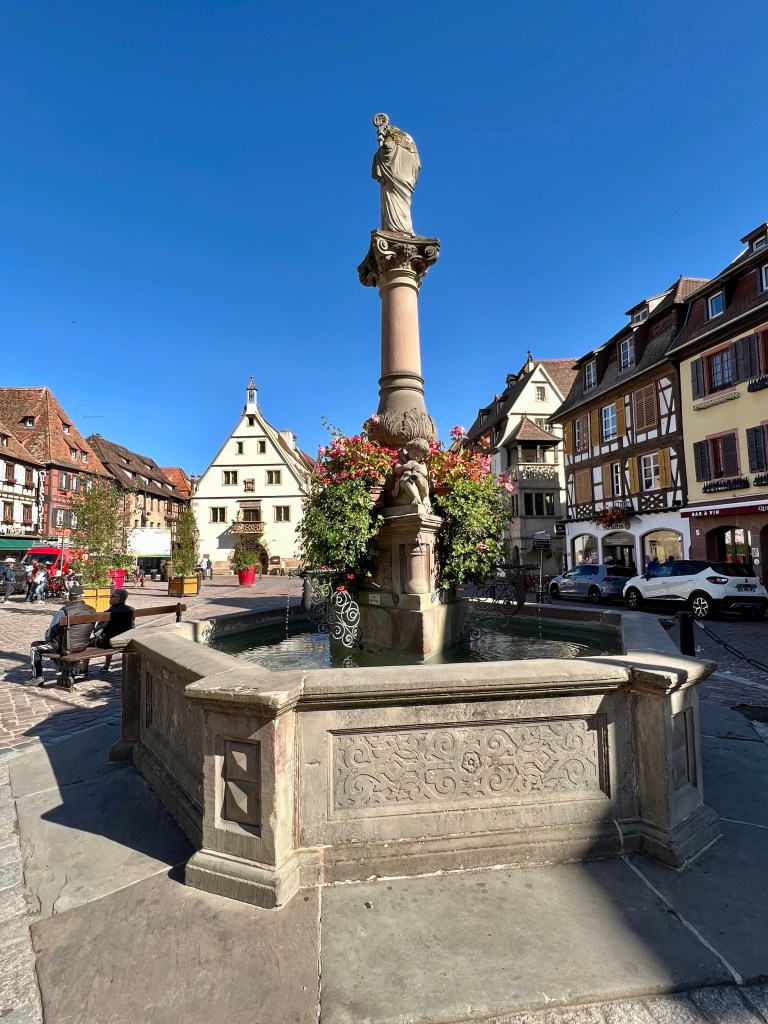
The houses in City Center date back to the 16/17th century. The corn house on the main square (historically market square) was originally a slaughter house. The bell on the top rang twice a day; at 6 am to open the market and again at noon to close the market.
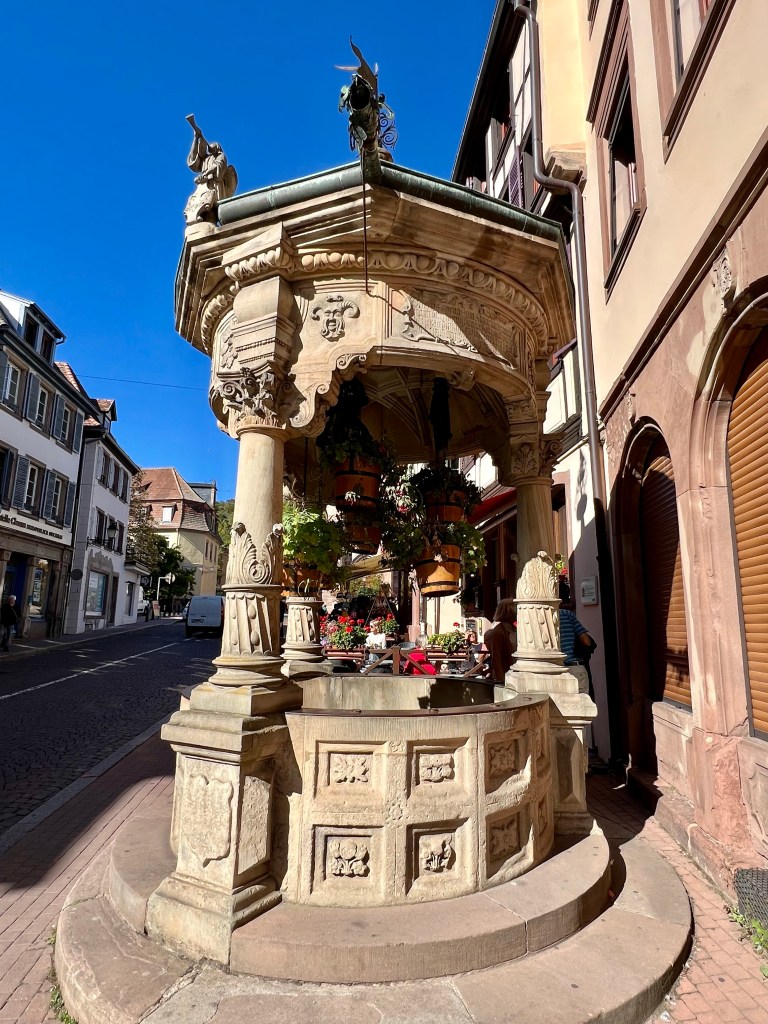
Pretty WellMarket SquarePrivate Chapel on the RightThe Corn House
Across from the square is the city hall as is the bell tower of the church used for war time services inside city. People went to church outside the town during peace time.
City Hall and Bell Tower
Only the tower with bells remain. A new church is found just outside the town. The church is oriented north-south not east-west as is typical. They wanted to build a large church and if they stuck with tradition would have needed to move the bodies from cemetery. This church has two steeples but no bells because it was so close to the bell tower from the original church. They used the money they saved to invest in an organ.
Graveyard behind the church
Pretzels (originally called bretzel) were invented in Alsace in 1873. Originally designed as a welcome gift for new residents; shape of embrace (bread and salt).
Alsace is also the gingerbread capital. This dates back to the Middle Ages when simple honey cakes were made in the winter. After finding America and travels around world brought back spices like cinnamon, anise and cardamon which were used to transform the simple honey cake into gingerbread; mainly a Christmas treat.
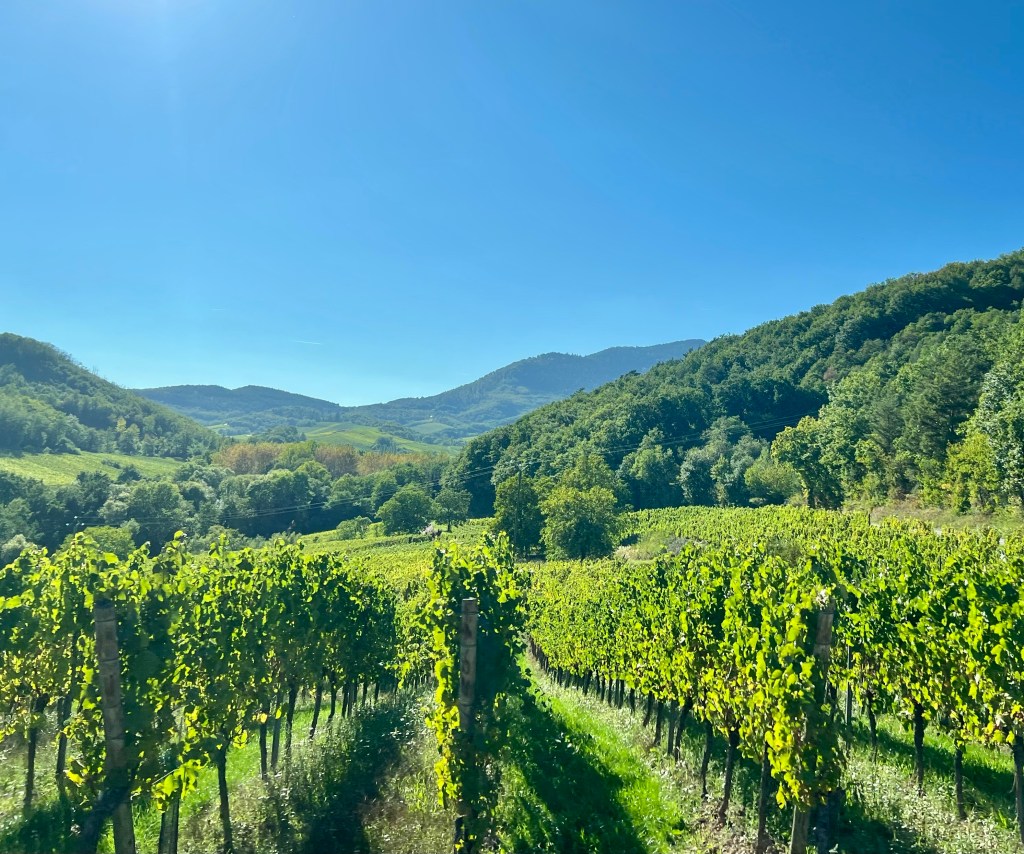
Vineyards are on mainly in the hills not on plains as vines need to suffer and soil on the plains are too rich with abundant water. Vines on plains become too lazy and produce grapes with lots of liquid but not much taste. It is forbidden to irrigate vines in Alsace. Vines need to grow deep roots through all the soil types to feed. Mainly grow Sylvaner grapes on the plains; used to make the less complex wines. The other six noble varieties are pretty much exclusively grown on the hills.
Vines can be productive for sixty years and then the land rests two years. After replanting the vines take three years or so to bear enough fruit to be useful in wine production.
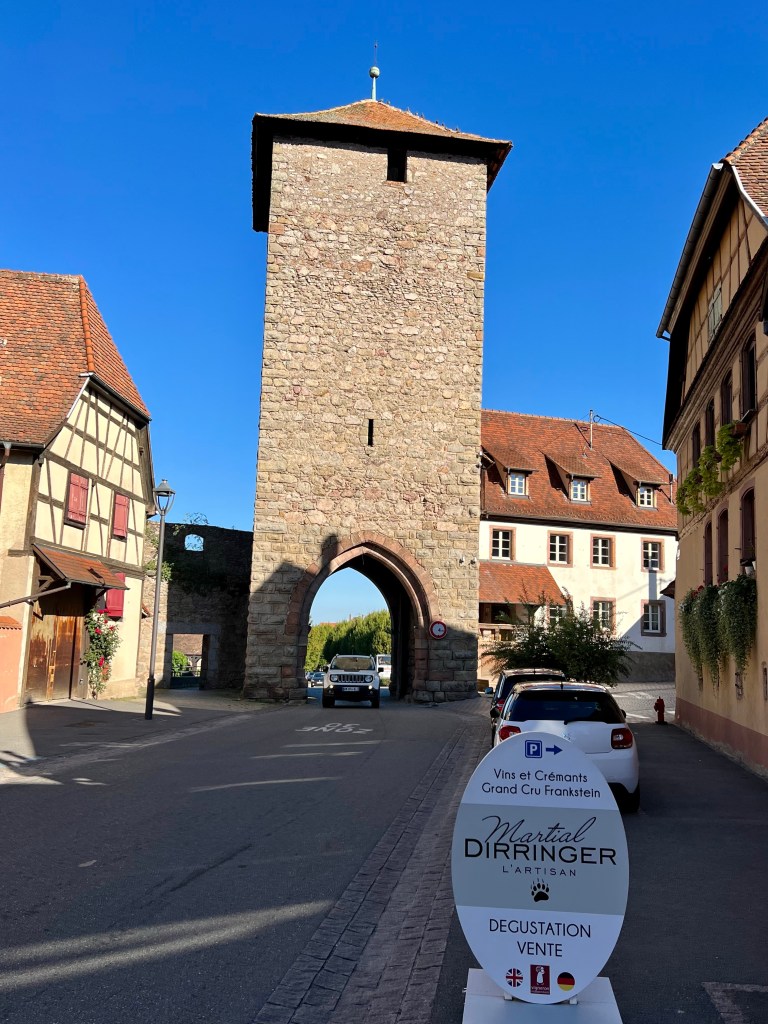
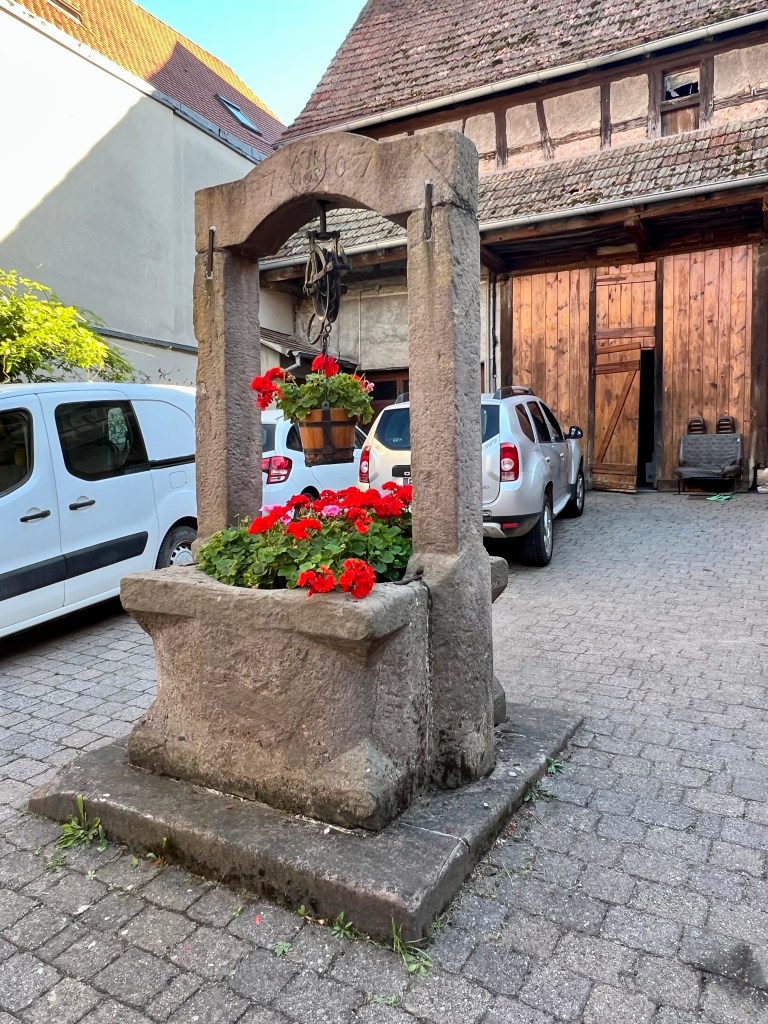
Finally we arrived at the town where our wine tasting will take place; Dambach-la-Ville; a town on the eastern slopes of the Vosges Mountains known for its quality wines. The town is home to 2000 residents living in half-timbered or Renaissance houses with lots of flowers and pretty fountains. The village is located amidst in a 470 ha of vineyards; the largest in Alsace. We entered through one of the gates from Middle Ages, barely large enough for us to squeak through, and headed to the home/atelier of Martial Dirringer. The family has been creating wines here for five generations since 1707. Here we learned even more about the wines of Alsace, especially theirs’ but my brain was full!!
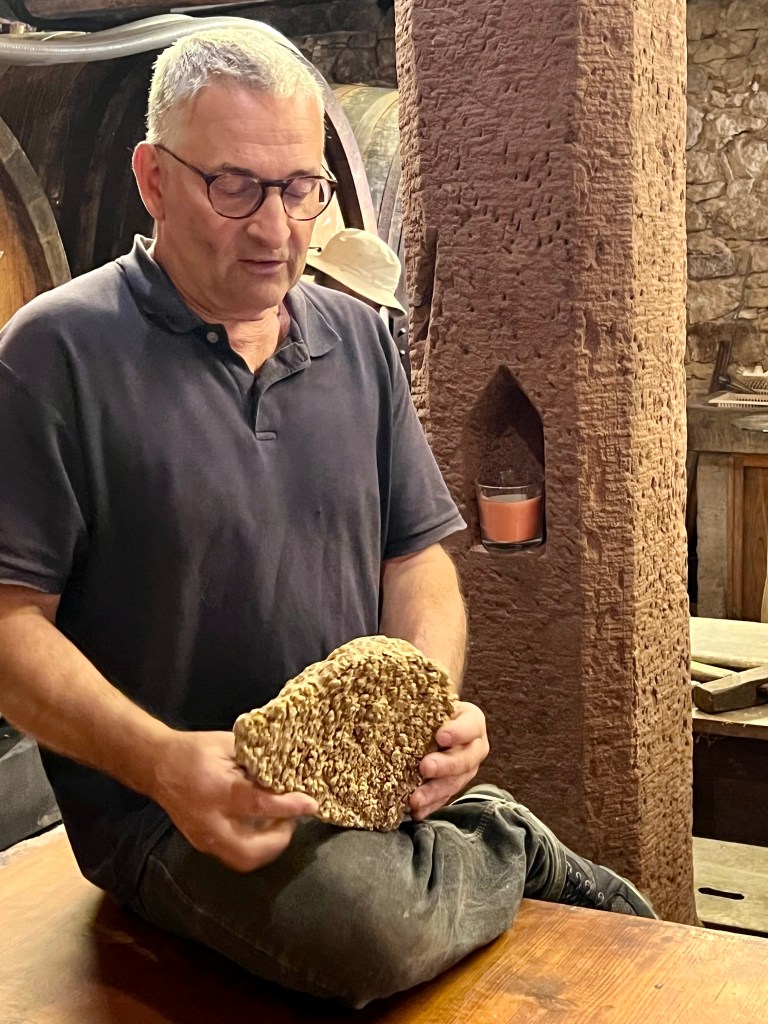
Gate into the TownCourtyardWellOur Host
The family cultivates 18 ha of vines; selling half the grapes and bottling the rest (50,000 bottles/year) – all cut by hand. They grow all of the seven grapes of Alsace here on their different terroirs. They also produce Cremant and Frankstein Grand Cru. The Grand Cru appellation means that the wine is a product of a specific terroir which meets strictly controlled geological and climatic criteria that confer specific characteristics to the wine.
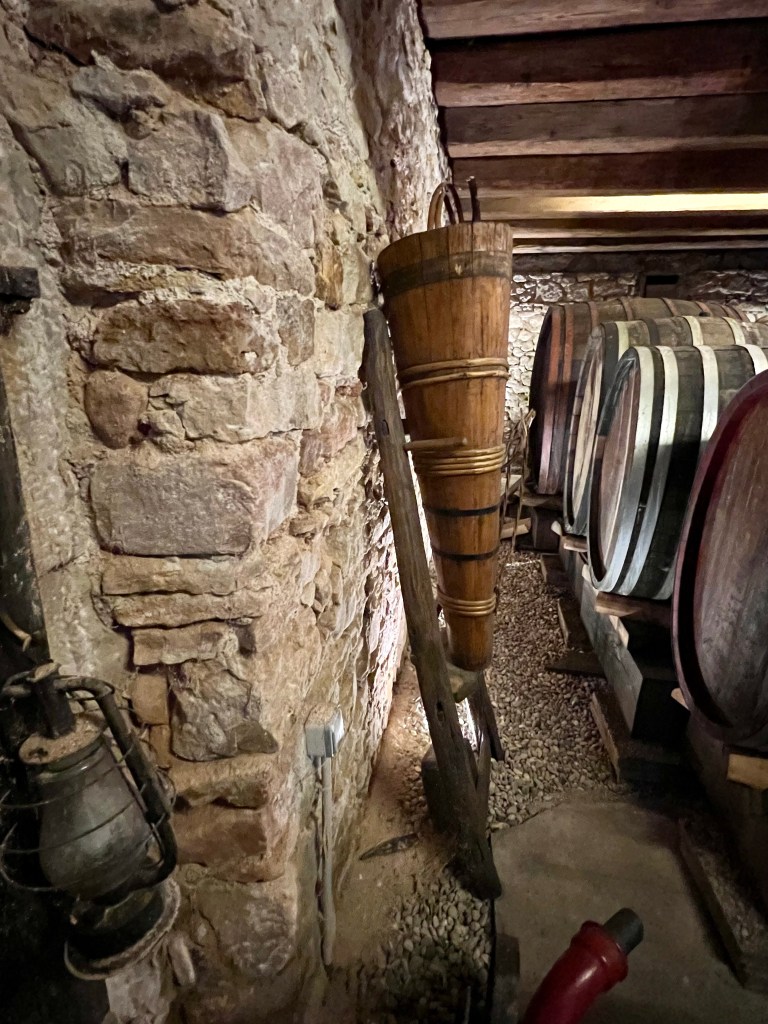
The cellar
The Alsace boasts 51 Grands Crus, reflecting the complexity and rich diversity of the Alsatian winegrowing region. Four grape varieties are allowed under the Grand Cru Appellations: Riesling, Muscat, Pinot Gris and Gewürztraminer. The Frankstein Grand Cru, from this area, is a Gewürztraminer. The vines have a SSE orientation on a hill with the correct soil type and a minimum of 50 years growing the same grape variety on the same spot. These superior quality wines are confirmed by experts. We did get a chance to try their Grand Cru from 2017 Terre de Granite and I’ve bought a bottle; not sure it’ll make it home!
We first tried their pink Cremant which was quite tasty and may or may not be in my suitcase when I arrive home. This is made from the Pinot Noir grapes and has four hours with skin to impart the pink colour. Aged in both the barrel and the bottle, Cremant was first made in Alsace. Around 30% of Alsatian wines are Cremant with Alsace producing a whopping 50% of the Cremant originating from France.
Bigger barrels designed by beer producer brewery oval shape. Other wine regions have round. Oval barrels use less space and beer barrels had been used so cheaper.
Oldest (1903) Barrel on Left
Had hole in one of the posts to hold candle to monitor CO2 level. As long as candle was burning was safe to work here.
Best tea made in an old cup – 25 years of flavour!
After the wine tasting (and buying) we hopped back on the bus to head back to the boat this time using the highway. We were a bit late and luckily the boat was waiting for us.
The typical evening routine includes a discussion of tomorrow’s schedule of activities and the Executive Chef’s recommendations for dinner with of course a few cocktails.
Dinner is again fabulous though we all may have a tad too much wine – lol. After dinner we headed to the lounge for more drinks and a Name That Tune Game Show. There are two teams and yours truly is the Captain for our side. We were doing pretty well at the beginning but at some point the wheels fell off and we came in a “close” second. Great fun and silliness for a bit so all good.
Tomorrow is another day. Luxurious adventures await …
The day that I’d been anticipated for over a year has arrived and I’m in Basel, Switzerland; the starting point for our river cruise to Amsterdam on the Scenic Crystal. I’m meeting a bunch of friends and family here and I’m looking forward to spending some time with my peeps.
Linda and I join my sister Robyn and her wife Joan for the hotel breakfast. The buffet was very nice especially after we discovered the Prosecco which we transformed into mimosas to wash down our delicious breakfast choices. During our extended breakfast, we ran into a bunch of the cruising crew. It was lovely to have a chance to catch-up on their recent adventures as most folks had come to explore Switzerland for a few days or a few weeks prior to the cruise.
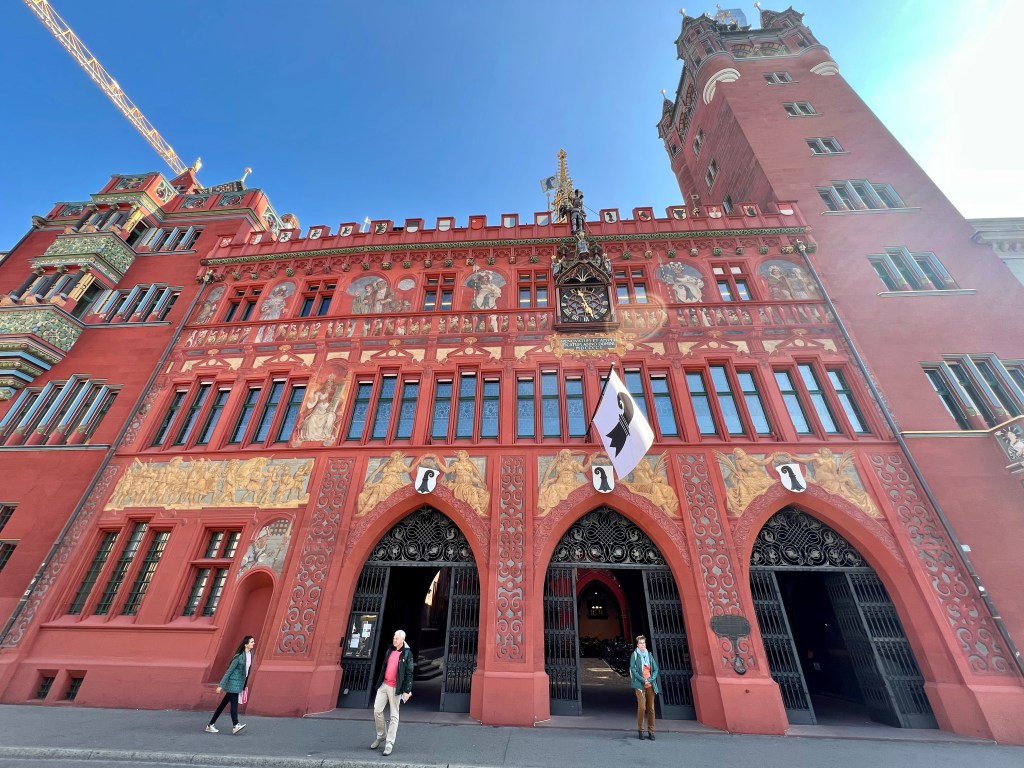
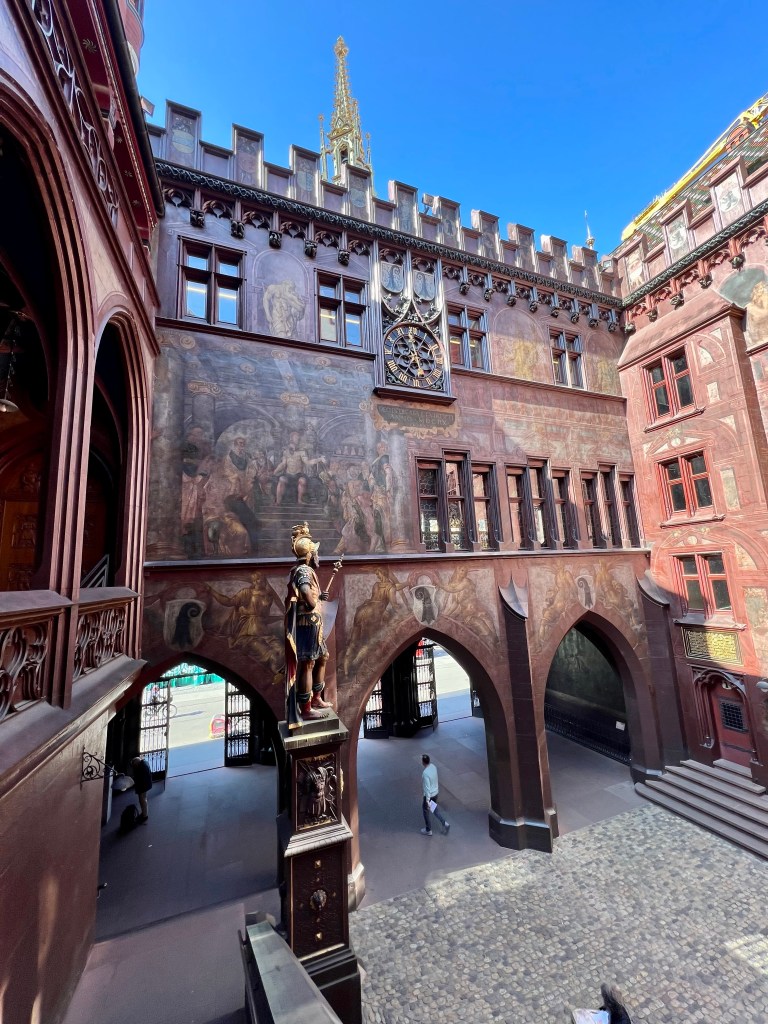
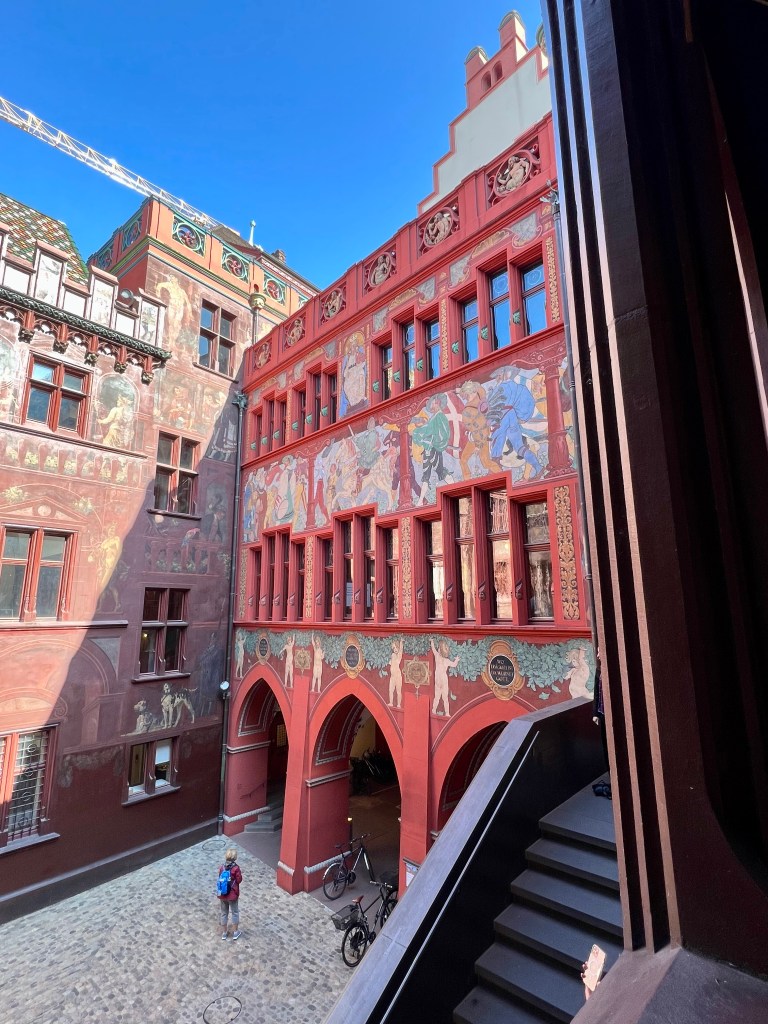
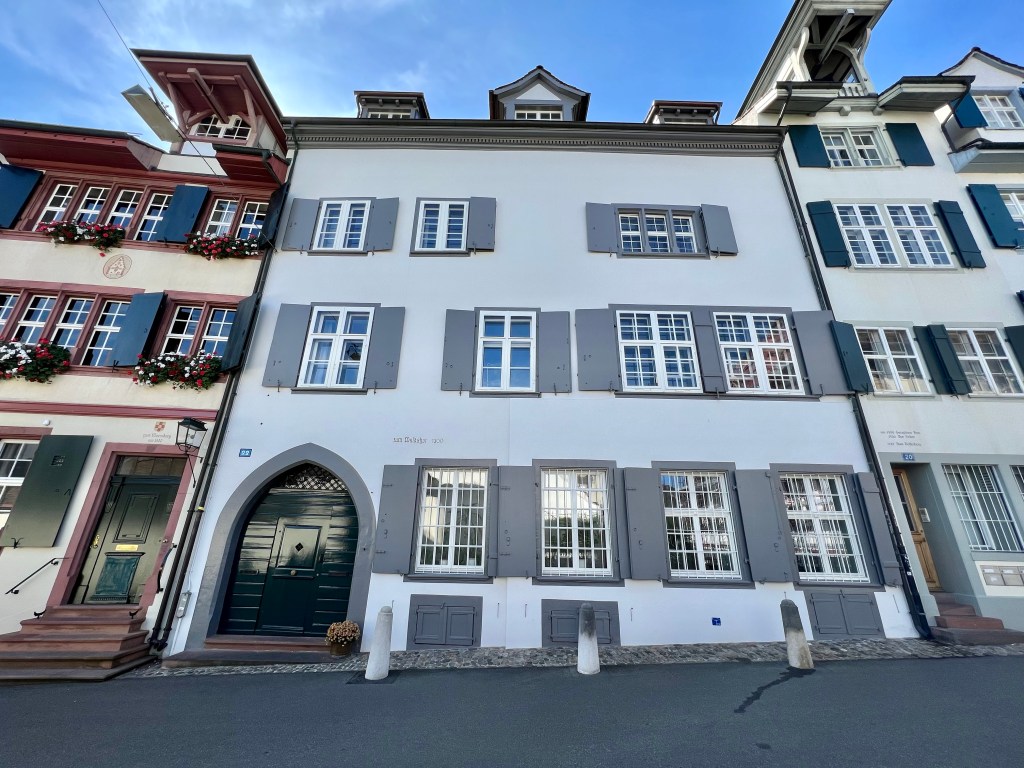
A quick trip back to the room to grab our bags so we could check out and head out to explore the city before heading to board our boat later in the day. Our hotel is very close to the Basel Rathaus (City Hall); a 500-year-old building dominating the Marktplatz and as good a place as any to start our explorations. Linda and I are joined by Deb and John Hutchings who’ve been in Basel for a few days and know their way around.
Basel RathausIn the Basel Rathaus Courtyard
Basel is a city in northwestern Switzerland on the Rhine with a population of around 175,000; Switzerland’s third largest city after Zurich and Geneva. Basel is commonly considered to be the cultural capital of Switzerland and the city is famous for its many museums; 40 museums are spread across the city. No time or interest in museums today. It’s beautiful and sunny so we opt for a quick walkabout instead.
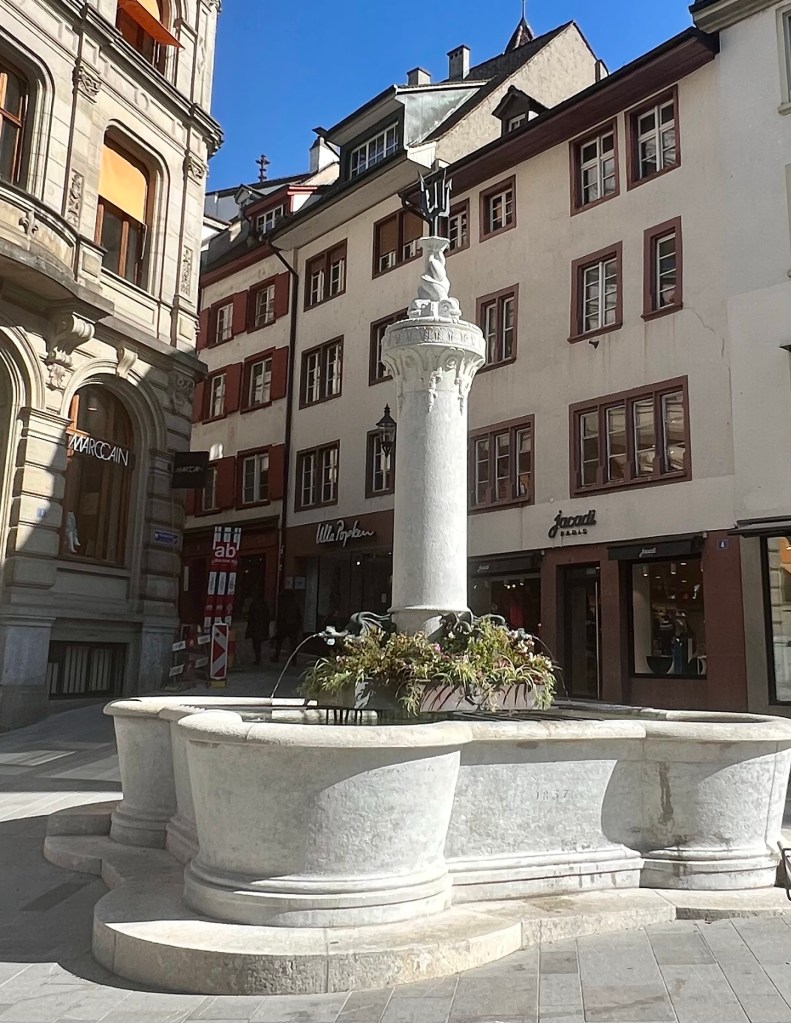
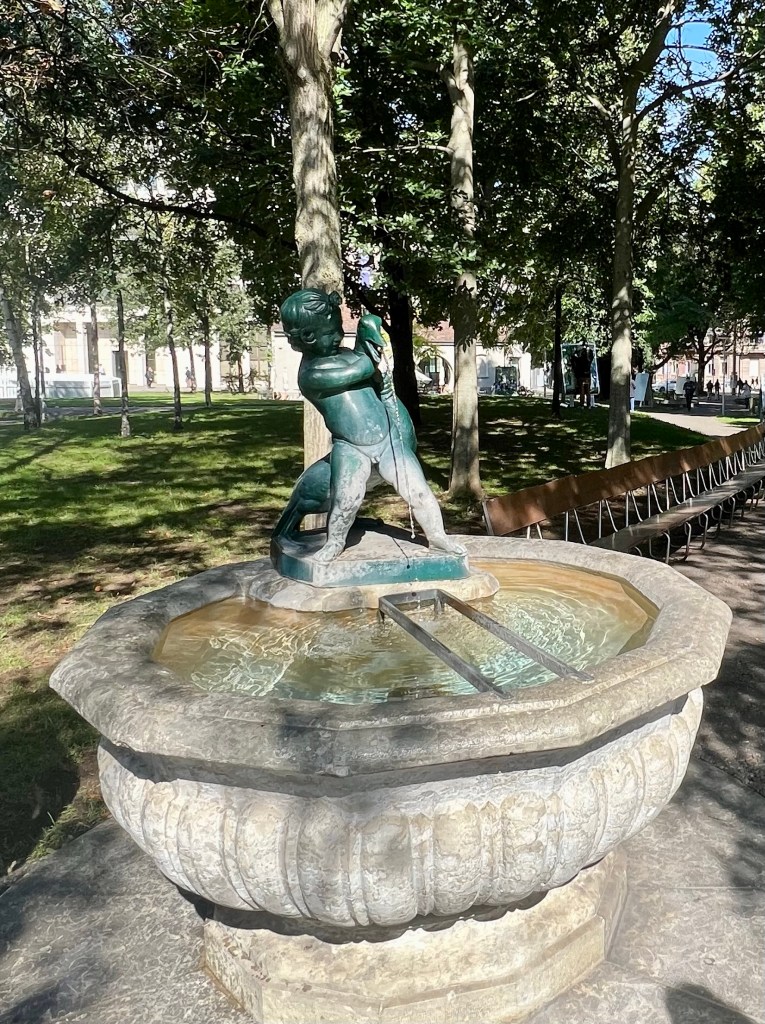
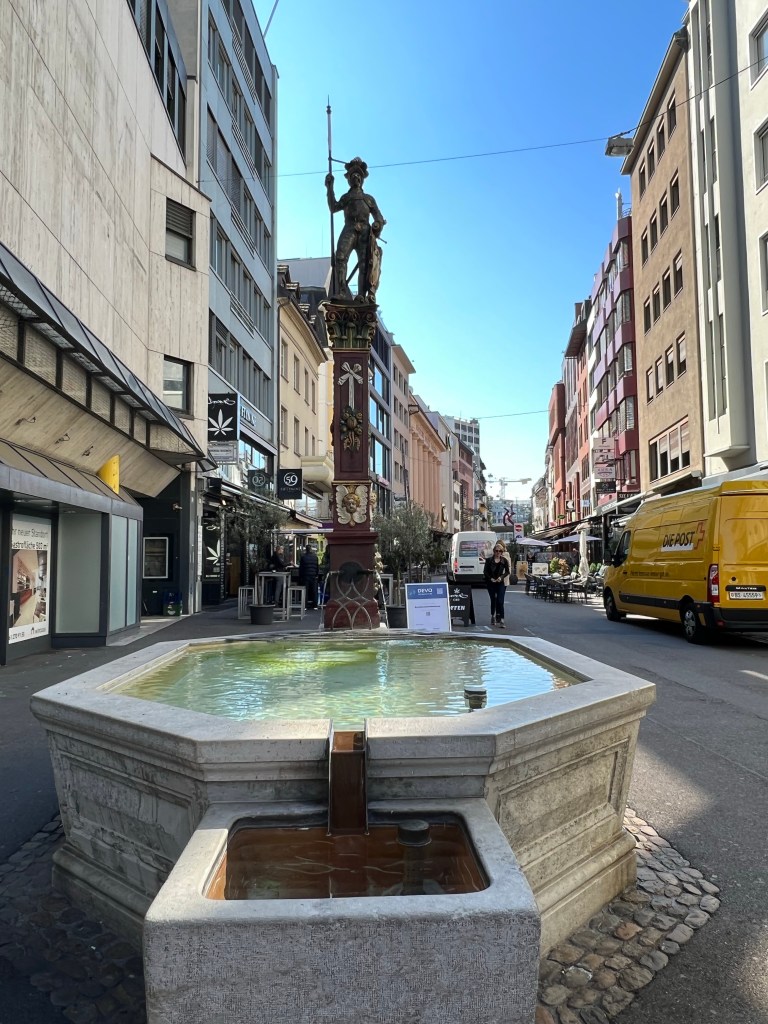
Water water everywhere
We walked around for a bit going where the wind blew us indulging in a little window shopping and some actual shopping before heading back toward the hotel.
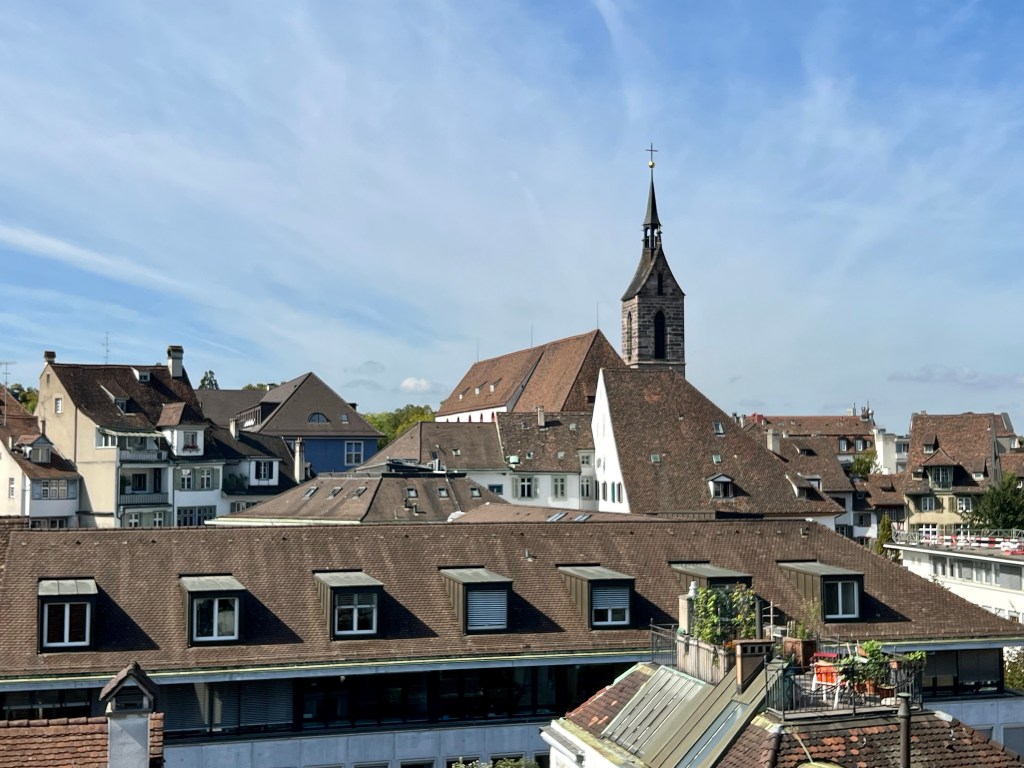
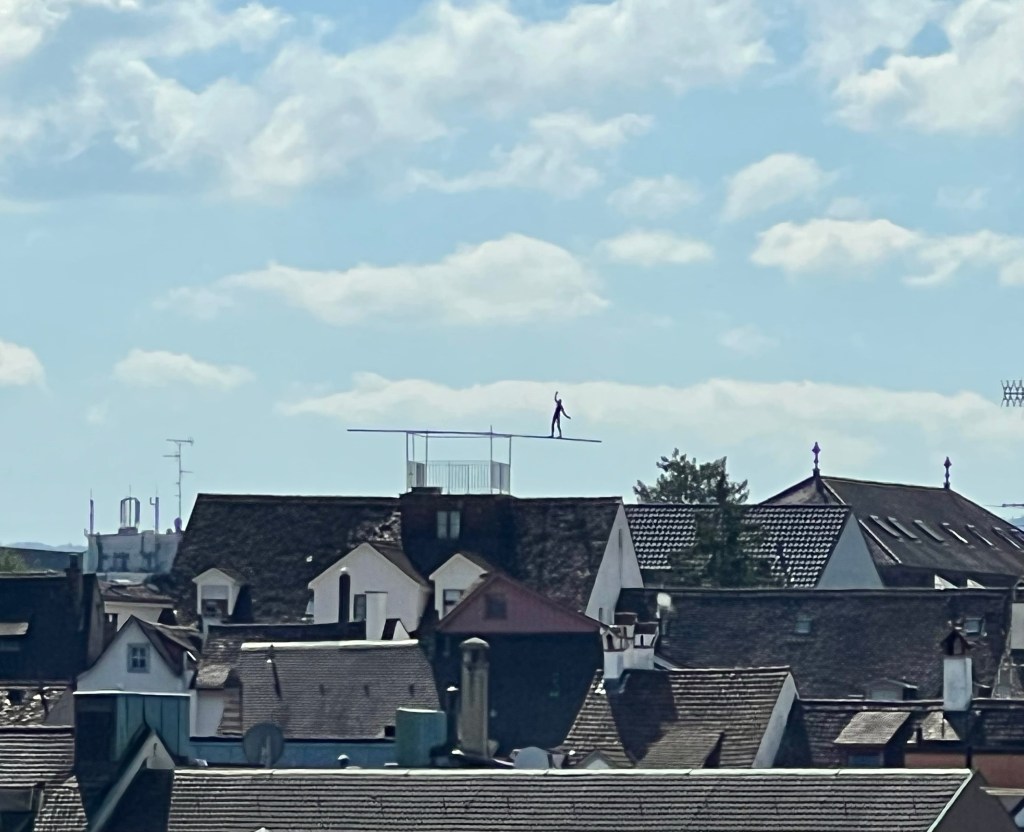
We made it back a bit early so dropped into the local Coop to pick up a couple of beer to enjoy on the lovely terrace of the Hotel Märthof with spectacular views of the city. Soon enough it was time to grab our bags and hop into cabs to the cruise boat mooring.
View from the topWalking the wire
On arrival, we were greeted by the friendly crew who relieved us of our luggage and escorted us to our cabins. The boat is beautiful and our room is cozy with a lovely balcony. I’ll take pictures another day. Once our bits and bobs are unpacked and stowed away, Linda and I head to the lounge for some refreshments where we find some of the crew to begin the shenanigans and explore the boat a bit.
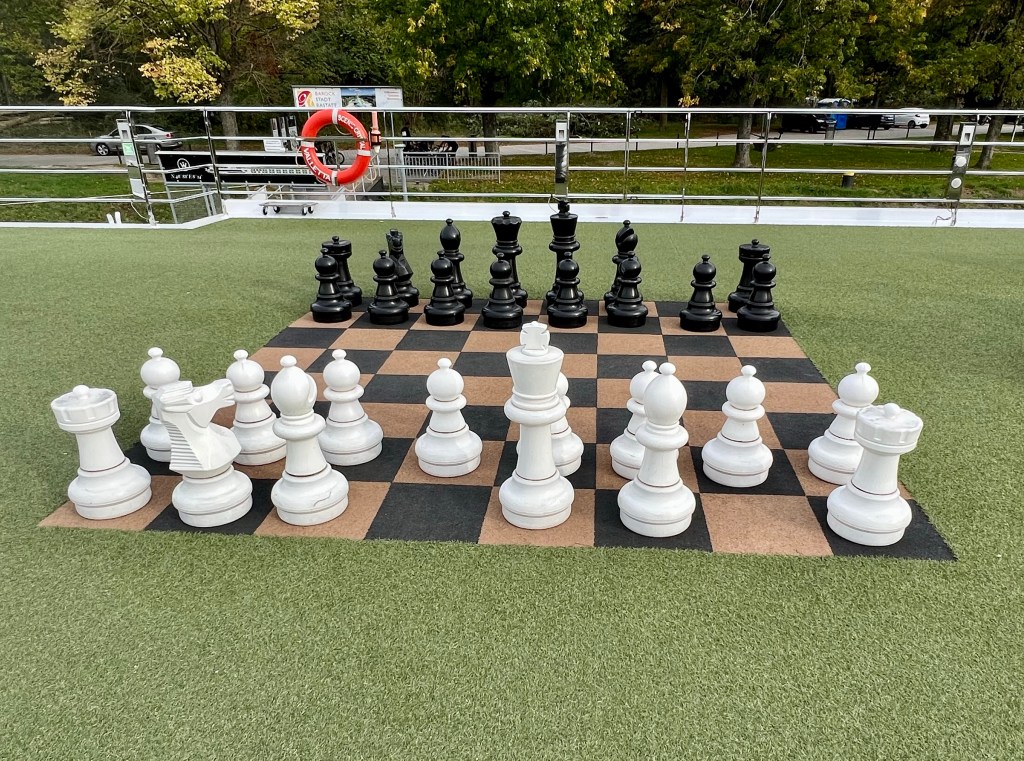
Chess anyone?Ring my bell On the sun deck
The late afternoon and evening sped by (time with friends always seems to fly) and after the requisite welcomes and speeches from various members of the crew, we were off to the dining room for dinner. The caprese salad, veal ragout and lemon profiteroles washed down with the sommelier’s wine choices were scrumptious and filling.
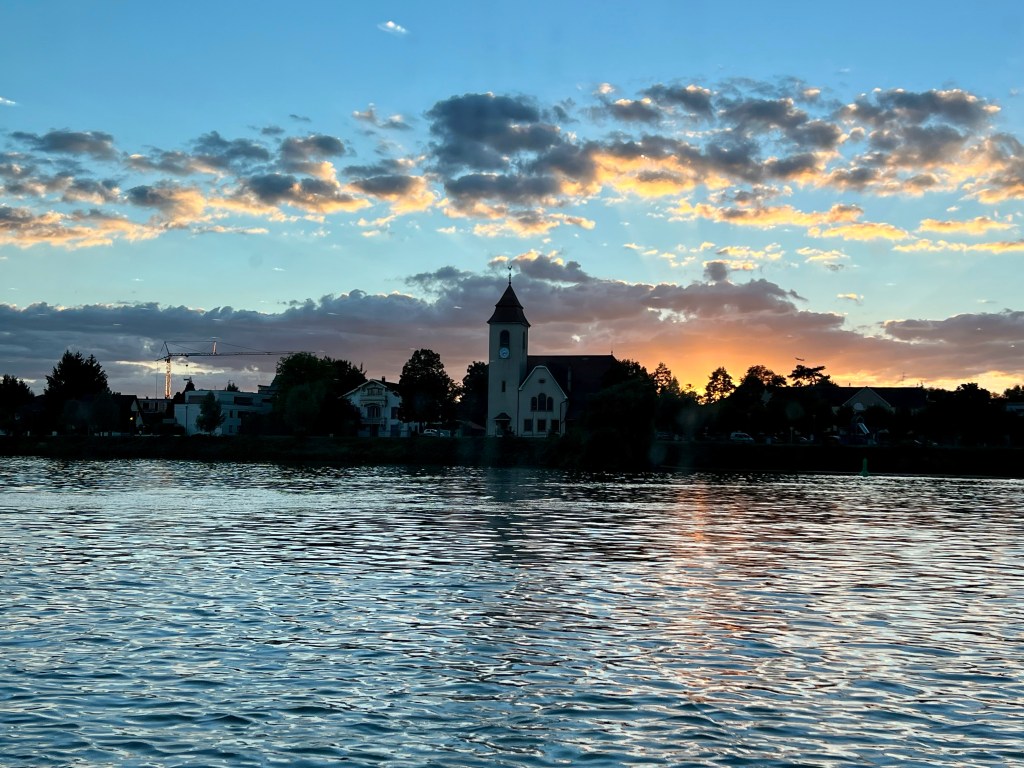
Sunset on the Rhine
After a leisurely dinner, we headed back to the lounge for more chatting and a nightcap or two; the first of many days to enjoy great food and even better company.
Tomorrow is another day. Luxurious adventures await …
Today is our first full day on our own in Split and we opted for a leisurely start to the day. The plan is to head back to Diocletian’s Palace and explore some of the back streets and alleys which we didn’t visit with the guide on our walking tour. I’m also interested in getting inside the Cathedral and some of the other installations in that complex for a closer look.
But first, we head down to find the meeting place for the all day tour to Krka National Park and Trogir that we have planned for tomorrow. Our departure time is 8:15 am so we want to know where we’re going to make tomorrow morning stress-free. Luckily, it turns out to be not that far from our well-located VRBO. After a quick selfie with the Split sign, we head toward the Palace and the Cathedral.
Hello (again) Split
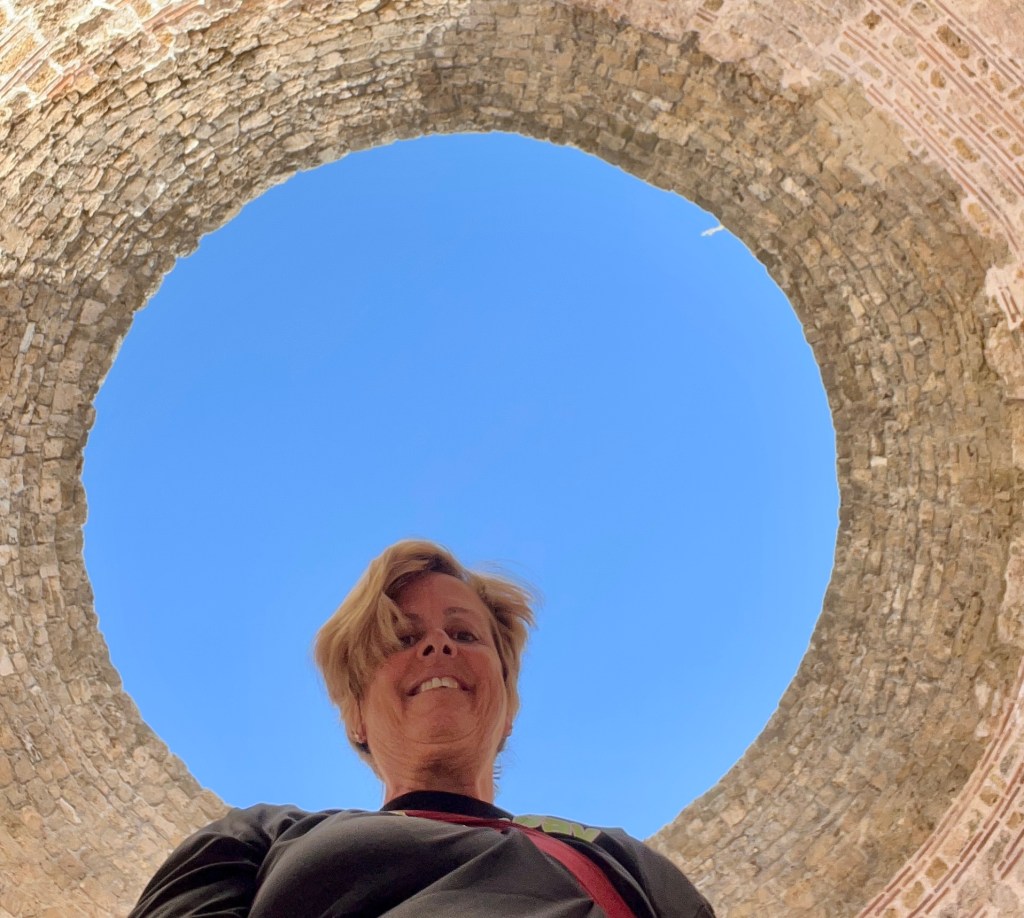
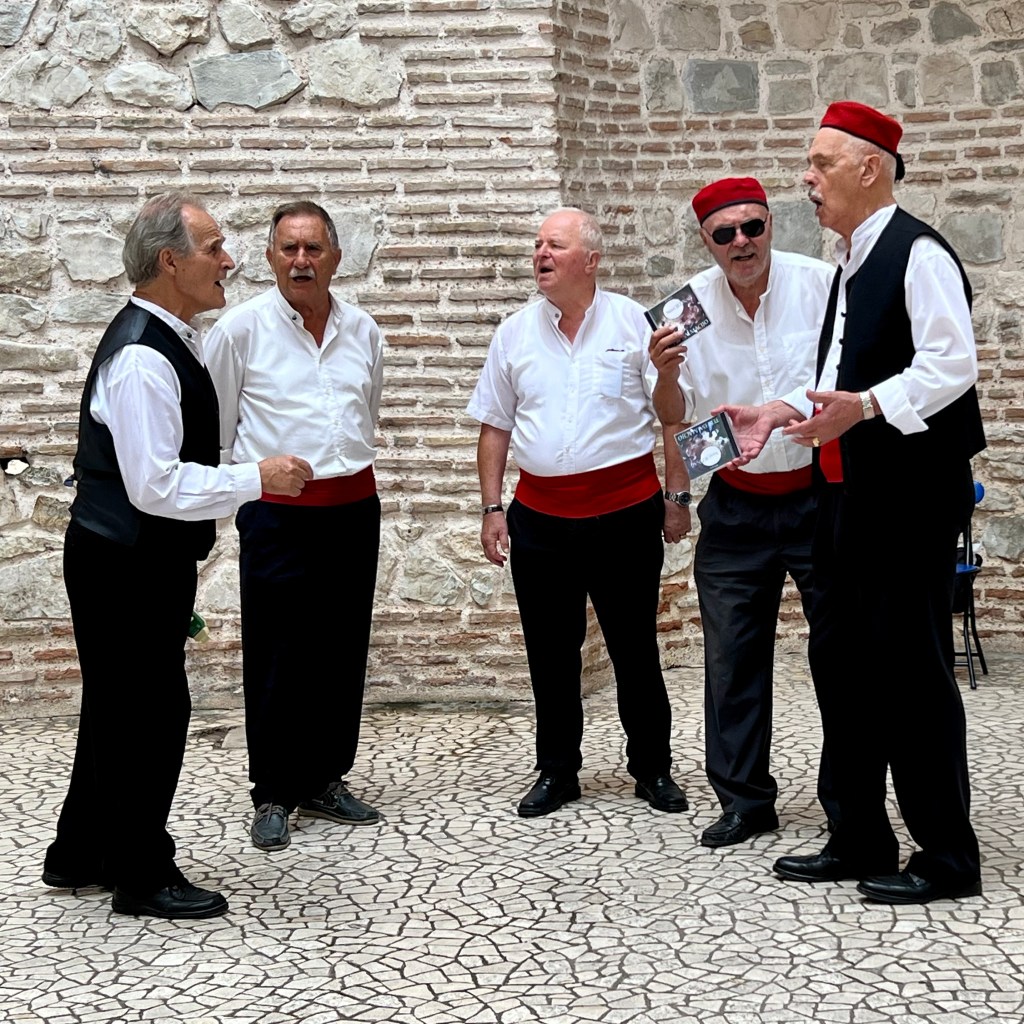
It’s Sunday so the church isn’t open for tourists until noon so we’re off to explore. Another Klapa group is in the Vestibulum so we give them a listen and I take another selfie, this time with the open ceiling as my halo; hmm not sure I look all that angelic.
Another day another Klapa groupMy halo is crooked!
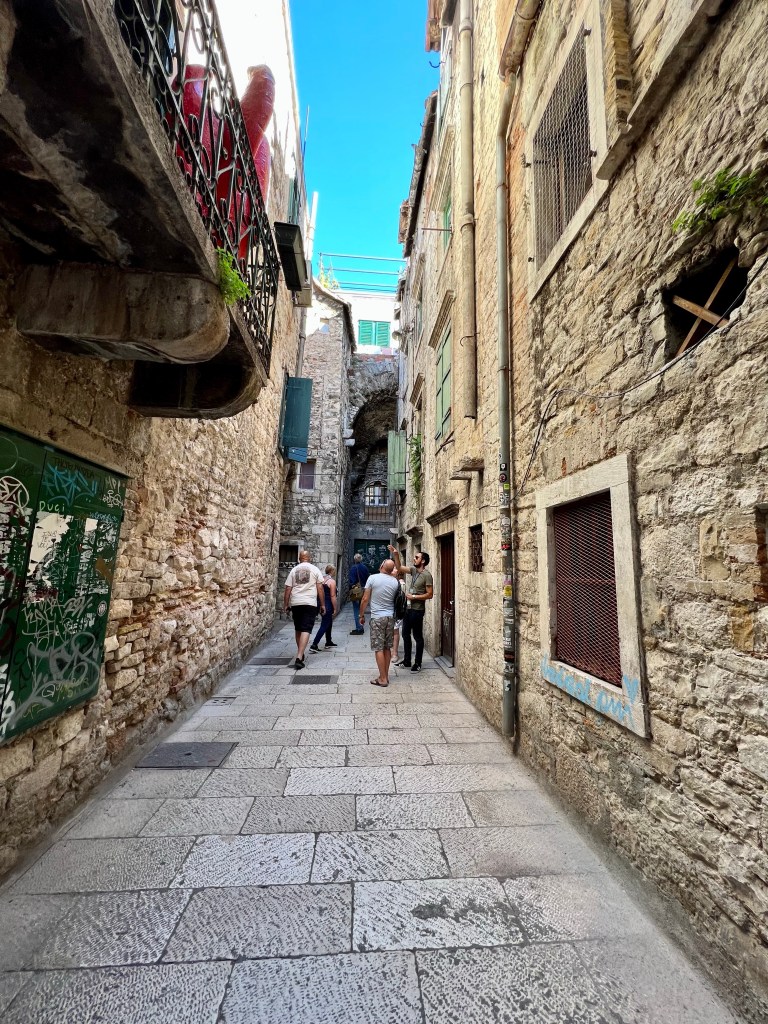
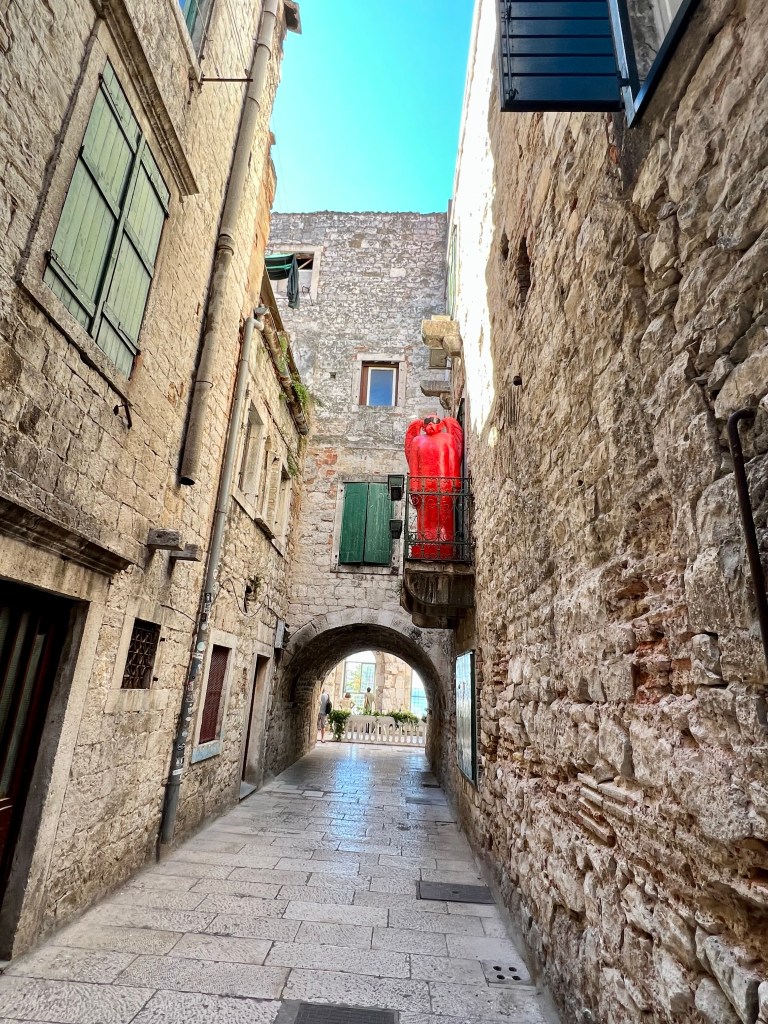
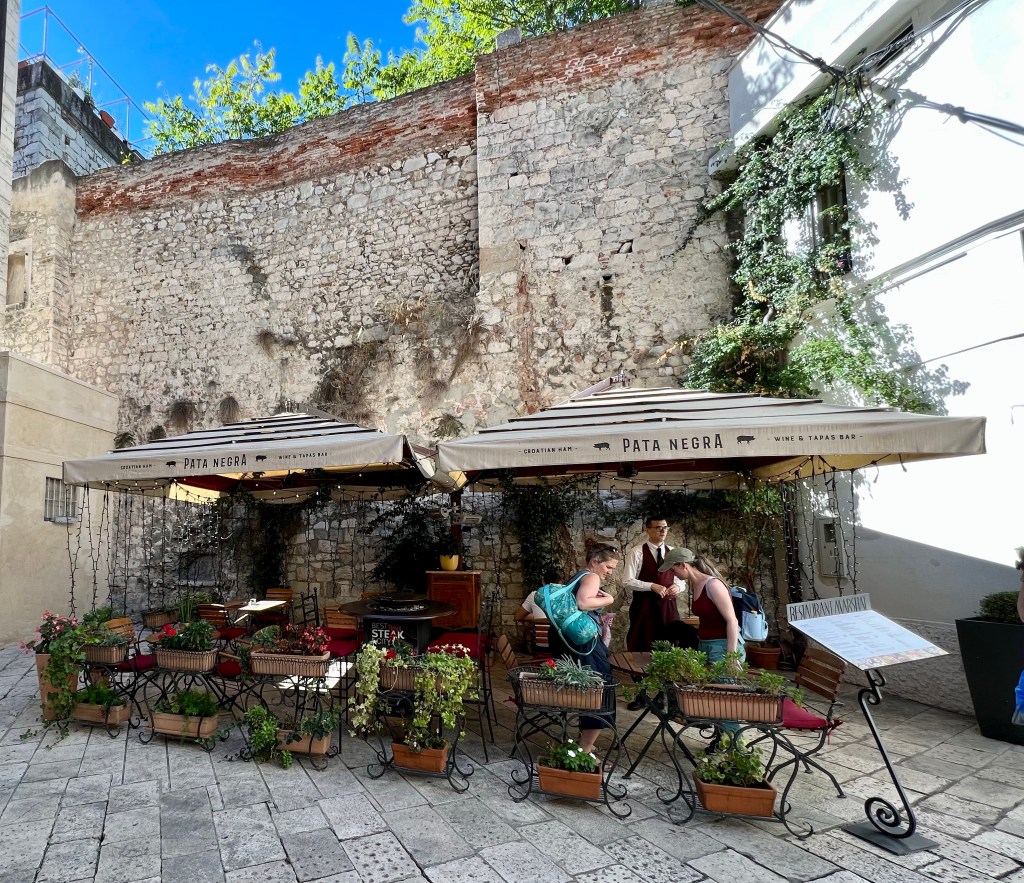
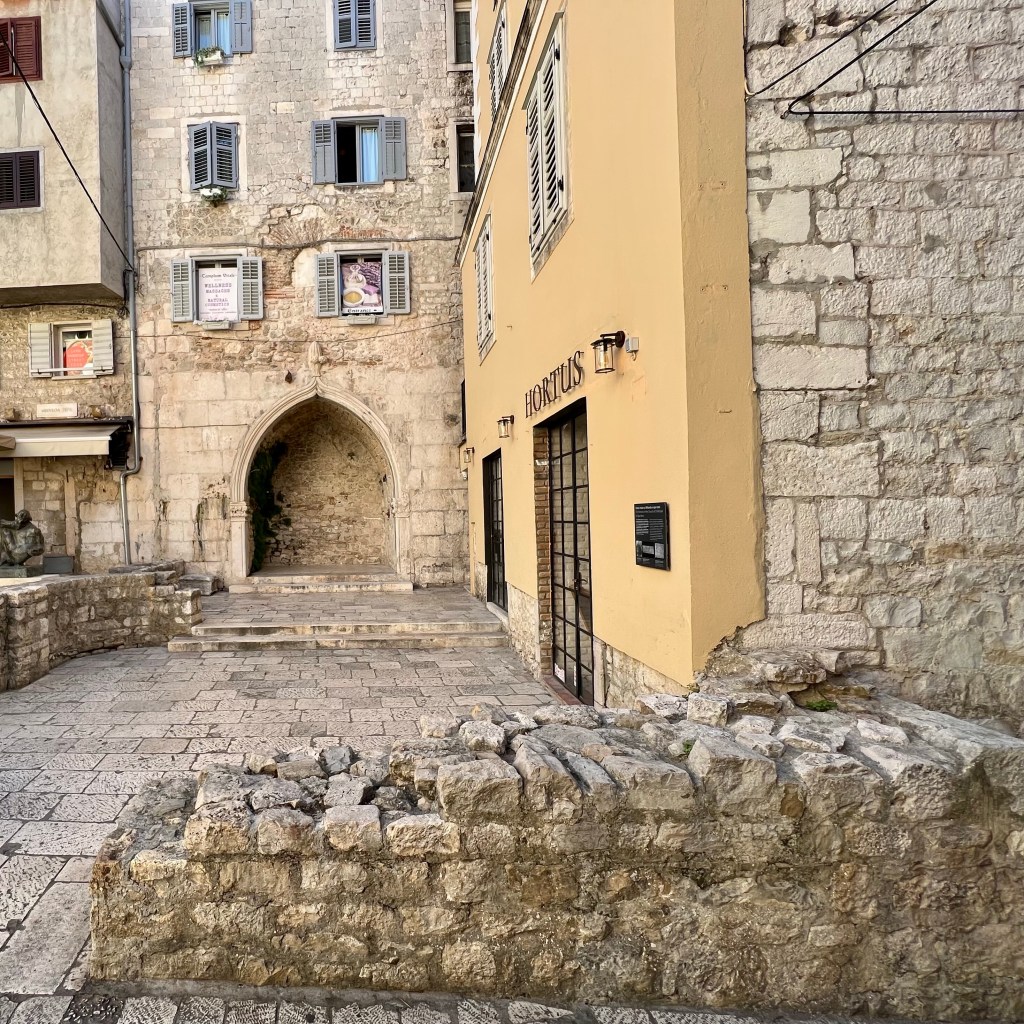
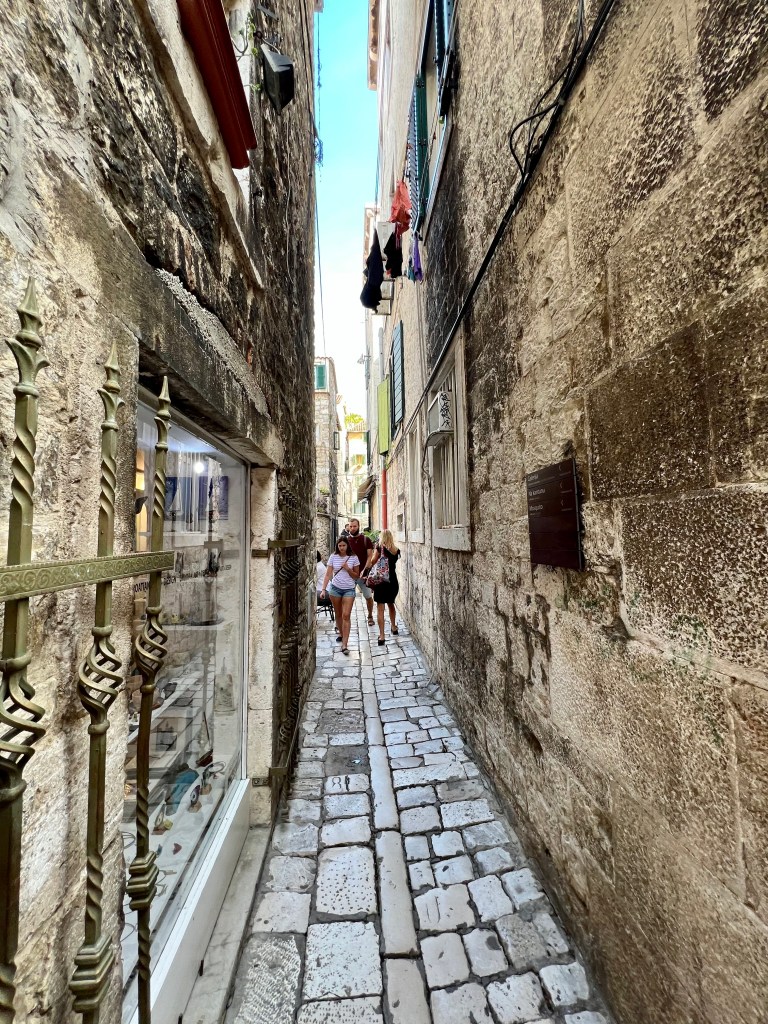
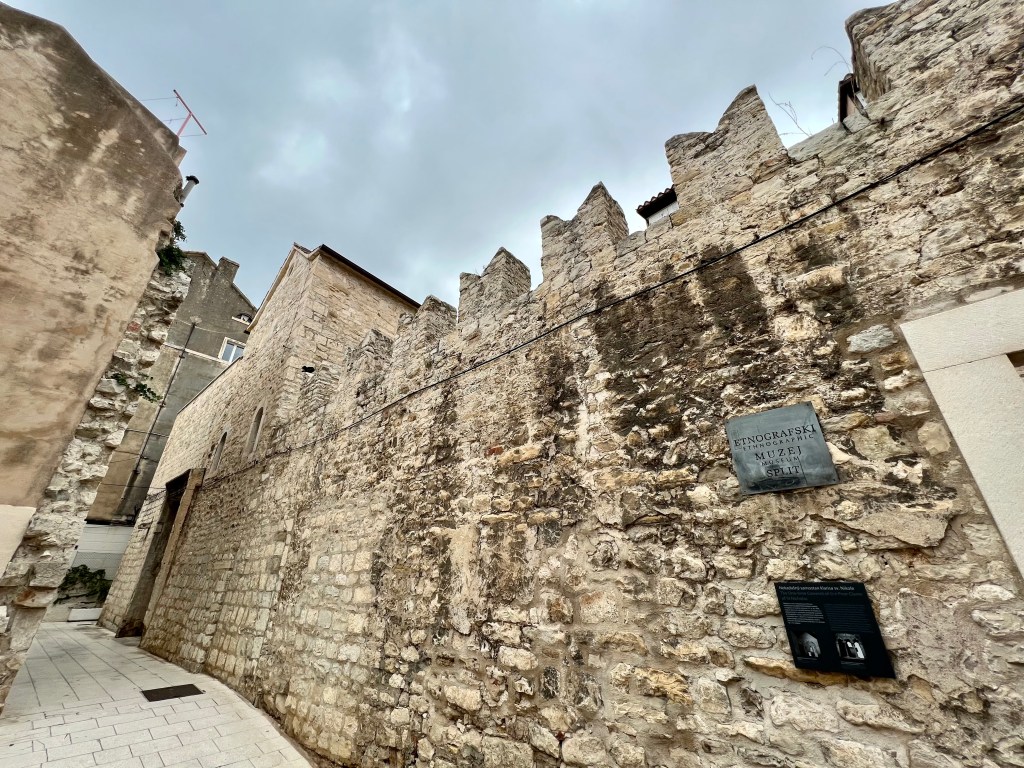
Time to explore the back streets and alleys where there are waaay fewer people and some interesting sites. We weave in and out of the Palace in our wanderings on a beautiful day under bright blue skies which make the white limestone city sparkle.
Off the Beaten PathExploring the periphery
Along the way, we stumble on what remains of the Church of St Michael in Rita Maris (on the coast). Tradition says that this was commissioned by the first archbishop of Split, John of Ravenna. All that remains of the of the 15th century church is the Gothic apse carved into the western wall of the Palace.
Remains of the Church of St Michael in Rita Maris
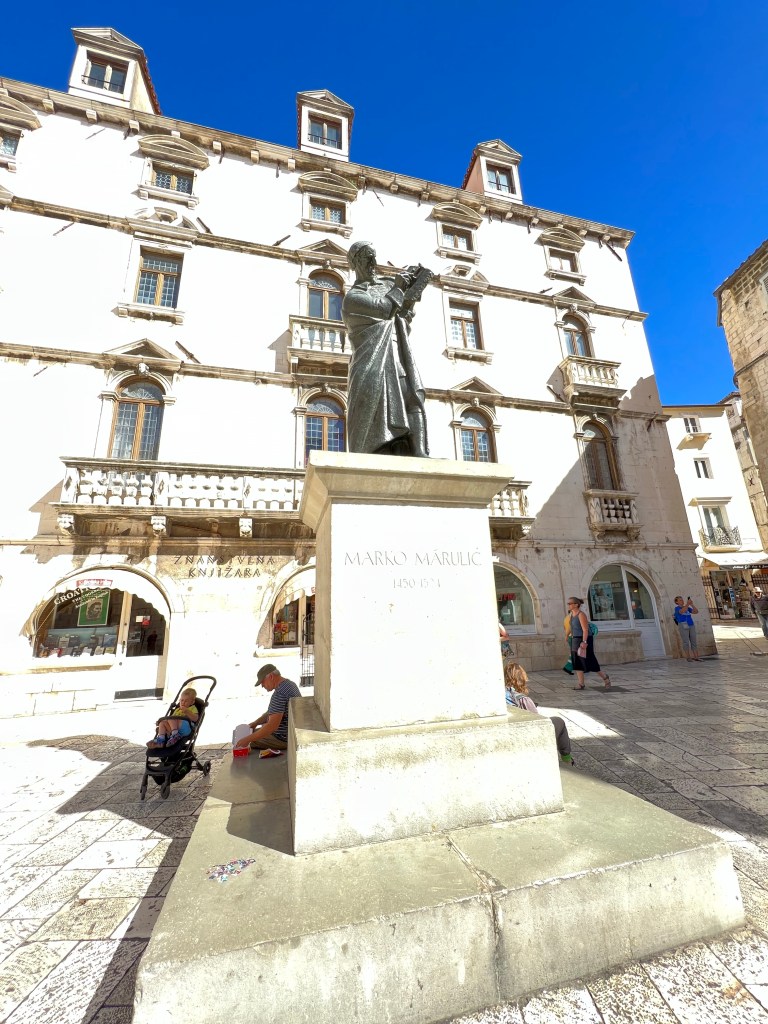
We also meet Marko Marulić (or at least his statue) in Fruit Square. Marko Marulić Splićanin was a Croatian poet, lawyer, judge, and Renaissance humanist who coined the term “psychology”. He is the national poet of Croatia and many credit him with the Croatian Renaissance. The statue is yet another example of Ivan Mestrovič’s handiwork.
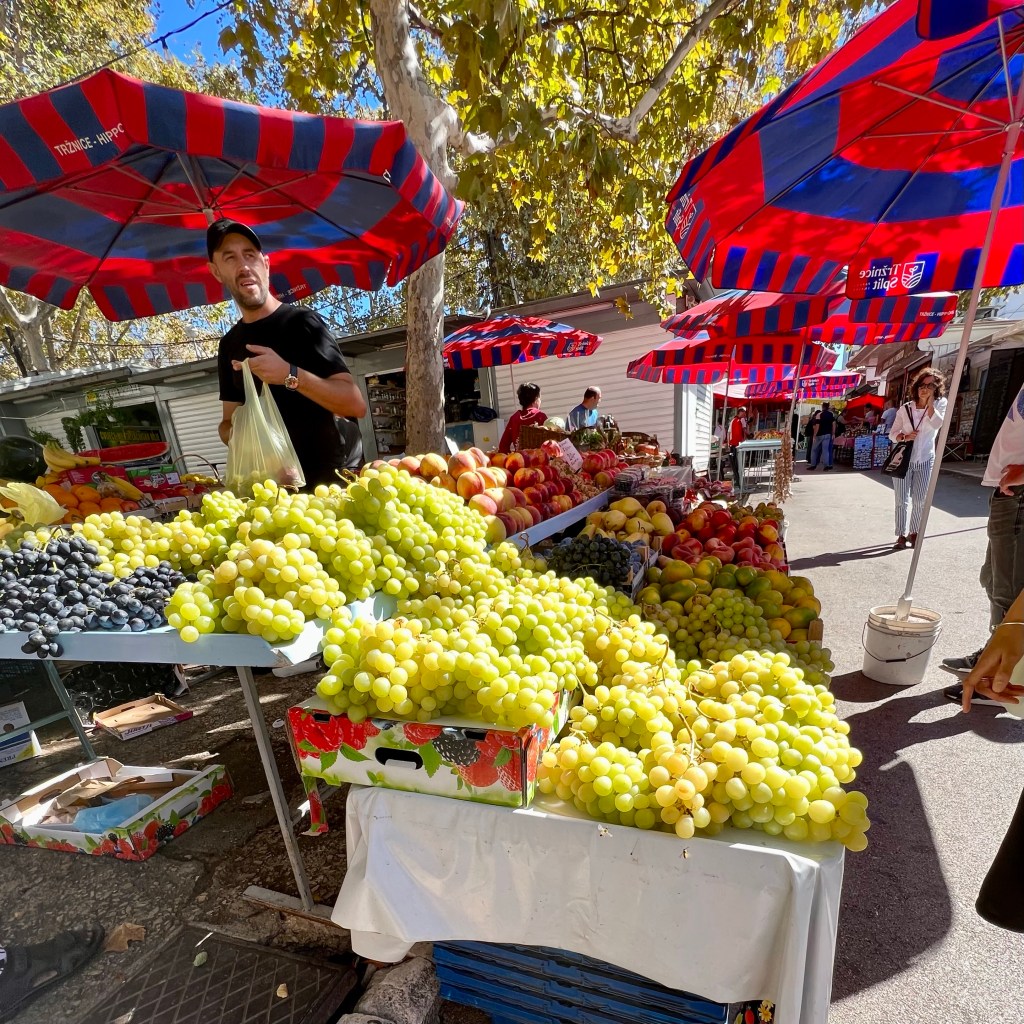
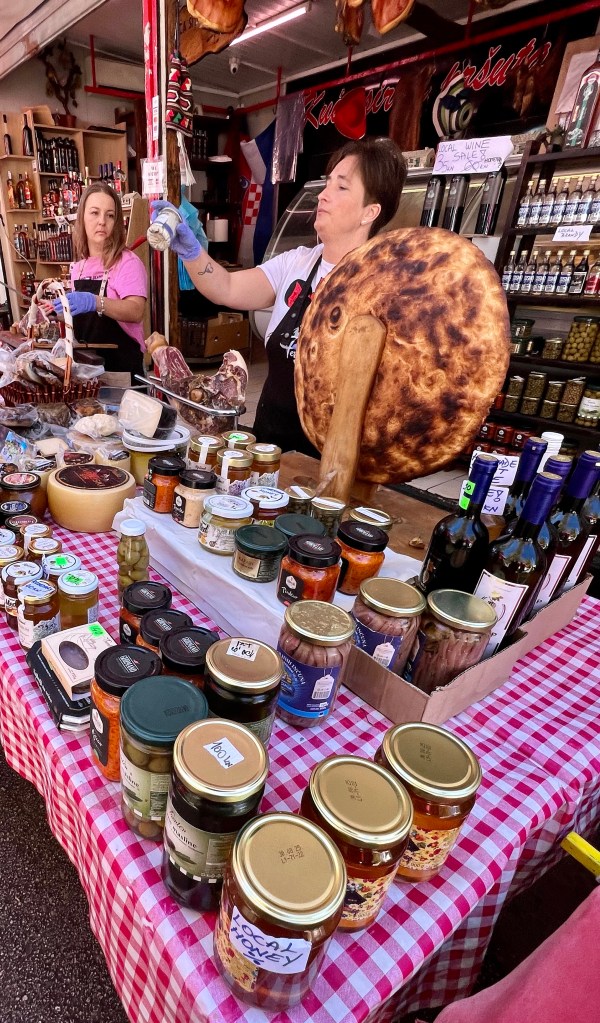
We end up behind the palace at the Green Market where there are a range of fruit, veggies and other edibles displayed for sale. We’re a bit too late for the early morning fish vendors who have sold out of their catch of the day.
Green Market Offerings
The wall in this area is not as well preserved so it’s easier to see how the homes within the wall are built.
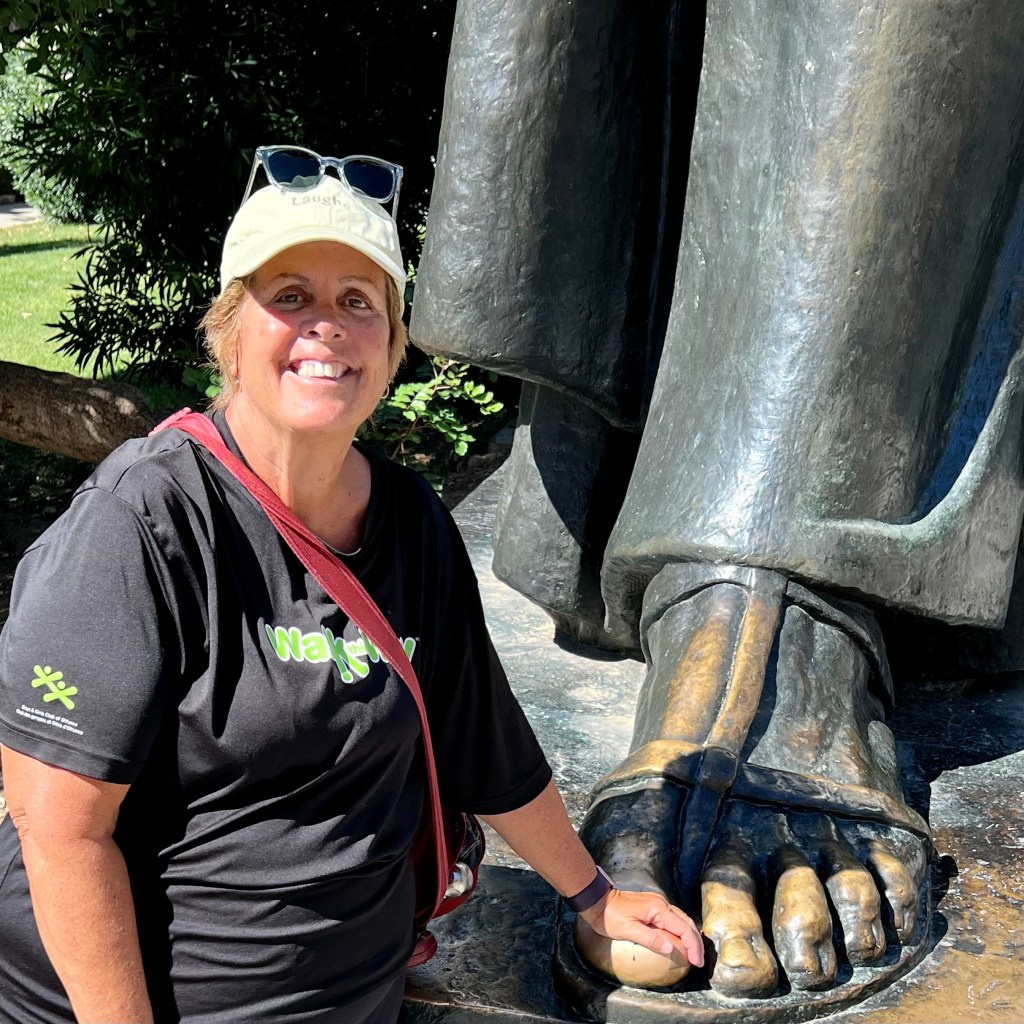
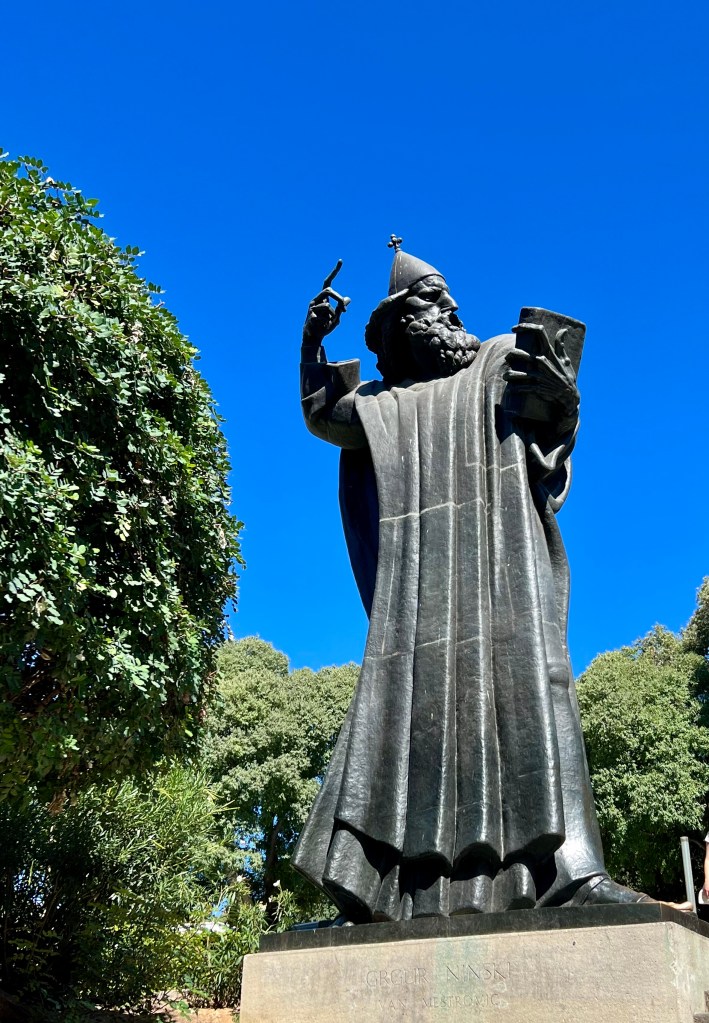
Before heading to the cathedral, we detoured to Grgur Ninski’s statue for another toe rub and another wish. If Tanya is right about his 50% success rate, this one might not be realized but still worth a shot!
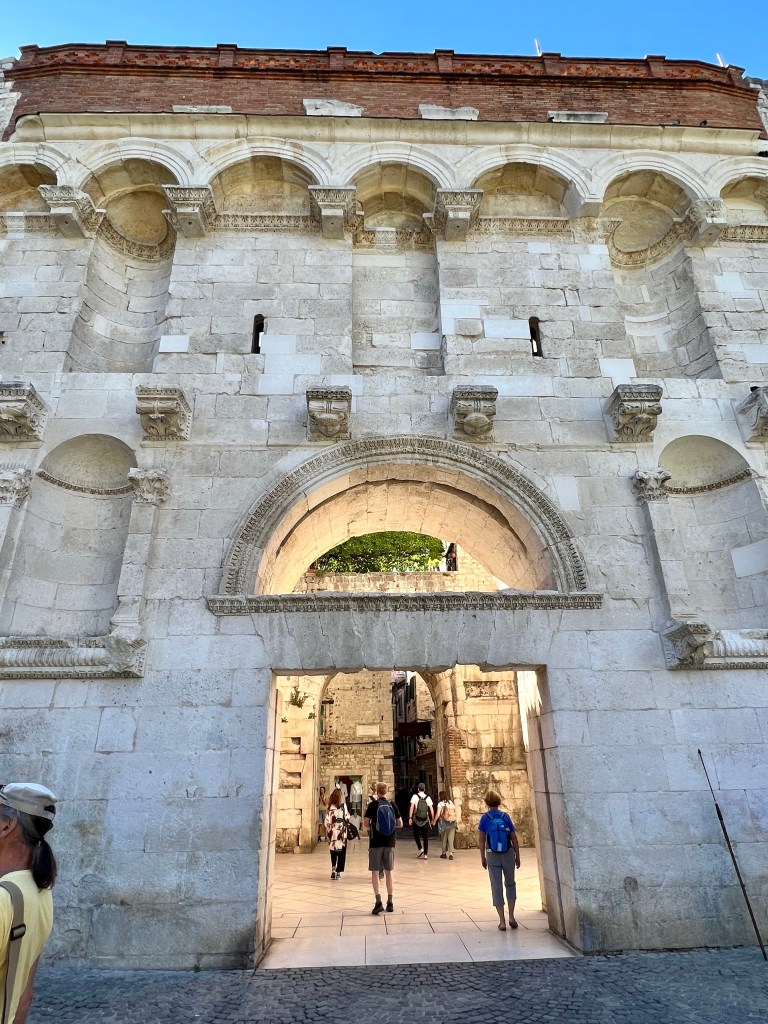
After snapping a few pics at the gate, we set off for the chocolate shop to replenish our supplies in case we don’t come back this way.
North GateFlirting with historyBetween the walls
Continuing our explorations, we stumble across The Church of St. Martin; one of the first little churches in Diocletian’s Palace. It was built in the 5th/6th century in the sentries’ walkway above the Golden Gate, and was remodelled many times.
The Church of St. Martin
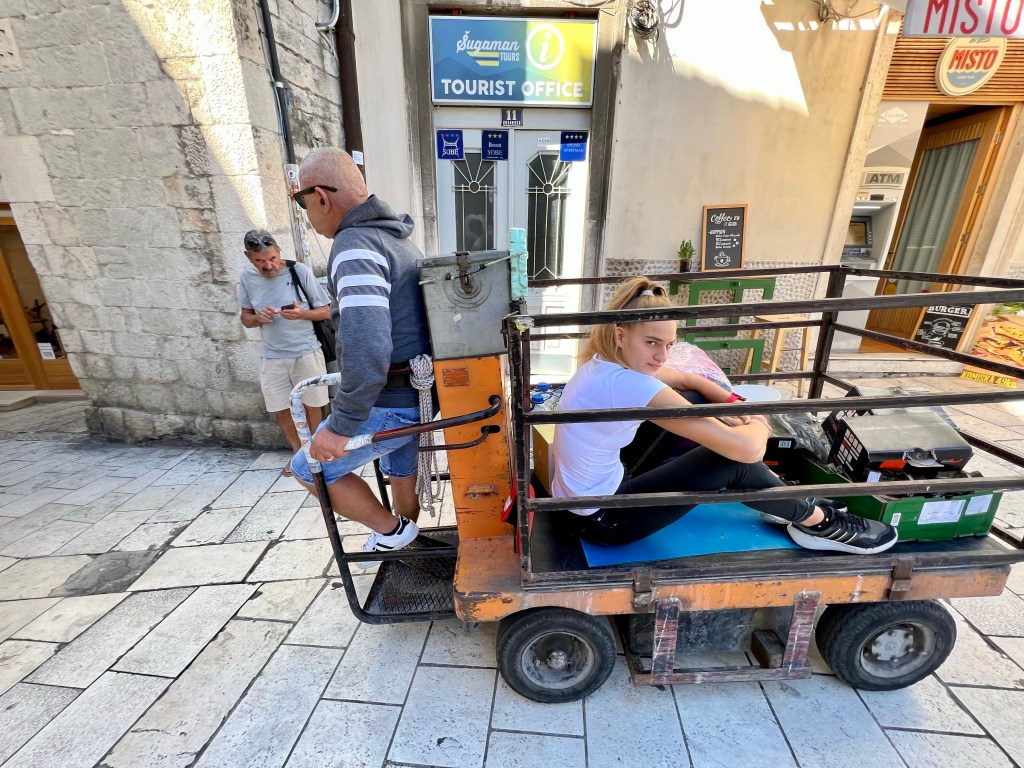
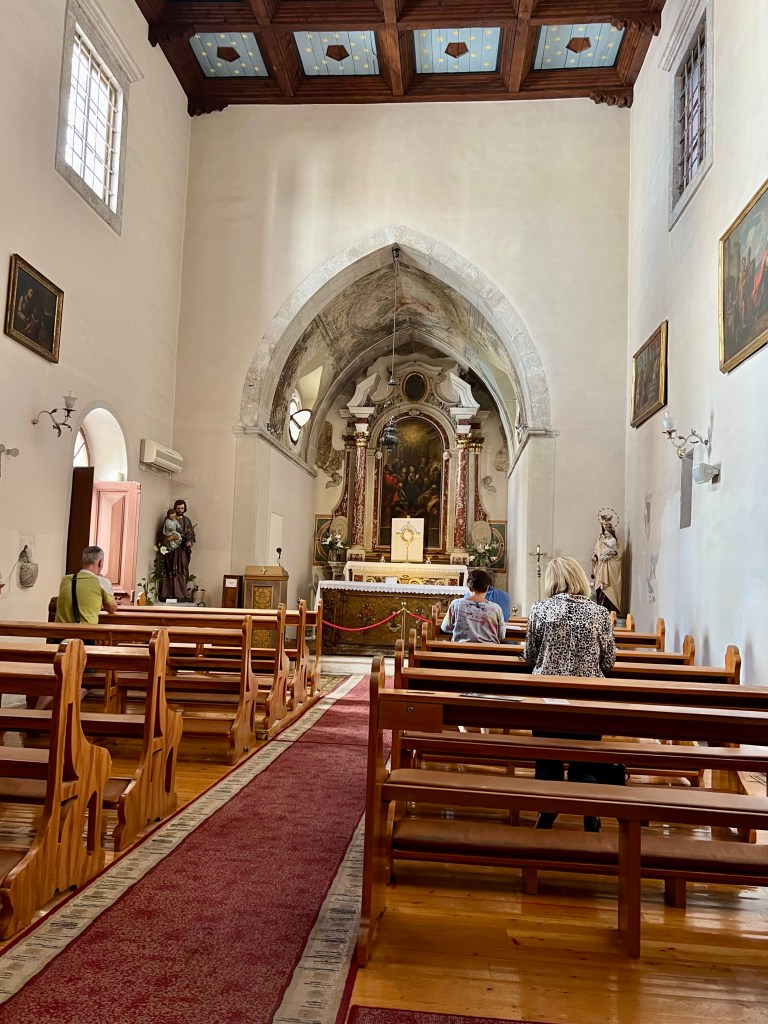
Lots more sights and sounds, including an interesting mode of transport and a small medieval church located in the northwestern part of the historic city center; the Holy Spirit which dates from the 11th century.
Wow, the sky is soooo blue!Split “taxi”Church of the Holy SpiritInside the Church of the Holy Spirit
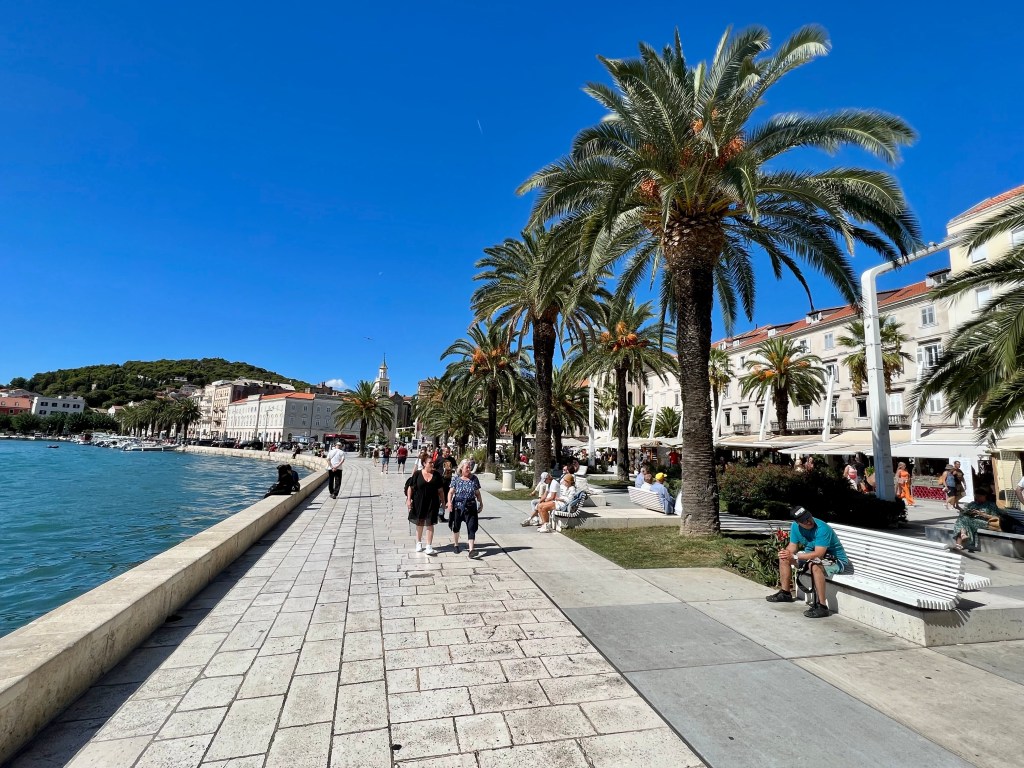
We eventually ended up on the Promenade with the beautiful people walking along the edge of the water sparkling in the sun. Soon enough it’s time to head back to the Cathedral to go inside for a better look.
Views along the Promenade
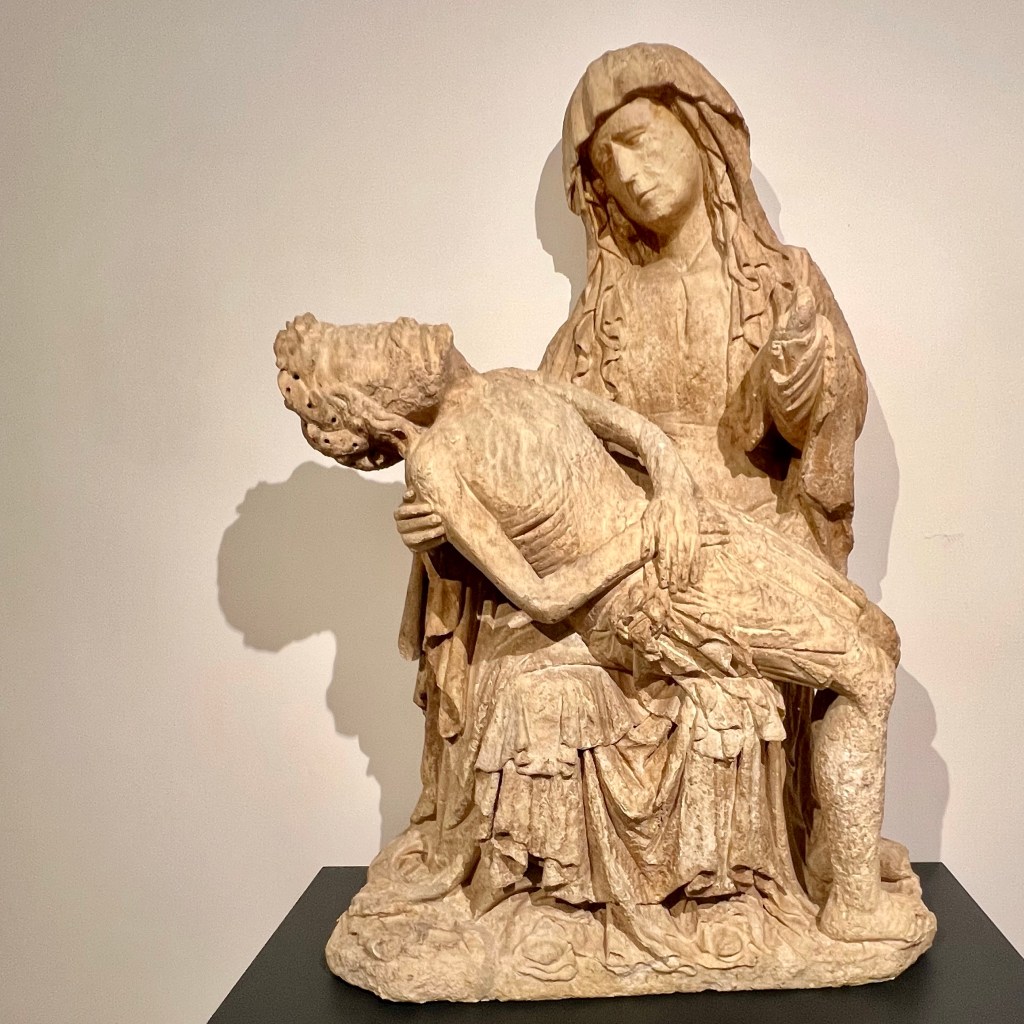
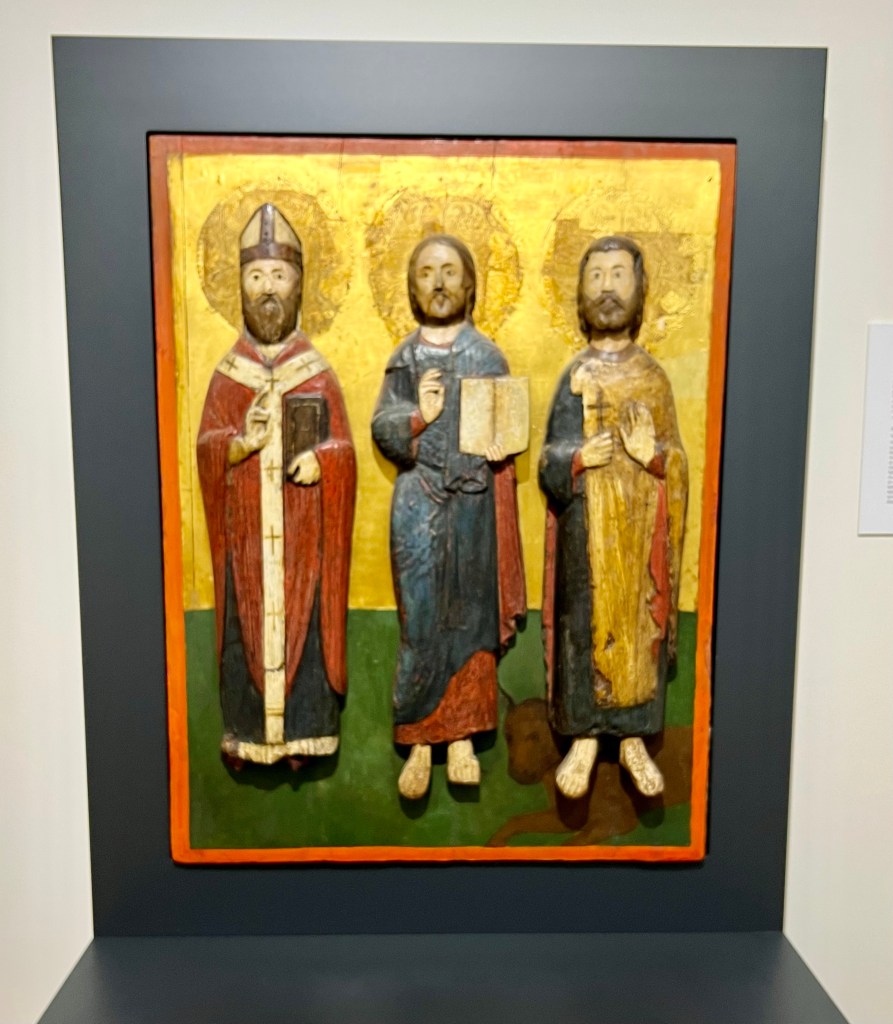
I started my exploration in the Treasury housed in the medieval palace of the ancient Lucaris patrician family; originally a circular Roman pagan temple dedicated to the mother goddess Cybele. Split Cathedral Treasury boasts one of the most valuable ecclesiastical collections in this part of Europe. Here are a few of my faves.
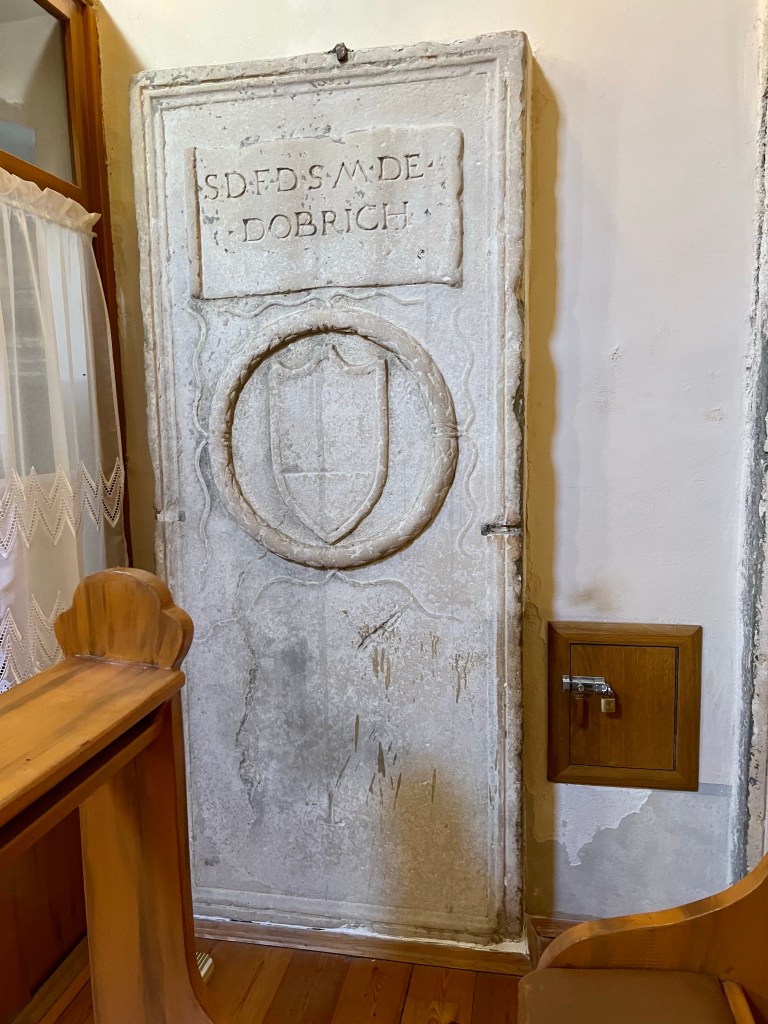
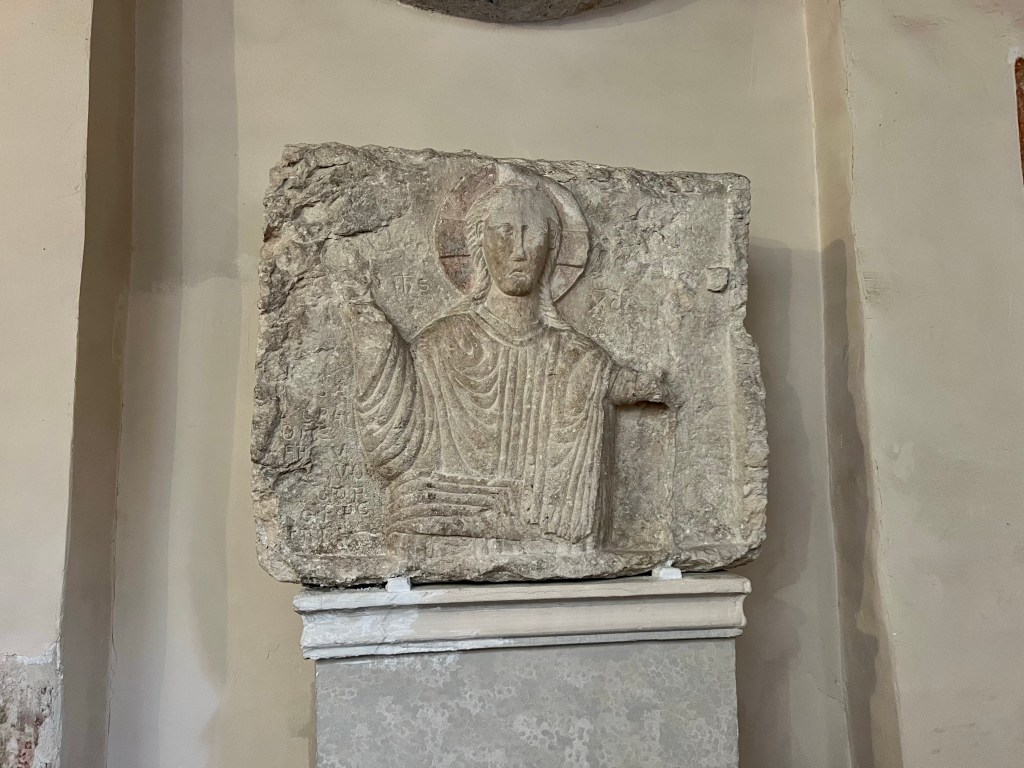
Statue of the Pietà Altar from the Church of Our Lady of BethlehemTombstone of Janko AlbertiOur Lady of the Bell TowerThree Patron Saints – St. Dominus, Christ and St. Anastasius Arm Reliquaries of St. Dominus
Next stop was St Lucy’s Crypt; located under the Cathedral of Split with the same circular plan as the church above with rectangular niches and a vaulted dome. The crypt is dedicated to holy Lucie of Syracuse; one of the last victims of Christian persecutions under the reign of Diocletian.
Panoramic view of the CryptAltar to St. Lucie
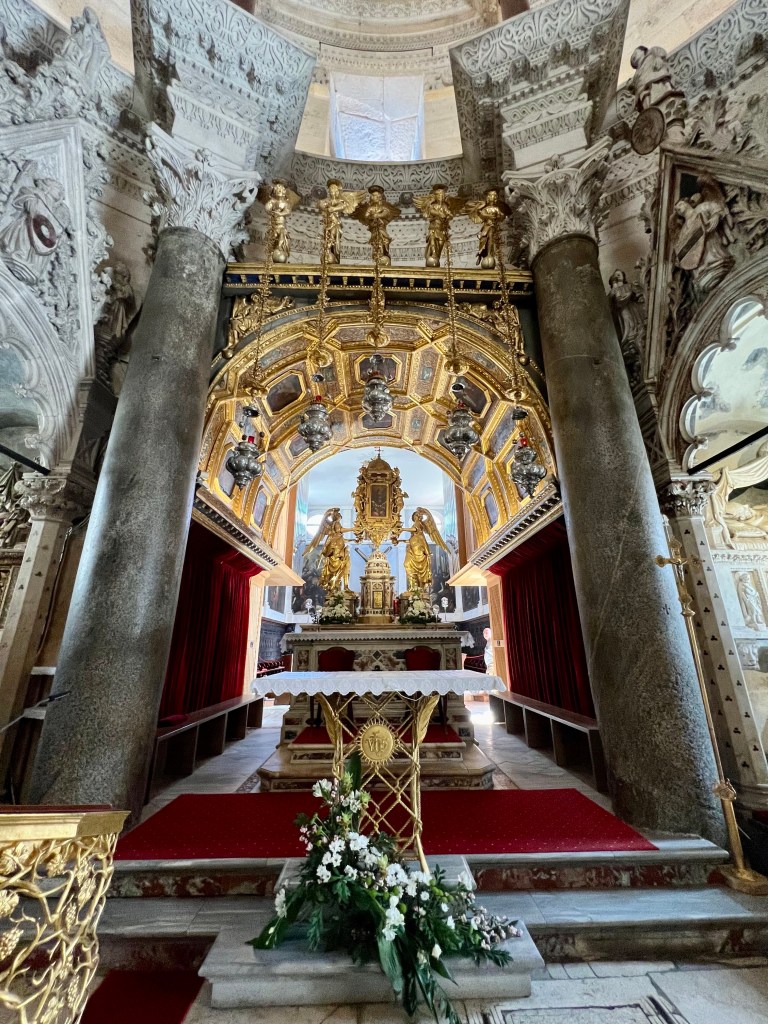
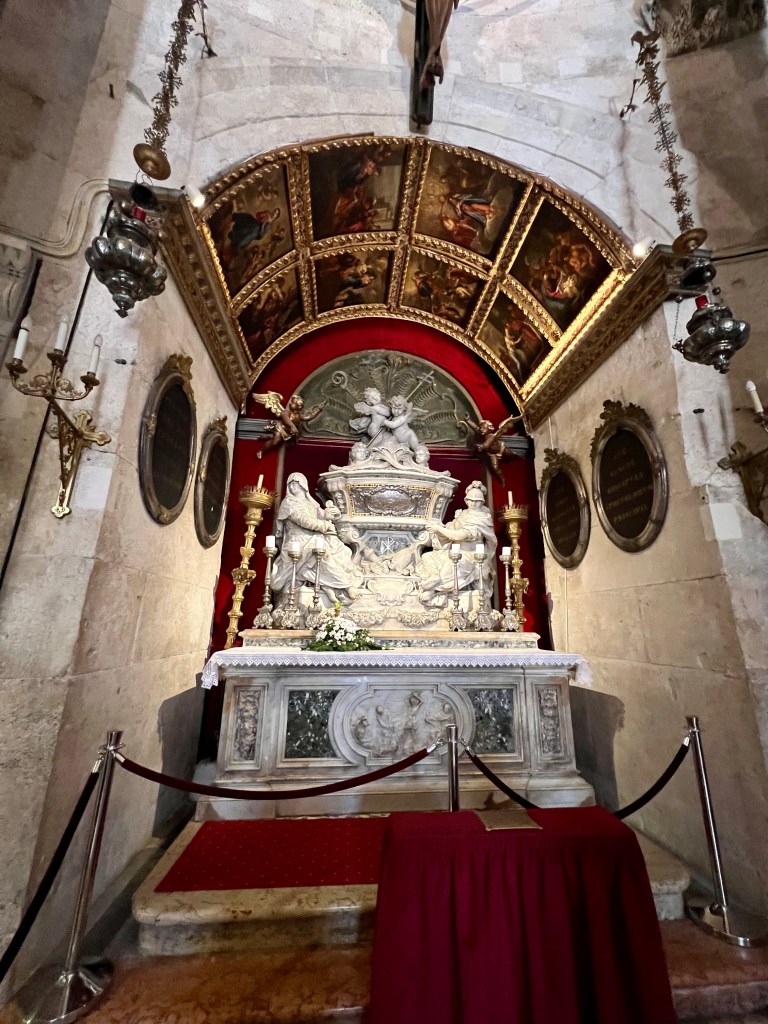
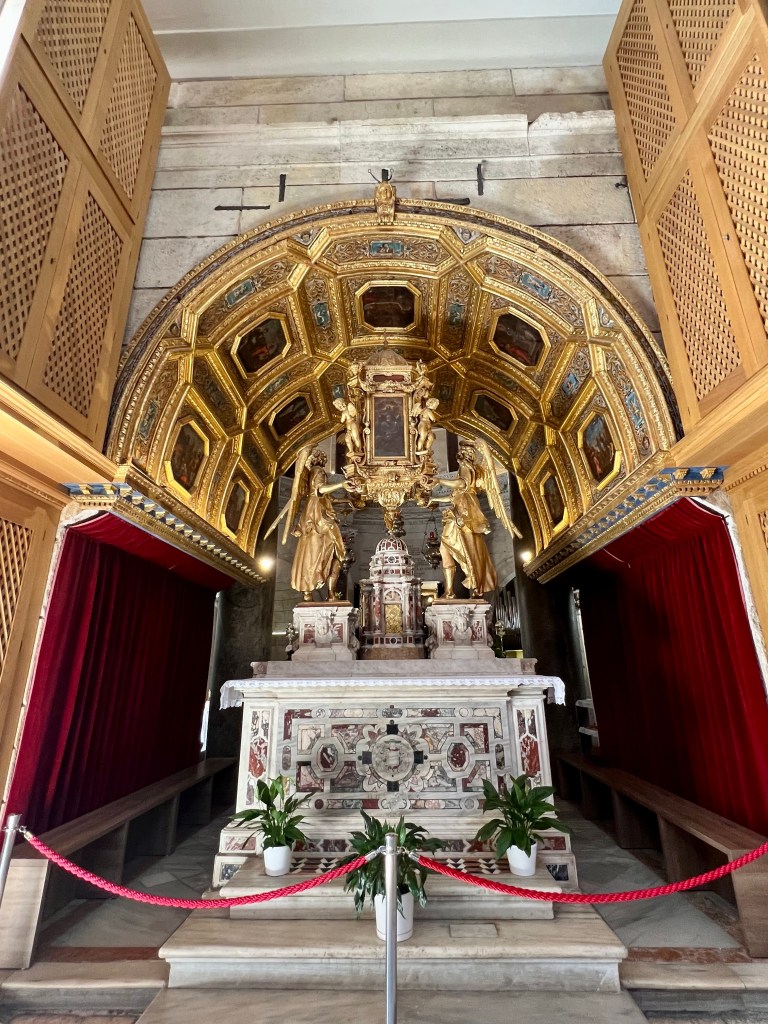
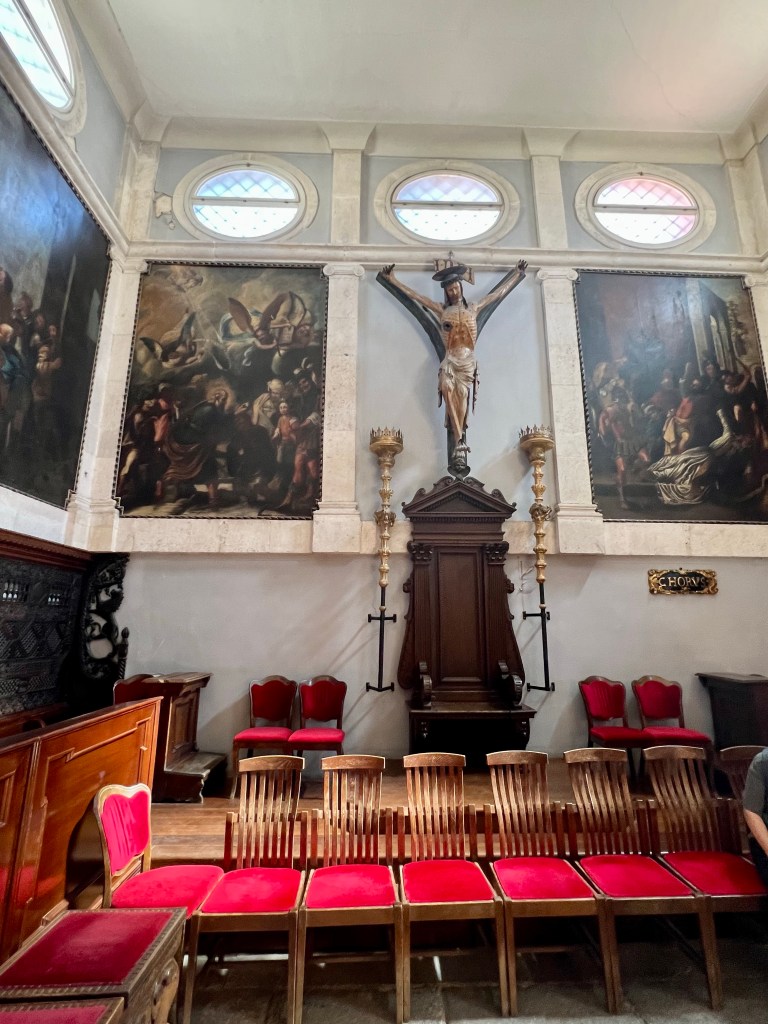
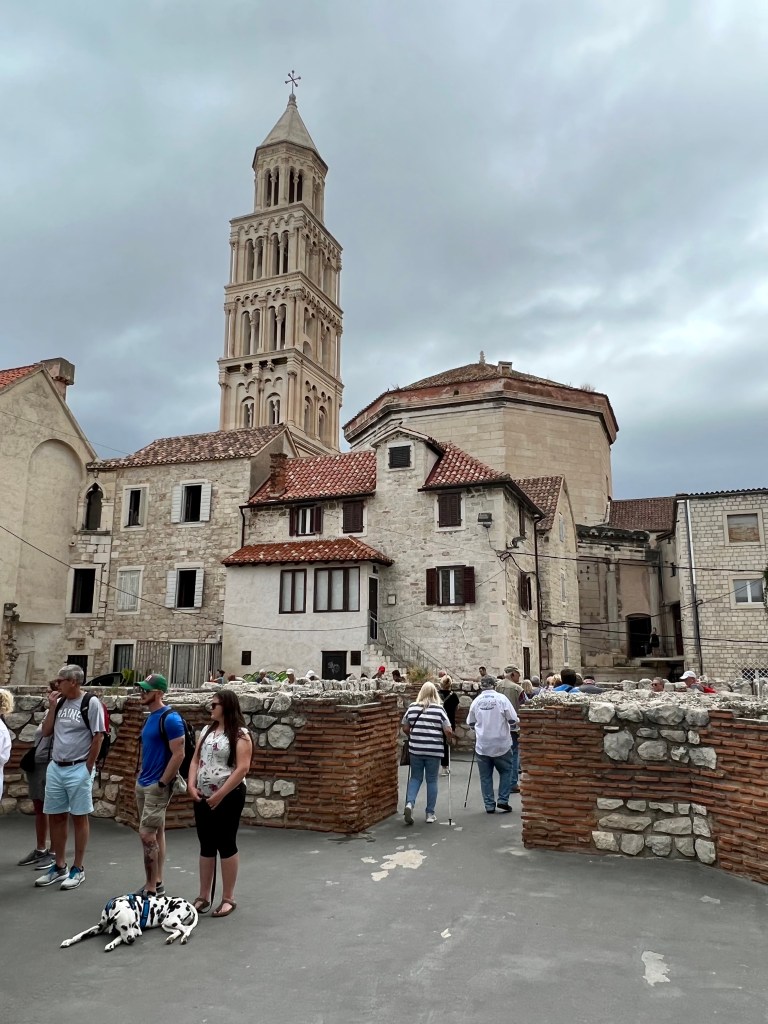
My third stop was the Cathedral of Saint Dominus; consecrated at the turn of the 7th century AD and regarded as the oldest Catholic cathedral in the world that whose original structure remains in use. The structure itself was built in AD 305 as the Mausoleum of Diocletian. The church is magnificent inside and has a beautiful choir loft behind the altar. I decided to skip the bell tower as my dislike of narrow spaces and heights made it a nonstarter.
AltarRounded ceilingAltar of St. AnastasiusAltar dedicated to St. DomniusAltar from the back in the ChorusCrucifix
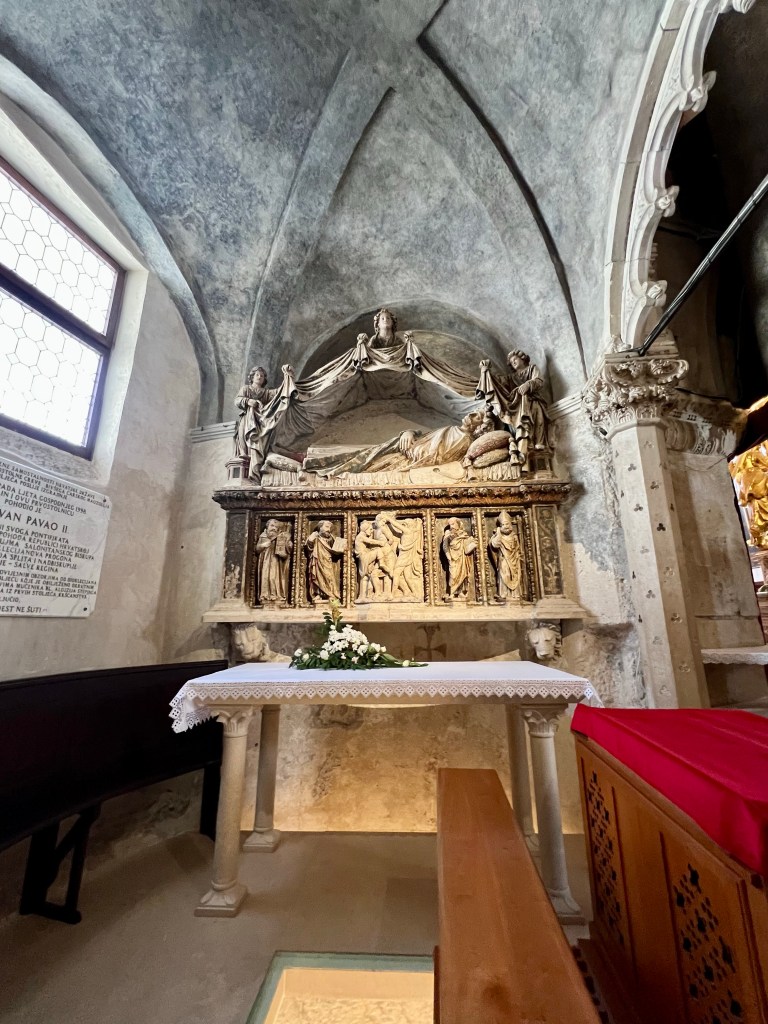
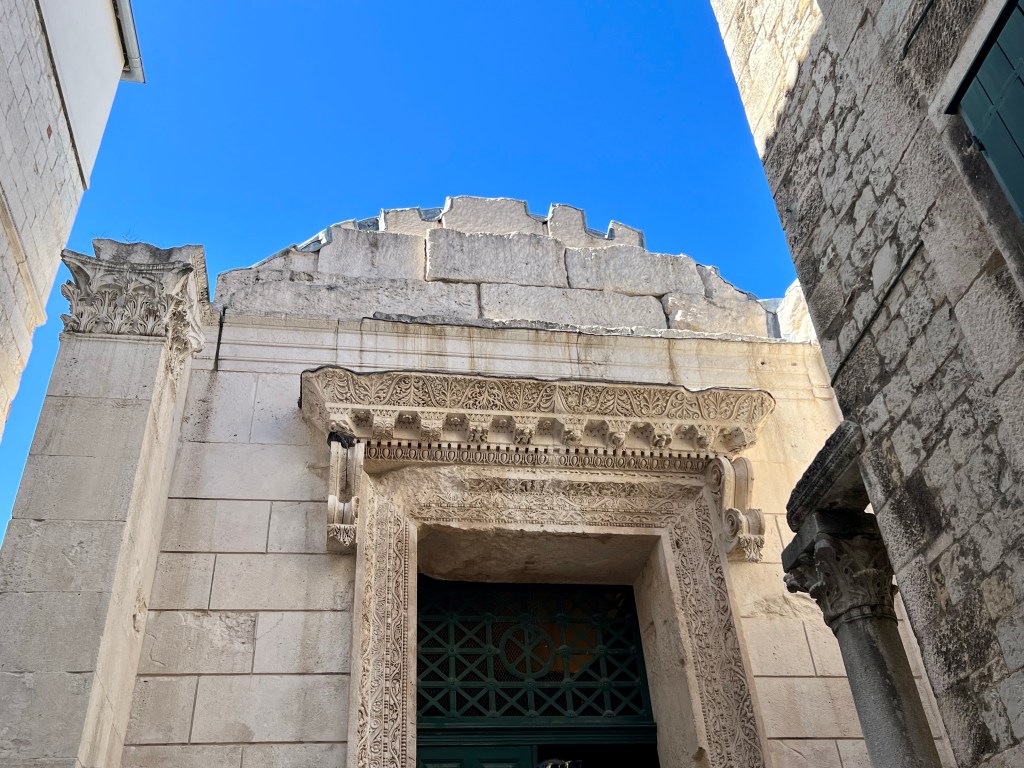
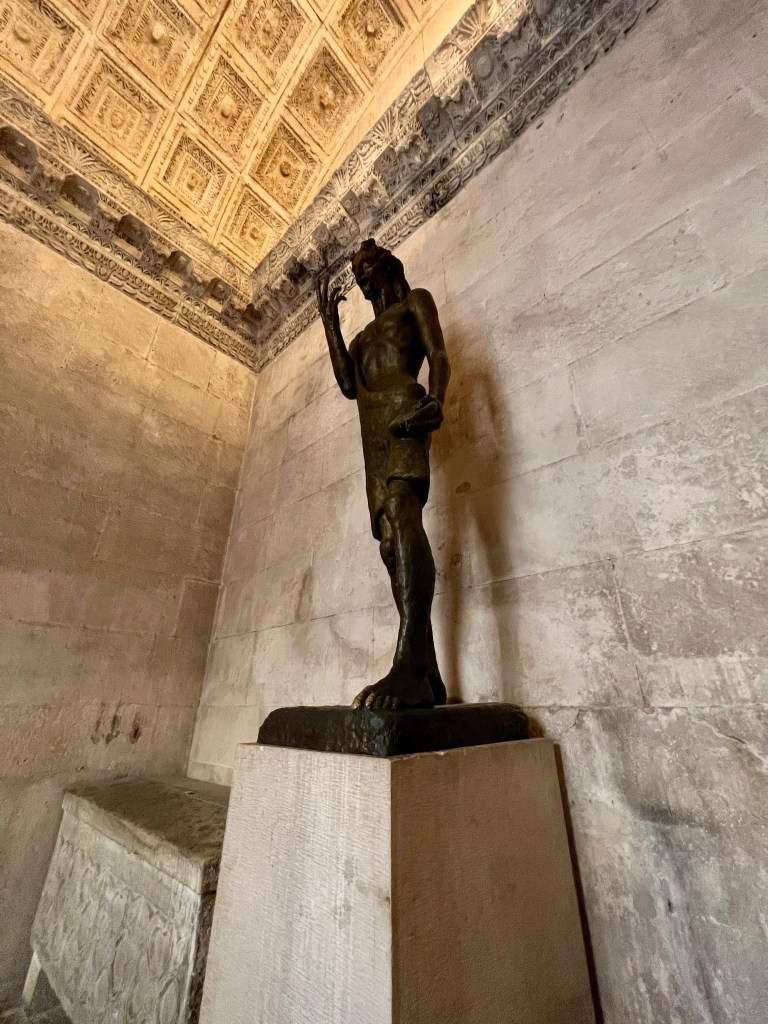
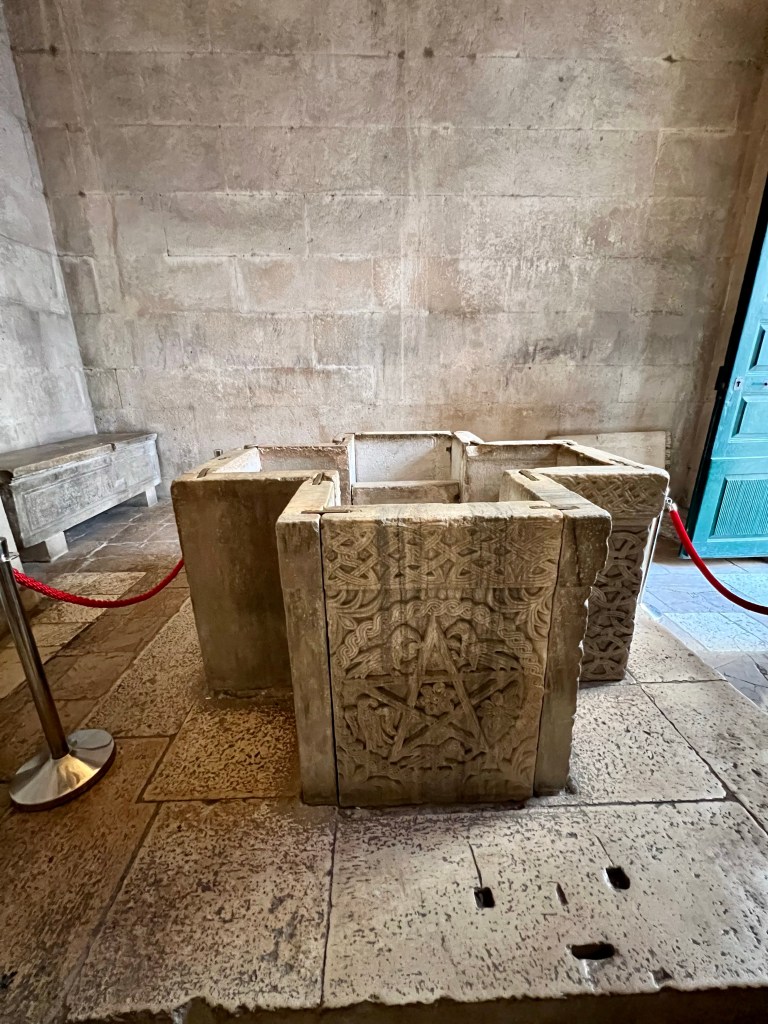
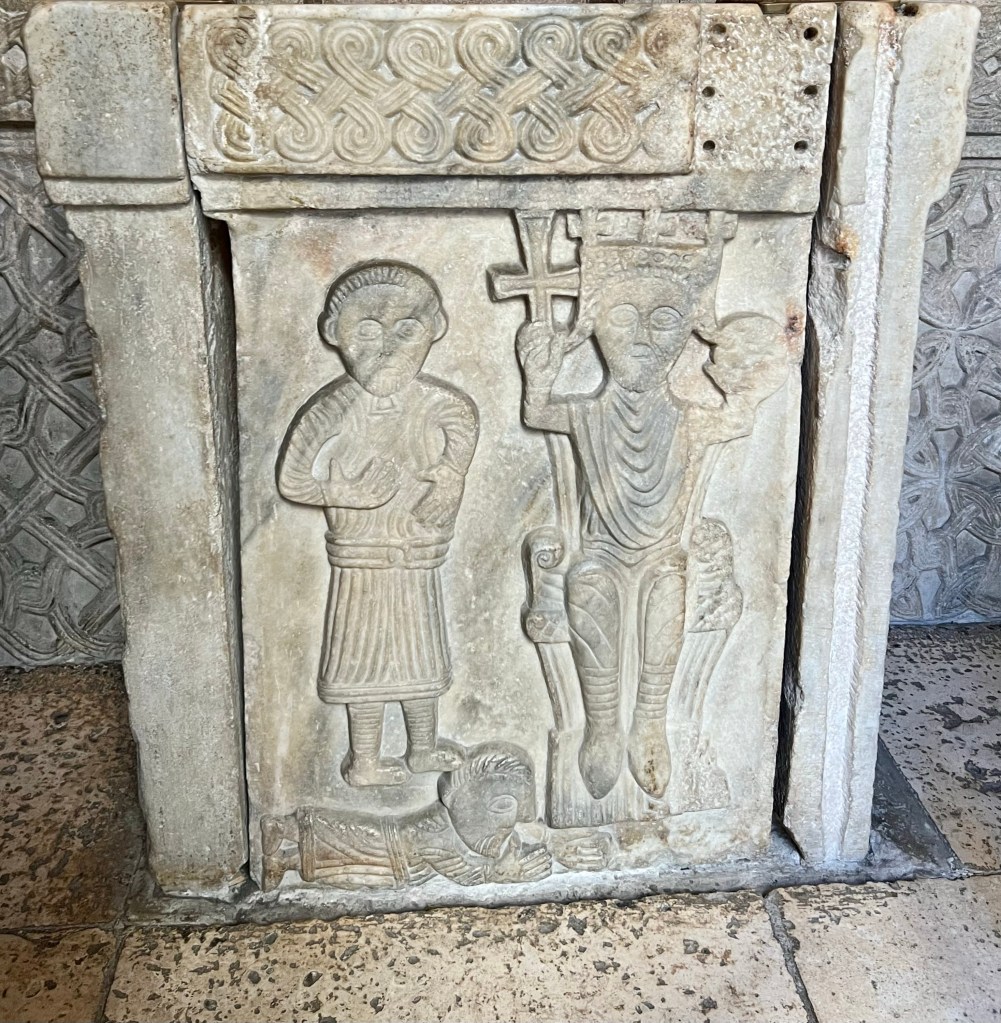
My last stop was the Temple of Jupiter. The temple was built between 295 and 305, during the construction of the Palace, and was turned into a Baptistery of St. John the Baptist in the 6th century. Before the entrance to the Temple is one of the twelve sphinxes brought from Egypt by Emperor Diocletian. Sarcophagi, containing the remains of two Archbishops of Split, Ivan of Ravenna (died c. 1059) and Lovre (died c. 1099), are placed inside the Temple. In addition, there is a large bronze statue of St. John the Baptist made by our friend Ivan Meštrović. A Renaissance sarcophagus of Jakov Selembrije from the 16th century is in front of the baptistery.
Entrance to Temple of Jupiter/Baptistery John the BaptistBaptismal FontBaptismal Font Up Close
Being a tourist is thirsty work so I find Linda and together we head to the courtyard of Konoba Laganini for a light lunch and a glass of rosé. We both opt for a burrata salad with adriatic shrimp, cherry tomatoes, purple onion cream, black olive powder and basil. As scrumptious as it is beautiful and we still have room for some gelato later …
Lunch!
No gelato but we did stop for another glass of rosé at a lovely café on the Promenade before heading back up the hill toward the VRBO. We were trying to find a wine store but ended up at a different wine store where we bought a couple bottles of local wine we thought would be good; they were not! One ended up down the sink and the other was marginally better when paired with the left over charcuterie items from the previous night. Yikes!
My turn to be the cribbage champ before retiring for an early night so we can hit the ground running in the a.m.
Tomorrow is another day. Adventures await…
September 19, 2022
So yesterday’s preparations for today’s tour meeting place were for naught. We arrived with plenty of time to spare but the bus was not well marked and our meeting spot not really well defined. Despite the challenges, miraculously we did find the bus and our tour guide in time to board just a few minutes late.
We’re off to Krka National Park with a stop in the nearby city of Trogir – aka Little Venice. Trogir has a well preserved old town that lies on a small island connected to the mainland and the island of Čiovo by bridges. The historic centre of Trogir has been included in the UNESCO list of World Heritage Sites since 1997.
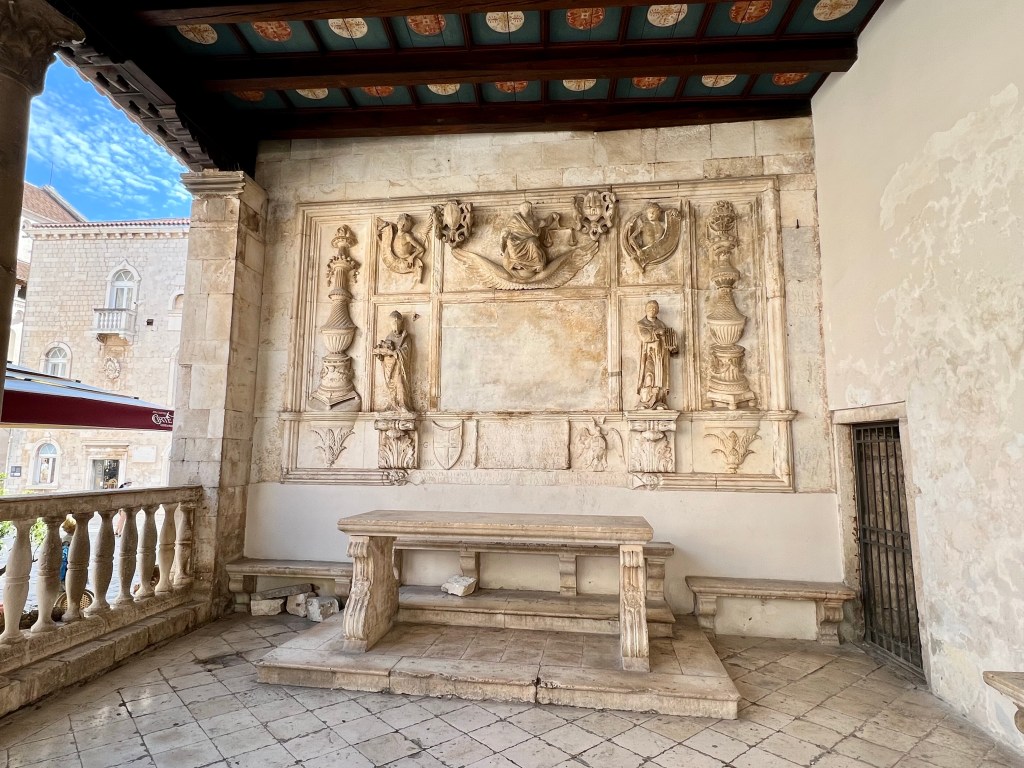
We passed by the 13th century Cathedral of St. Lawrence to reach the Town Loggia for the requisite history briefing. The Loggia was not only a public gathering space, but, on occasion the seat of the town’s court. The judge, seated at the table on the eastern wall, would decide the case under the watchful gaze of Justice flanked by St. Lawrence on the right and St. Ivan, patron saint of Trogir, on the left. The central field of the lion was removed in 1932 so that Mussolini wouldn’t think the city belonged to Italy.
Seat of Justice in the Loggia
On the south wall is a relief of Petar Berislavić, viceroy of Croatia (1513–1520). The original was destroyed by the fascist army and rebuilt in 1970 to commemorate the 450 anniversary of his death.
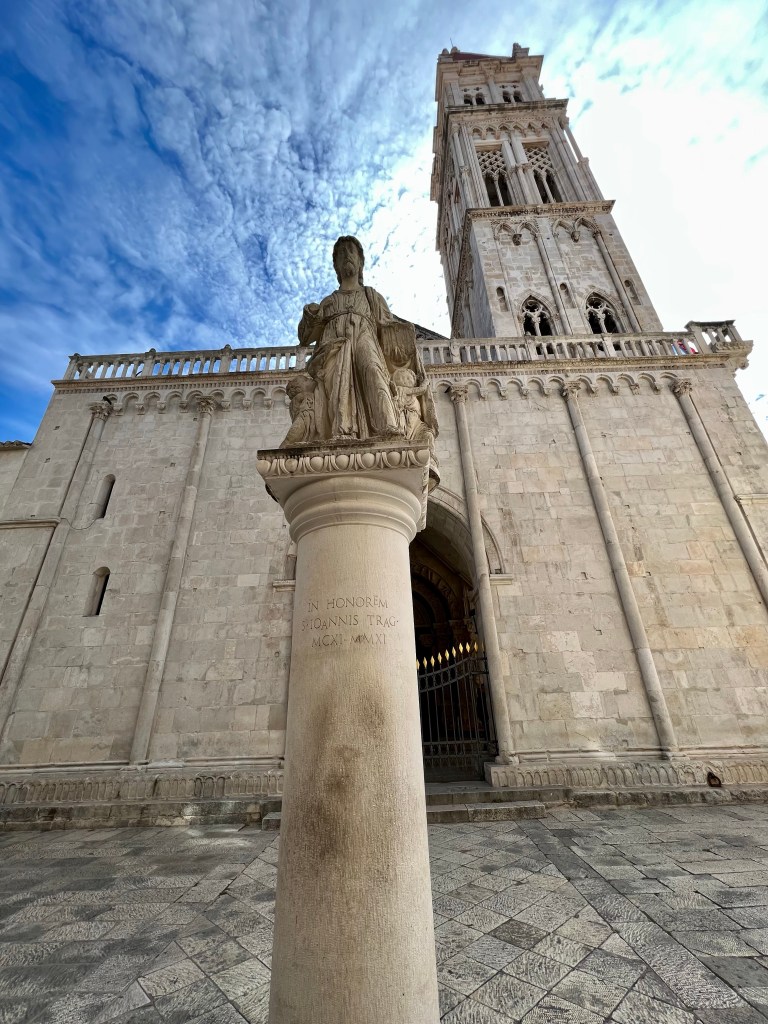
The largest building in Trogir is St Lawrence Cathedral. Building started in the 13 century and it was finally finished in the 16th century. The beautiful building is a mix of styles given the 400 years it took to build.
St Lawrence Cathedral
We’re having a whistle stop here so Linda and I wander around a bit, checking out the town. Our first “stop” is across from the cathedral; the Great Cipiko Palace is an ensemble of Romanesque buildings which were remodelled for the first time during the Early Renaissance ca. 1457.
Great Cipiko Palace
Next we stumble upon the Garagnin-Fanfogna Palace; two blocks of Romanesque and Gothic buildings, incorporated into the ensemble in the second half of the 18th century, according to the plans of Ignacije Macanovic. The Palace now houses collections of paintings and graphics from the 17th and 18th centuries as well as the Town Museum.
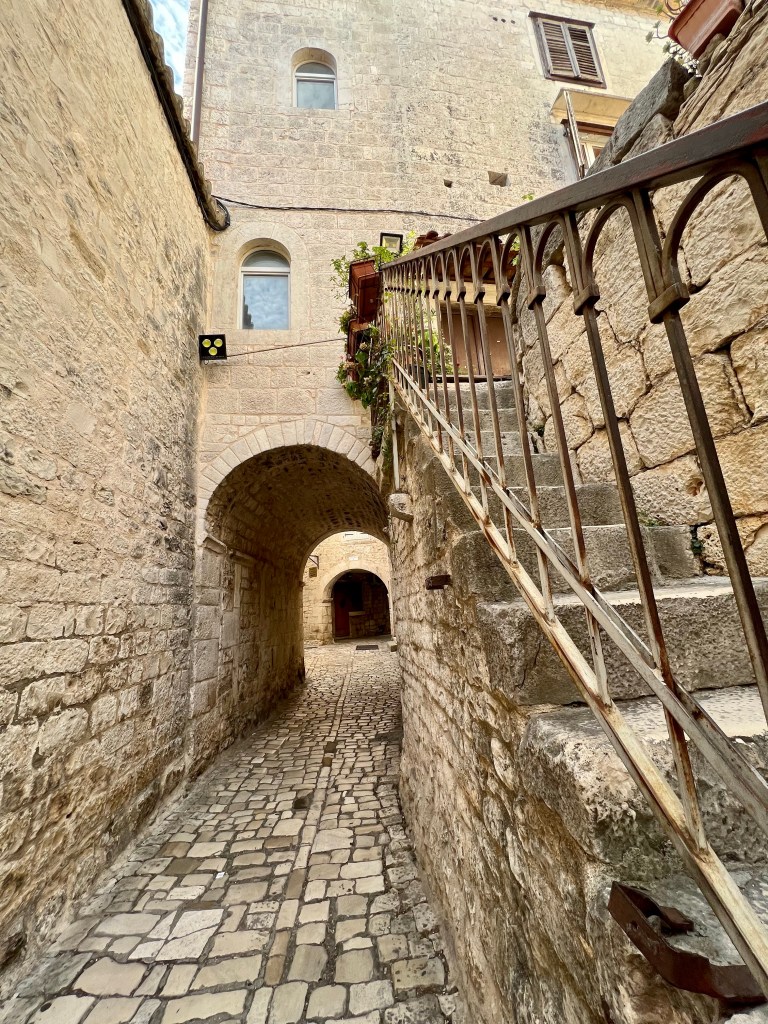
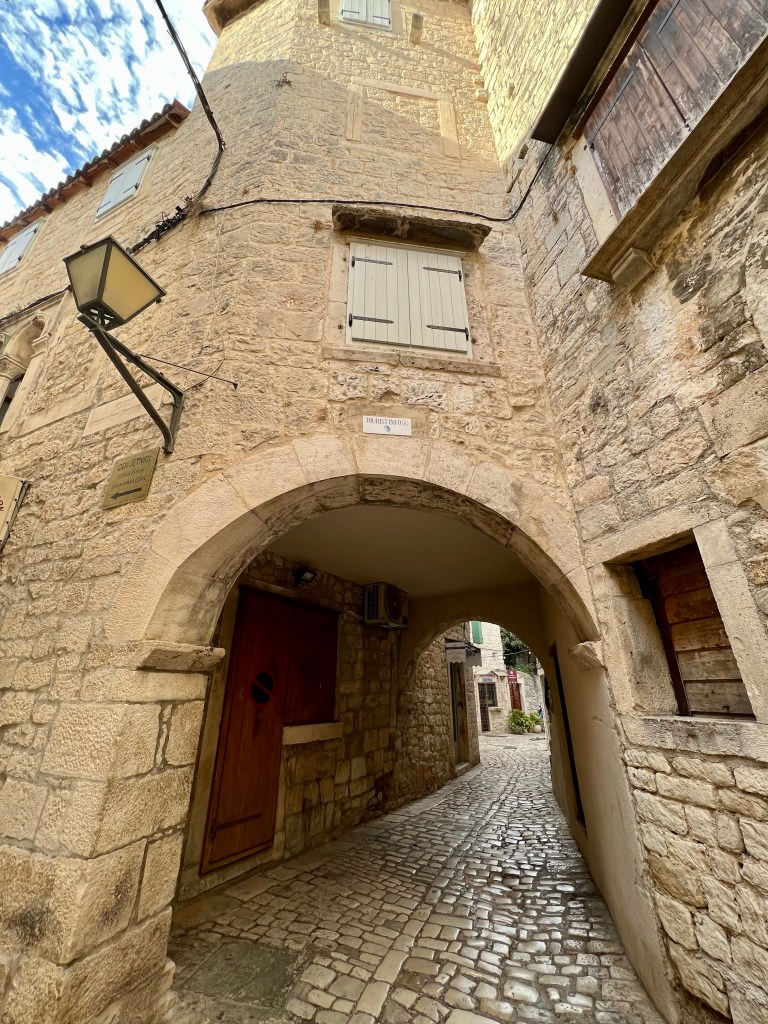
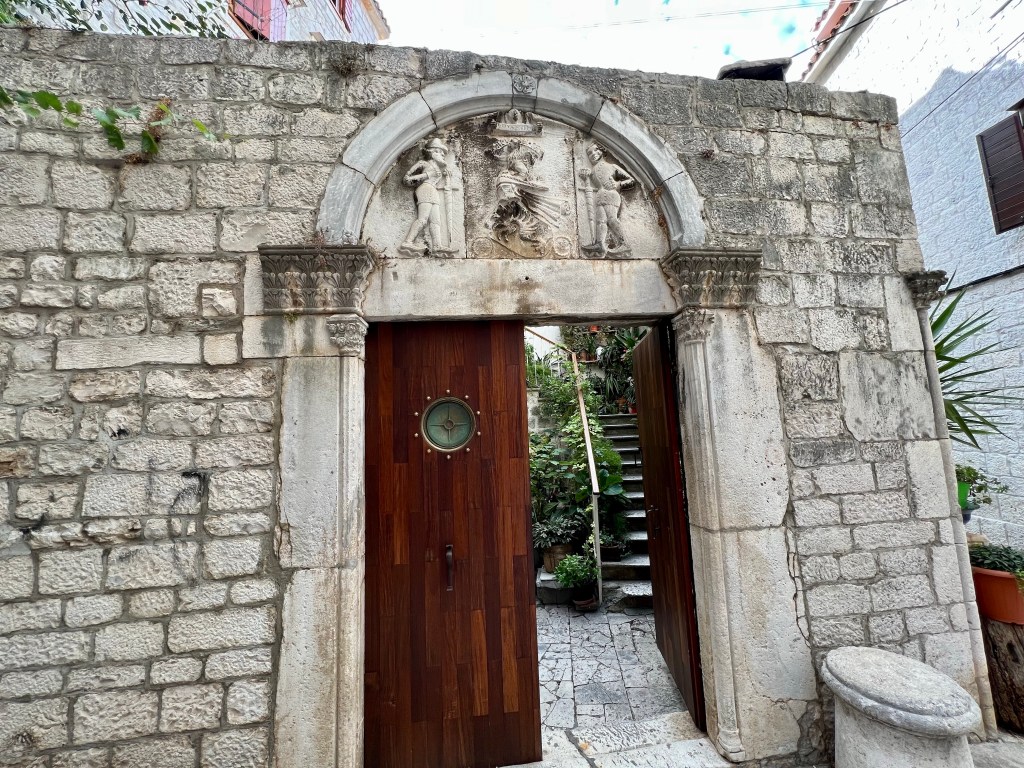
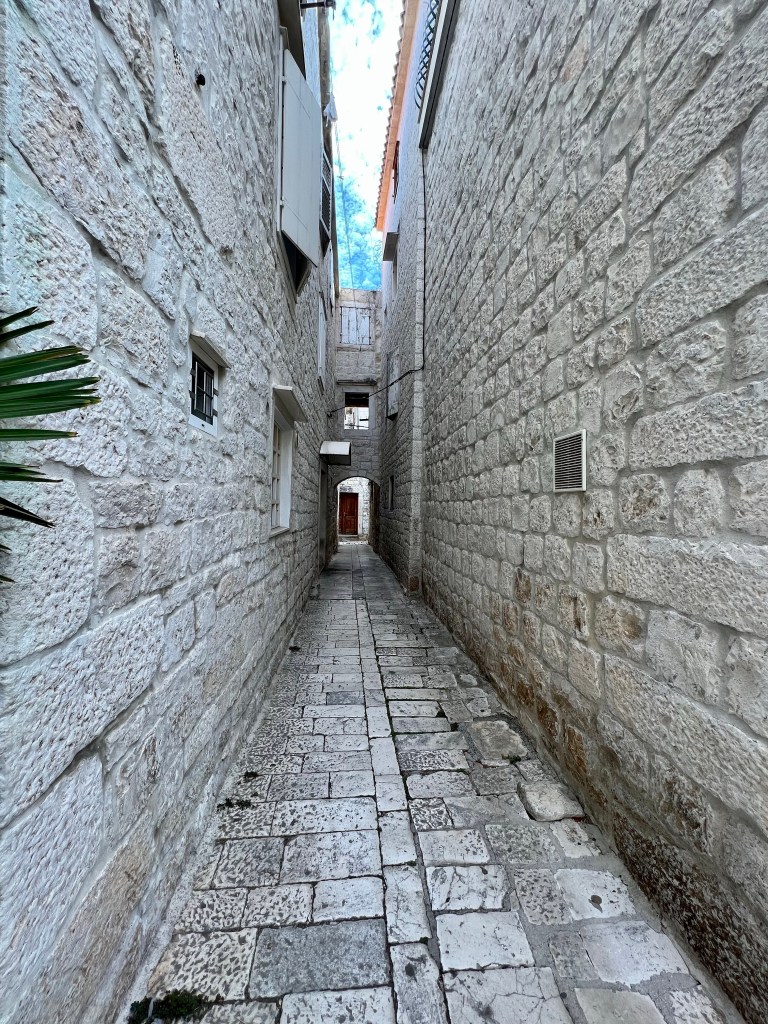
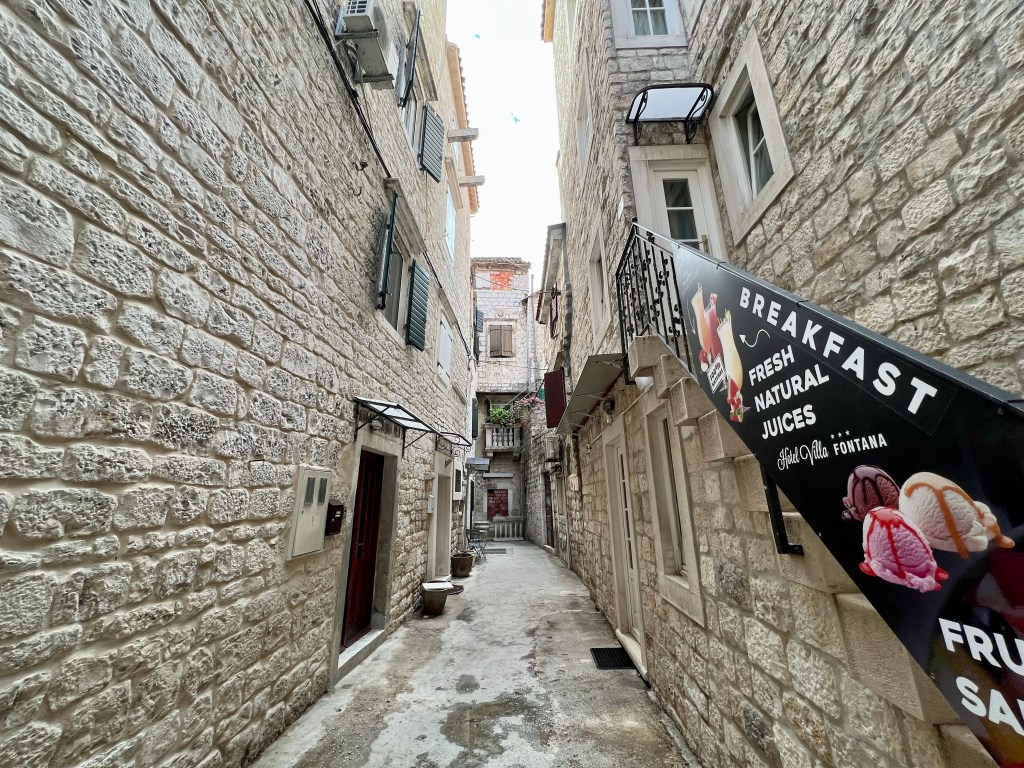
Garagnin-Fanfogna PalaceBack Alleys of Trogir
No town in Croatia would be complete without a few little churches. We found St. Peter’s Church; originally part of the women’s Benedictine monastery which was, according to the legend, founded by the wife of King Béla IV of Hungary.
St. Peter Church
I’m not the best listener so I headed to the bus instead of the appointed meeting place outside the town gate. When no one was there five minutes before the appointed time, I figured it out and headed to the gate!
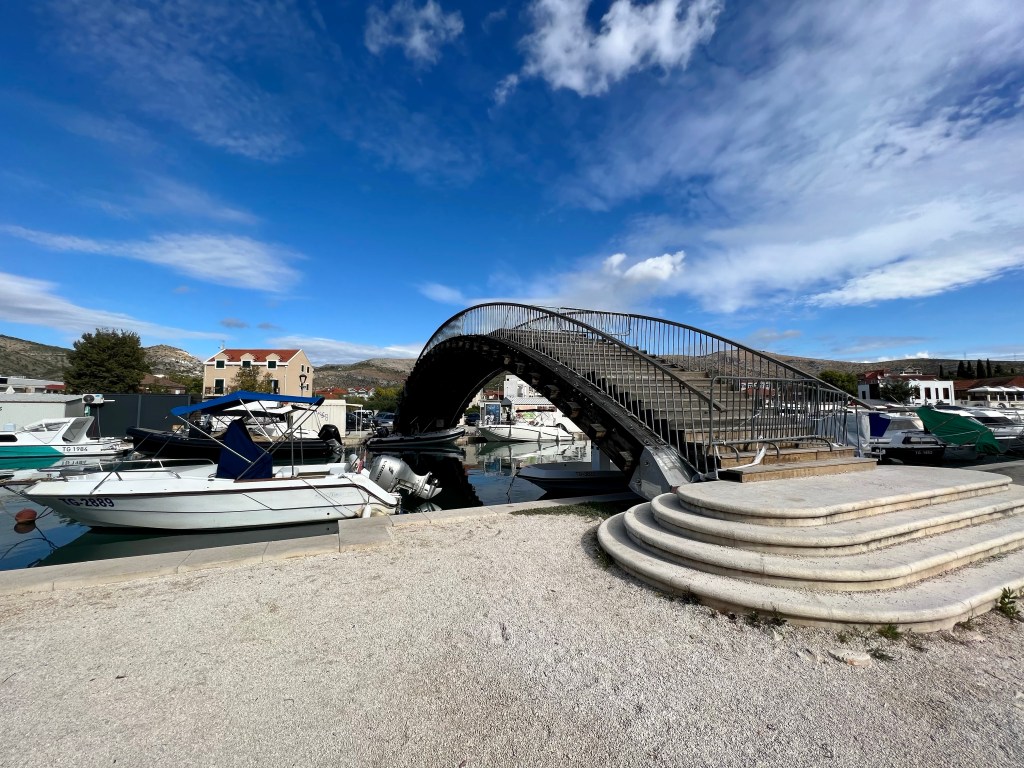
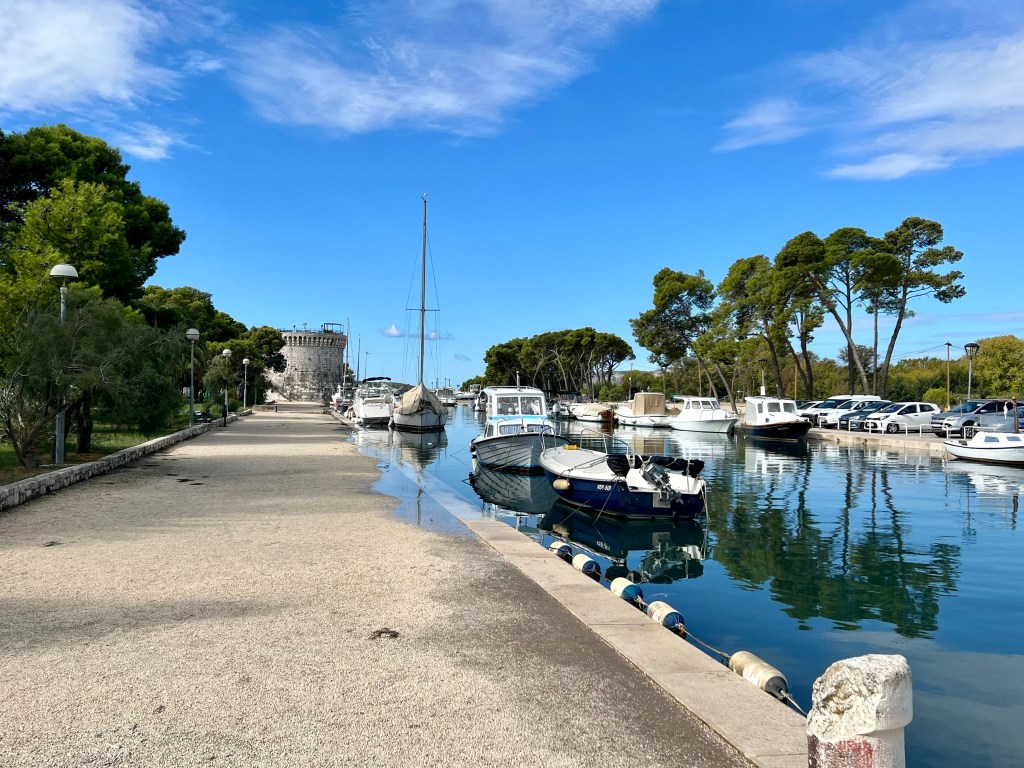
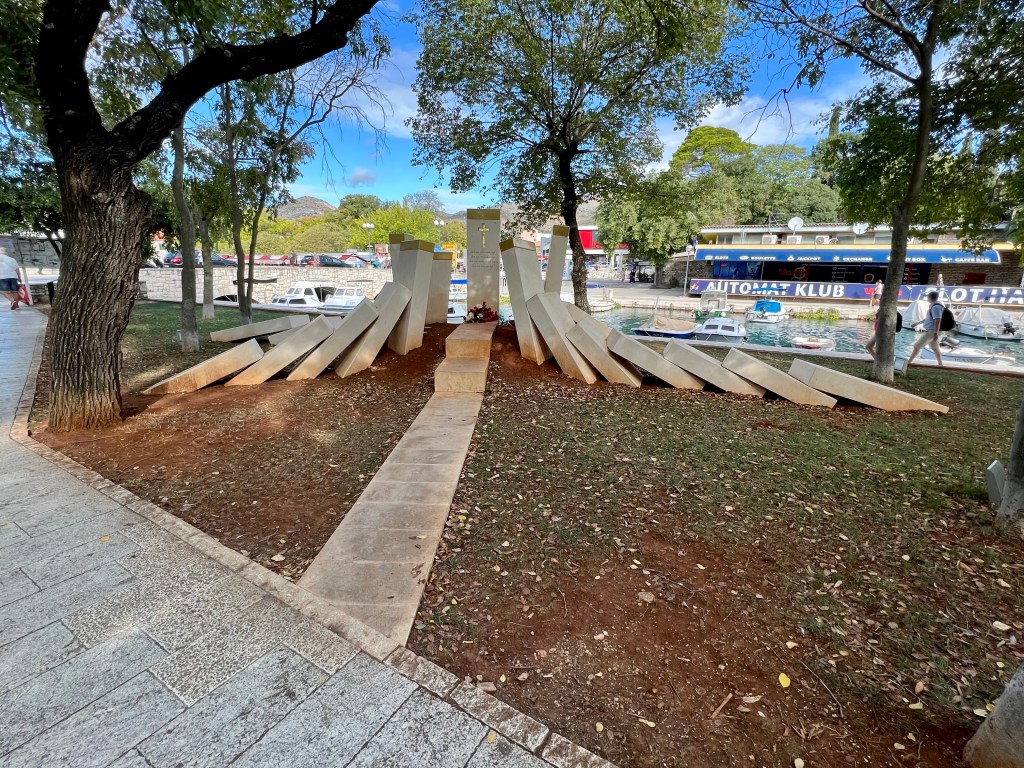
Arched bridgeNice river view Veterans Memorial
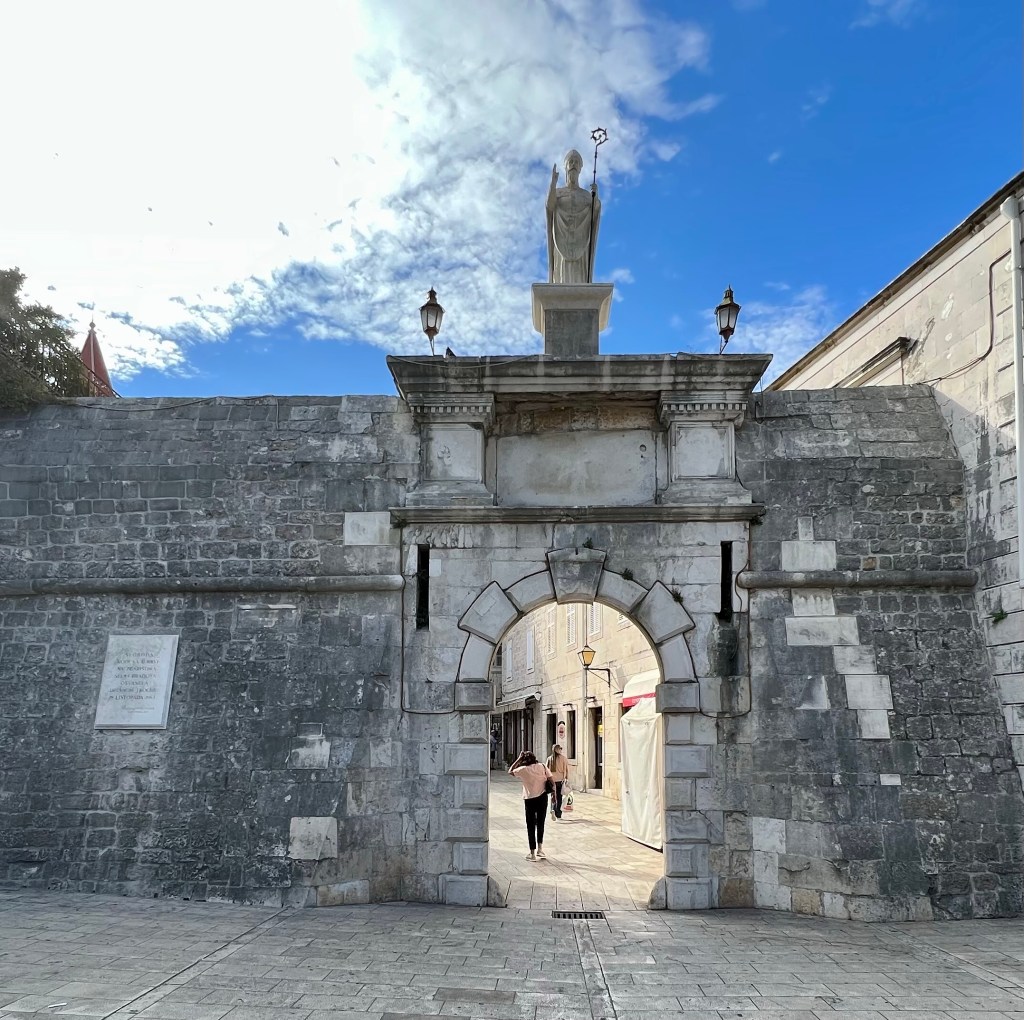
One last picture of the gate into town featuring a statue of Bishop John (of Trogir) before bidding adieu.
Bishop Hohn of Trogir
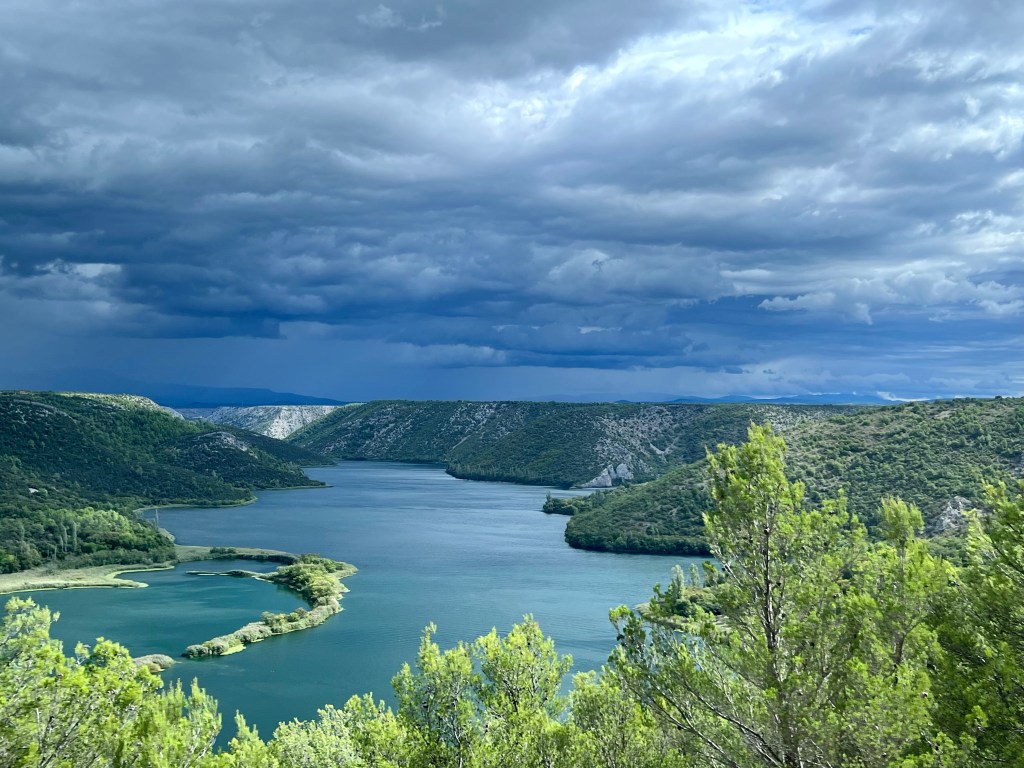
Soon enough we join the group and board the bus for Krka National Park; notable for it’s rich flora and fauna and many waterfalls.
View from the bus window
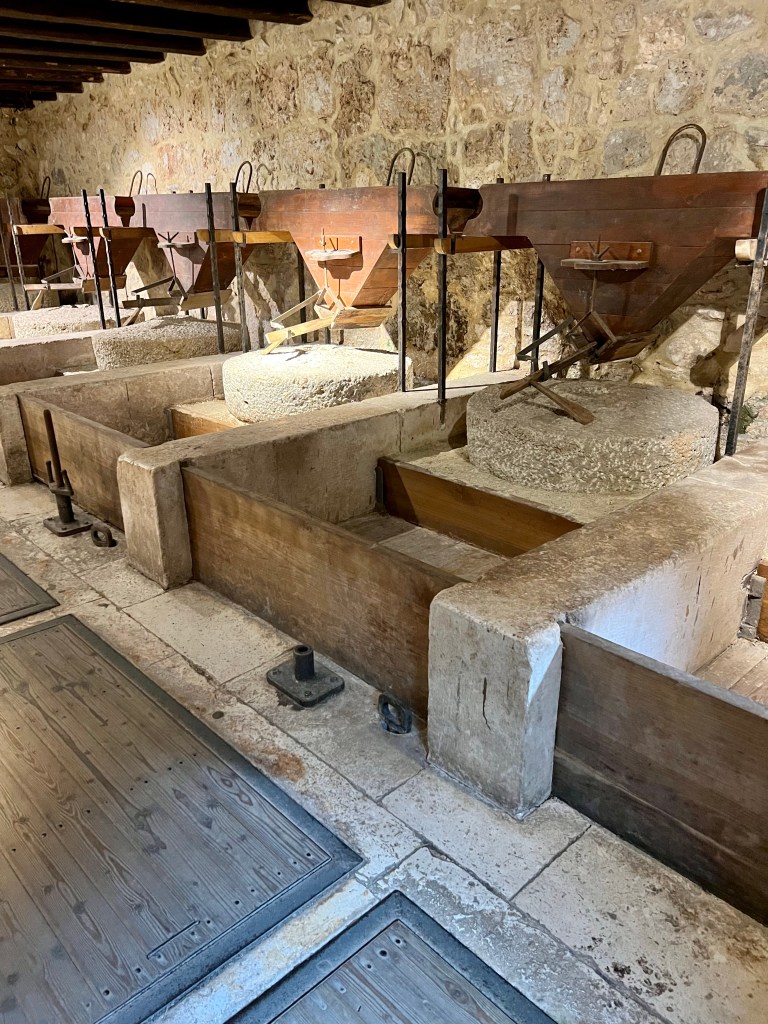
Before exploring nature, we have a chance to visit an example of the water-powered plants that were used to grind grain, and wash and soften wool. There have been water mills along the Krka River for 1200 years but the one we’re visiting is only 150 years old.
Stream close to the mill – look at the sky!The mill
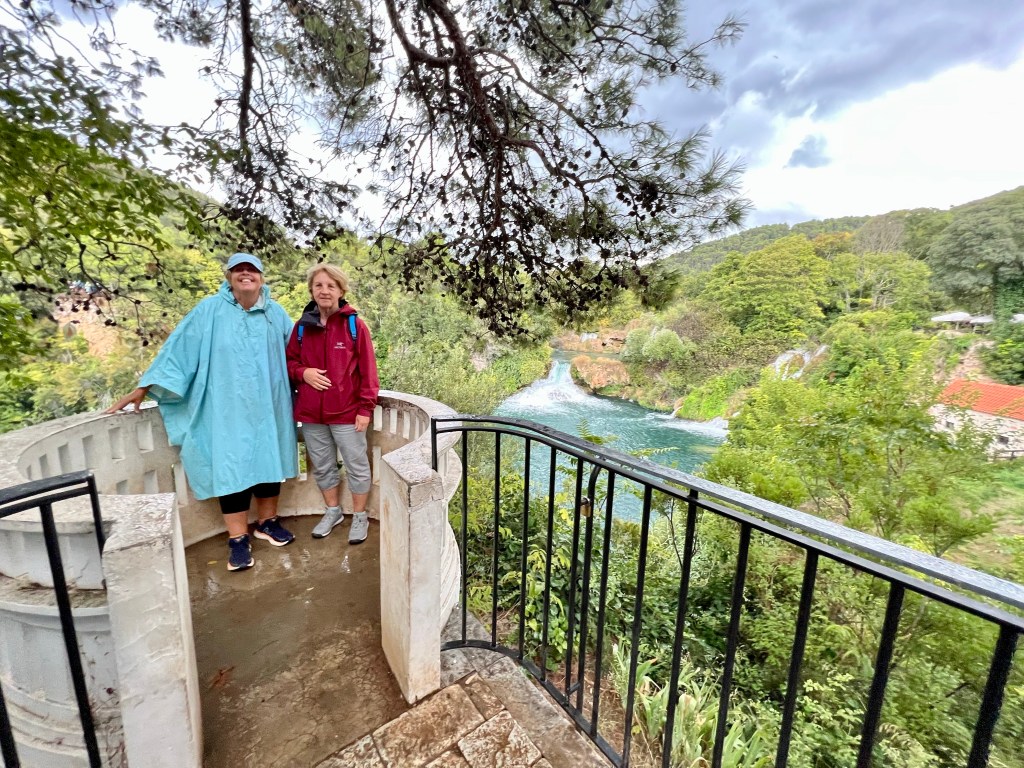
The skies are threatening so it starts to rain a bit; nothing serious at first but some of our group buy rain ponchos at the tourist shop in case it gets worse. Close to the mill, there is a viewing platform and our guide offers to take photos. Lol, he’s snapping pictures from all angles like he’s catching butterflies but I don’t think he’s looking at the photo display. I should have lots of pics to delete.
His best pic, lol!Better without us blocking the view!
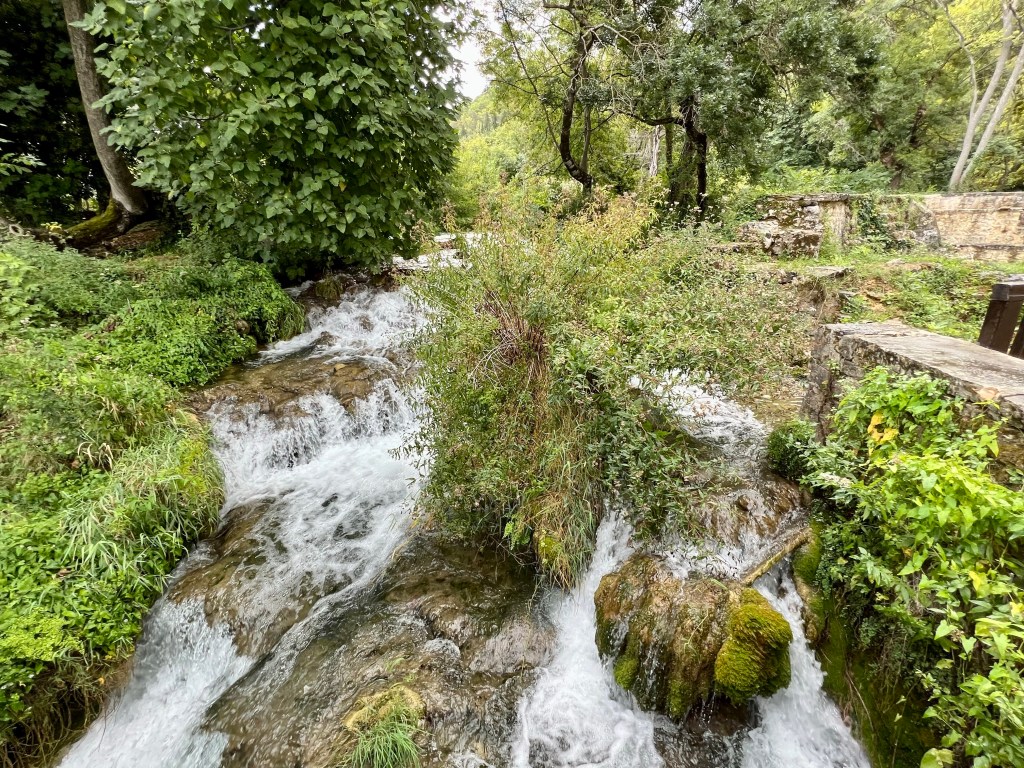
We’re meeting in an hour or so for a boat ride, so he lets us loose to follow the one way wooden path through the forest and along the river. It’s not exactly the yellow brick road but even I can’t get lost. The earlier rain has made the wooden planks a bit slippery and handrails and side rails are scarce so I taking my time and enjoying nature.
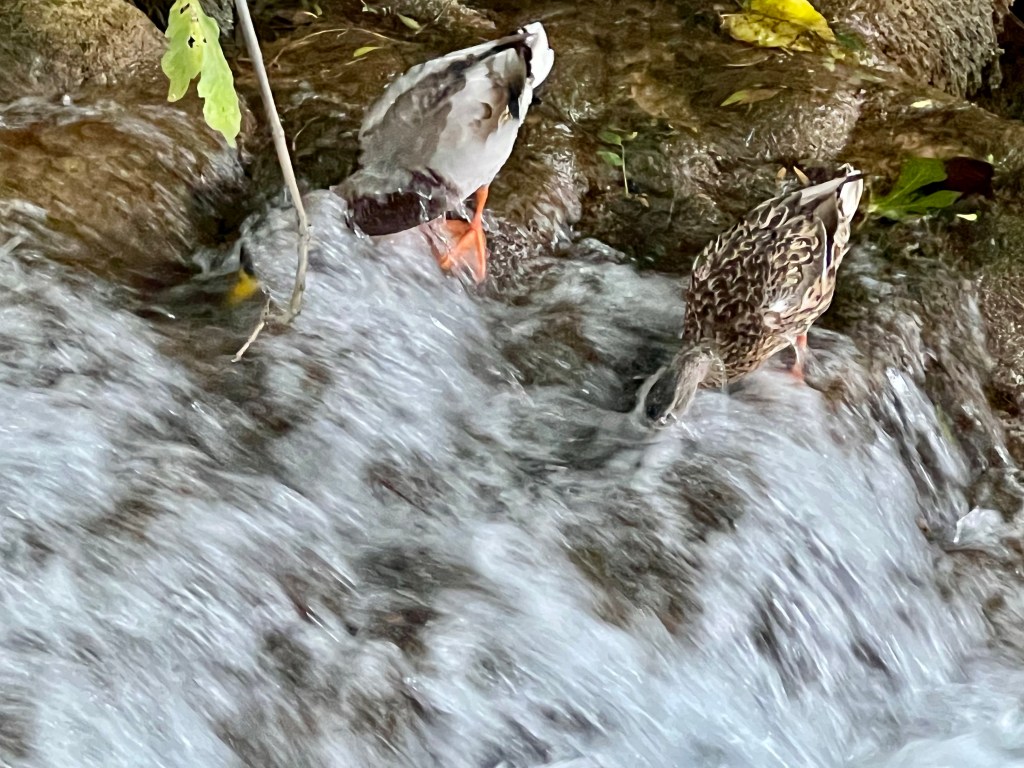
Water water everywhere Ducks acting crazy!
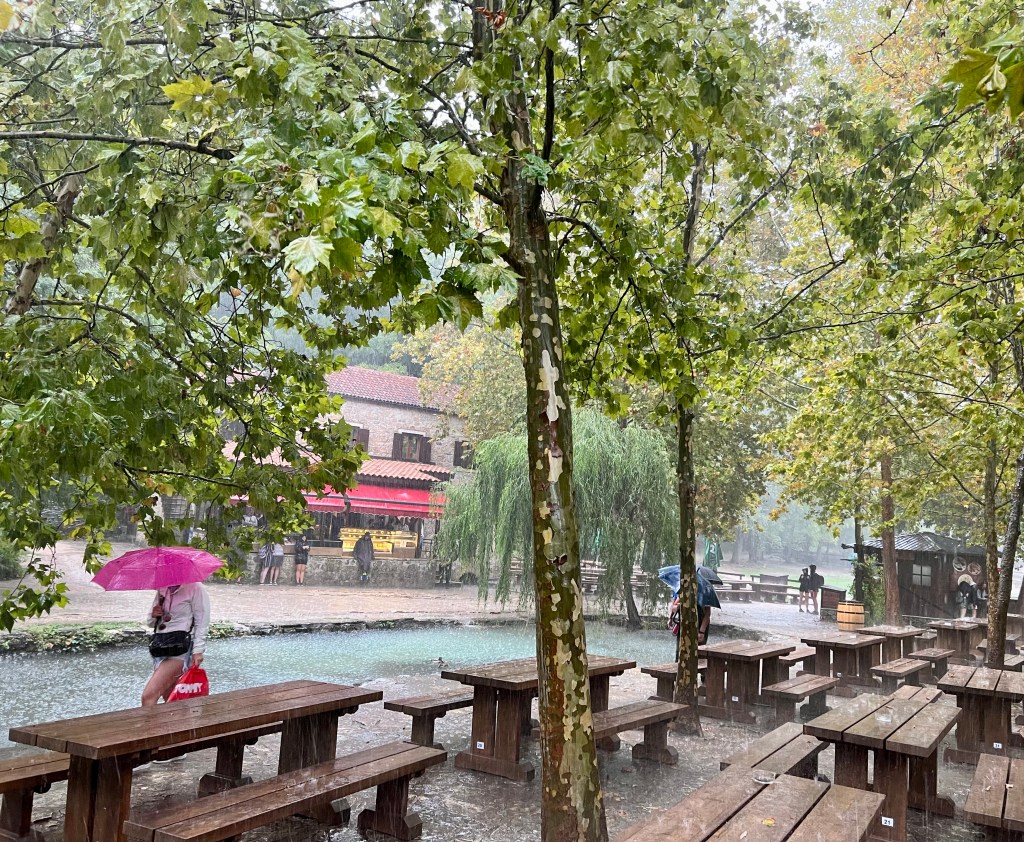
At some point, it starts raining again, a little heavier so everyone is picking up the pace. By the time, we reach the meeting point early, it raining cats and dogs and everyone is scrambling to find some type of shelter. The rain pelts down for half an hour and just around the time we were supposed to meet it was safe to venture out. Lol, this is our third boat ride with bad weather. As things usually happen in threes, I’m optimistic that we’ll have great weather for our cruise down the Rhine that starts on September 21st.
Raining cats and dogs – a good day for ducks!
We slosh our way to the boat and board with the masses trying to get somewhere they can warm up. Met a lovely lady on the boat, originally from Ireland and now living in Santa Fe, NM and we chatted all the way.
The boat landed in Skradin where we were having our lunch break. Linda and I hoofed it to the recommended restaurant in the center of town for lunch. We sat inside for the first time in ages and basked in the warmth. Our lovely meal started with a steaming bowl of tomato soup; good for the soul followed by a nice plate of chicken, grilled vegetables, fries and a salad. Replete and warm, we headed back to the bus for the drive back to Split.
We passed a bakery on the way to the VRBO and picked up some cheese burek to have with whatever was left in the pantry for dinner. Given our experience buying wine at the grocery in Split, we decided not to bother. After last load of laundry and a bite to eat, Linda kicked my butt in crib and we retired for the night.
Tomorrow is another day. Adventures await…
Tomorrow is another day. Luxurious adventures await …
September 20, 2022
The blue skies are back in Split as we figure out our plan for the last day here, clean up, finish packing and grab a bite of breakfast. Our VRBO host continues to be very accommodating so we are leaving our luggage here for pick up later in the day when we head to the airport.
Our plan is to hoof it to the Meštrović Gallery to learn a bit more about this prolific Croatian sculptor, architect, and writer.
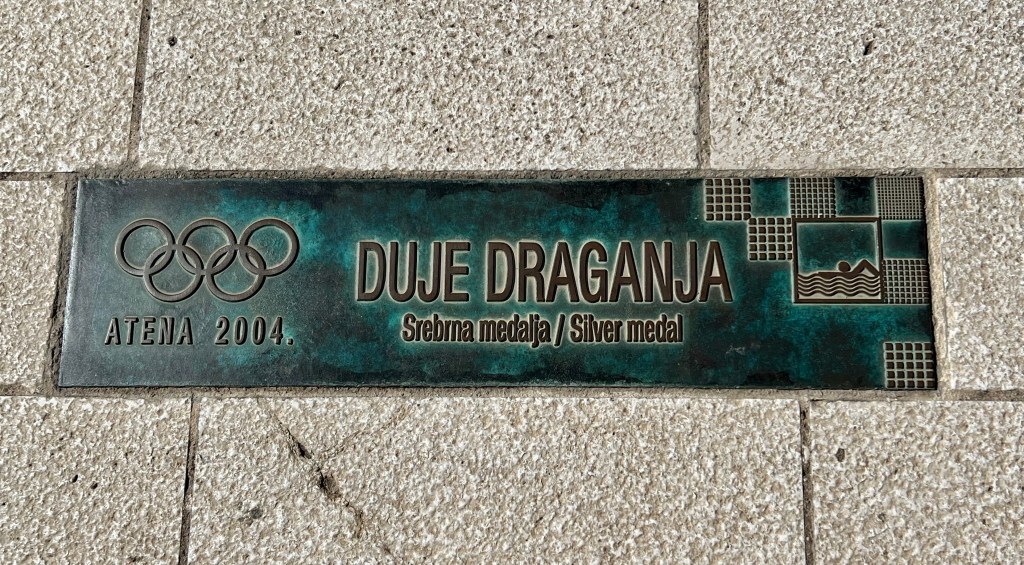
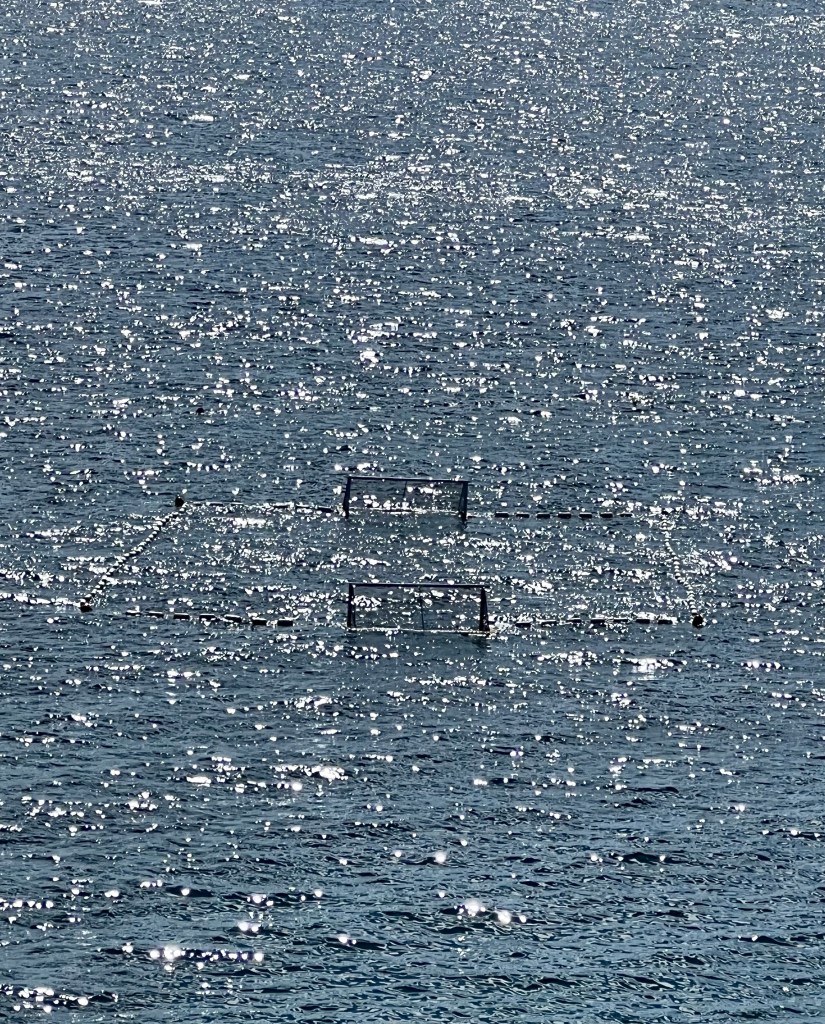
Our route takes us through the Green Market, past the British Consulate and along the Western Riva toward ACI Marina. It’s at the latter that we stumble across plaques commemorating the glorious stories of Croatian Olympic medal winners from Split in chronological order. Croatians are renown water polo players but there are also medals for football, swimming, basketball, rowing, tennis, weight lifting, handball, and athletics. There are no less than 73 names on this Olympic Walk of Fame, and that makes Split the true capital of Croatian sport. Linda also spies a water polo net out in the sea near the beach. No wonder they are champs!
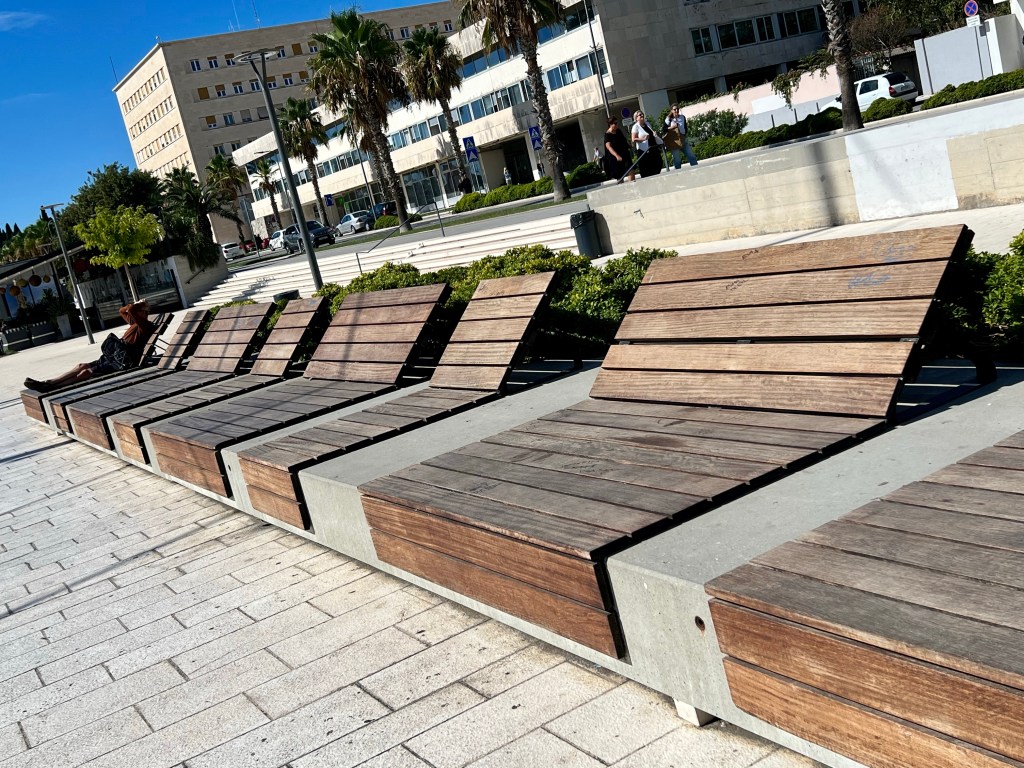
British Consulate in SplitSome heroes on Split’s Olympic Walk of FameLife is GoodLounger in the sunView of the harbourFunky statue along the wayFleurs Cool buildingWater polo court
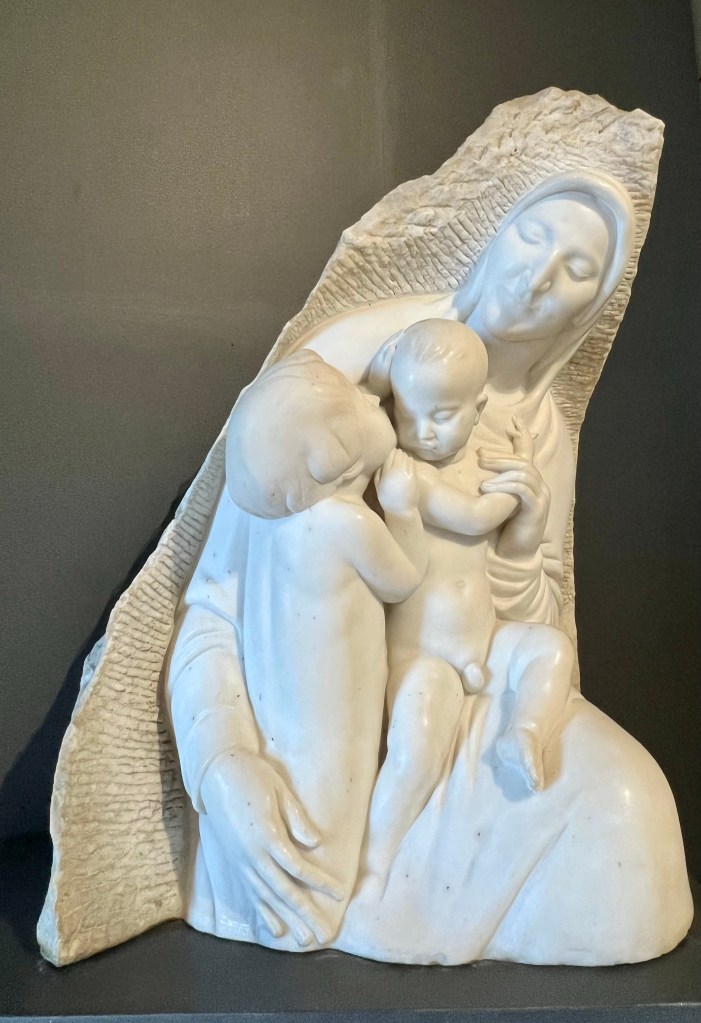
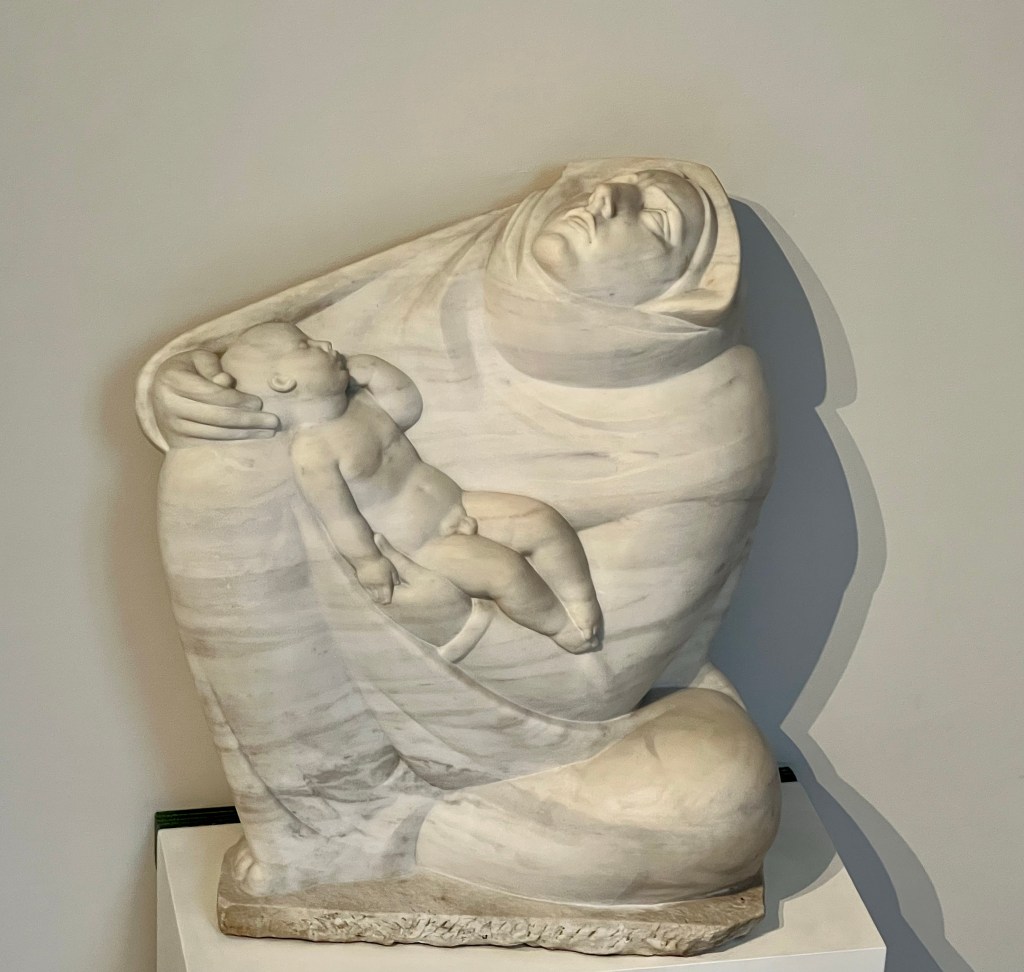
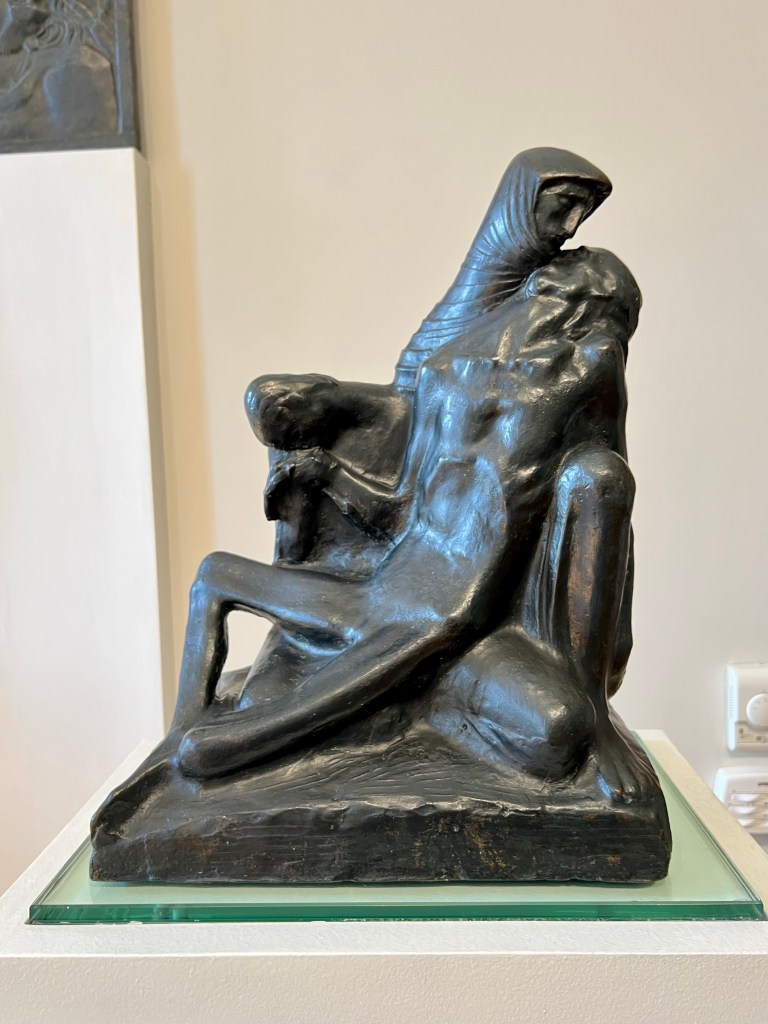
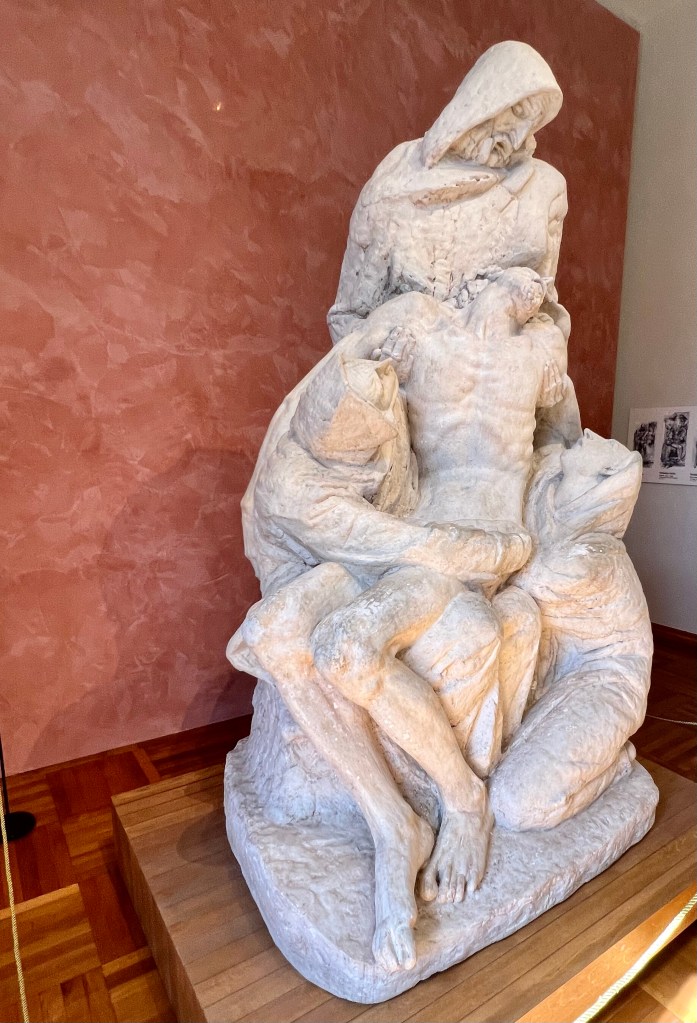
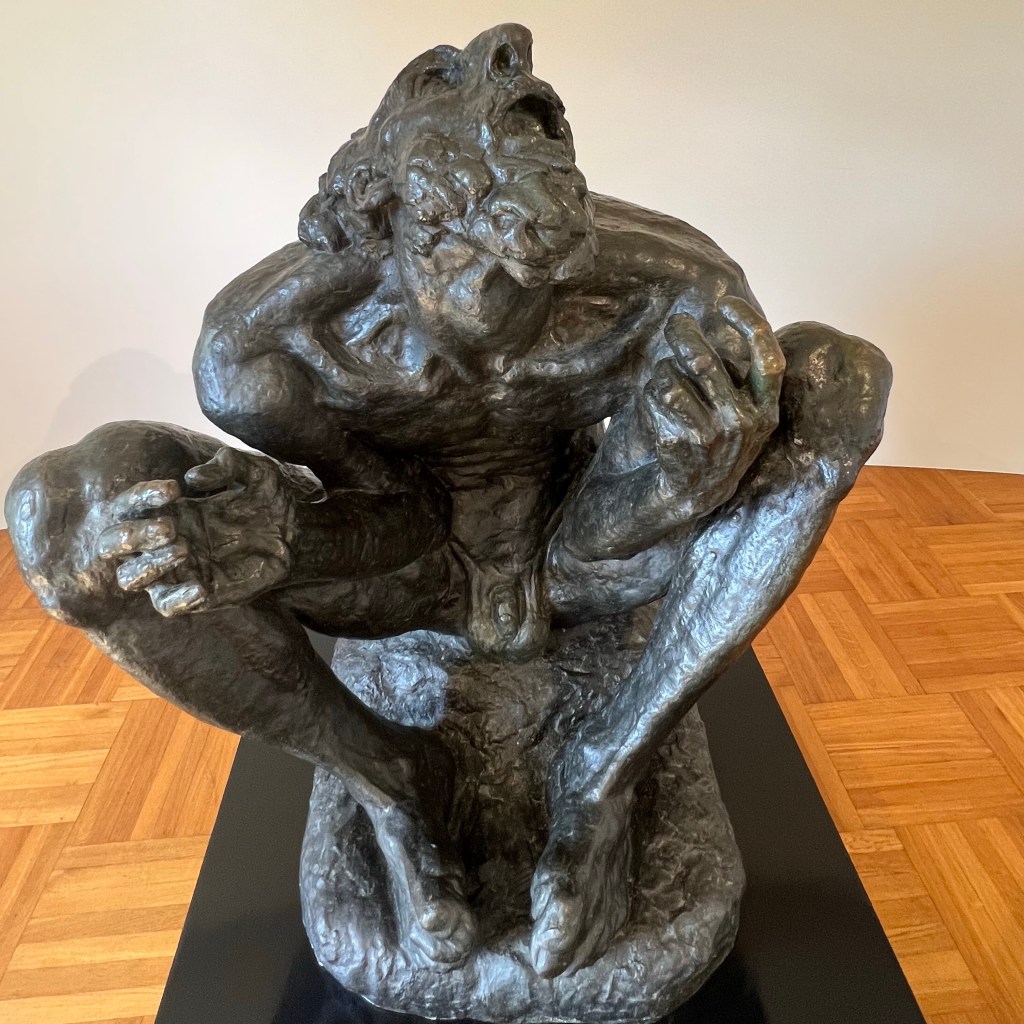
We know generally where we are headed and soon enough we make it to our destination, Meštrović’s summer villa in the west end of Split. Ivan does not disappoint; the range of his work in terms of subject matter and the material of choice is very broad. I was fascinated that he could breathe life into pieces of bronze, marble, stone and wood. Here are some of my favourite pieces but if you’re ever in Split, don’t miss the opportunity to go check out his works out for yourself. The balcony of his villa also provides stunning views of the area.
PersephoneBoy with a Toy PonyVirgin and ChildrenDistant ChordsThe CryLe PietàVelika PietàMerry AngelsHead of ChristGrieving AngelsJobView from Villa balcony
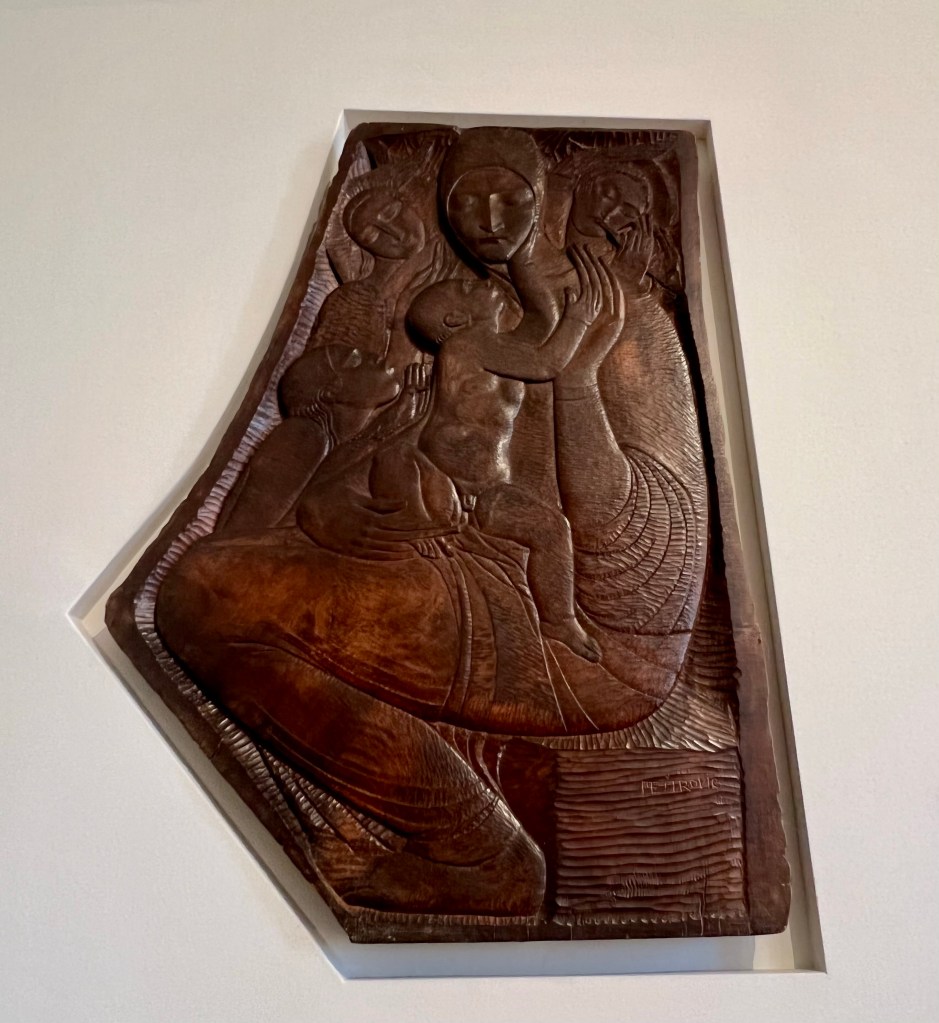
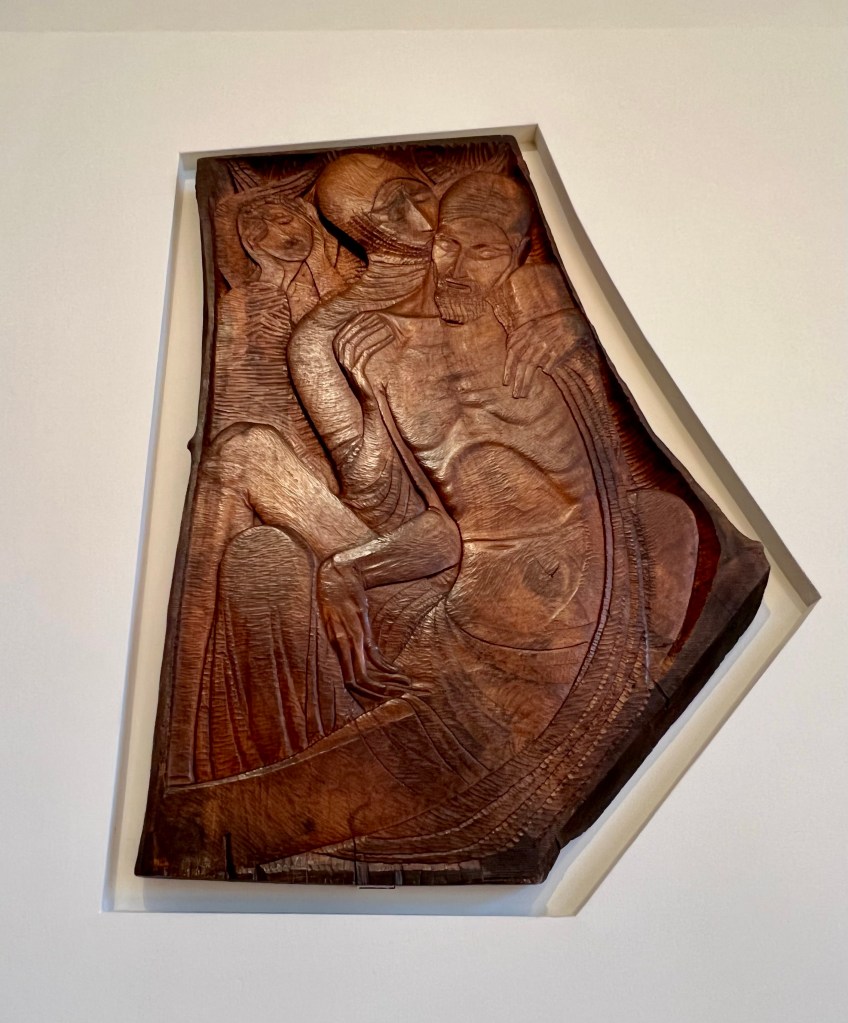
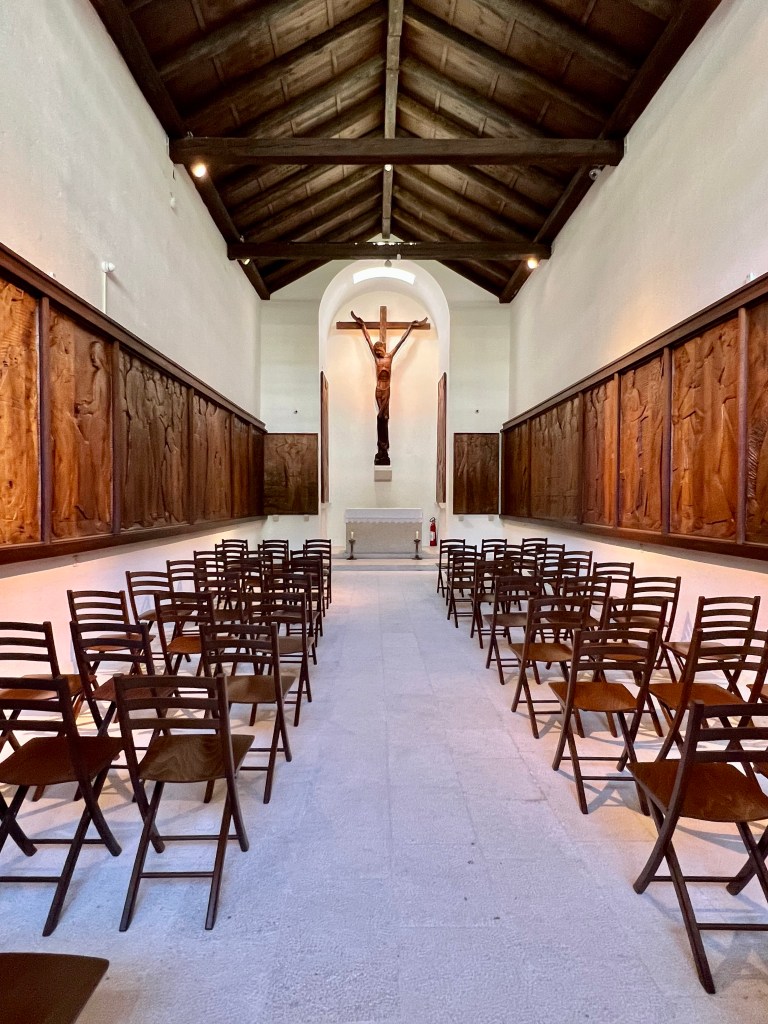
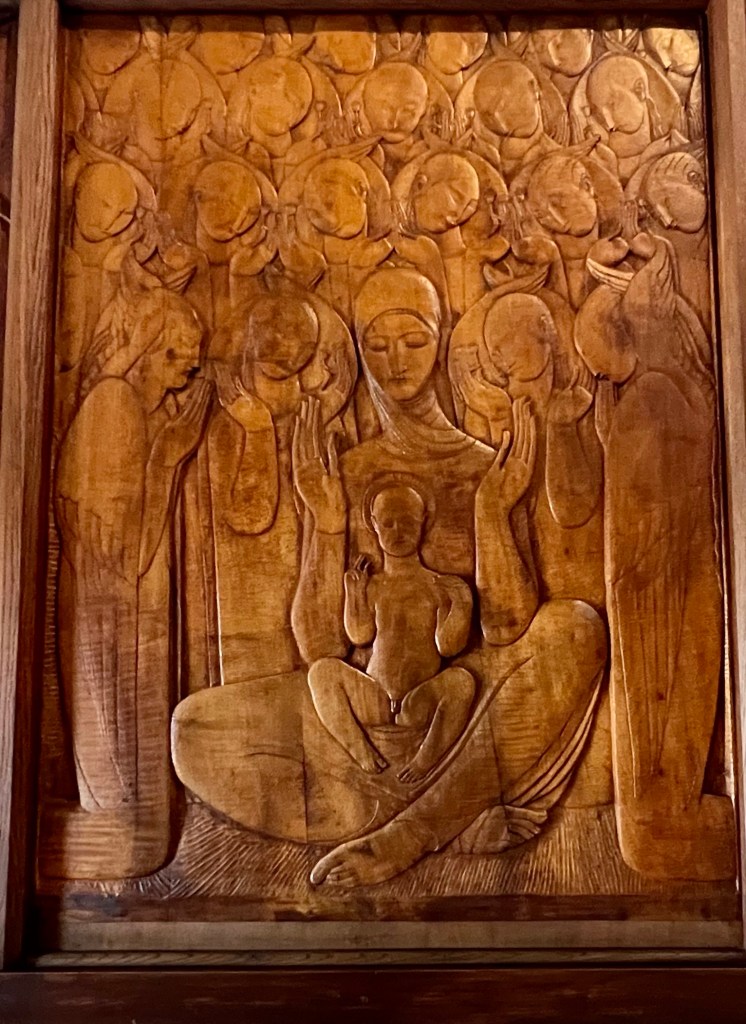
After a thorough tour of the Museum, we headed to the nearby Meštrović Church where the wooden panels depicting Christ’s life, death and rebirth are simply stunning.
Meštrović ChurchSimple beautyPanel
On our return journey along the wharf and the Promenade, we had a well deserved gelato; dark rich chocolate for Linda and a sumptuous date and walnut for me before heading back to the apartment to gather our luggage and meet our transfer to the airport. Tonight we’re off to Basel and another adventure on our Cruise down the Rhine to Amsterdam with lots of friends and family.
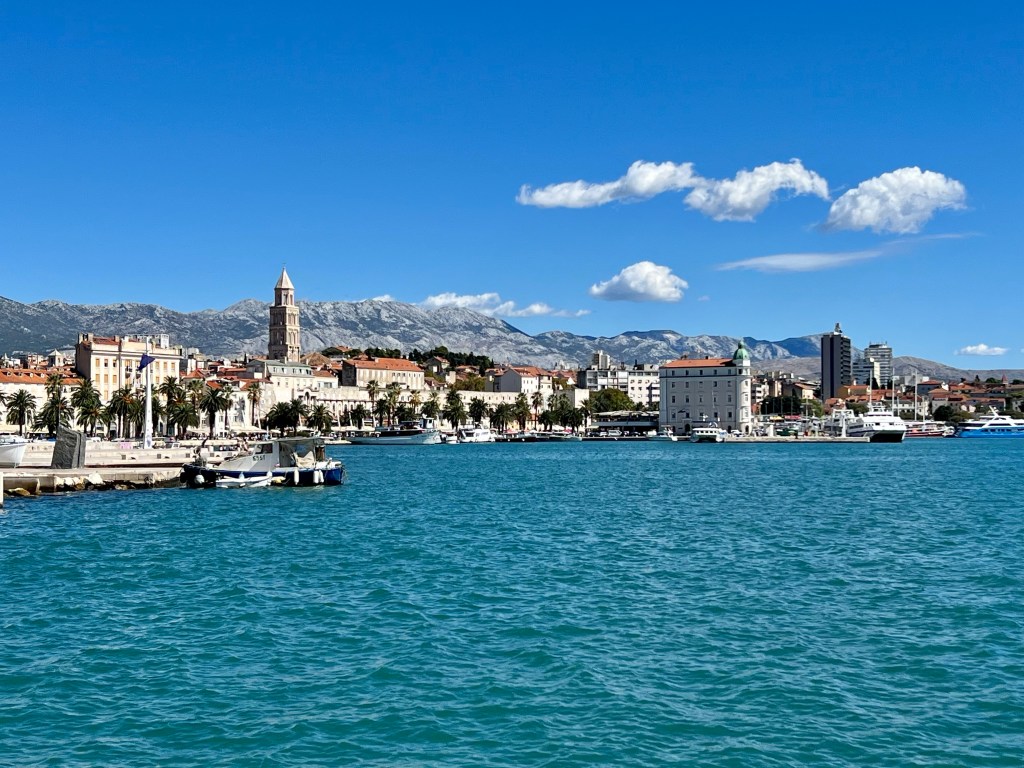
Some last views of Split
Tomorrow is another day. Luxurious adventures await …
Not sure what it is about this group and boat tours but we wake up to a cloudy, damp day and an unappealing forecast. Also not sure that I’ll be swimming in the rain but I pack up the necessary gear anyway and add my rain poncho and a deck of cards for good measure.
The hotel breakfast is the best so far so after a nice meal to start the day, I head back to the room for a bit and then off to meet the hardy souls that are still planning on taking the boat cruise. It’s actually a bit sunnier so it might be a perfect day after all; time will tell.
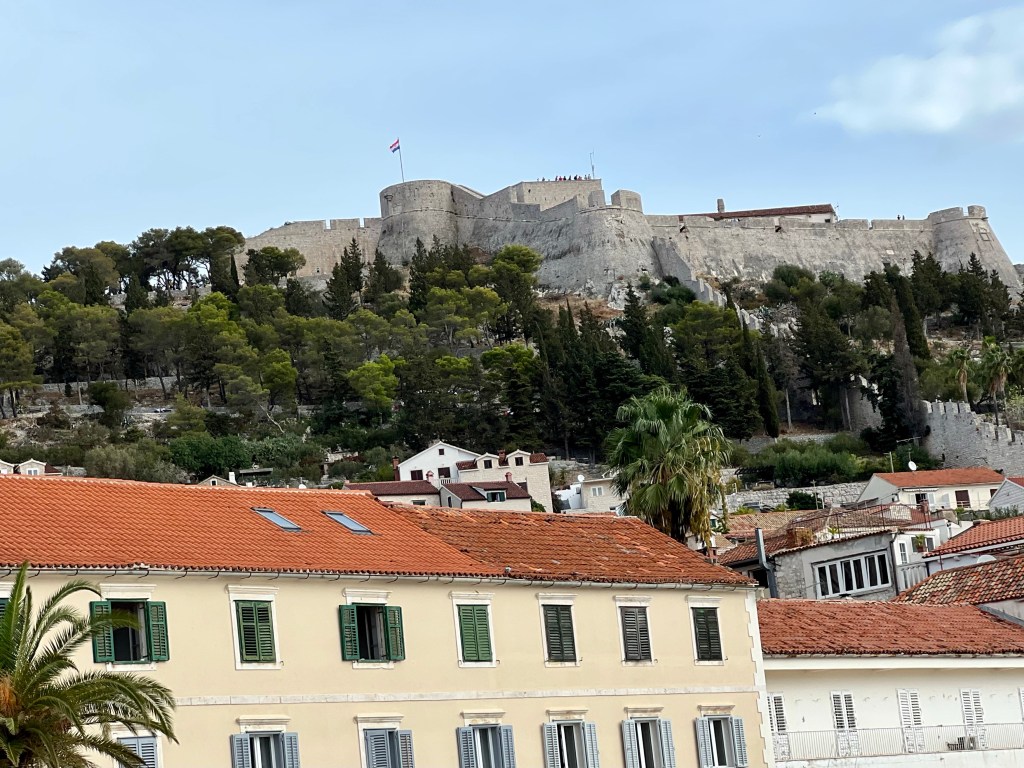
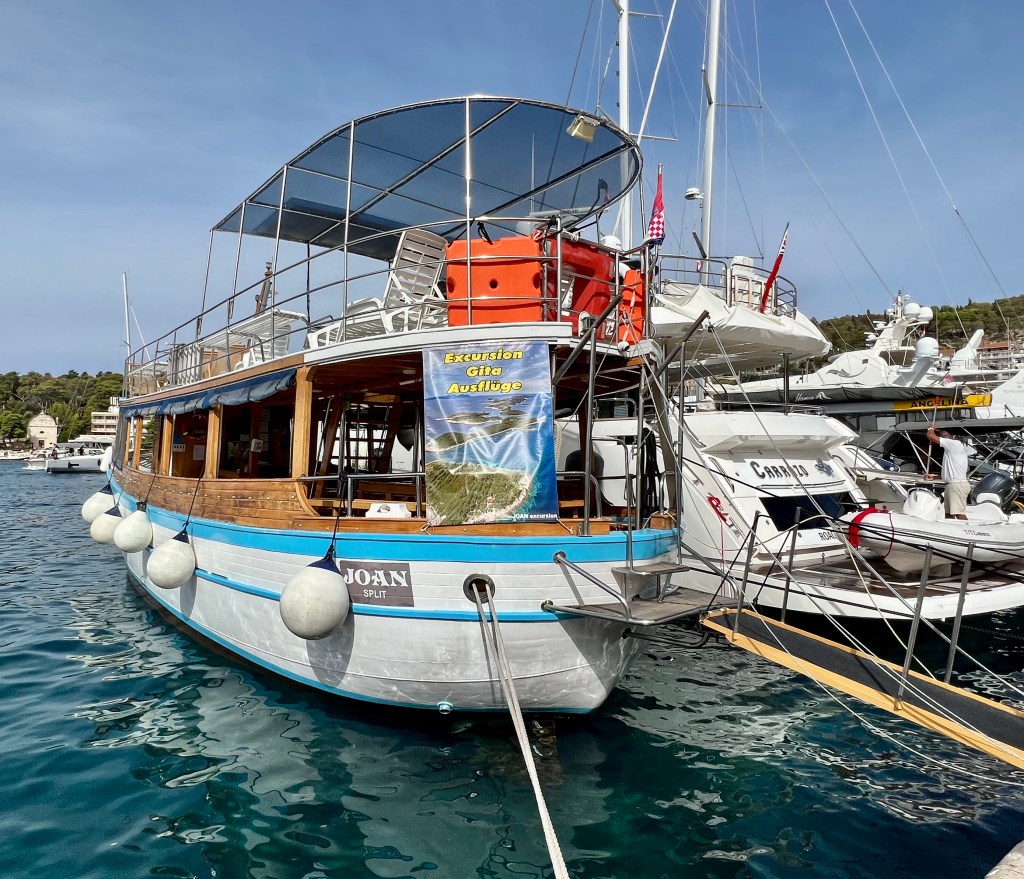
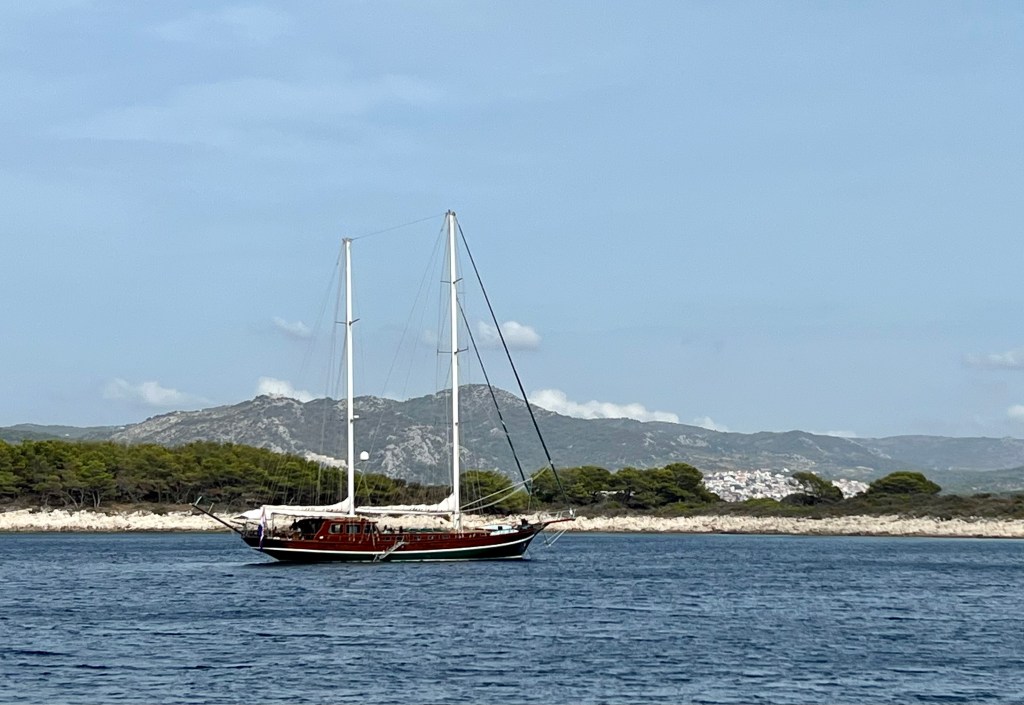
Hvar Harbour in the MorningHvar FortressHvarHvarOur “Ride” for the day – Joan
When we boarded the boat it was rocking and rolling so needless to say, since I’m klutzy, I landed in a heap in one of the chairs on the upper deck before we’d even set sail. Lol, I’m developing quite a nice bruise just below my left knee and another on my right forearm but like Dad used to say, it’s a long way from my heart so I’ll live! We’re headed to the Pakleni islands for the day so I just soldier on!
Our first swim stop is Milne Bay not too far from Hvar. Lots of people went for a swim and were jumping from the upper and lower decks of the boat but I opted to stay dry since it really wasn’t that warm and the next stop wasn’t too far off and was a much longer (2.5-3 hr) stop.
Milne Bay
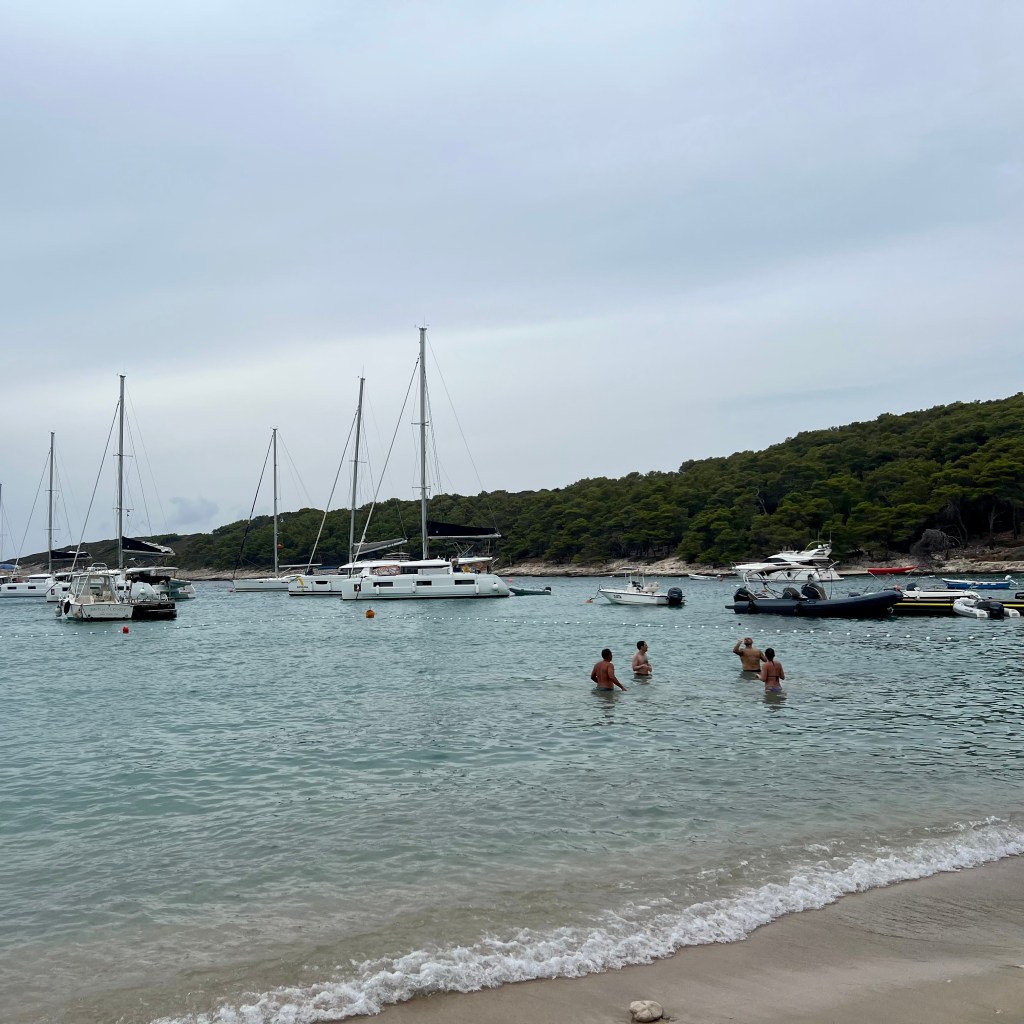
After everyone was back on board we headed to another island where we were docking for lunch and had the chance to walk across the island to Palmižana Bay, a small rocky beach, for a swim before lunch. Our choices for lunch were chicken, mackerel and a veggie/cheese plate washed down with water, orange juice and white wine; all were pretty good and very inexpensive for the area.
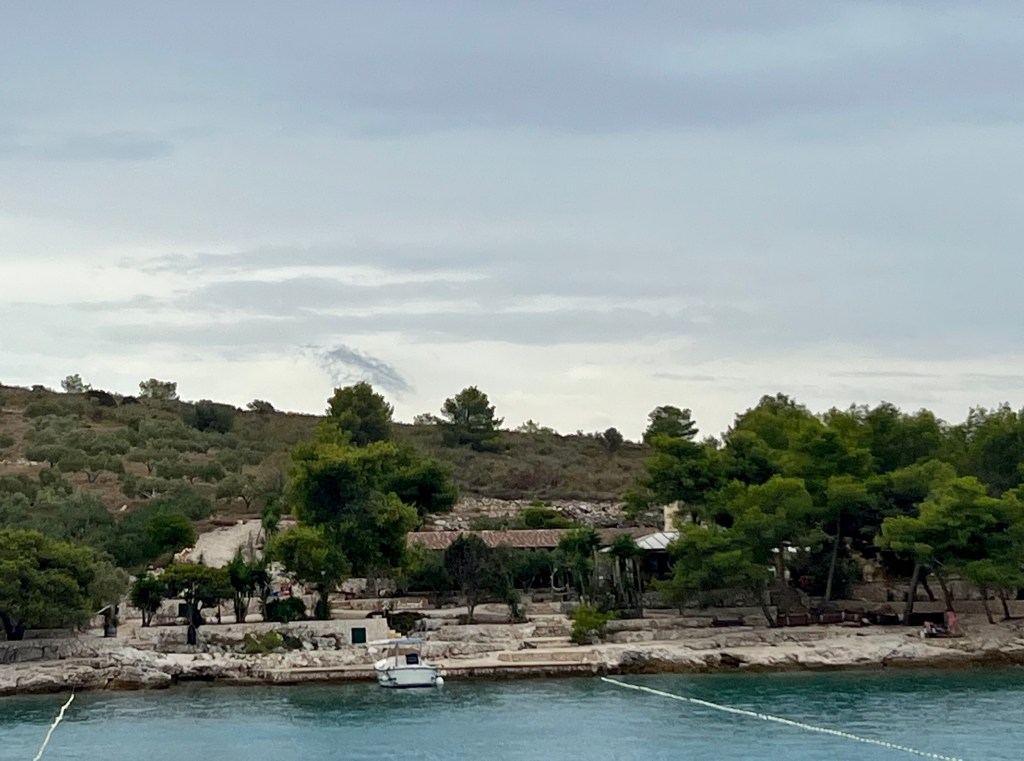
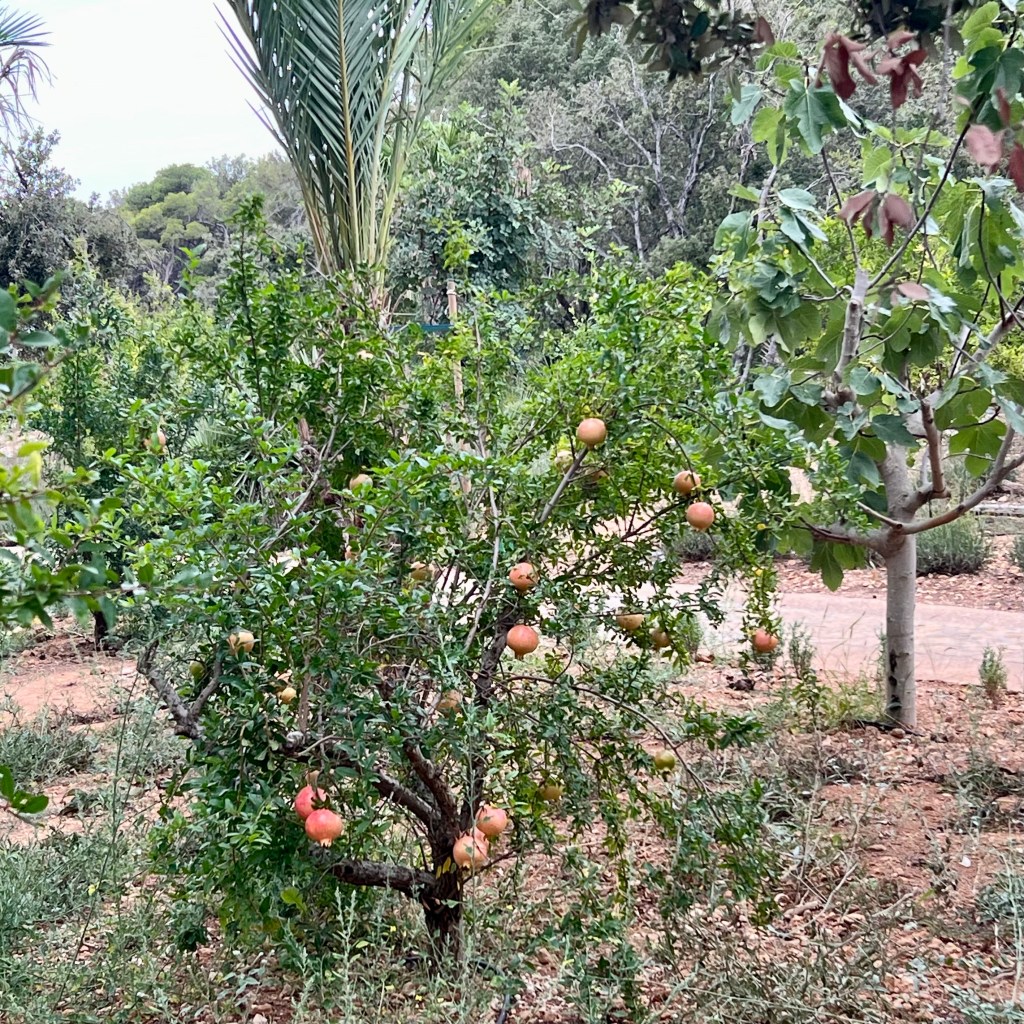
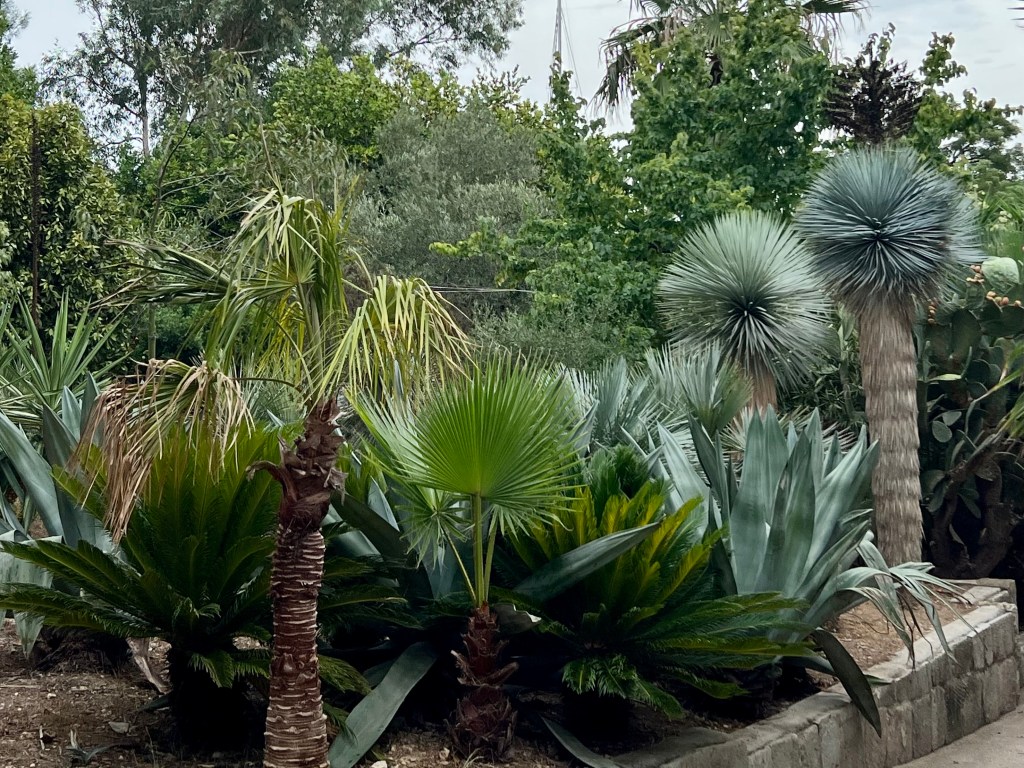
Cool home on the IslandPomegranate TreeGreenery on the pathPalmižana Bay
Our last swim stop was in St. Klement and then we headed back to Hvar against fairly strong winds. We reached terra firma safely and though the weather for the day was a mixed bag, it was much more pleasant than our ill-fated speed boat tour in Kotor, lol!
Back up the hill for a shower with a bit of time to relax before joining Jen and Linda to share the last bottle of wine purchased at the Bosnian Monastery. It was raining with thunder and lightning so we opted for pizza and more wine at the hotel restaurant rather than a jaunt down the hill. The sole waiter was run off his feet and though the wine came fairly quickly, the same could not be said about our pizzas which arrived hours late and cold. Oh well, at least we didn’t have to eat our arms!
The next morning we have a much too early start time so it’s time to crash.
Tomorrow is another day. Adventures await …
September 16, 2022
After our “crack of dawn” meeting in the hotel lobby, we headed down to the harbour to catch the early ferry to Split. Thankfully our luggage was transferred to the pier by the hotel.
After a short and uneventful voyage, we clamoured into three cabs and headed to our hotel in Split to drop off our stuff before heading out to enjoy our last day with the G Adventures crew. As we approached Old Town Split, we passed a very large statue of Grgur Ninski. His toe was bright and shiny which typically means good luck so I wished that I would find my prescription sunglasses that I’d misplaced earlier in the day as I passed.
Grgur Ninski – note the shiny toe on his right foot!
We met our guide, Tanya, outside the North gate of Old Town for the usual discussion of local history, culture and a stroll by the most important sites.
Croatia is a small country with a population of less than 4 million. Split is the second largest city in Croatia and the capital of Dalmatia (southern Croatia) with a population of less than 200,000. Split sounds idyllic with 300 sunny days during the year; a lovely Mediterranean climate. Tanya joked that you never cook or run in the south. Maybe I should move here!!
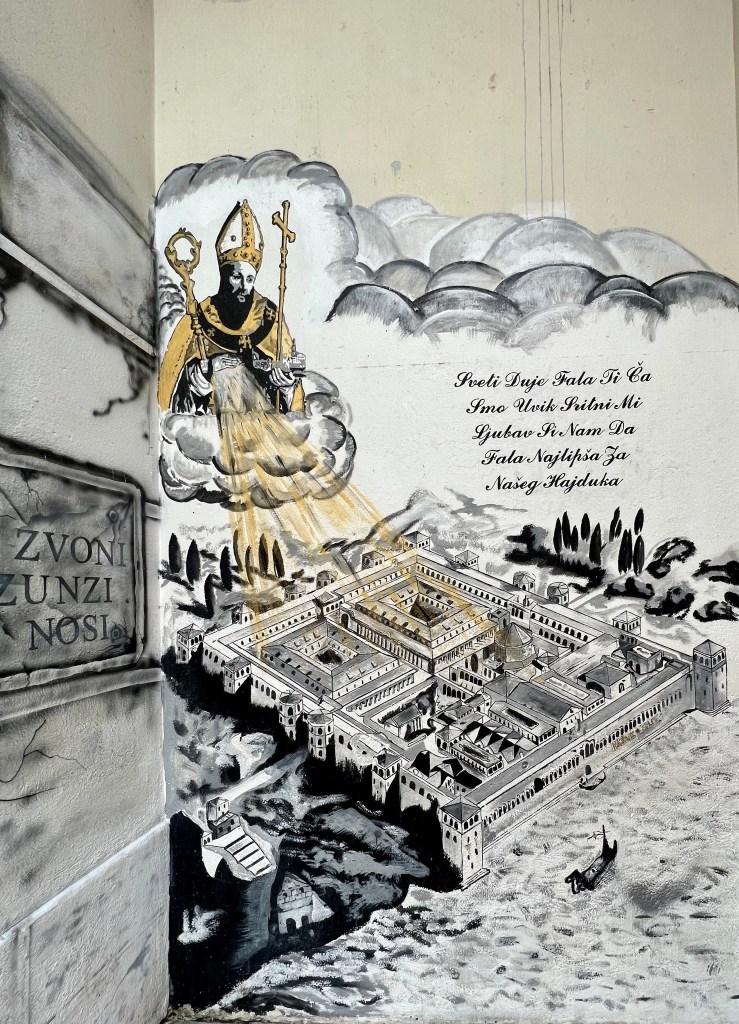
The city was founded as the Greek Colony of Aspálathos in the 3rd or 2nd century. In 305 AD, it became the site of the Palace of the Roman emperor Diocletian; his retirement home. Nine years after moving here, Diocletian died and the Palace was abandoned. After the sack of Salona, the fortified Palace of Diocletian was settled by Roman refugees who used the materials from the buildings inside the palace to build themselves houses within the walled city. The city expanded beyond the original palace walls to the west when they felt safe. Diocletian’s Palace is the only UNESCO cultural monument where people are still living inside.
The city can be accessed through four double arched entrances; north, south, east and west. The gates all have two arches so that visitors could be “screened” before accessing the Palace/Old Town. If you didn’t pass muster, you would likely get treated to a shower of boiling oil – yikes!
No man’s land – waiting for the green lightNarrow streets in town
The Palace/Old Town has two main streets; Cardo which runs between the north and south gates and Decumanus which runs between the east and west gates and many little side streets some of which lead nowhere.
Tanya told us a bit more about Grgur Ninski. He was a medieval bishop of Nin who was a big supporter of the Croatian language; introducing the use of Croatian language in religious services in defiance of the pope in the 10th century. The 28 ft statue was built by Ivan Meštrović as a single piece of brass and erected in 1929 in the centre of the Palace. When Split was occupied by the Italians during WWII, the statue was moved outside of the city because Mussolini didn’t want it in town. In 1954, it was re-erected just outside the Golden Gate in its current location.
Back to the Old Town. 900 people live inside the Walls. Originally, the north end of the palace housed, servants, slaves, soldiers and horses while the south end was reserved for the Emperor and his family. The north end was largely destroyed during WWII when in June 1944, it was accidentally hit with 600 American bombs! At the time, Split was occupied by Germans and they meant to hit military targets but missed over and over again!
One of Split’s claims to fame is a Guinness Book World Record for the largest chocolate bar in the world (2015). Tanya pointed out her favourite chocolate store which makes traditional flavours such as red wine and figs, dark chocolate with sea salt and white chocolate with lavender. We stopped by later and bought the first two and I can recommend them both highly. Sadly, I doubt any would survive the rest of the trip so you’ll have to come to Split and buy your own!
Buy chocolate here
Diocletian’s mausoleum is part of the emperor’s palatial complex. The building was constructed before his death to house the remains of the emperor after his passing. The building signified his divine descent; the Roman emperor was considered the son of Jupiter which is what gave him power over his subjects and the Mausoleum was intended as a place of worship. The Mausoleum is located in what once was the imperial section of the palace and positioned so that people arriving at the palace would notice its splendor from a distance.
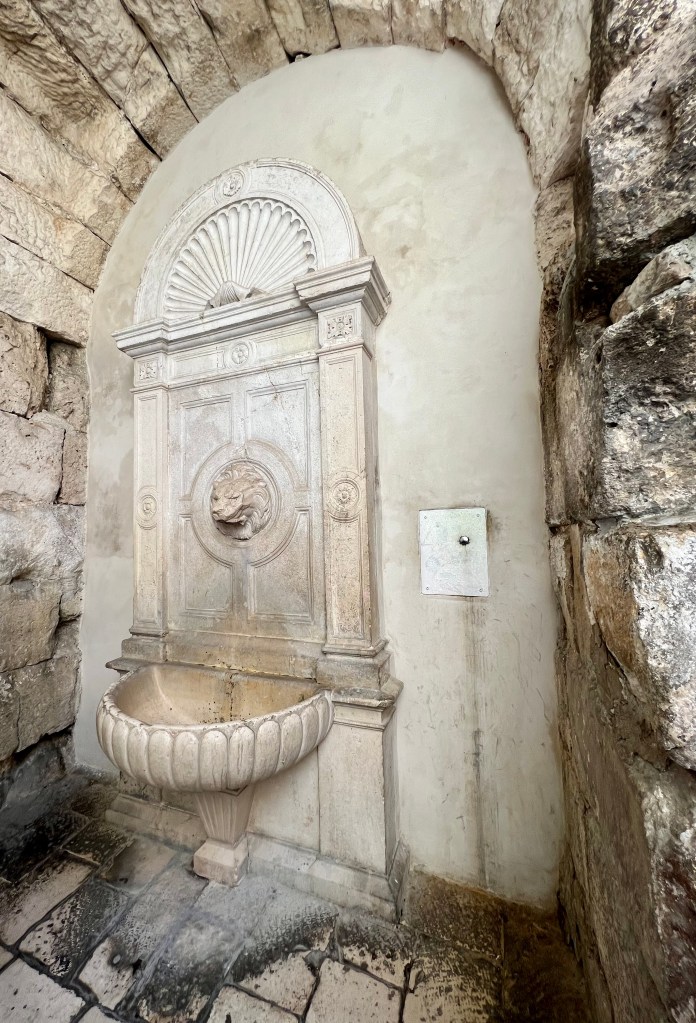
Get your water hereMap of Diocletian’s Palace
Diocletian allowed no other religions and especially hated Christians and his brutality to them was legendary. This makes it quite fitting/ironic that in 653 the mausoleum was consecrated by the first bishop of Split and has been the city’s cathedral ever since. It is the Cathedral of Saint Domnius, the patron saint of Split, who was the Bishop of Salona at the time of Diocletian and was persecuted by the emperor for his faith and martyred.
Our next stop was the West Gate (aka the Iron gate) which leads to the medieval part of Split which is outside the Palace walls. Houses were also built inside the west wall around the same time.
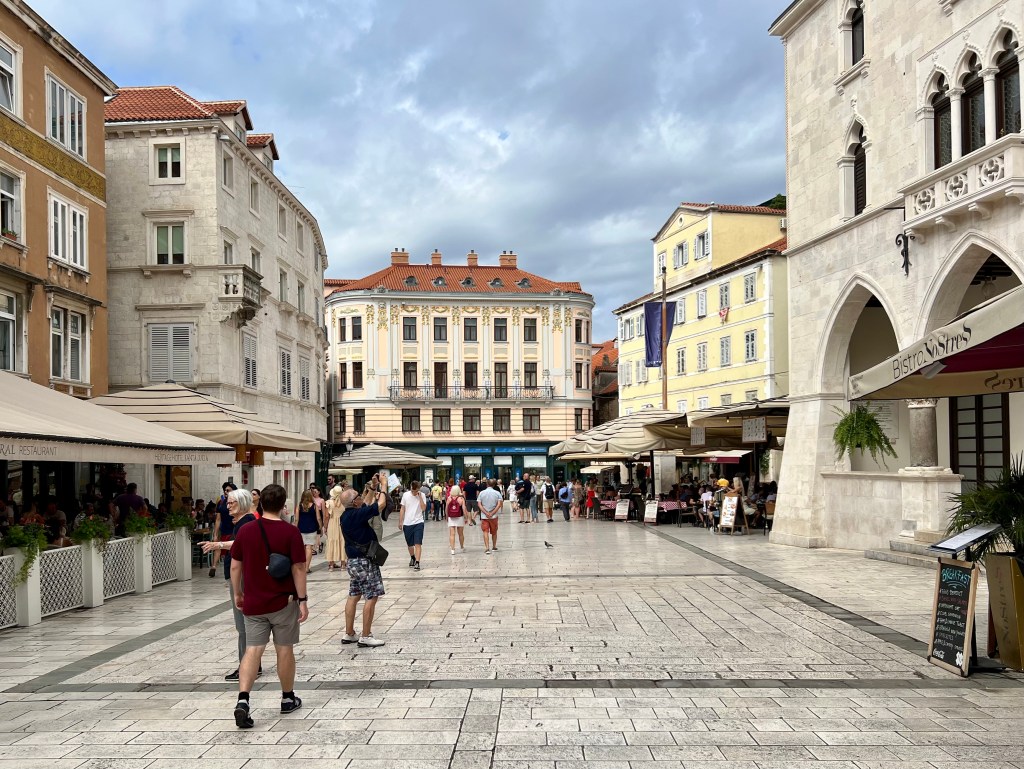
The People’s Square just outside the west gate is known by locals as Pjaca. This popular meeting place is home to many interesting Renaissance, Venetian, and Gothic buildings built by the nobility. The Renaissance style Old Town Hall flanks the square and one of the beautiful Palaces provides a screen for the daily fish and green markets that are tucked behind it.
PjacaOld City Hall
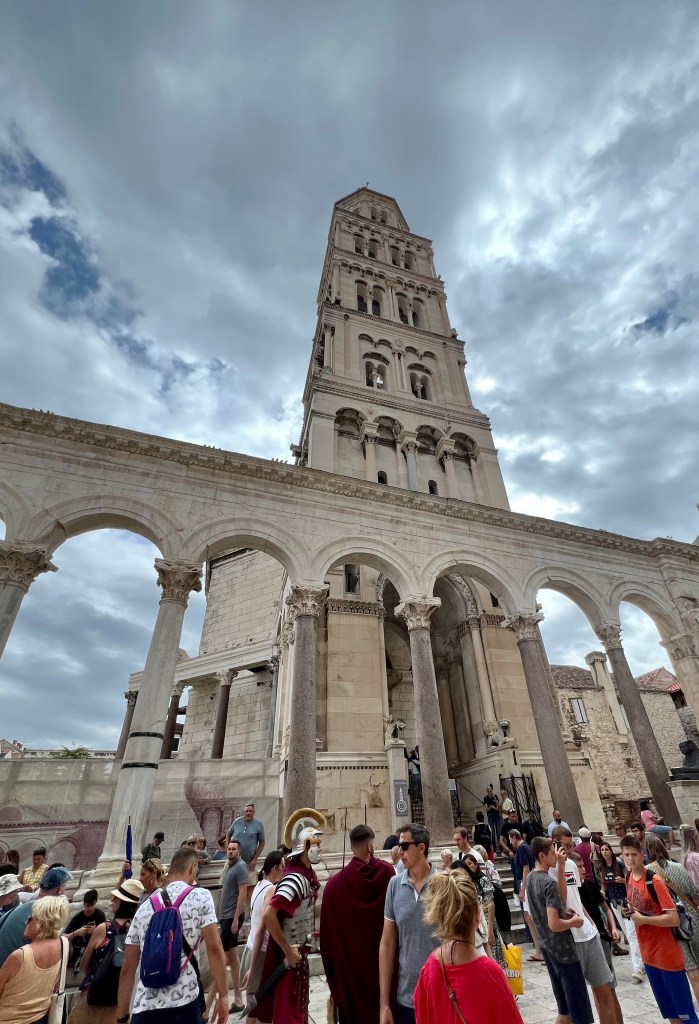
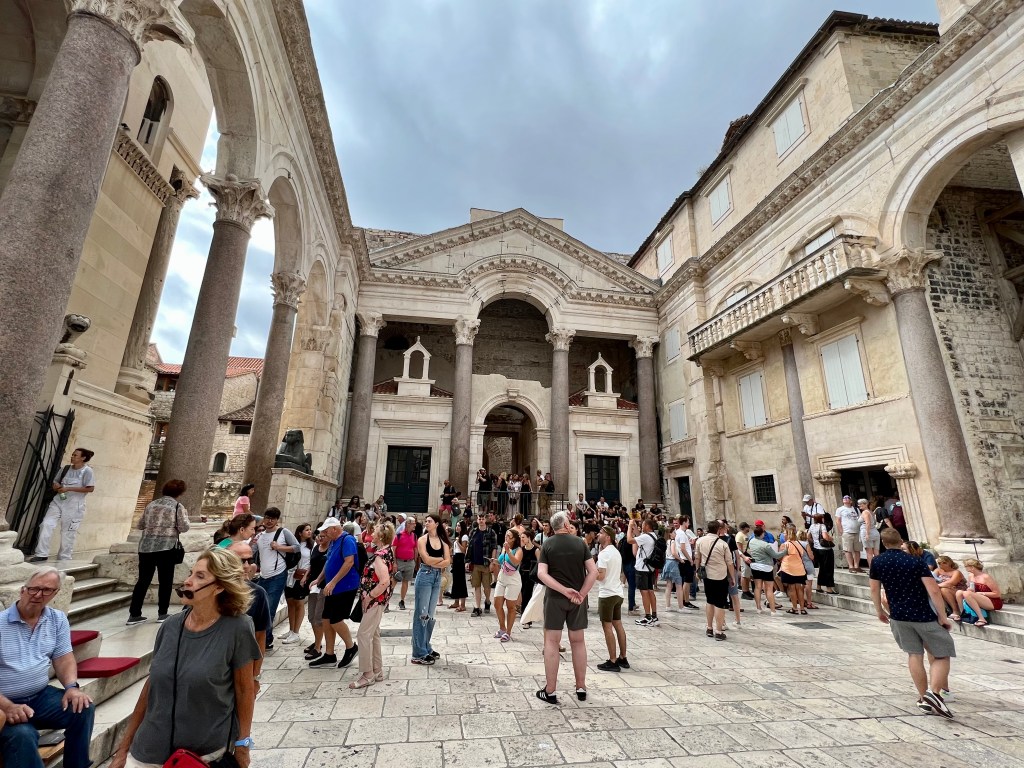
Next we’re off to the Peristyle, the main square of the palace where Diocletian, decked out in his purple toga, would stand on the balcony to receive the “adoration” of his subjects. Here we find Diocletian’s Mausoleum which is the present day Cathedral. The cathedral complex has four parts: the cathedral, a 14th century bell tower that apparently provides great views of the palace (I’ll see if my fear of heights allows further exploration or not), St. Lucy’s Crypt and the Treasury which houses a collection of sacral artwork. The Temple of Jupiter is also located on the square as is a 4000 year old African black granite sphinx; a very large tchotchke brought by Diocletian as a souvenir of his time in Egypt.
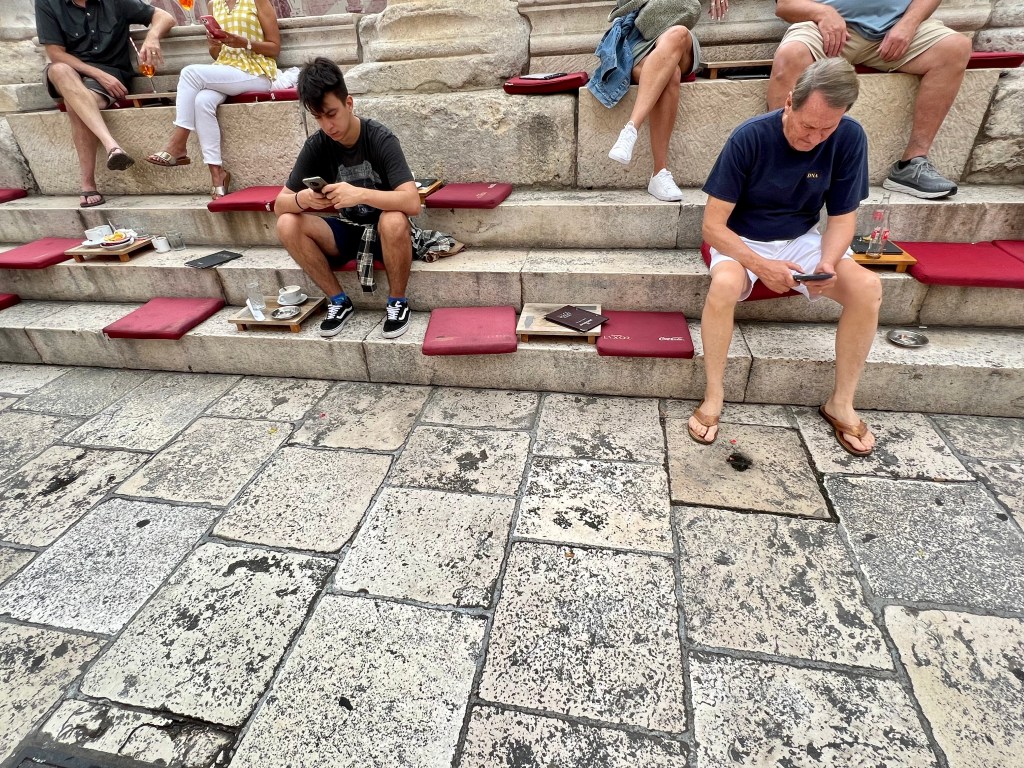
The Mausoleum and Bell TowerRestaurant on steps around the SquareThe Emperor’s Balcony Now that’s a tchotchke!.
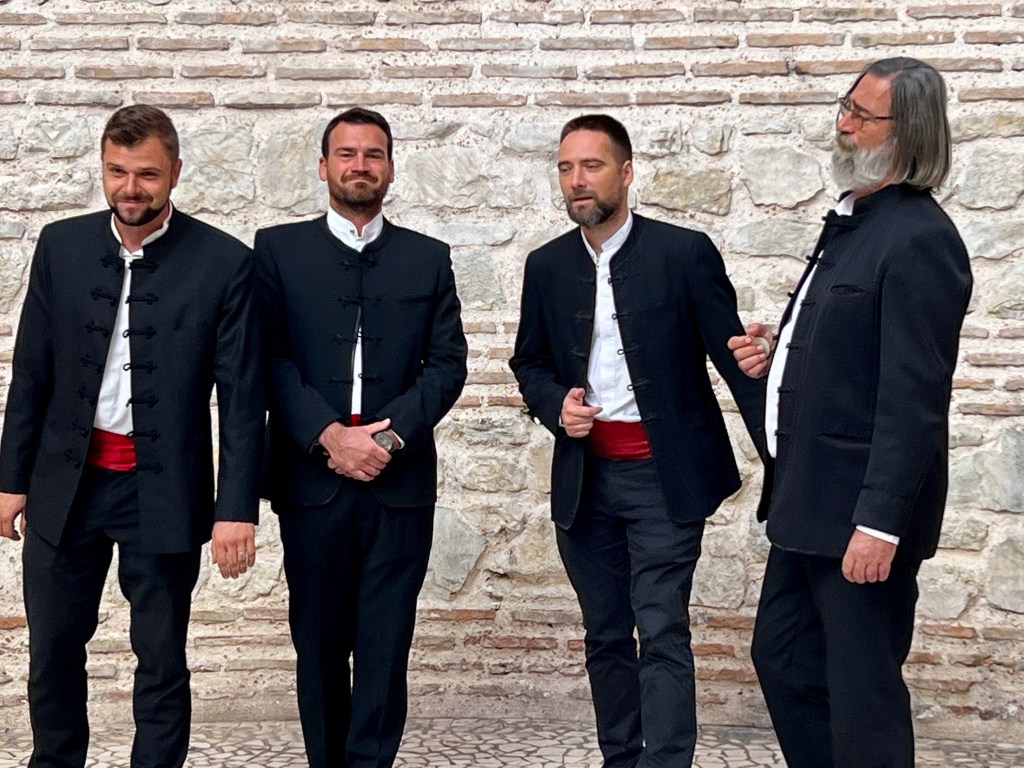
Next stop was the Vestibulum; a square building with circular hole in center with an open ceiling like a halo. The walls were originally decorated with colourful mosaics. This was also the preparation room for guests of the emperor. Here, in an ancient room with fabulous acoustics, we are treated to the melodious sounds of Klapa singers. According to Tanya, men sing about love for mothers, hard work, or the country they love while women always sing about their men.
Klapa SingersThere’s a hole in the roof!
We’re off to the balcony of the emperor which runs along the south wall of palace and has 42 windows. In Diocletian’s time, the windows would have looked out on the sea and islands as the water came right up to the wall. The south side of the city was expanded by the French 200 years ago and now is a beautiful seaside Riva Promenade with lovely restaurants and cafés.
The Emperor’s Balcony and Dining Room
80% of city is built of white limestone from the nearby island of Brač. The large stones are kept together by pressure and gravity with no mortar, etc. in between. The same people that built the pyramids were brought to build the Palace and they were master builders.
Nearby is the dining room where Diocletian’s guest could gorge themselves on rich food and wine and the conveniently located vomitorium next door with handy goose feathers to tickle their throats and speed the retching along so they could “enjoy” the next course; the original bulimics.
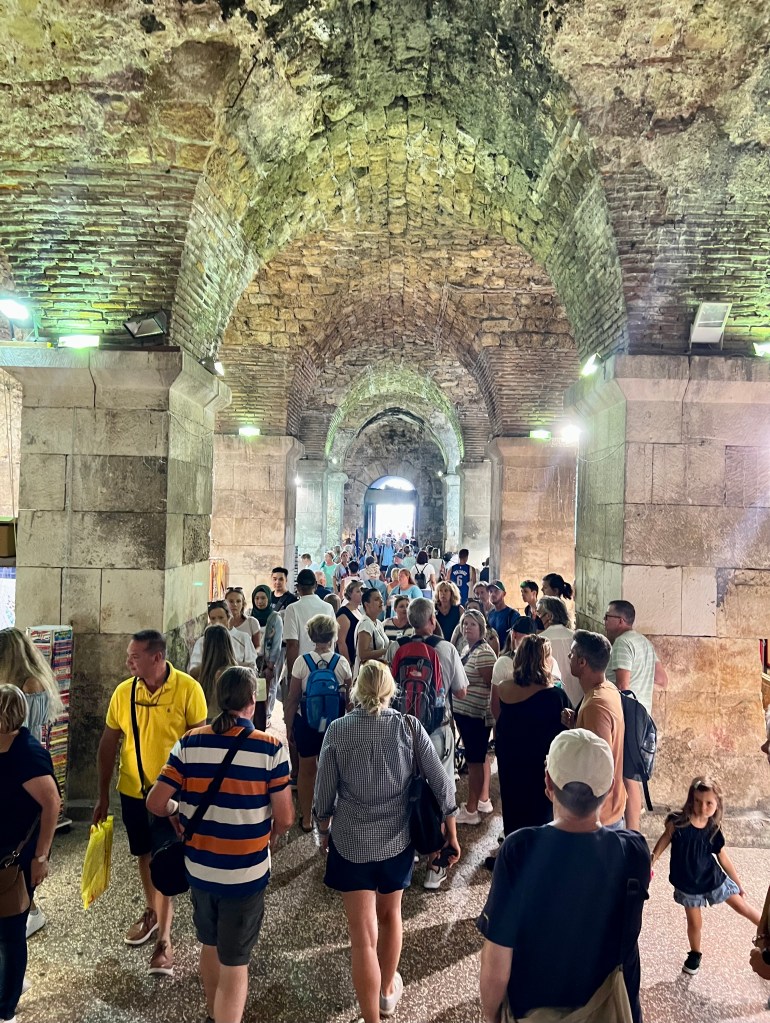
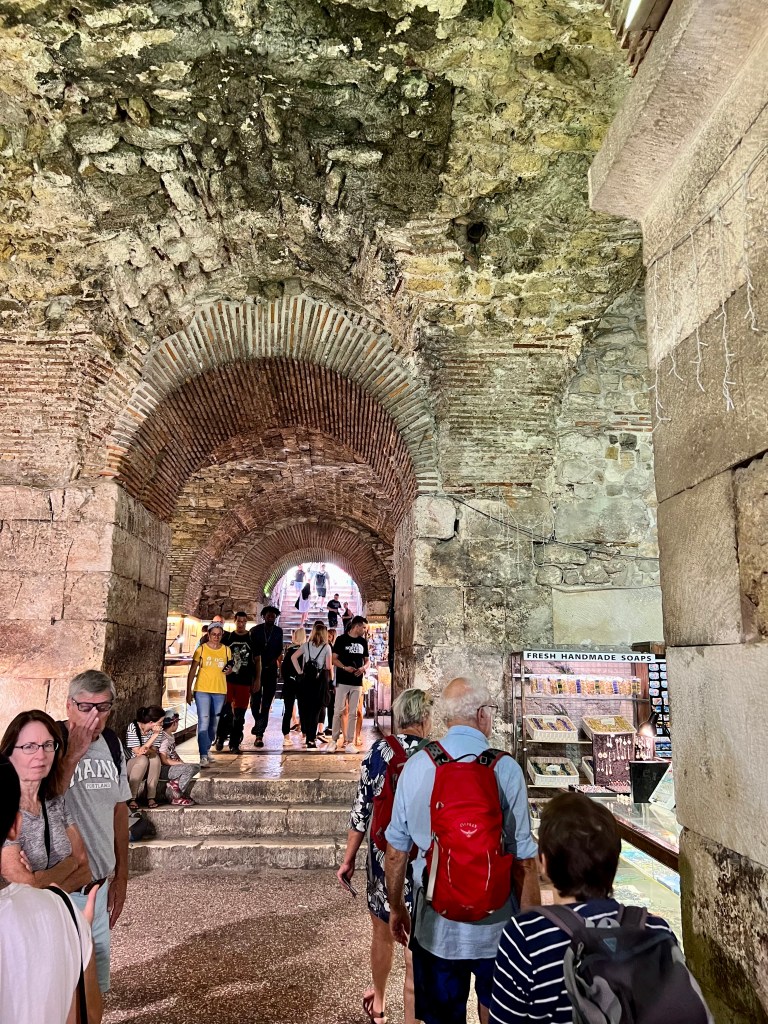
Originally the basement was intended as a sewer and seven centuries of garbage and sewage ended up in the lower level before it was overfull and the inhabitants were forced to find other options. In 1850, archeological digs discovered the well preserved underground level which is believed to have the same basic design as the upper floors. The underground area was featured in Game of Thrones as the home of the dragons.
The underground The underground
We exited the underground to the Promenade where we met Filip to discuss the plans for the rest of the day. He suggested we grab lunch at Fife, a restaurant frequented by locals, which we discovered serves gargantuan portions of simple cuisine for a reasonable price.
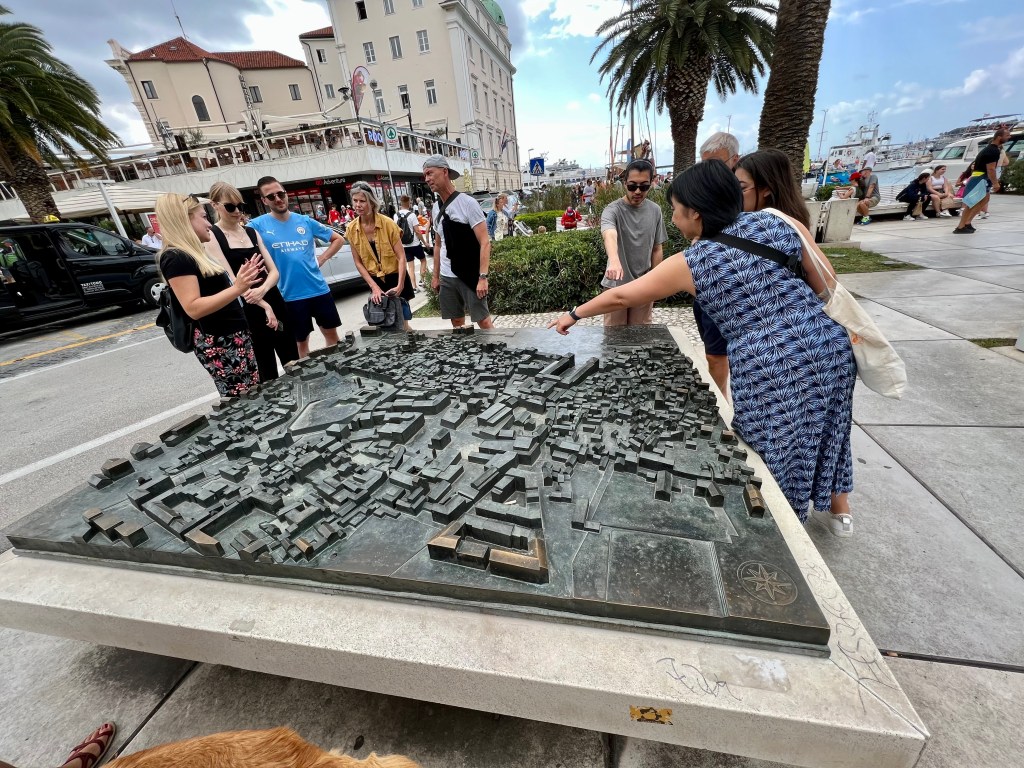
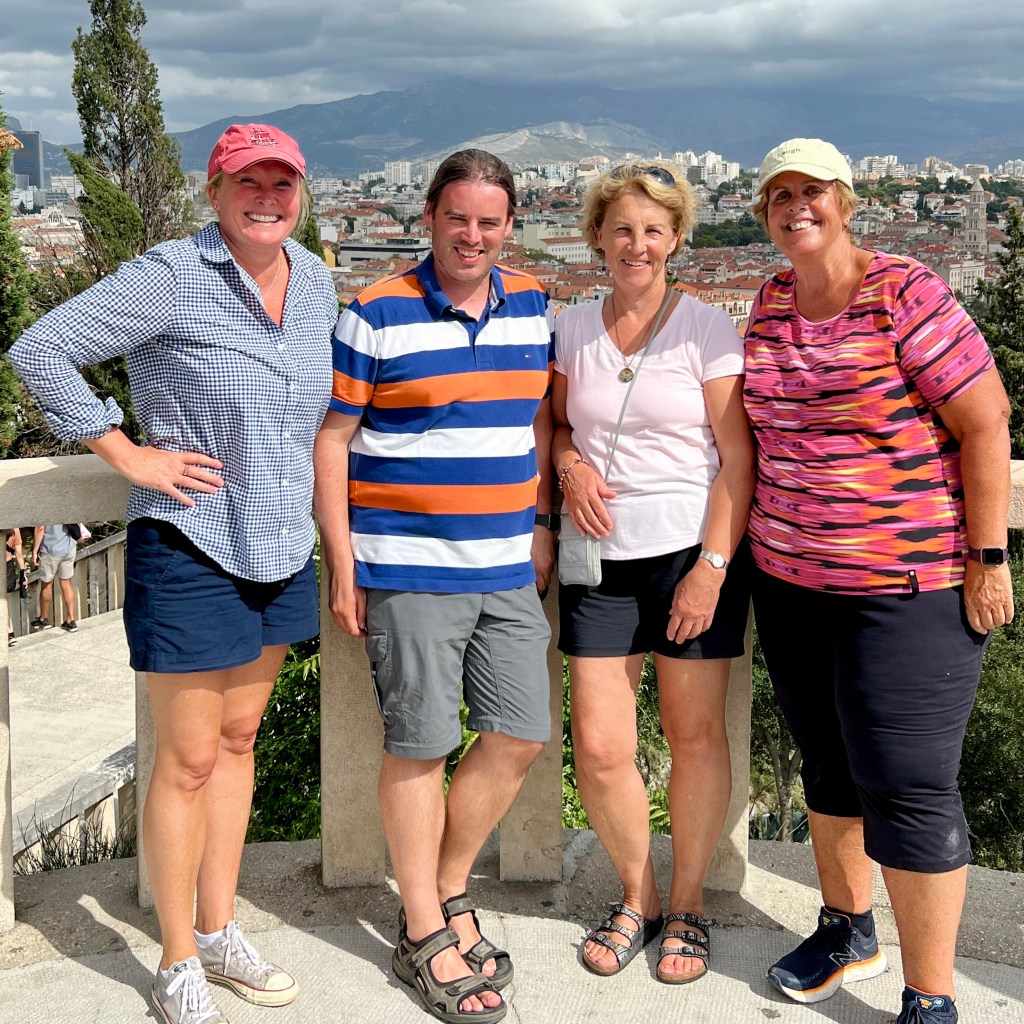
Map of SplitCalamari for six?View of Split from LookoutWe made it! – Jen, Alan, Linda and I
After a not so light lunch of fried calamari and fries, Linda, Jen, Alan and I headed for a lookout point that Filip had also recommended. I’m not a big fan of stairs and there were waaay too many of them but with some huffing, puffing and cursing at Filip, I made it to the top where we were treated to a spectacular view.
Back down at ground level, Jen went off to explore a bit more and the rest of us headed back through the Palace to the hotel to check in with a stop at the chocolate shop on the way. Courtesy of my earlier toe rub, when I inquired at reception, my prescription sunglasses had reappeared. So now I’m looking forward to my next wish!
Strolling the PromenadeWhy not to do!Tower outside the gate
We’re meeting the gang for a farewell dinner in the lobby at 7:00 so after relaxing a bit and getting cleaned up and changed, Linda and I headed to the hotel bar for some wine before dinner. Dinner was at a local eatery known for traditional food. I had a beef dish with gnocchi smothered with a rich sauce washed down with a lovely bottle of Dingač wine. The serving was overly generous especially after our big lunch so I didn’t put much of a dent in it but it was tasty!
After dinner, Filip walked us back to the hotel and bid us adieu (he’s catching a 12 hour night bus home) after which some of us retired to the bar for a bit of a chat before turning in. Tomorrow, everyone is going their own way and partings are always a bit bittersweet.
Off to dreamland. Tomorrow is another day. Adventures await.
September 17, 2022
Off to breakfast where there was a chance for some last chats and hugs before getting the steamer trunk ready for transport. We lounged about until checkout then grabbed an Uber to our VRBO (the owner had kindly allowed an early check in). The whole process was supposed to be pretty straightforward but 21 was nowhere near 20 and we missed our host. Linda found some wifi after a bit and a note from the host explaining he’d had to leave and that the key was under the rug. LOL, what rug?!
With a bit more exploration, our destination was found up the hill and then up the stairs. Lol, I really do need to start packing lighter. The apartment is bright and airy with eclectic decor and has a lovely covered seating area outside; perfect for our needs. Another note to the host, we can’t find the washer-dryer and he comes over to get us sorted out; a lovely young man and very helpful.
With laundry started, we head to the grocery store for a few supplies (we’d decided on charcuterie and wine for dinner) and then relax for a bit with phone calls to respective family members. It’s my Mom’s birthday so I finagle a FaceTime call with my niece Ashton handling tech support in Halifax.
Our wine choice was subpar but improved when imbibed with the food so overall not horrible. Tomorrow we’ll have to look beyond the local grocery store for a better selection. After dinner, we played a couple games of crib with Linda the winner of the deciding game. Soon enough, it was time to turn in.






































































































































 Judy’s Rambles