On the Road Again – Cruising Through Croatia Part II

September 15, 2022

Not sure what it is about this group and boat tours but we wake up to a cloudy, damp day and an unappealing forecast. Also not sure that I’ll be swimming in the rain but I pack up the necessary gear anyway and add my rain poncho and a deck of cards for good measure.

The hotel breakfast is the best so far so after a nice meal to start the day, I head back to the room for a bit and then off to meet the hardy souls that are still planning on taking the boat cruise. It’s actually a bit sunnier so it might be a perfect day after all; time will tell.

When we boarded the boat it was rocking and rolling so needless to say, since I’m klutzy, I landed in a heap in one of the chairs on the upper deck before we’d even set sail. Lol, I’m developing quite a nice bruise just below my left knee and another on my right forearm but like Dad used to say, it’s a long way from my heart so I’ll live! We’re headed to the Pakleni islands for the day so I just soldier on!

Our first swim stop is Milne Bay not too far from Hvar. Lots of people went for a swim and were jumping from the upper and lower decks of the boat but I opted to stay dry since it really wasn’t that warm and the next stop wasn’t too far off and was a much longer (2.5-3 hr) stop.

After everyone was back on board we headed to another island where we were docking for lunch and had the chance to walk across the island to Palmižana Bay, a small rocky beach, for a swim before lunch. Our choices for lunch were chicken, mackerel and a veggie/cheese plate washed down with water, orange juice and white wine; all were pretty good and very inexpensive for the area.

Our last swim stop was in St. Klement and then we headed back to Hvar against fairly strong winds. We reached terra firma safely and though the weather for the day was a mixed bag, it was much more pleasant than our ill-fated speed boat tour in Kotor, lol!

Back up the hill for a shower with a bit of time to relax before joining Jen and Linda to share the last bottle of wine purchased at the Bosnian Monastery. It was raining with thunder and lightning so we opted for pizza and more wine at the hotel restaurant rather than a jaunt down the hill. The sole waiter was run off his feet and though the wine came fairly quickly, the same could not be said about our pizzas which arrived hours late and cold. Oh well, at least we didn’t have to eat our arms!

The next morning we have a much too early start time so it’s time to crash.

Tomorrow is another day. Adventures await …

September 16, 2022

After our “crack of dawn” meeting in the hotel lobby, we headed down to the harbour to catch the early ferry to Split. Thankfully our luggage was transferred to the pier by the hotel.

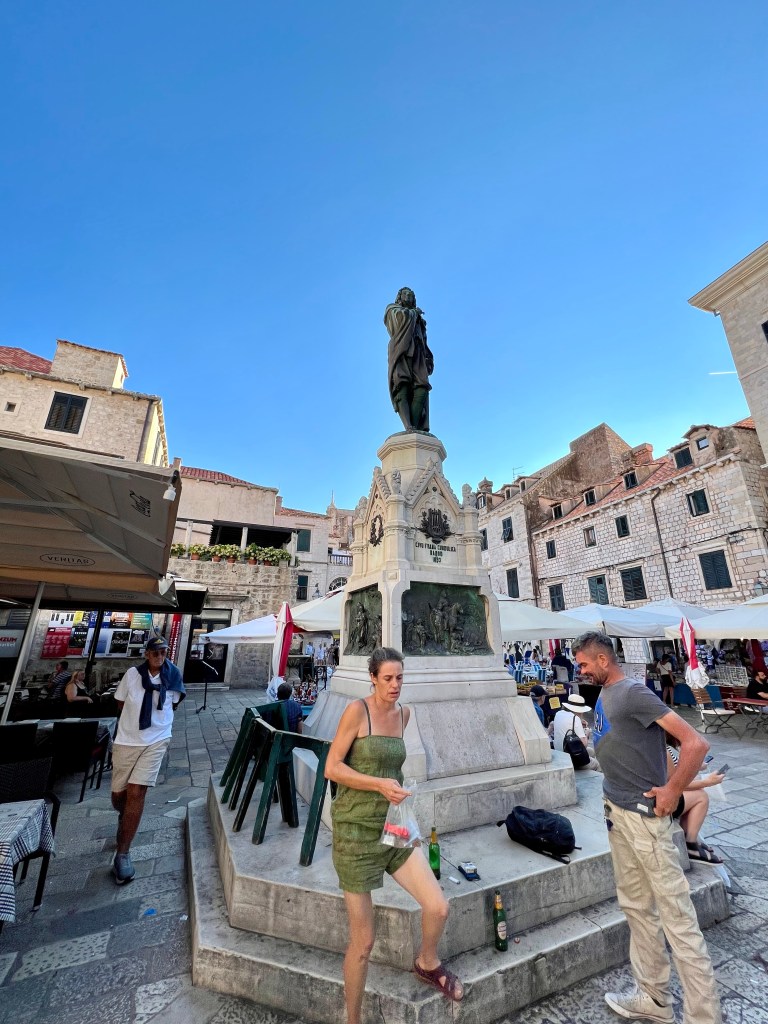
After a short and uneventful voyage, we clamoured into three cabs and headed to our hotel in Split to drop off our stuff before heading out to enjoy our last day with the G Adventures crew. As we approached Old Town Split, we passed a very large statue of Grgur Ninski. His toe was bright and shiny which typically means good luck so I wished that I would find my prescription sunglasses that I’d misplaced earlier in the day as I passed.

We met our guide, Tanya, outside the North gate of Old Town for the usual discussion of local history, culture and a stroll by the most important sites.

Croatia is a small country with a population of less than 4 million. Split is the second largest city in Croatia and the capital of Dalmatia (southern Croatia) with a population of less than 200,000. Split sounds idyllic with 300 sunny days during the year; a lovely Mediterranean climate. Tanya joked that you never cook or run in the south. Maybe I should move here!!

The city was founded as the Greek Colony of Aspálathos in the 3rd or 2nd century. In 305 AD, it became the site of the Palace of the Roman emperor Diocletian; his retirement home. Nine years after moving here, Diocletian died and the Palace was abandoned. After the sack of Salona, the fortified Palace of Diocletian was settled by Roman refugees who used the materials from the buildings inside the palace to build themselves houses within the walled city. The city expanded beyond the original palace walls to the west when they felt safe. Diocletian’s Palace is the only UNESCO cultural monument where people are still living inside.

The city can be accessed through four double arched entrances; north, south, east and west. The gates all have two arches so that visitors could be “screened” before accessing the Palace/Old Town. If you didn’t pass muster, you would likely get treated to a shower of boiling oil – yikes!

The Palace/Old Town has two main streets; Cardo which runs between the north and south gates and Decumanus which runs between the east and west gates and many little side streets some of which lead nowhere.

Tanya told us a bit more about Grgur Ninski. He was a medieval bishop of Nin who was a big supporter of the Croatian language; introducing the use of Croatian language in religious services in defiance of the pope in the 10th century. The 28 ft statue was built by Ivan Meštrović as a single piece of brass and erected in 1929 in the centre of the Palace. When Split was occupied by the Italians during WWII, the statue was moved outside of the city because Mussolini didn’t want it in town. In 1954, it was re-erected just outside the Golden Gate in its current location.

Back to the Old Town. 900 people live inside the Walls. Originally, the north end of the palace housed, servants, slaves, soldiers and horses while the south end was reserved for the Emperor and his family. The north end was largely destroyed during WWII when in June 1944, it was accidentally hit with 600 American bombs! At the time, Split was occupied by Germans and they meant to hit military targets but missed over and over again!

One of Split’s claims to fame is a Guinness Book World Record for the largest chocolate bar in the world (2015). Tanya pointed out her favourite chocolate store which makes traditional flavours such as red wine and figs, dark chocolate with sea salt and white chocolate with lavender. We stopped by later and bought the first two and I can recommend them both highly. Sadly, I doubt any would survive the rest of the trip so you’ll have to come to Split and buy your own!

Diocletian’s mausoleum is part of the emperor’s palatial complex. The building was constructed before his death to house the remains of the emperor after his passing. The building signified his divine descent; the Roman emperor was considered the son of Jupiter which is what gave him power over his subjects and the Mausoleum was intended as a place of worship. The Mausoleum is located in what once was the imperial section of the palace and positioned so that people arriving at the palace would notice its splendor from a distance.

Diocletian allowed no other religions and especially hated Christians and his brutality to them was legendary. This makes it quite fitting/ironic that in 653 the mausoleum was consecrated by the first bishop of Split and has been the city’s cathedral ever since. It is the Cathedral of Saint Domnius, the patron saint of Split, who was the Bishop of Salona at the time of Diocletian and was persecuted by the emperor for his faith and martyred.

Our next stop was the West Gate (aka the Iron gate) which leads to the medieval part of Split which is outside the Palace walls. Houses were also built inside the west wall around the same time.

The People’s Square just outside the west gate is known by locals as Pjaca. This popular meeting place is home to many interesting Renaissance, Venetian, and Gothic buildings built by the nobility. The Renaissance style Old Town Hall flanks the square and one of the beautiful Palaces provides a screen for the daily fish and green markets that are tucked behind it.

Next we’re off to the Peristyle, the main square of the palace where Diocletian, decked out in his purple toga, would stand on the balcony to receive the “adoration” of his subjects. Here we find Diocletian’s Mausoleum which is the present day Cathedral. The cathedral complex has four parts: the cathedral, a 14th century bell tower that apparently provides great views of the palace (I’ll see if my fear of heights allows further exploration or not), St. Lucy’s Crypt and the Treasury which houses a collection of sacral artwork. The Temple of Jupiter is also located on the square as is a 4000 year old African black granite sphinx; a very large tchotchke brought by Diocletian as a souvenir of his time in Egypt.

Next stop was the Vestibulum; a square building with circular hole in center with an open ceiling like a halo. The walls were originally decorated with colourful mosaics. This was also the preparation room for guests of the emperor. Here, in an ancient room with fabulous acoustics, we are treated to the melodious sounds of Klapa singers. According to Tanya, men sing about love for mothers, hard work, or the country they love while women always sing about their men.

We’re off to the balcony of the emperor which runs along the south wall of palace and has 42 windows. In Diocletian’s time, the windows would have looked out on the sea and islands as the water came right up to the wall. The south side of the city was expanded by the French 200 years ago and now is a beautiful seaside Riva Promenade with lovely restaurants and cafés

80% of city is built of white limestone from the nearby island of Brač. The large stones are kept together by pressure and gravity with no mortar, etc. in between. The same people that built the pyramids were brought to build the Palace and they were master builders.

Nearby is the dining room where Diocletian’s guest could gorge themselves on rich food and wine and the conveniently located vomitorium next door with handy goose feathers to tickle their throats and speed the retching along so they could “enjoy” the next course; the original bulimics.

Originally the basement was intended as a sewer and seven centuries of garbage and sewage ended up in the lower level before it was overfull and the inhabitants were forced to find other options. In 1850, archeological digs discovered the well preserved underground level which is believed to have the same basic design as the upper floors. The underground area was featured in Game of Thrones as the home of the dragons.

We exited the underground to the Promenade where we met Filip to discuss the plans for the rest of the day. He suggested we grab lunch at Fife, a restaurant frequented by locals, which we discovered serves gargantuan portions of simple cuisine for a reasonable price.

After a not so light lunch of fried calamari and fries, Linda, Jen, Alan and I headed for a lookout point that Filip had also recommended. I’m not a big fan of stairs and there were waaay too many of them but with some huffing, puffing and cursing at Filip, I made it to the top where we were treated to a spectacular view.

Back down at ground level, Jen went off to explore a bit more and the rest of us headed back through the Palace to the hotel to check in with a stop at the chocolate shop on the way. Courtesy of my earlier toe rub, when I inquired at reception, my prescription sunglasses had reappeared. So now I’m looking forward to my next wish!

We’re meeting the gang for a farewell dinner in the lobby at 7:00 so after relaxing a bit and getting cleaned up and changed, Linda and I headed to the hotel bar for some wine before dinner. Dinner was at a local eatery known for traditional food. I had a beef dish with gnocchi smothered with a rich sauce washed down with a lovely bottle of Dingač wine. The serving was overly generous especially after our big lunch so I didn’t put much of a dent in it but it was tasty!

After dinner, Filip walked us back to the hotel and bid us adieu (he’s catching a 12 hour night bus home) after which some of us retired to the bar for a bit of a chat before turning in. Tomorrow, everyone is going their own way and partings are always a bit bittersweet.

Off to dreamland. Tomorrow is another day. Adventures await.

September 17, 2022

Off to breakfast where there was a chance for some last chats and hugs before getting the steamer trunk ready for transport. We lounged about until checkout then grabbed an Uber to our VRBO (the owner had kindly allowed an early check in). The whole process was supposed to be pretty straightforward but 21 was nowhere near 20 and we missed our host. Linda found some wifi after a bit and a note from the host explaining he’d had to leave and that the key was under the rug. LOL, what rug?!

With a bit more exploration, our destination was found up the hill and then up the stairs. Lol, I really do need to start packing lighter. The apartment is bright and airy with eclectic decor and has a lovely covered seating area outside; perfect for our needs. Another note to the host, we can’t find the washer-dryer and he comes over to get us sorted out; a lovely young man and very helpful.

With laundry started, we head to the grocery store for a few supplies (we’d decided on charcuterie and wine for dinner) and then relax for a bit with phone calls to respective family members. It’s my Mom’s birthday so I finagle a FaceTime call with my niece Ashton handling tech support in Halifax.

Our wine choice was subpar but improved when imbibed with the food so overall not horrible. Tomorrow we’ll have to look beyond the local grocery store for a better selection. After dinner, we played a couple games of crib with Linda the winner of the deciding game. Soon enough, it was time to turn in.

Tomorrow is another day. Adventures await …
On the Road Again – Cruising Through Croatia – Part I

September 12, 2202

Early breakfast, check out of hotel and head out of Old Town Kotor, schlepping our possessions, to board yet another bus, this time to Croatia. The drive to Dubrovnik is about 2.5 hours but our bathroom stop is a bust with closed toilets and the border crossing is a bit slower because of the crowd so it takes a bit longer than planned.

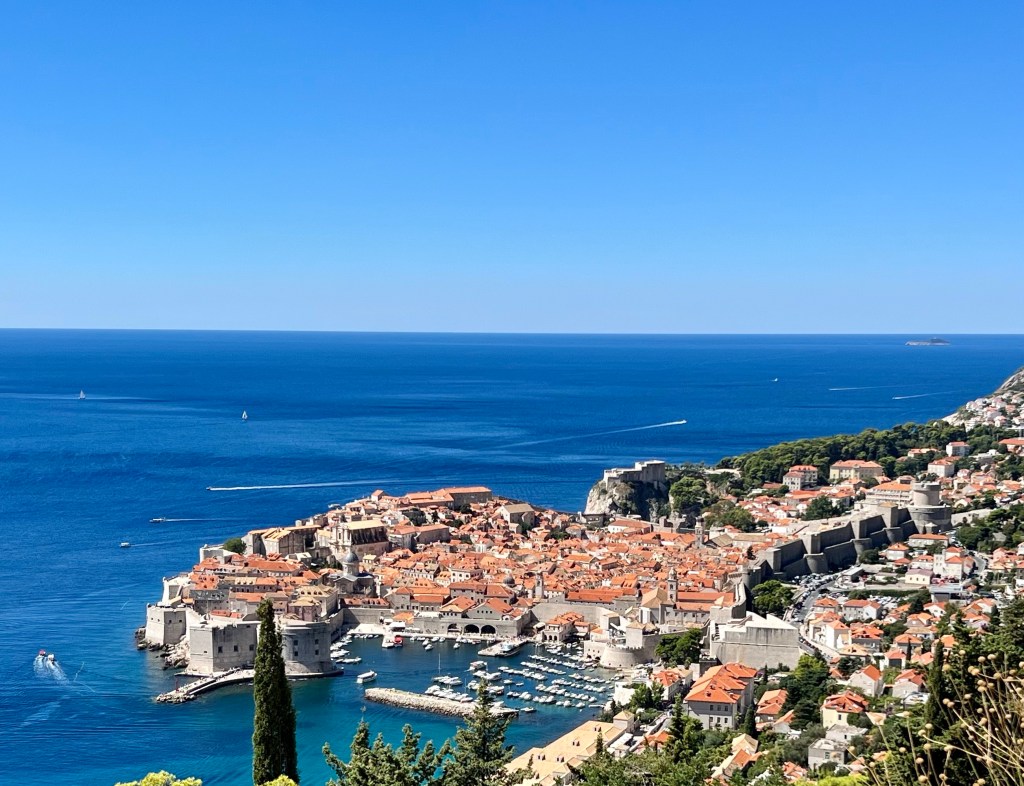
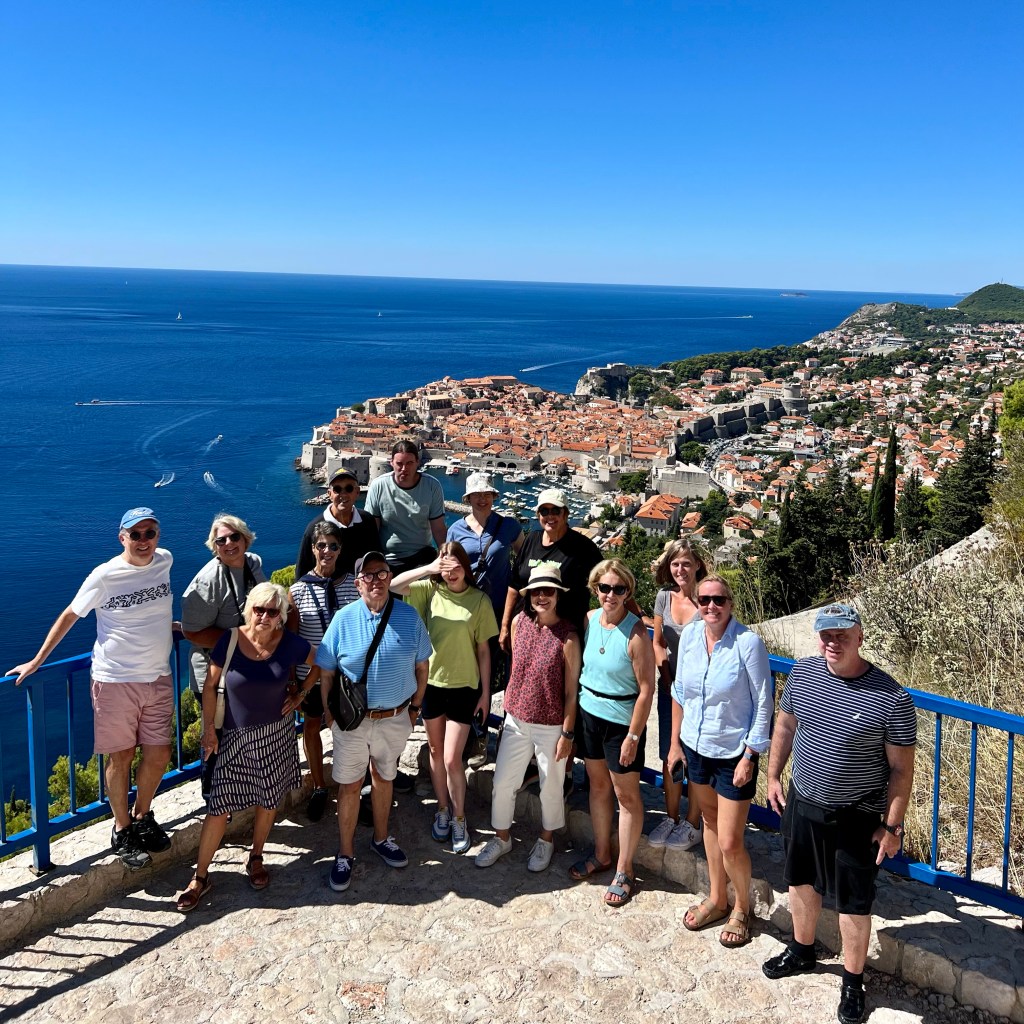
Soon enough we make it to a spot overlooking Dubrovnik for or a photo stop before heading to the hotel which is a little way out of town. Our early arrival means we store the luggage for a bit, head out to get local currency, grab lunch and then return to the hotel for checkin. After a quick refresh, we’re off to grab the local bus for our short transfer into Old Town Dubrovnik.

View from the top!
The crew

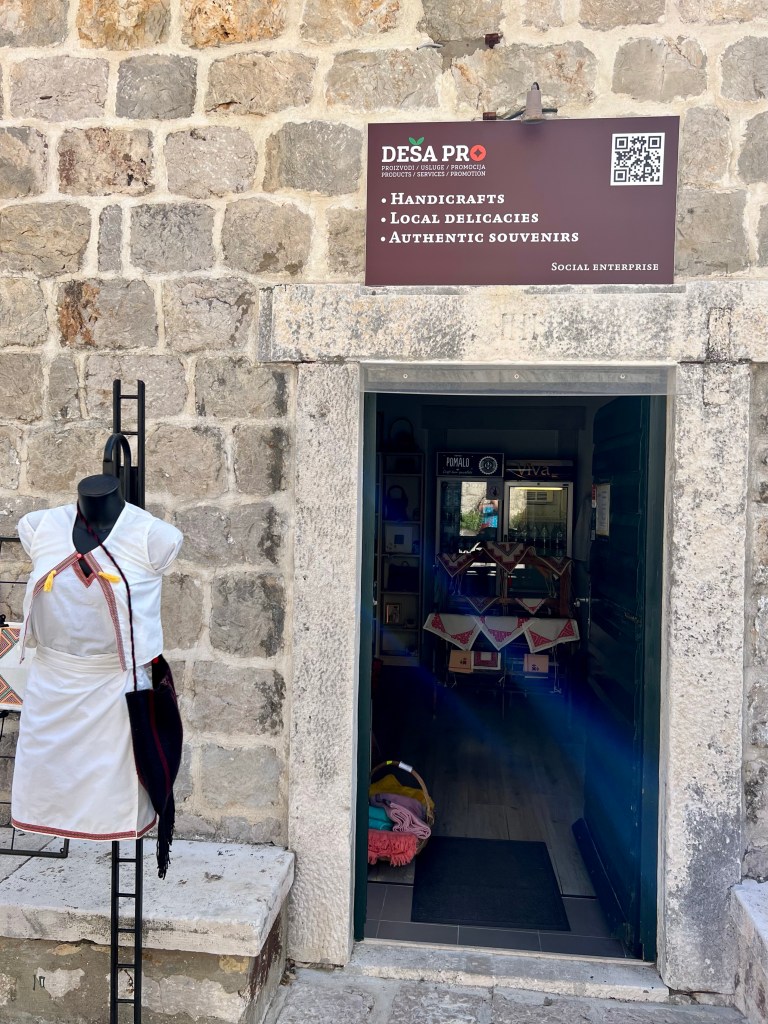
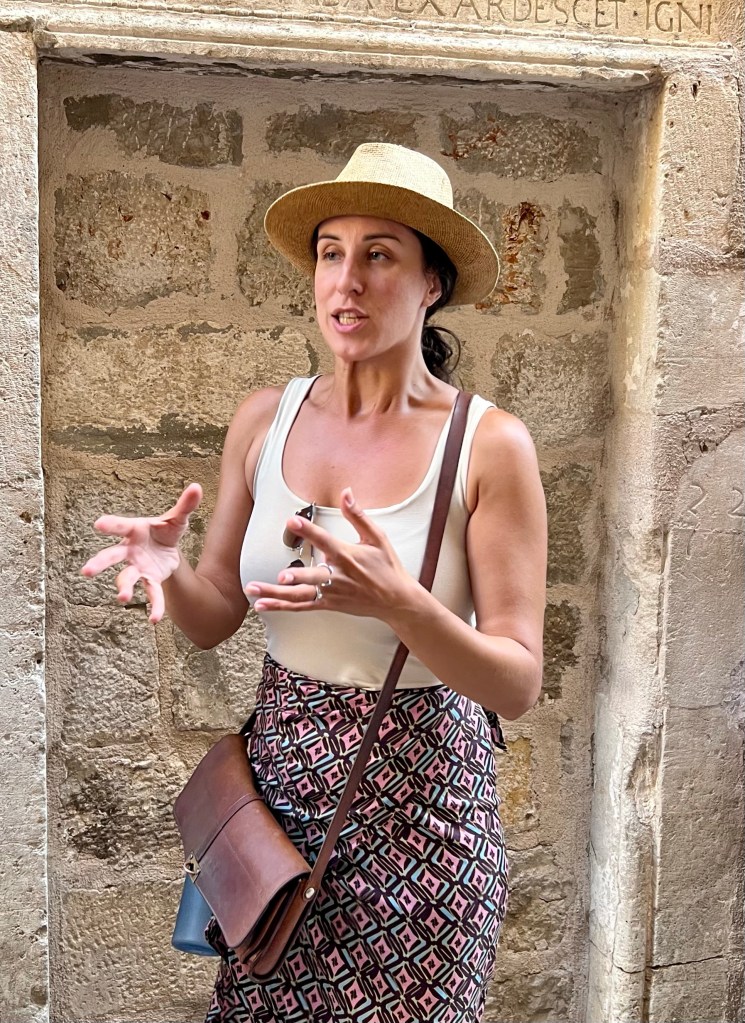
Filip “marches” us through old town to our first stop – DEŠA; a Planeterra project supported by the G Adventures’ Foundation. We were greeted by one of their staff members, Anna, who provided us with an overview of the organization’s history and current activities.

DEŠA was founded during the homeland war by a group of locals from Dubrovnik who partnered with refugees to establish a small handicraft business. The organization promotes family values and economic empowerment for women. They run workshops in a number of areas, including: craft revival, computer skills, foreign languages and other projects that support women in particular. DEŠA also functions as a women’s centre providing support for victims and witnesses of crime; lawyers, psychologists, etc.

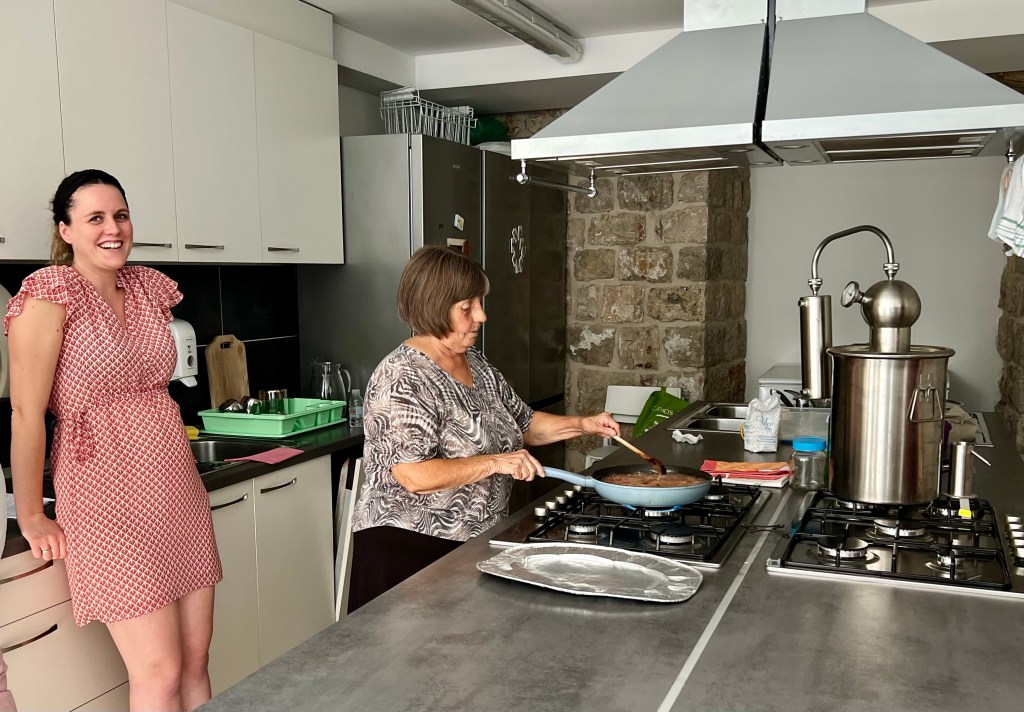
After Anna’s overview, we were treated to a demonstration of how the locals make candied almonds by one of their longtime members and, of course, had a chance to snack on them when they were warm out of the pan.

Anna and her cooking friend making candied almonds

Next stop was their storefront to peruse their members’ handicrafts and buy some to support the cause. Through selling handicrafts, made by women across the country, and providing tourists with the opportunity to learn about traditional costumes, weaving, and cooking, DEŠA contributes to the sustainable and inclusive development of its communities.

DŠA’s Storefront

Once our retail therapy is complete, we are met by Anya for our two hour tour of this beautiful Old City featured in Game of Thrones and many other cinematic productions.

Our guide for the day; Anya

Dubrovnik is located on the southern tip of Croatia surrounded by Bosnia and Montenegro. The city is a mix of east (Slavic) and west (Venice) in language, cuisine and architecture; as Anya put it a Slavic soul influenced by the west.

The history of the city probably dates back to the 7th century, when the town was known as Ragusa. Dubrovnik was a small independent Republic for 500 years trapped between the Venetians and Ottomans. Diplomacy was one of their strengths and information one of their most valuable exports; their strategic location was key to their success.

Dubrovnik is known for its distinctive Old Town, encircled with massive stone walls completed in the 16th century. It’s well-preserved buildings range from baroque St. Blaise Church to Renaissance Sponza Palace and the Gothic Rector’s Palace, now a history museum. Paved with limestone, the pedestrianized Stradun is lined with shops and restaurants.

In 1979, the city of Dubrovnik was added to the UNESCO list of World Heritage Sites in recognition of its outstanding medieval architecture and the fortified old town. The 19th century was the beginning of tourism here and today 90% of people now work directly or indirectly in tourism.

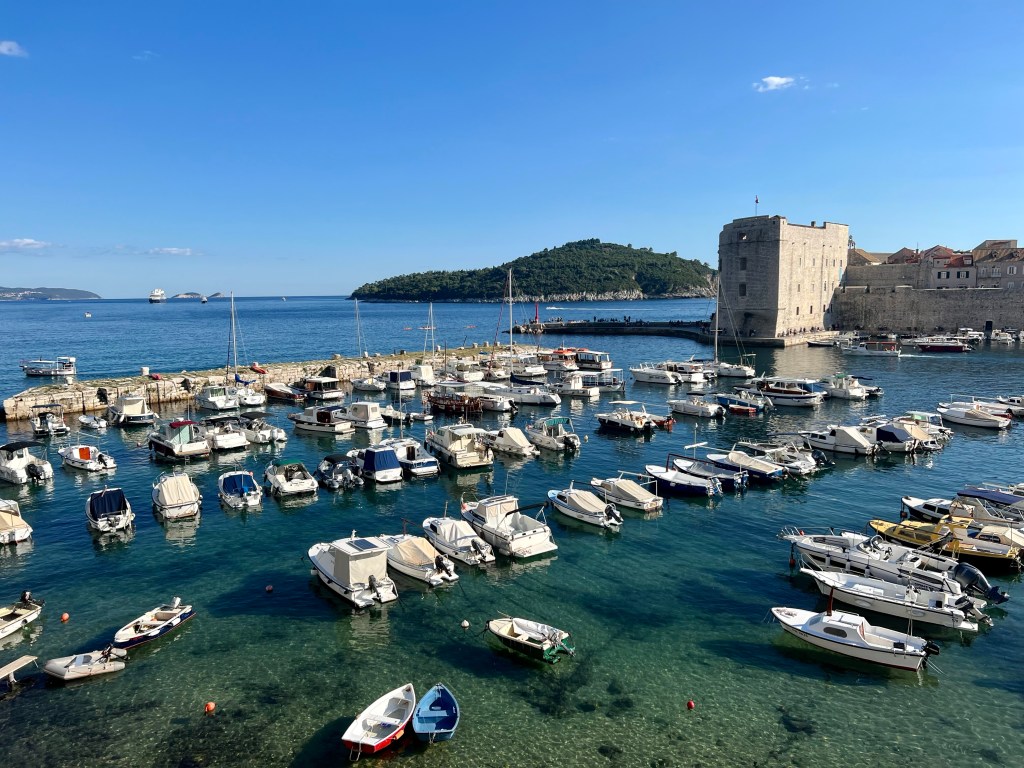
Our walk through town started at the Old City Harbour. From here you can enter Old Town through the Ploče gate from the east which is connected to the “main” entrance into Old Town through the Pile gate in the west. Between them Main Street runs 300 meters across the lowest part of the town; previously a sea channel that separated the two parts of the town.

Old City Harbour – Dubrovnik

Today, Dubrovnik boasts around 1000 residents with an additional 3000 rentals during tourist season. No cars are allowed in the Old City which is still delineated by the original city wall. Historically, the North wall protected the city inhabitants against the Ottomans and the South wall protected them against the Venetians.

The Austro-Hungarians urbanized Dubrovnik by closing shipyards in the Old Harbour and opening restaurants and bakeries etc.

An important local saying is to be friendly with everyone and … with no one. They also believed that their freedom was not for sale for all the gold in the world. They did, however, buy it by paying tributes to the Ottomans including allowing them free access to the harbour.

The east side of the city was populated mainly by non-Catholics (Orthodox or Muslims) so there are no religious symbols on the eastern Ploče gate. The west side of the city was the home of the Catholics so the western Pile gate has lots of religious symbolism, including St. Blaise.

Ploče gate.

Our next stop was The Assumption Cathedral; the oldest in Dubrovnik. Most people in Dubrovnik are Roman Catholics. When they were building the cathedral, the Ottomans wanted a door that faces Mecca so there is one. People from Dubrovnik know how to keep everyone happy,

Assumption Cathedral

We had a whistle stop at Buza (hole in the wall) bar restaurant which is built in the cliffs. Some of our travelling companions went the next day for a drink.

Hole in the Wall Bar

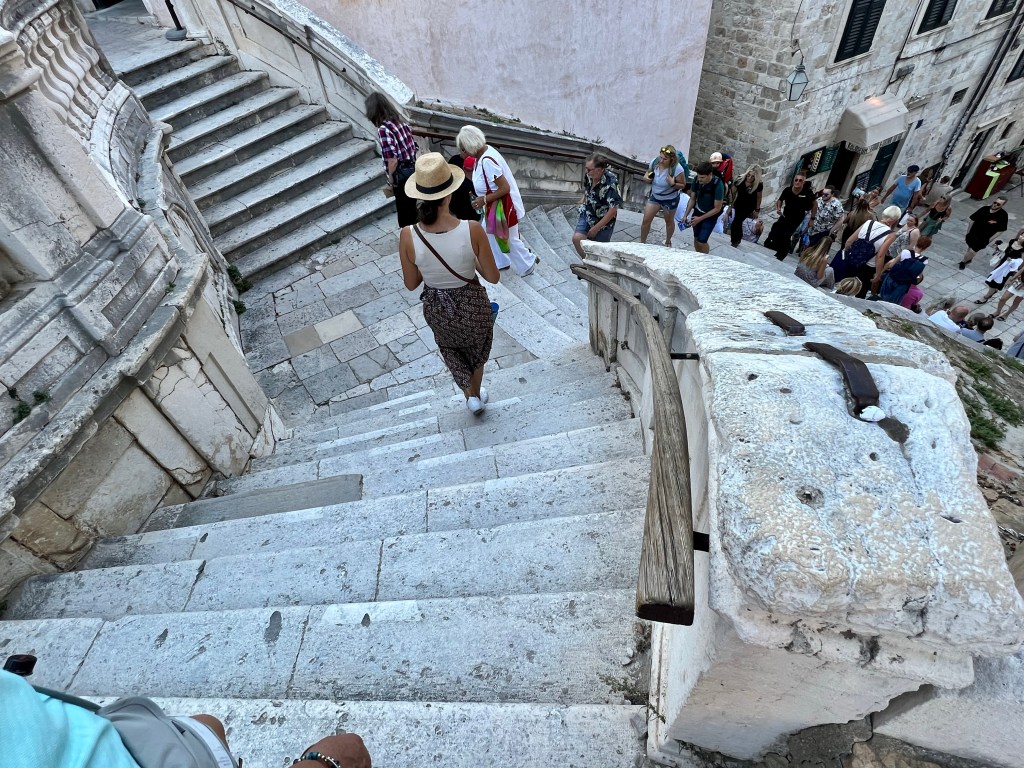
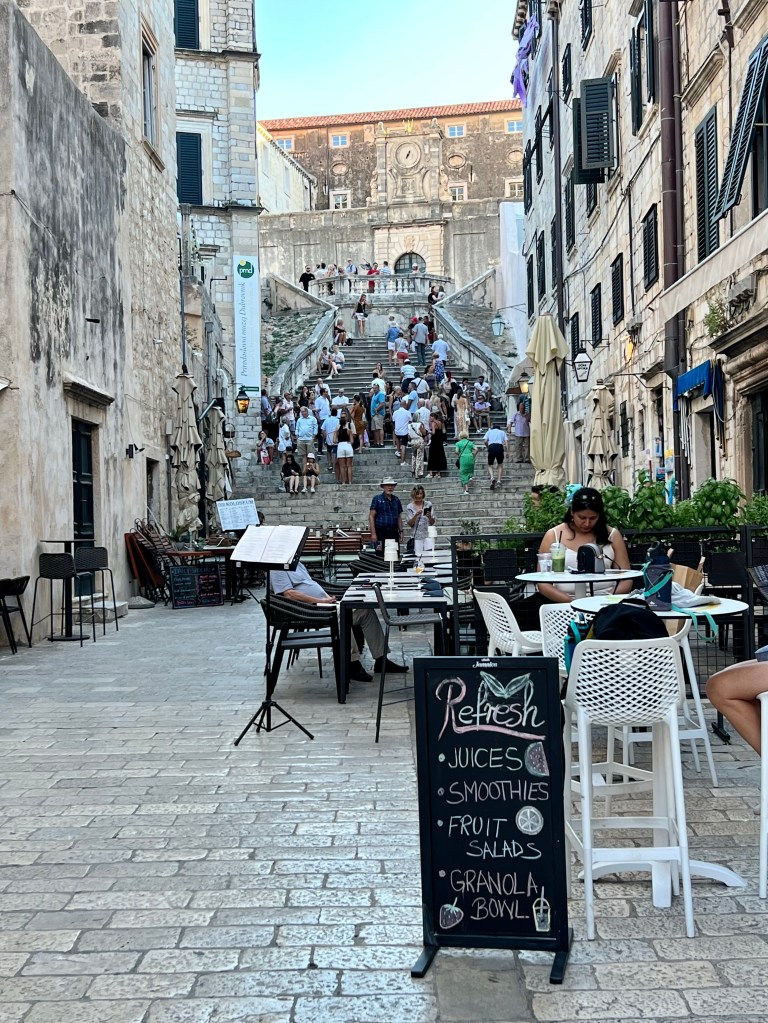
Soon enough we arrived at the Jesuit Church Square; home of the Jesuit Church of St. Ignatius of Loyola and the beautiful Baroque staircase. This is the most popular church for international weddings and a whole industry has developed around that similar to Anne of Green Gables weddings in PEI.

Jesuit Church of St. Ignatius of Loyola

The town is replete with monasteries Franciscan, Jesuit and Dominican as well as eight convents filled with the daughters of noblemen for which no dowries were made available.

Lots of places to fill up your water bottle

Our next stop was the Rector’s (Duke’s) Palace. The Rectors (Presidents) were man aristocratic men over 50. They served one month terms with no salary. During that term the wife couldn’t live with him and he wasn’t allowed to leave the palace to avoid him being bribed or influenced. Due to the short term, the position didn’t really have much power and the big decisions were mainly made by the Senate.

Rector’s Palace

Nearby was the Central Luža square home to the most important church in Dubrovnik; St Blaise’s Church named for the city’s patron saint. This is the favourite church for locals to get married and features statues of Faith and Hope.

St Blaise’s Church
Small Ornofrio Fountain

Sadly, Orlando’s Column located in front of the church was being restored so this site of proclamations and shaming! wasn’t available for photography. The small Ornofrio fountain is also found in this square.

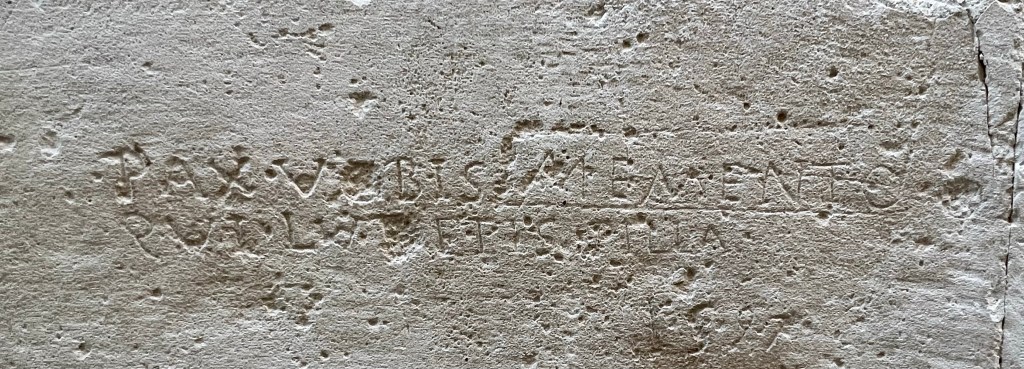
Anya showed us some graffiti from 1597 in a wall close to the church. Apparently, it was a subtle message from the Bishop for boys to stop playing Florentine football in front of the church.

Graffiti from 1597
His home was bombed and he gave the Dubrovnik equivalent of the finger!

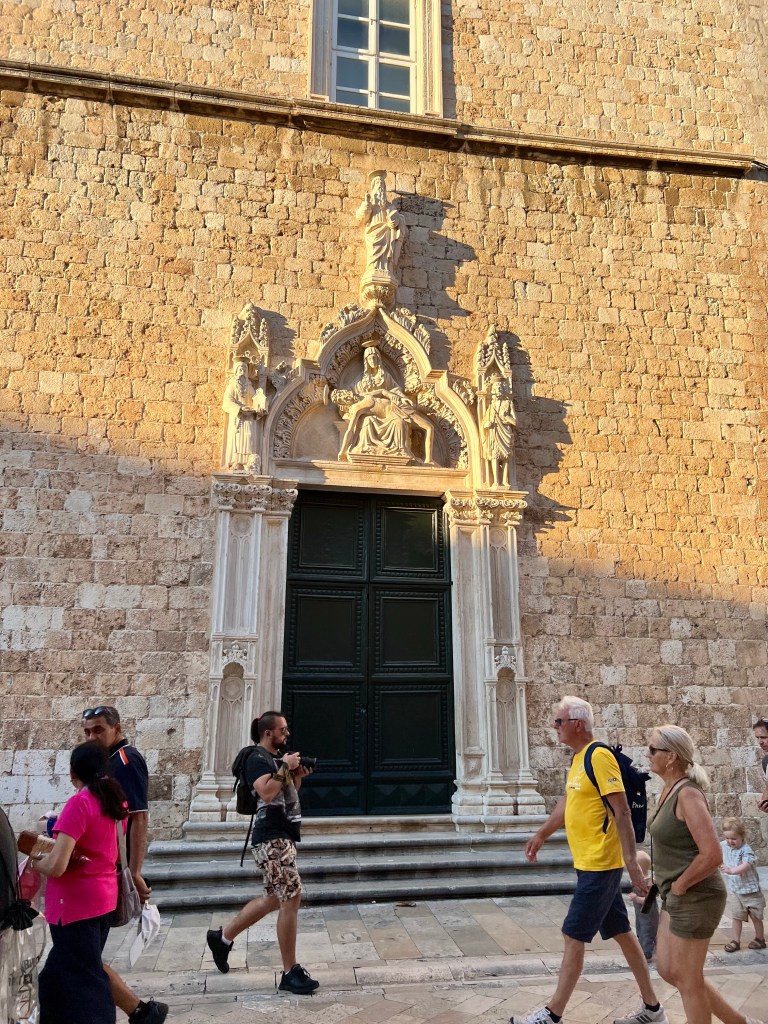
Our next stop was an orphanage where babies born of unions between aristocratic fathers and non aristocratic mothers were left anonymously for the nuns to take care of as such unions and their offspring were considered illegal. Politicians supported these orphanages as they were guilty of fathering many of the children that ended up here. The mothers would try to leave something with the babies, an earring or some other identifiable item, so they could figure out which of the children was theirs when they grew up. There is a frieze of Pieta at the end of the street which is an interesting counterpoint.

Pieta

Our next stop was the Big Ornofrio fountain where apparently, the same man has been playing the same tune for three years. Lol, talk about an ear worm. He usually stops playing if he catches you snapping a pic – I guess he saw me!

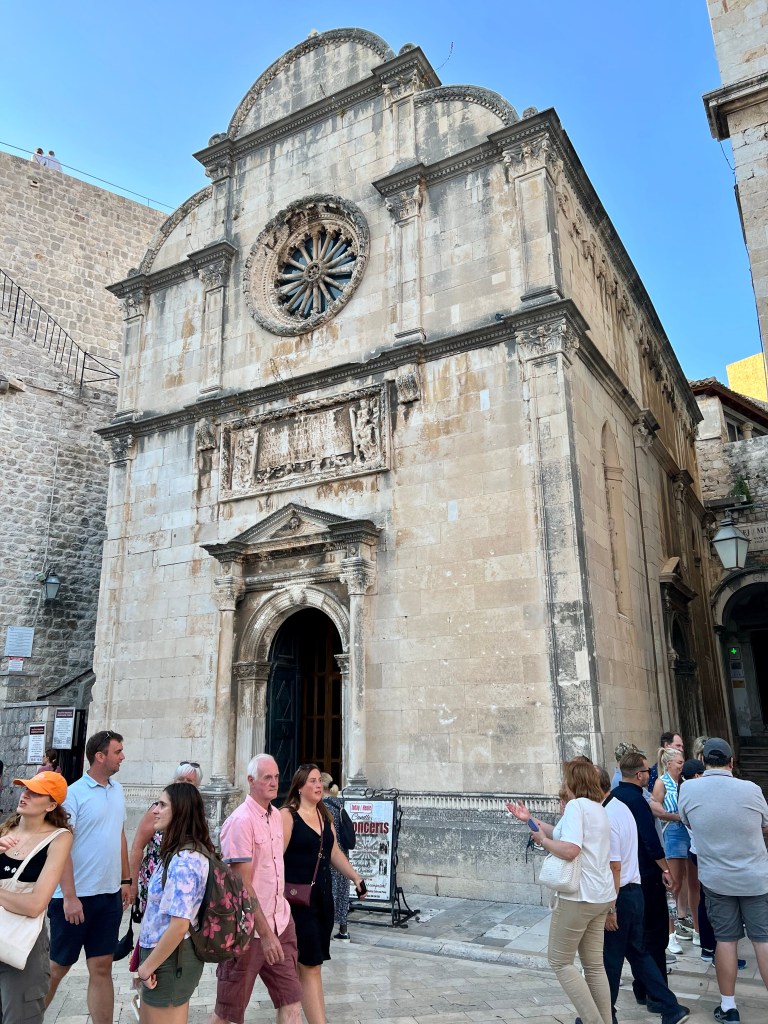
Nearby is a small church, the St. Saviour Church, the only church that survived the big earthquake.

St. Saviour Church
Pile Gate

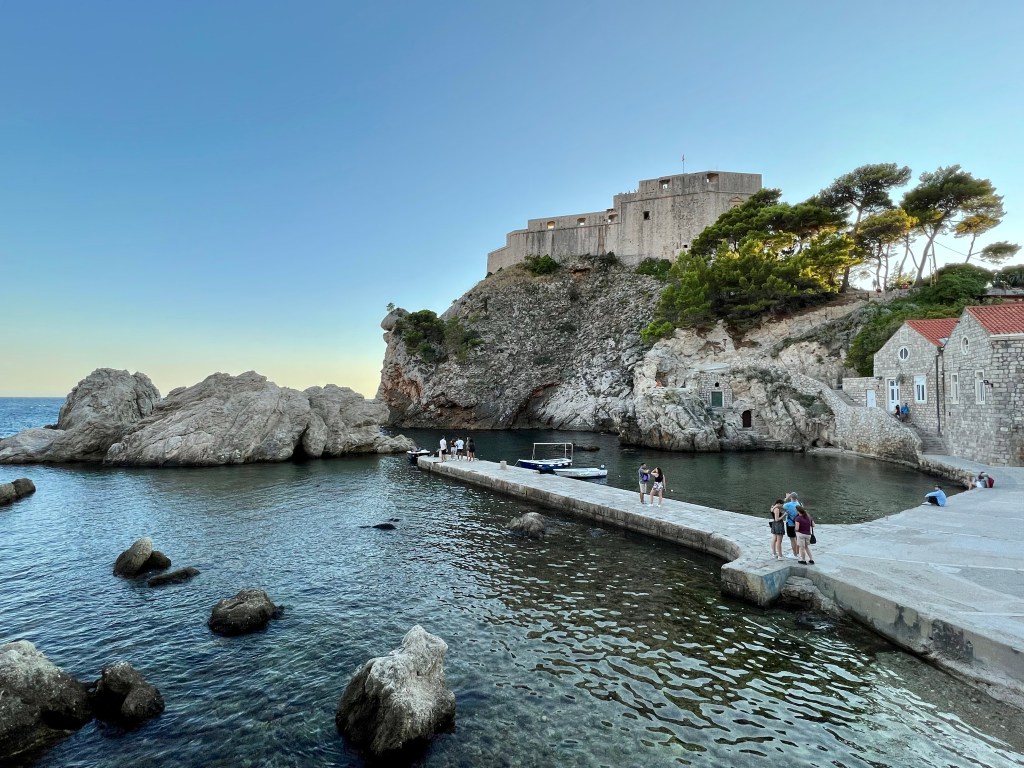
We exited Old town, through the Pile gate, to take a look at the St. Lawrence Fortress (aka Dubrovnik’s Gibraltar) built to protect town against the Venetians. The walls facing the sea are 12 meters thick while the walls facing the city are only 60 cm thick.

St Lawrence Fortress
More views of the wall
It’s getting late

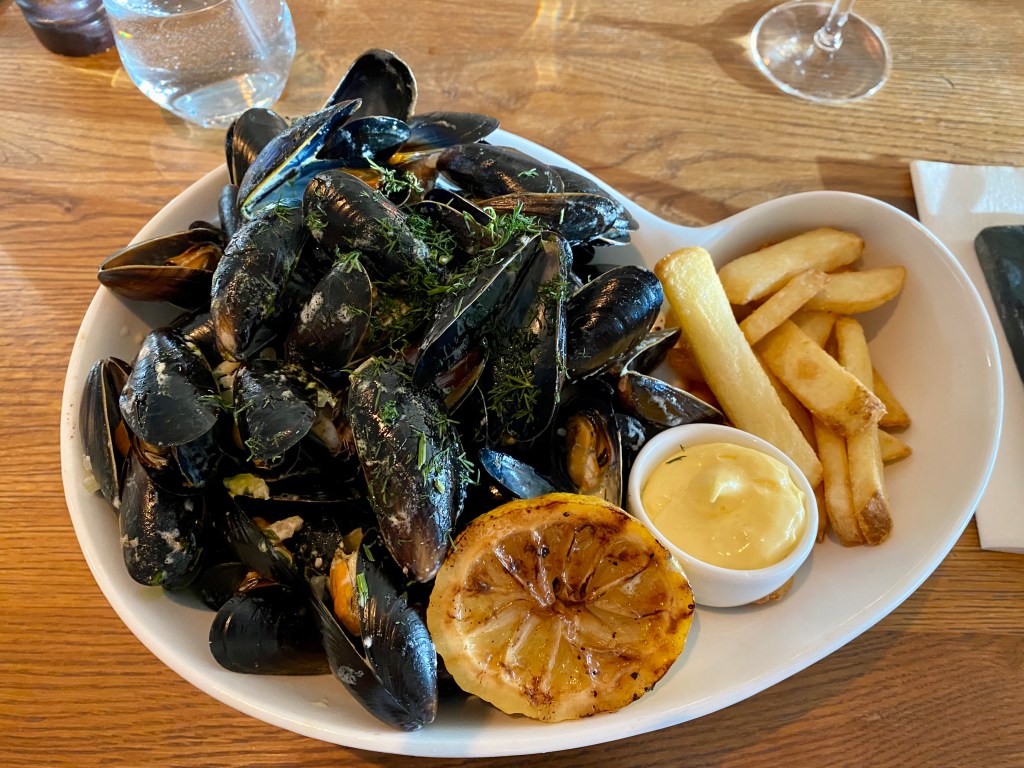
Everyone is pretty much done by the time we come back to the Pile gate again so Anya gave us some recommendations on things to eat and local wines before bidding us adieu. Apparently, the cuisine in the city restaurants is mostly Mediterranean though the residents usually cook Slavic delights. She recommended buying local wines and olive oil. There’s no space for bottles in my luggage but we did try several varieties of local wine with Dingač being the most robust and favourable. She also recommended oysters and mussels. I didn’t try any oysters but the mussels were just okay, too small for my taste.

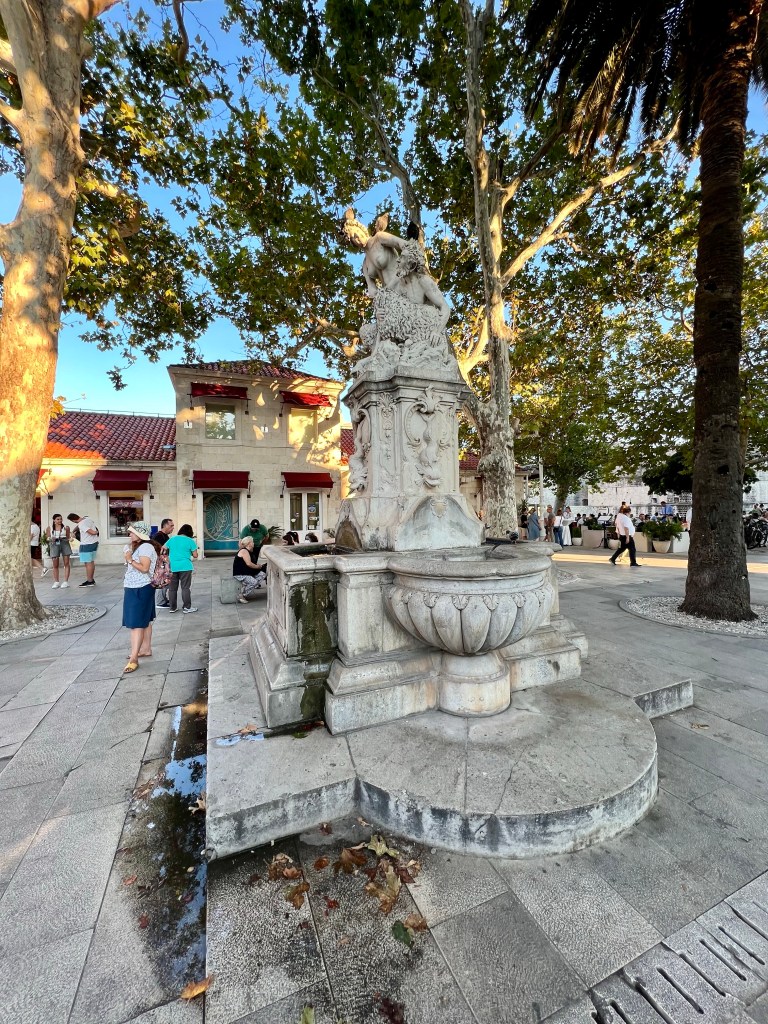
Fountain outside Pile Gate

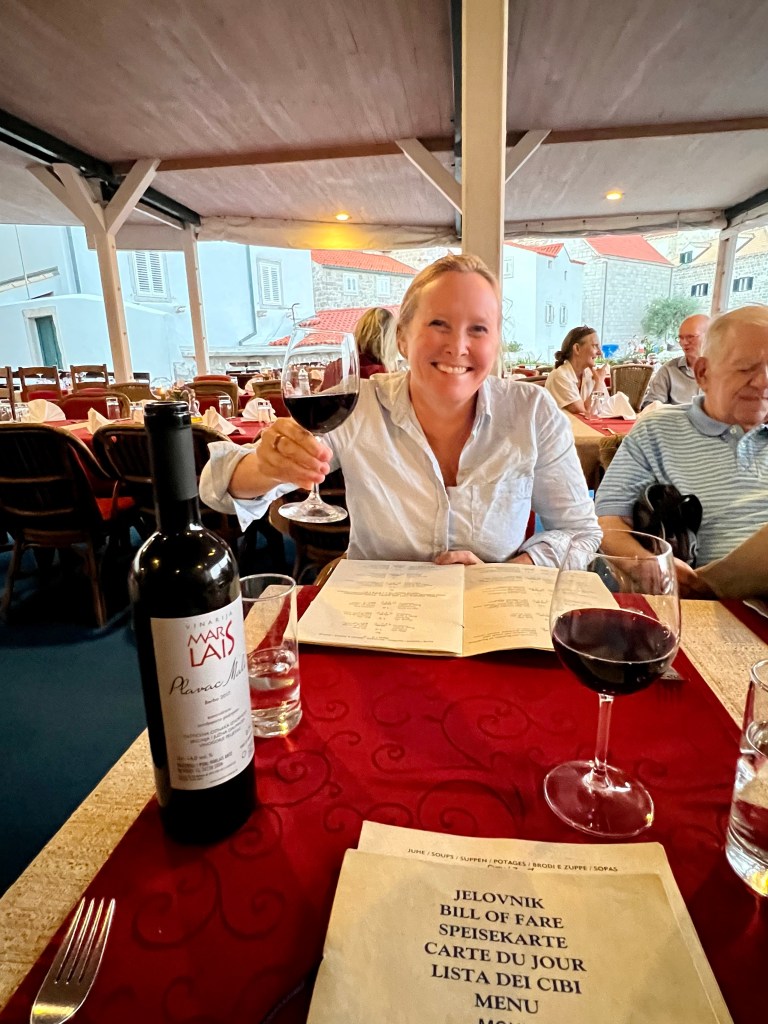
After the tour is done, we meet Filip and head to a beautiful seaside restaurant for a group dinner. Jen and I tried a feta salad and locally caught grilled tuna steak washed down with one of Anya’s recommended wines, Plavac Mali, before hopping the city bus back to the hotel. Linda, Jen and I decided it was time to try one of the bottles of wine we’d purchased from the Bosnian Monastery on our balcony before settling in for the night. The robust red wine was very tasty indeed.

Tomorrow is another day. Adventures await …
September 13, 2022

Today was another beautiful sunny day and over breakfast, people were discussing their plans for the day; some of them quite ambitious. As I’d visited Dubrovnik a few years ago on a cruise and was feeling a bit chill, I opted for a rest day to catch up with myself! Worked on blogging in the morning, hoofed it to the local market for some supplies shortly after noon and then enjoyed an al fresco lunch on my balcony before taking a nap.

When the gang returned from their adventures, they let Linda and I know they were interested in going for dinner so we joined them for a nice dinner on Sunset Beach and later shared some wine on the balcony. The perfect end to a perfect day!

Sunset at Sunset Beach

Tomorrow is another day. Adventures await …
September 14, 2022

Today we are catching the ferry to the Island of Hvar at 4 pm so there’s a good chunk of the day available for explorations after a good breakfast, checking out and storing our luggage. Linda and I opt for a beach day at Sunset Beach where we’d had dinner the night before.

We rented beach chairs and an umbrella and settled in to read our books with the odd dip in the refreshing water thrown into the mix.

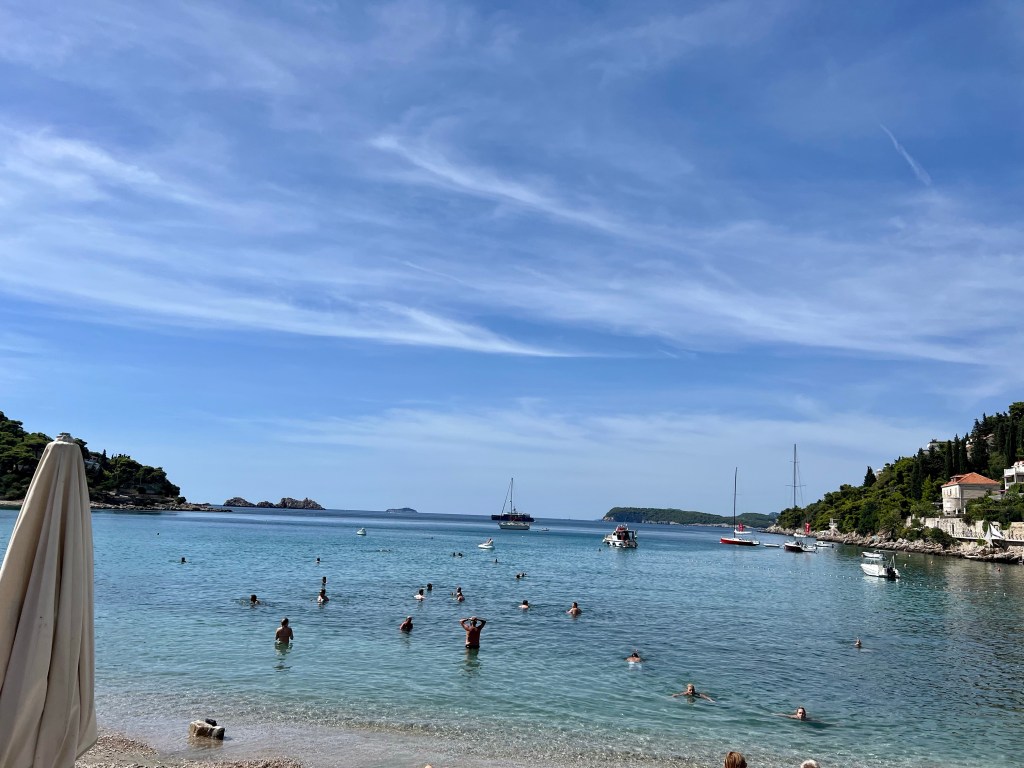
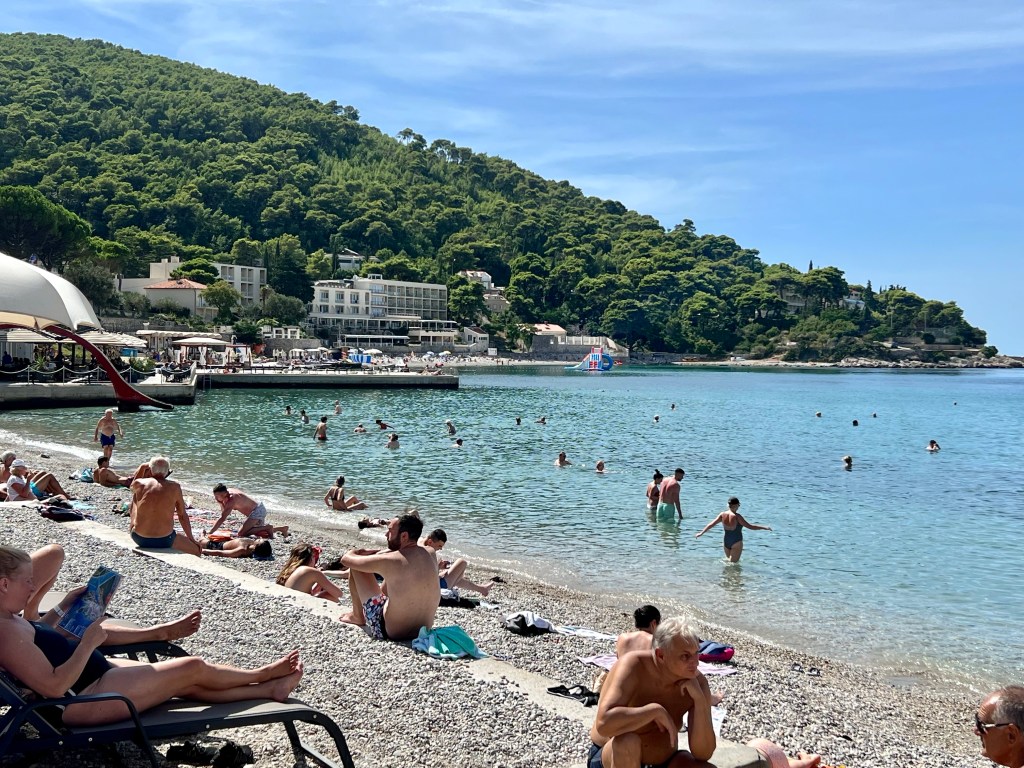
Sunset Beach during the day

Around 2, we packed up and headed to the hotel to change, have a quick bite and get ready to hop the bus to the ferry. Not sure if our luggage is expanding or the busses are getting smaller but the driver is challenged getting the baggage in the boot and several suitcases are loaded in the front of the bus. All good, at least we’re all on the bus and our stuff is as well.

The ferry crossing is pleasant enough and after around 3 hours we arrive in Hvar. The island and the town look great though I’m not sure there will be much time to explore given our schedule. Our hotel has sent a couple guys to pick up our luggage and bring it up the hill. We head up the hill in foot; at least we don’t have to drag our luggage along!

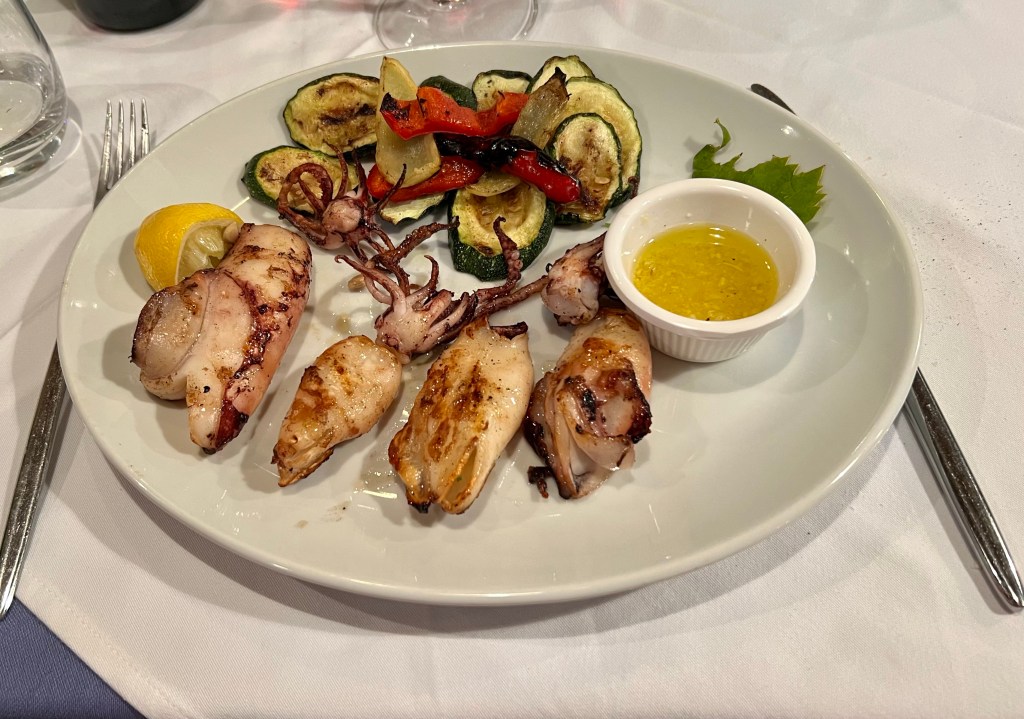
Time for a quick shower before heading back down the hill for a late dinner at a local restaurant. Filip knew the owners so they gave us a nice slug of rakia to start the evening. Linda, Jen and I shared a bottle of Dingač that was recommended by Filip. Yummm as was the nice salad, grilled calamari, grilled veggies and homemade bread with local olive oil I had for dinner.

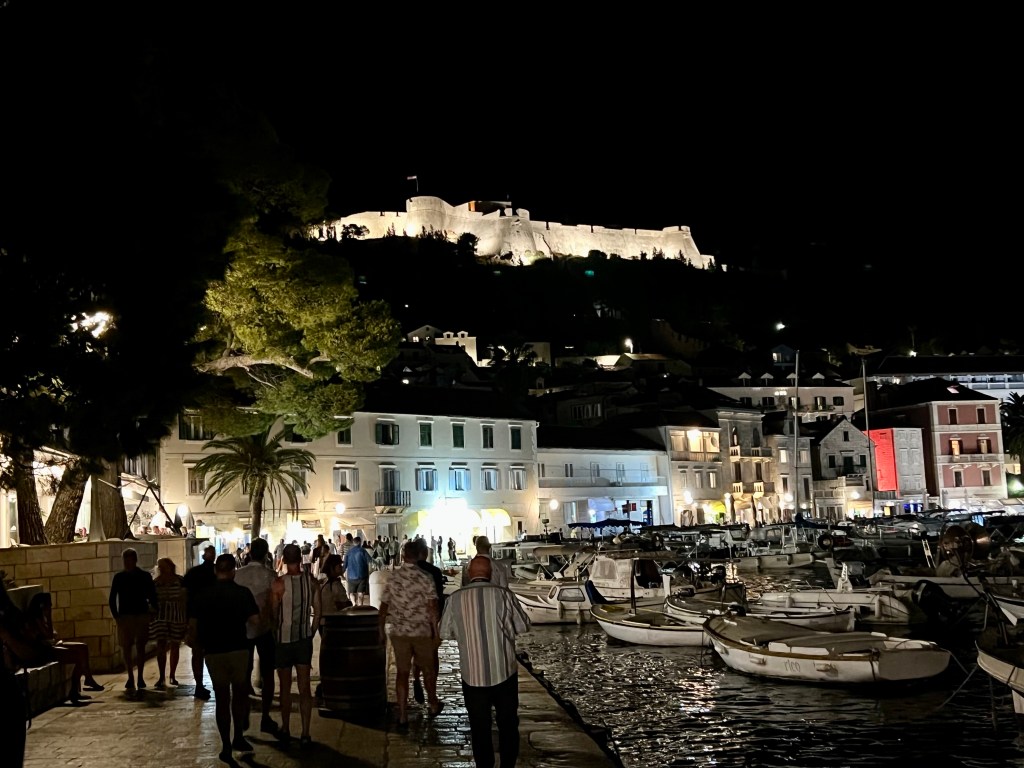
Hvar Harbour at Night
Dinner
Trying the Local Dingač

After dinner, we slog back up the hill and I had a couple more glasses of wine with Filip before calling it a night.

Tomorrow is another day. Adventures await …
On the Road Again – Adventures in Kotor

September 10, 2022

This morning we bid adieu to Bosnia & Herzegovina and later today we’ll say hello to Montenegro. After a hardy breakfast, we load all our bits and bobs on the bus for the 4.5-5 hour drive to Kotor; a coastal town in Montenegro located in a secluded part of the Bay of Kotor.

Enroute we stopped, not far from the Montenegrin border, at Monastery Ostrog built by Saint Basil in the 17th century, to pick up some of the wine that we’d enjoyed at Mustafa’s home a couple nights ago night during our Bosnian cooking class.

Monastery entrance – sadly no time for anything other than retail therapy

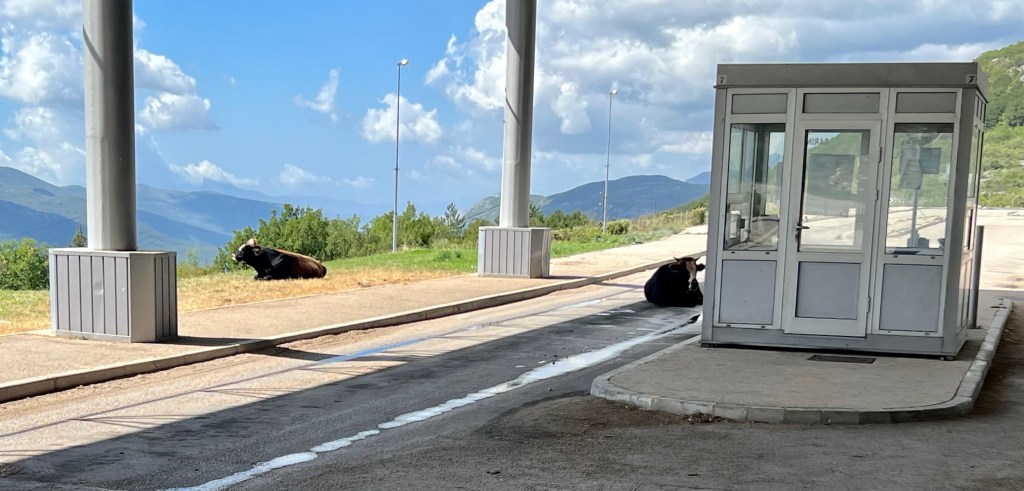
The border crossings were again easy enough though this time we were greeted by two cows “guarding” the border as we entered Montenegro. Sitting in the front of the bus, Filip regaled us with historical trivia throughout the drive which I can say we didn’t exactly excel at!

Agricultural inspectors ? at the Montenegrin border

Driving into town, Filip pointed out two islands in the Bay; one natural and the other man made. We should get a closer look at these on our speed boat tour of the harbour tomorrow; Our Lady of the Rocks and the Island of Saint George.

Our Lady of the Rocks is the manmade island in the inner portion of the Bay of Kotor. The history of this island stretches back to July 1452, when two fishermen allegedly discovered an image of the Virgin Mary on a pile of rocks that would later become the island as people dropped more and more rocks on the same place. A tiny Orthodox chapel was built in the place where the image was discovered. By 1630, the Venetians were running the region, and they replaced the Orthodox chapel with a Catholic one. They also built up the pile of rocks into a proper island.

Nearby is the Island of Saint George which is a natural island. The island features the Saint George Benedictine Monastery constructed in the 12th century, and the old graveyard for the old nobility.

We’re staying in Old Town so on arrival, we schlepped our luggage into town and then up the stairs in the hotel; no elevators in these old buildings, sigh. After check in and a quick moment to freshen up, we hit the bricks to meet or guide for the walking tour of Old Town, Toni.

Kotor is a fortified town on Montenegro’s Adriatic coast, in a bay near the limestone cliffs of Mt. Lovćen. Old Town is characterized by winding cobblestone streets and quaint squares with a vibrant café culture, well-preserved city walls you can walk, old fortresses, and churches galore, including the Kotor Cathedral. It’s also home to the Maritime Museum, which explores local seafaring history. The fortified city of Kotor is a UNESCO World Heritage Site.

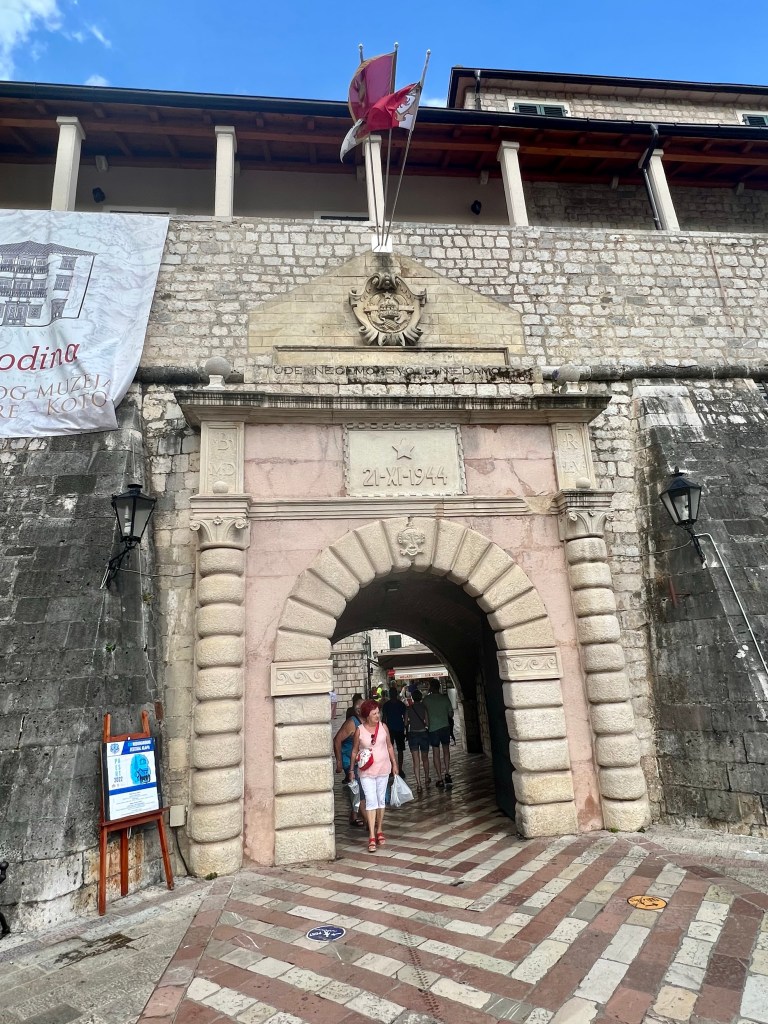
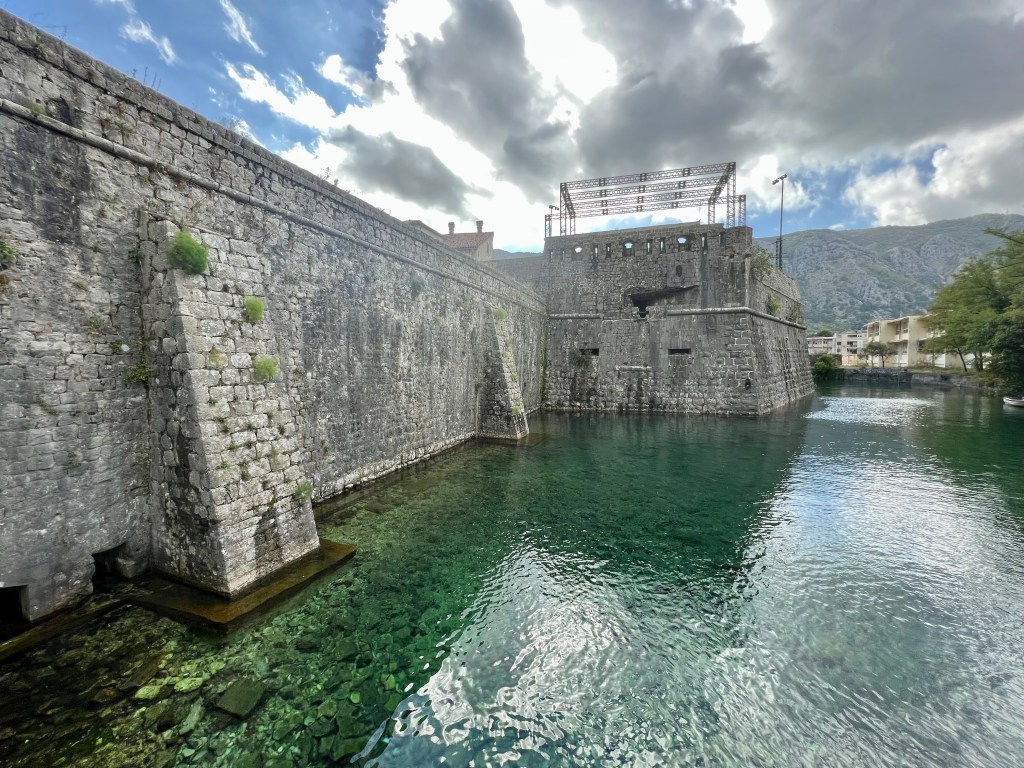
Our first stop was the Sea Gate, named when the town was accessible only by boat. The symbol of Venice, a winged lion (Griffin) is displayed on the walls here. Above the gate November 21, 1944 is engraved; the day the city was liberated from the Nazis during WWII. There is also a communist star and a quote from President Tito of Yugoslavia.

Sea Gate – Kotor

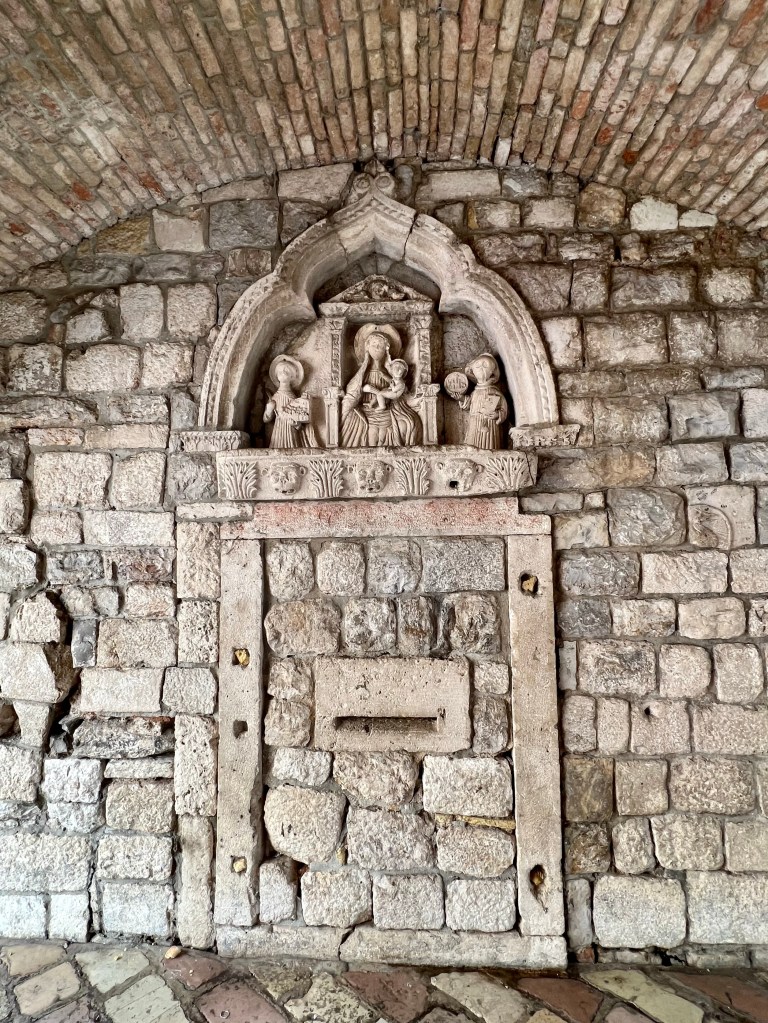
Inside the tunnel leading from the gate into Old Town is a slit which was formerly a “complaint box” where all complaints went straight into the sewer. I guess things never change!

You know what to do with your complaints!

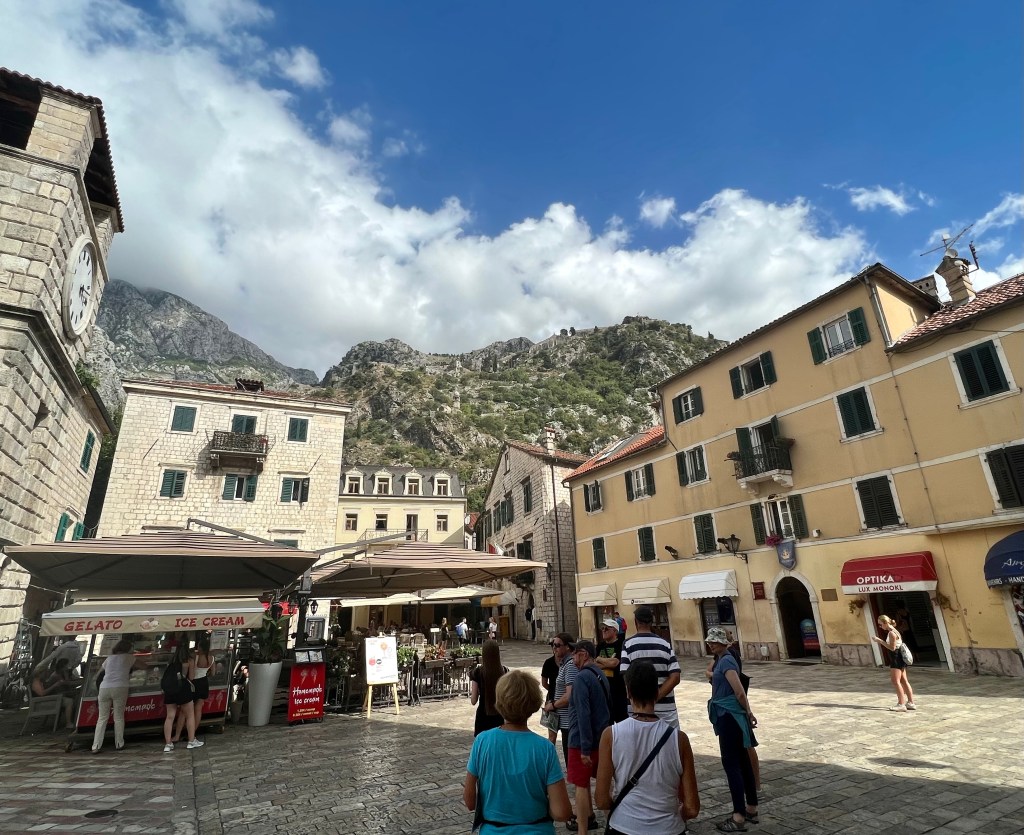
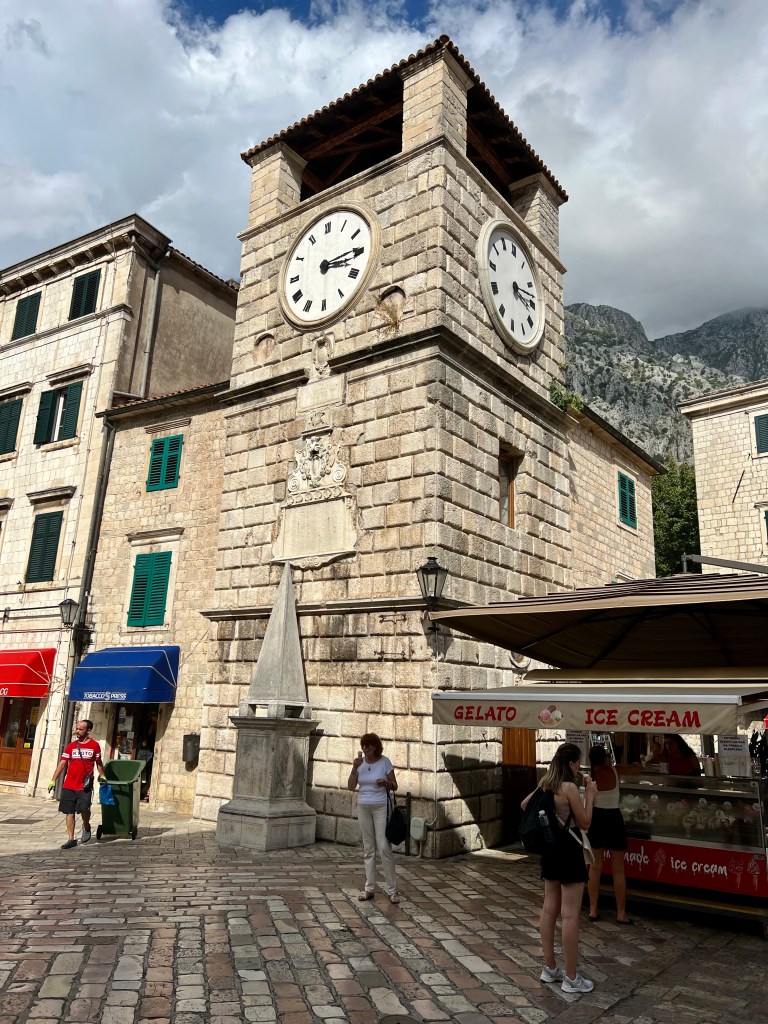
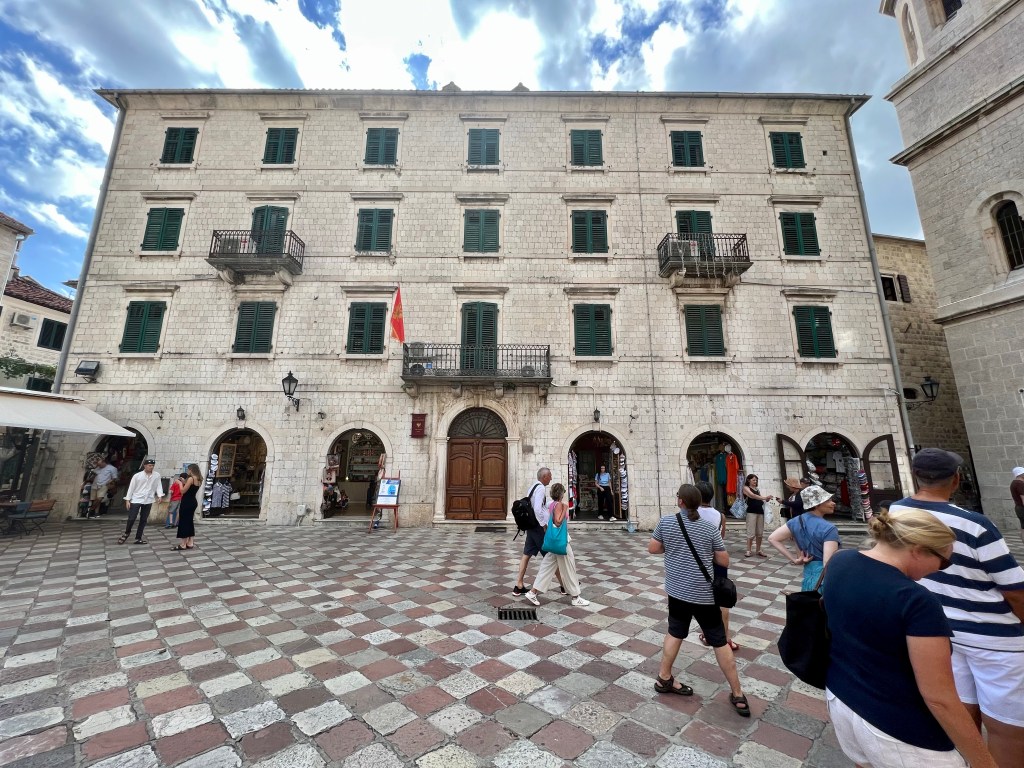
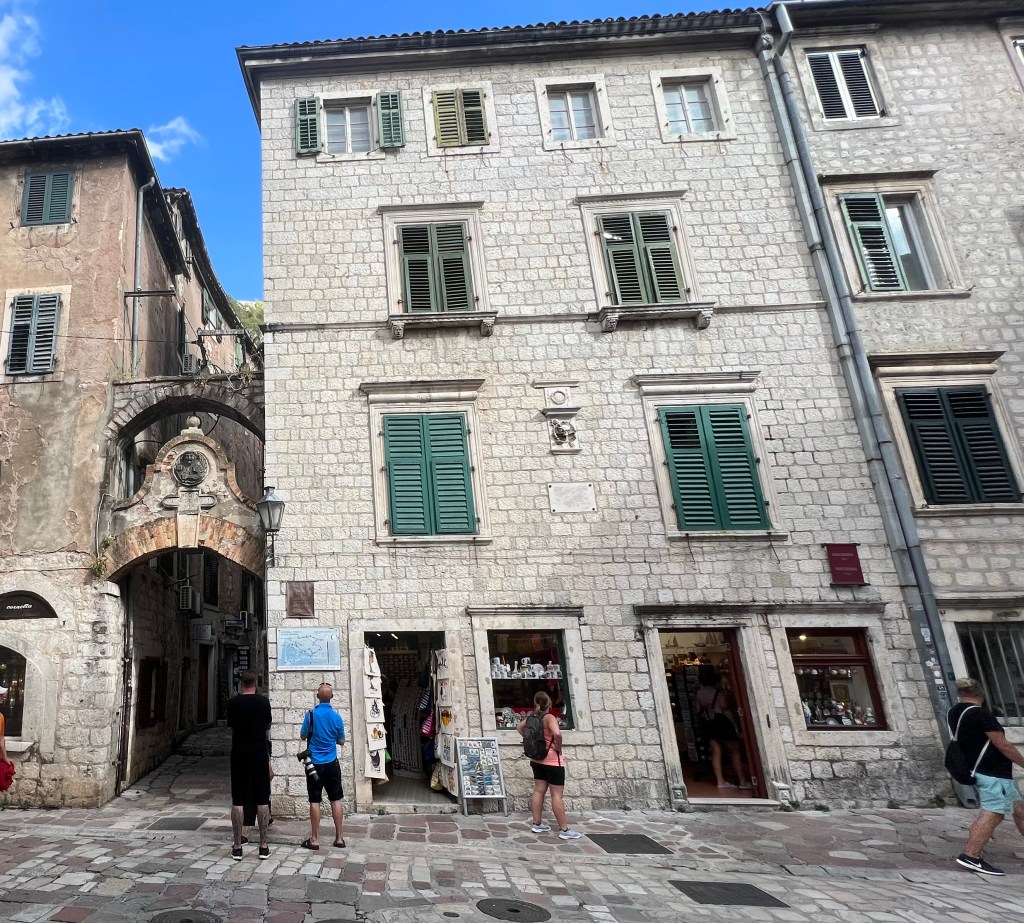
From the Sea Gate, we entered the old walled city onto the beautiful square lined with Venetian-style stone buildings now filled with cafés and shops. Also here, is the three-story high Kotor Clock Tower with two clock faces; a city focal and meeting point that dates back to 1602 featuring a mix of Baroque and Gothic architecture.

The Square
Kotor Clock Tower

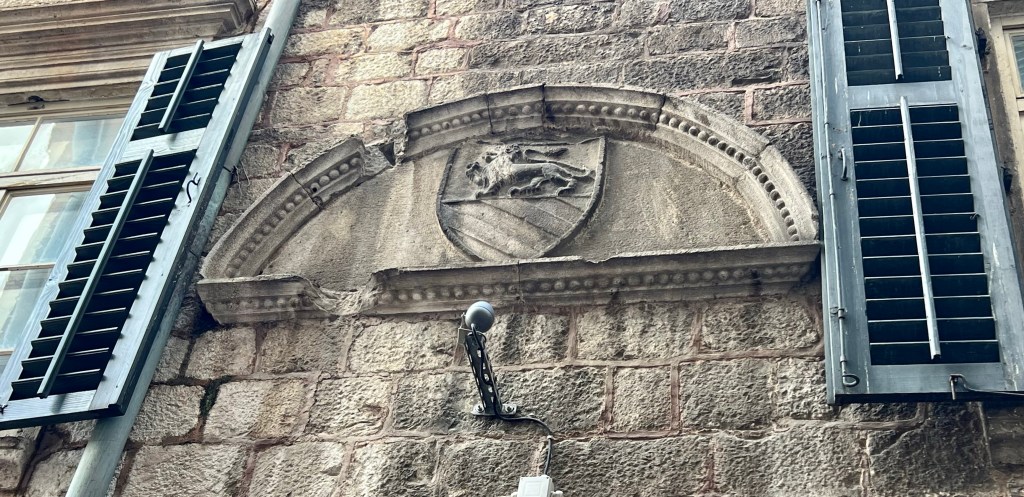
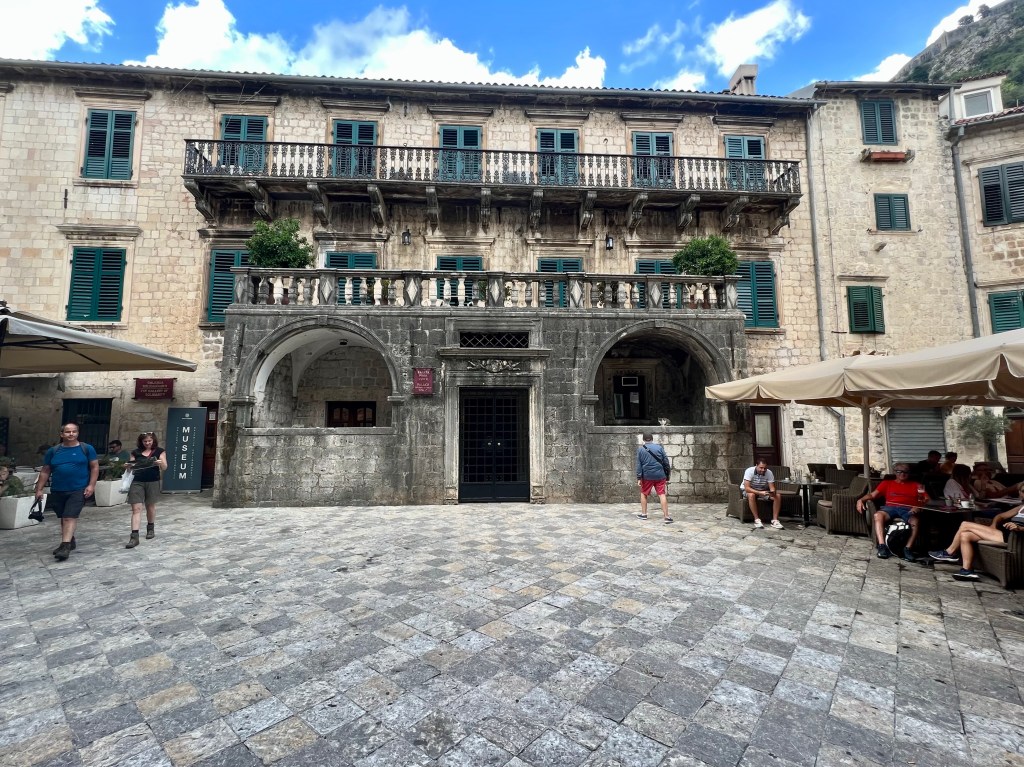
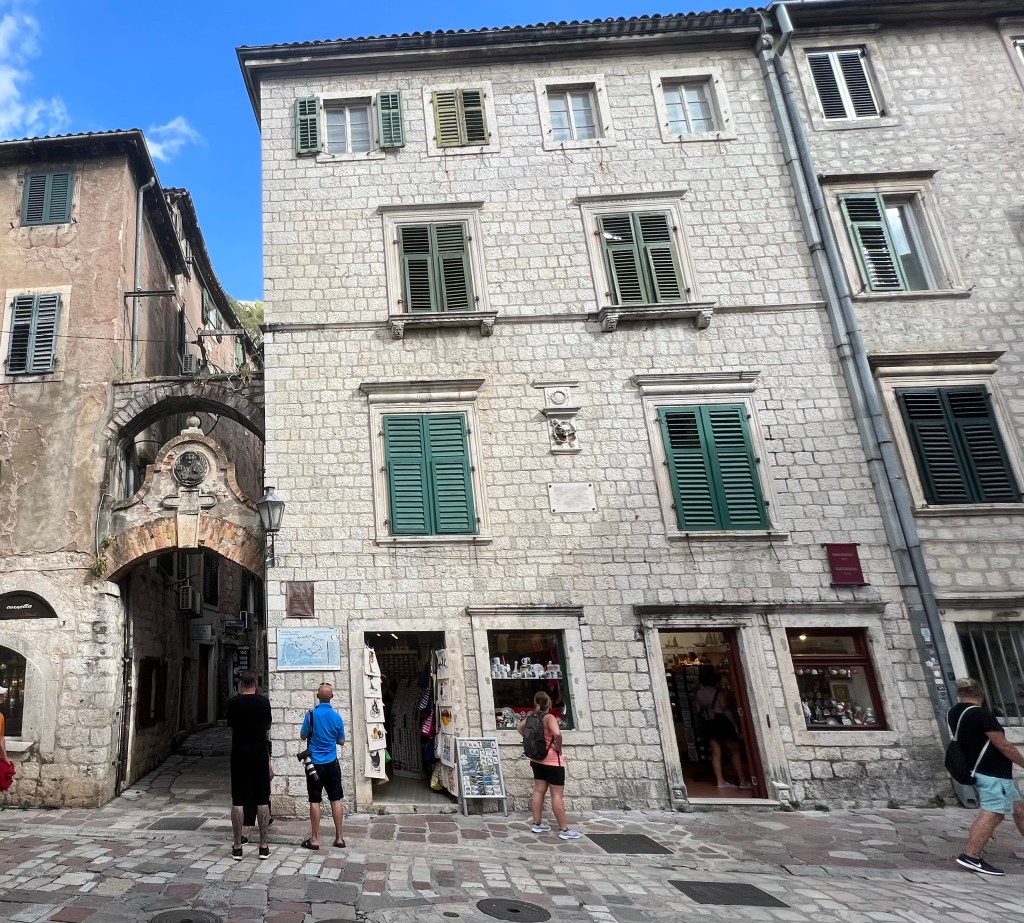
The town has many larger homes that once belonged to rich families. Most of them had a coat of arms and many had their own private churches; many of these churches are now museums or shops.

Coat of Arms for some noble family

Kotor has always been home to a lot of sailors and there is a school here whose graduates are captains and officers on many ships including my favourite – cruise ships.

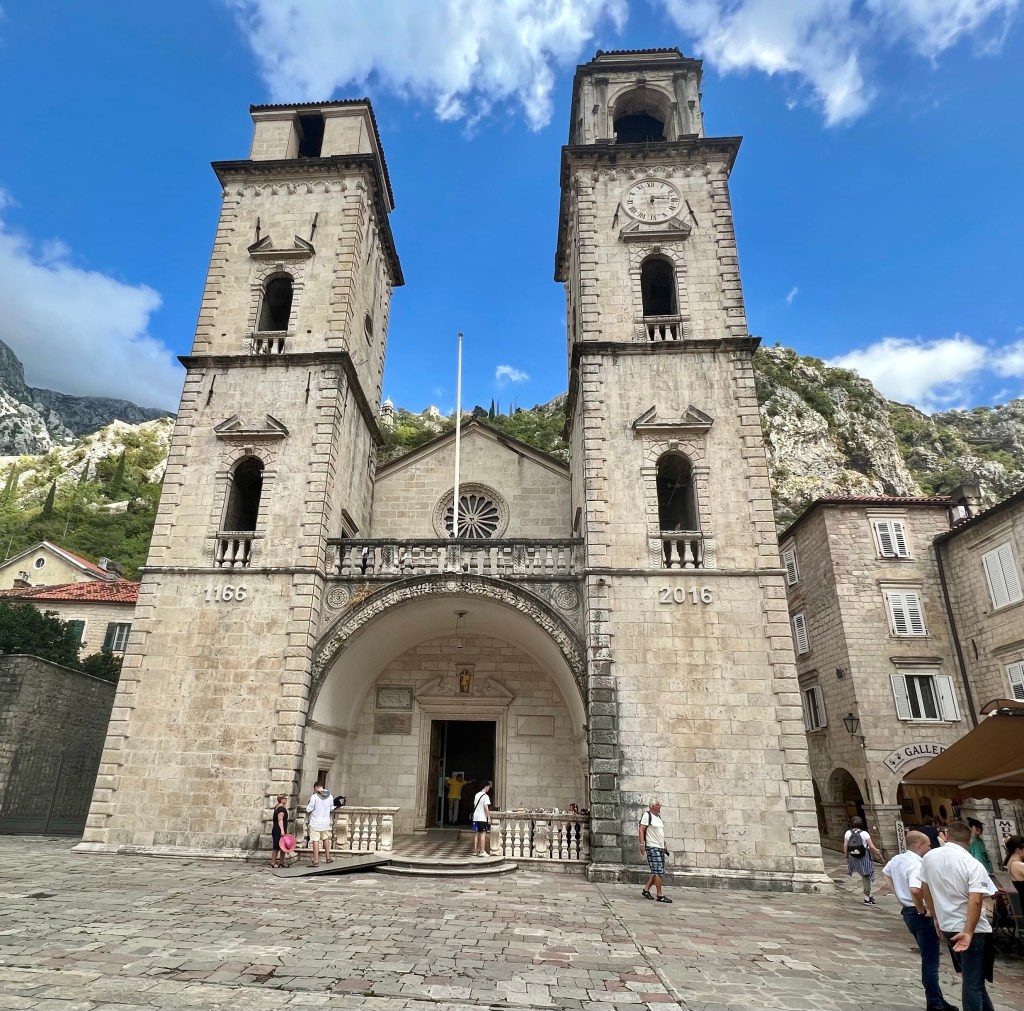
One of only two Roman Catholic churches in all of Montenegro, Saint Tryphon Cathedral is considered by many to be Kotor’s most beautiful building and a symbol of the city. The cathedral, with uneven towers, was originally built in 1166 and is one of the oldest in Europe. The church has been reconstructed over the centuries after damage from the earthquakes that plague the town and has gotten smaller.

Saint Tryphon Cathedral

The main market square used to be in front of Catholic church. As the haggling was too loud during services, a bishop chased the merchants away and they scattered around old town into smaller square dedicated to the marketing of specific products. City Hall is on the same square as the Church.

Kotor City Hall

After a big earthquake in 1979, Old Town residents were given properties outside Old Town and the city took over their properties; now rented out to shopkeepers on the ground floor with higher floors used as lodgings for tourists. One requirement for shop owners renting from the City is that they must stay open year round even in the winter though there’s not much happening in winter and very few tourists as it is quite rainy.

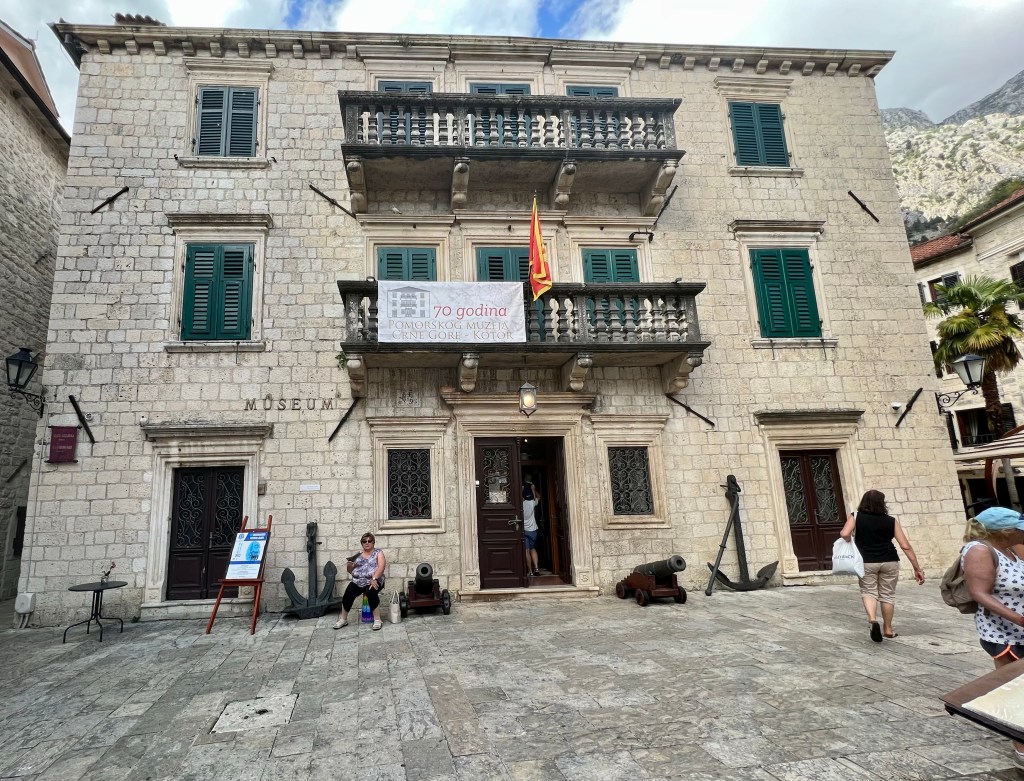
Next stop was the 70 year old Maritime Heritage Museum, a beautiful 18th-century Baroque mansion, for a quick photo stop before heading to the nearby Karampana well.

Maritime Heritage Museum

The Karampana well used to be the only source of water in this medieval town and is a favourite gathering place.

Karampana Well

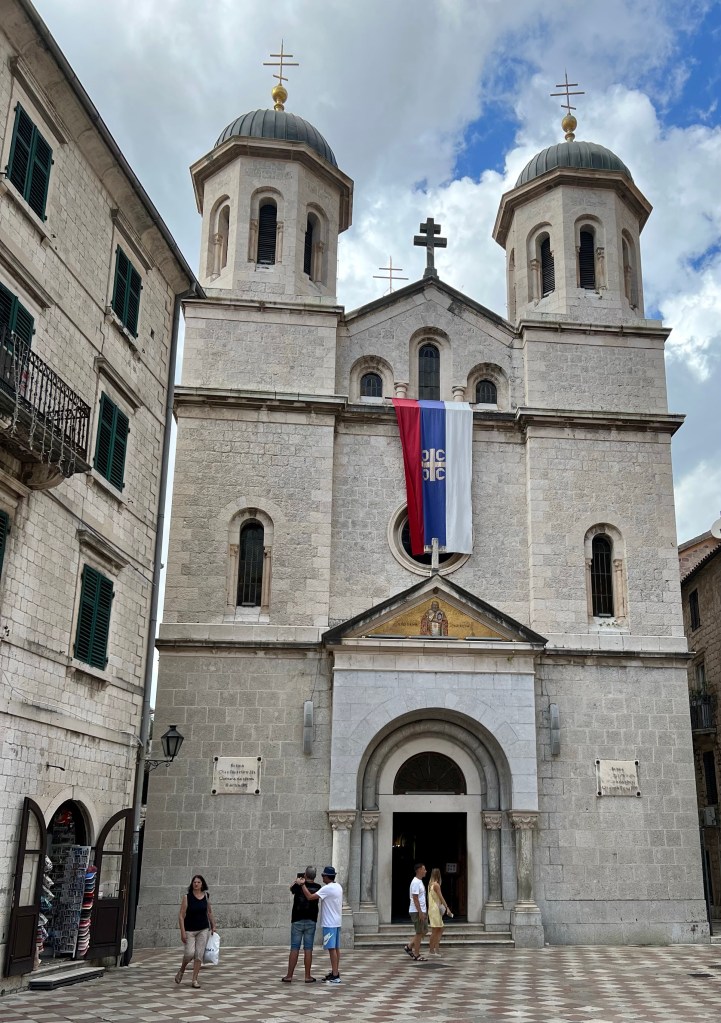
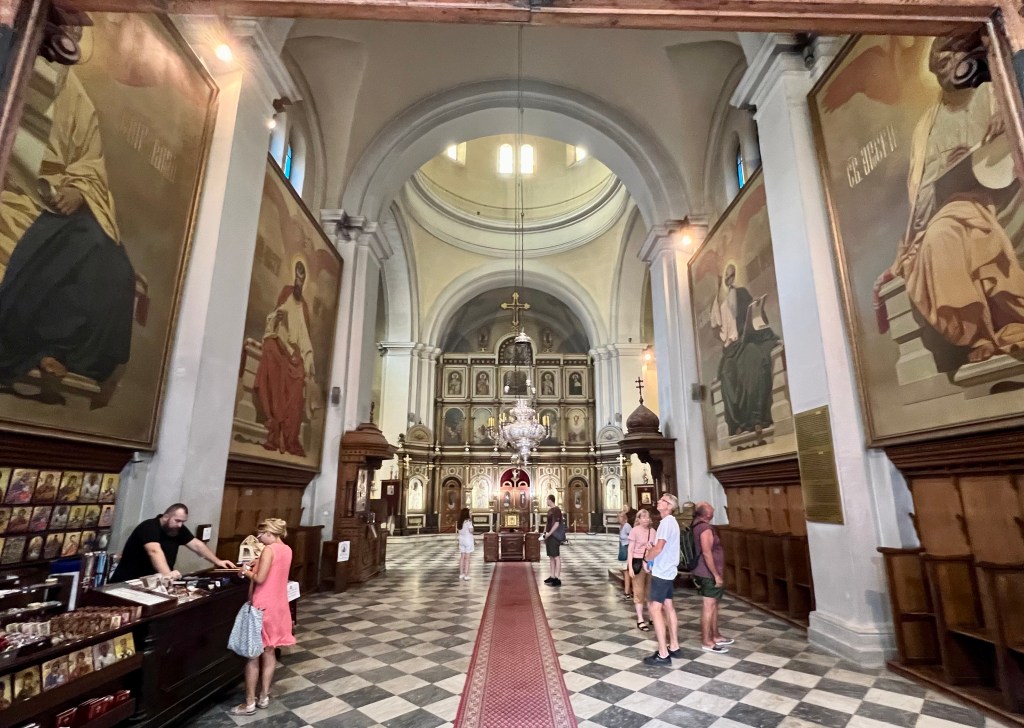
St. Nikolas’ Church is Kotor’s most important Orthodox Church and is on St. Luke’s Square. It was built over the foundation of a building destroyed by a fire in the late 1800s. Construction on St. Nikolas’ began in 1902 and was finished in 1909.

St. Nikolas’ Church
Inside Saint Nikolas’ Church

The church has two bell towers on its main facade and a large cupola that rises above the surrounding rooftops. The style is a mix of Byzantine and Romanesque. The golden crosses seen atop the black domed bell towers were a 1998 addition – a gift from Russia.

St Luke’s Church

Kotor is also home to one of the oldest (still functioning) pharmacies in Europe. The skull on wall with snakes come out of the eyes significies you can find medicines there!

Entrance to pharmacy on left

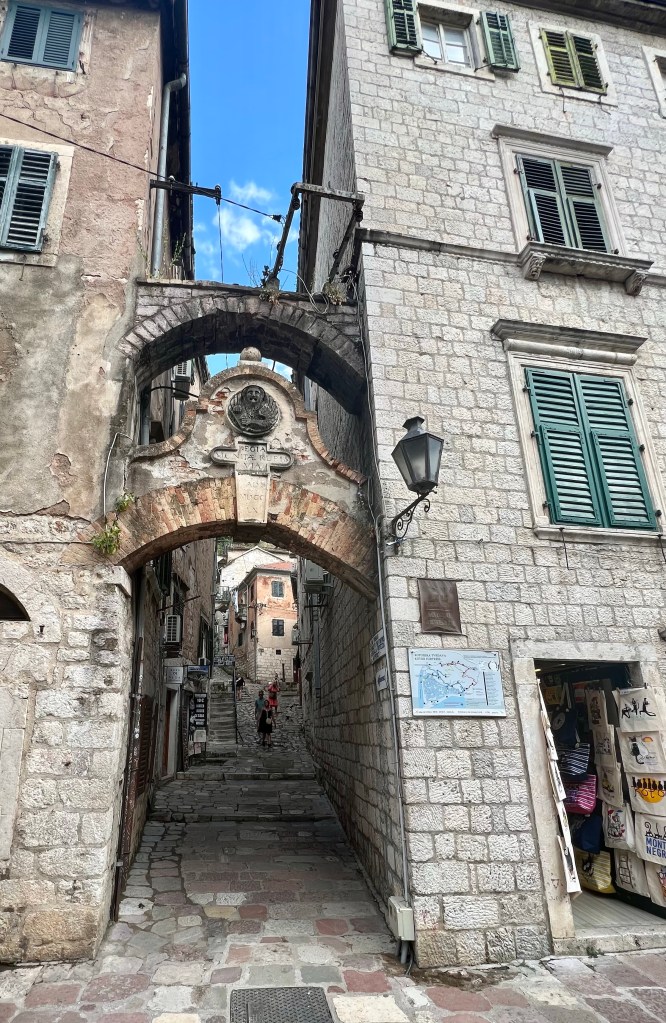
In town there is a gate which features a lion with an open book that leads to the stairs along the city wall. After the tour was done, some of the most energetic members of the group hiked up the 1500 or so steps to the very top of the town for mesmerizing views. You know I was drinking wine in a café while they were sweating up the hill, right?

Gate to the stairs for the city wall

We headed out of town to check out the walls.

Mullet come out of the warm bay and hang out in the streams during the summer
City walls

We came to an area “infested” with cats (as is most of the town!). Wherever you go in Kotor, you will see street cats and I’m pretty sure that each of them has a favourite restaurant. So it’s not a surprise that Montenegro’s self-proclaimed “cat capital” of Kotor has a museum dedicated to felines. The Cats Museum of Kotor opened in 2013. For cat lovers, apparently it is a must-see but as a dog person I gave this a miss.

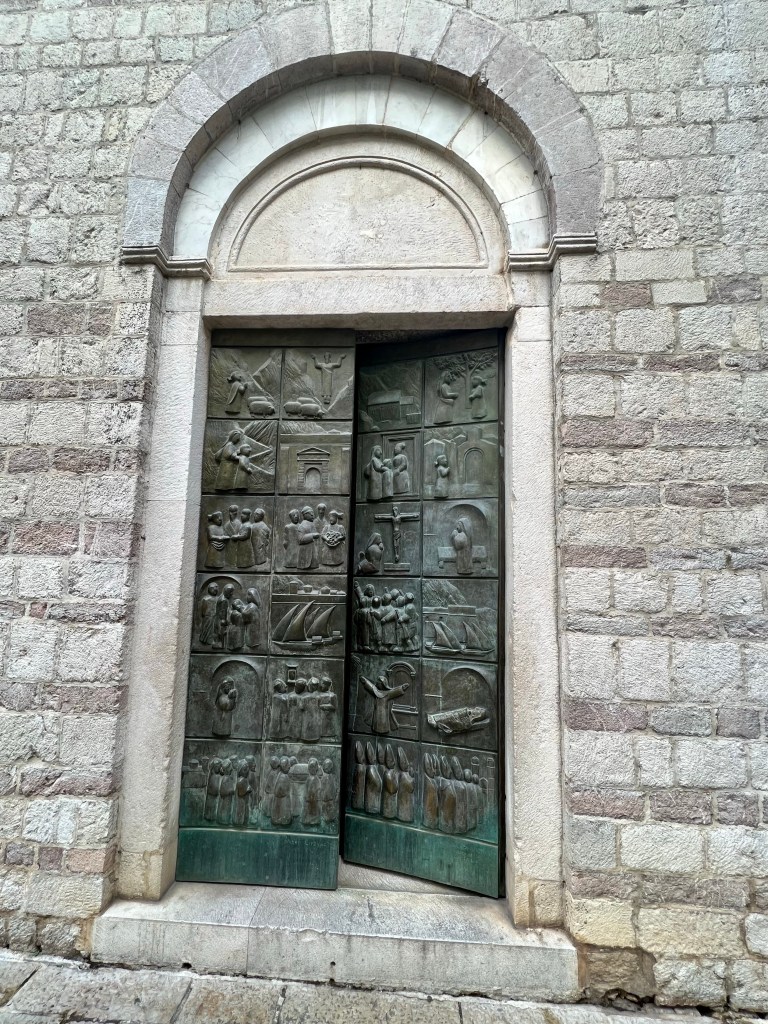
Our next stop was a door decorated with the story of Osanna of Cottaro (25 November 1493 – 27 April 1565); a Catholic visionary. She was a teenage convert from Orthodoxy. When the city was attacked on August 9, 1539 by Khair ad-Din Barbarossa, the citizens of Cattaro ran to her for help.They credited their deliverance to her prayers and counsel. Later, her prayers were credited to saving them from the plague. She was posthumously venerated as a Saint in Kotor and beatified in 1934.

The legend of Ossana of Cottaro
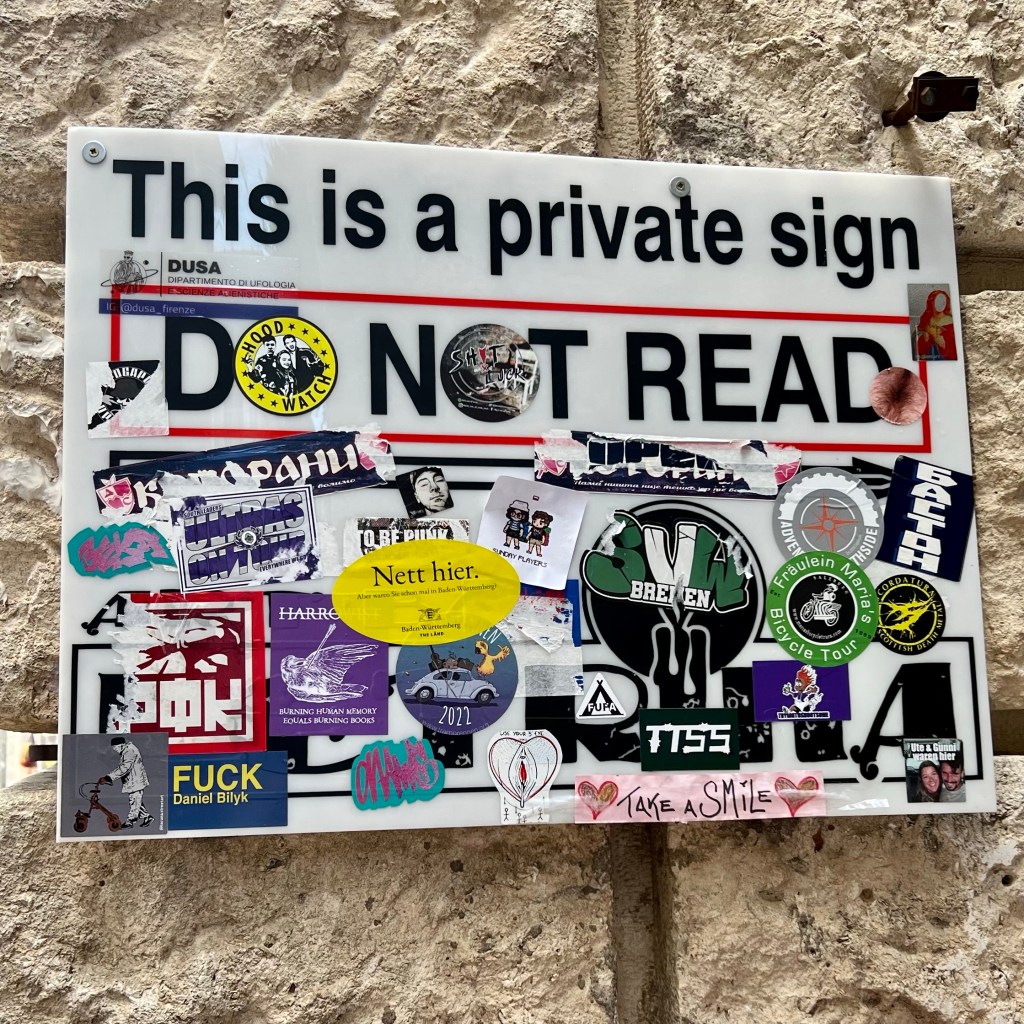
My favourite sign so far
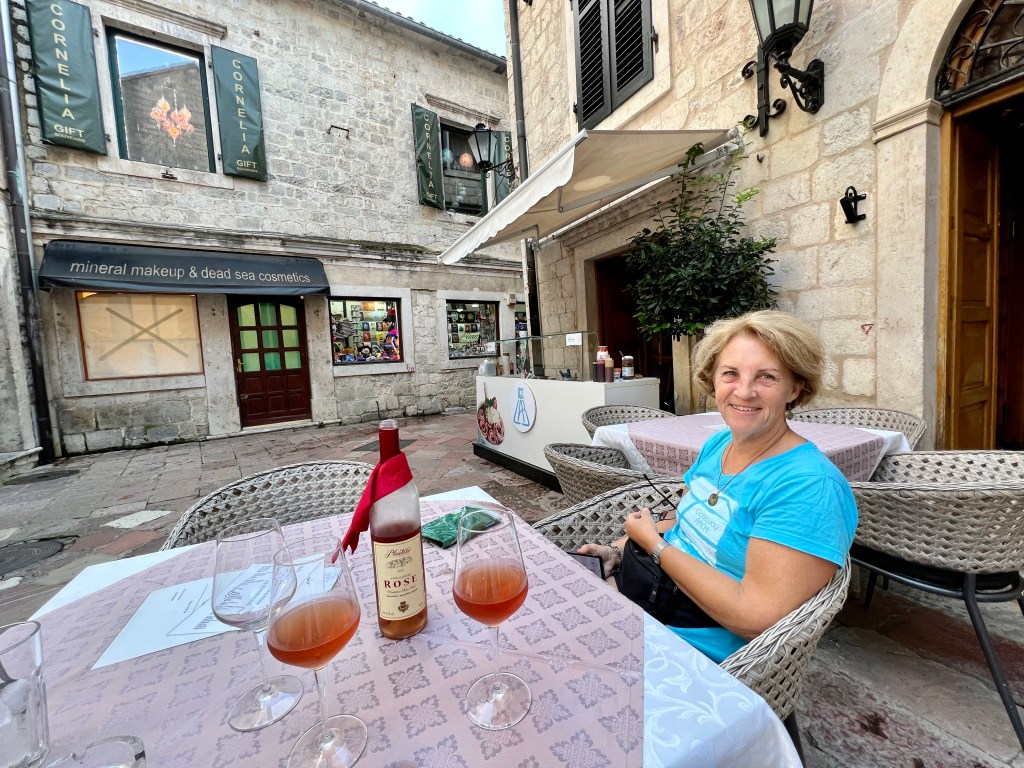
Rosé on the hotel patio

After enjoying a couple of glasses of rosé at the hotel bar, Linda and I joined the band for a group dinner at a local restaurant. After a bit more wine and a bite, we headed back to the hotel to crash for the night.

Cool door in Kotor

Tomorrow is another day. Adventures await…

September 11, 2022

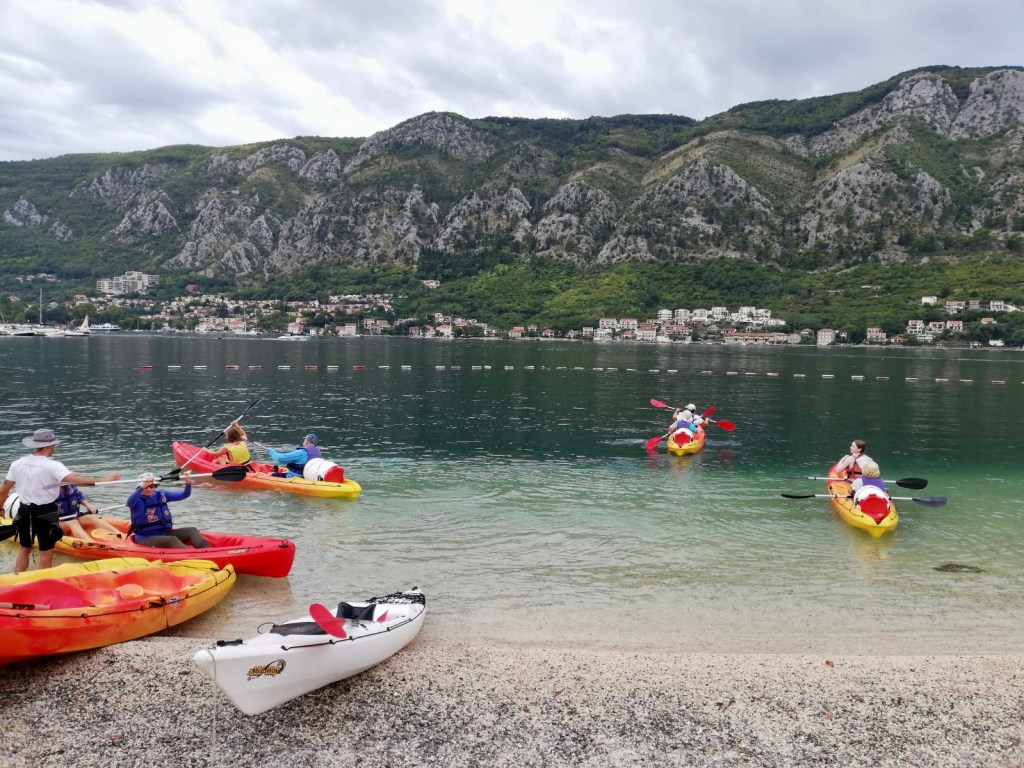
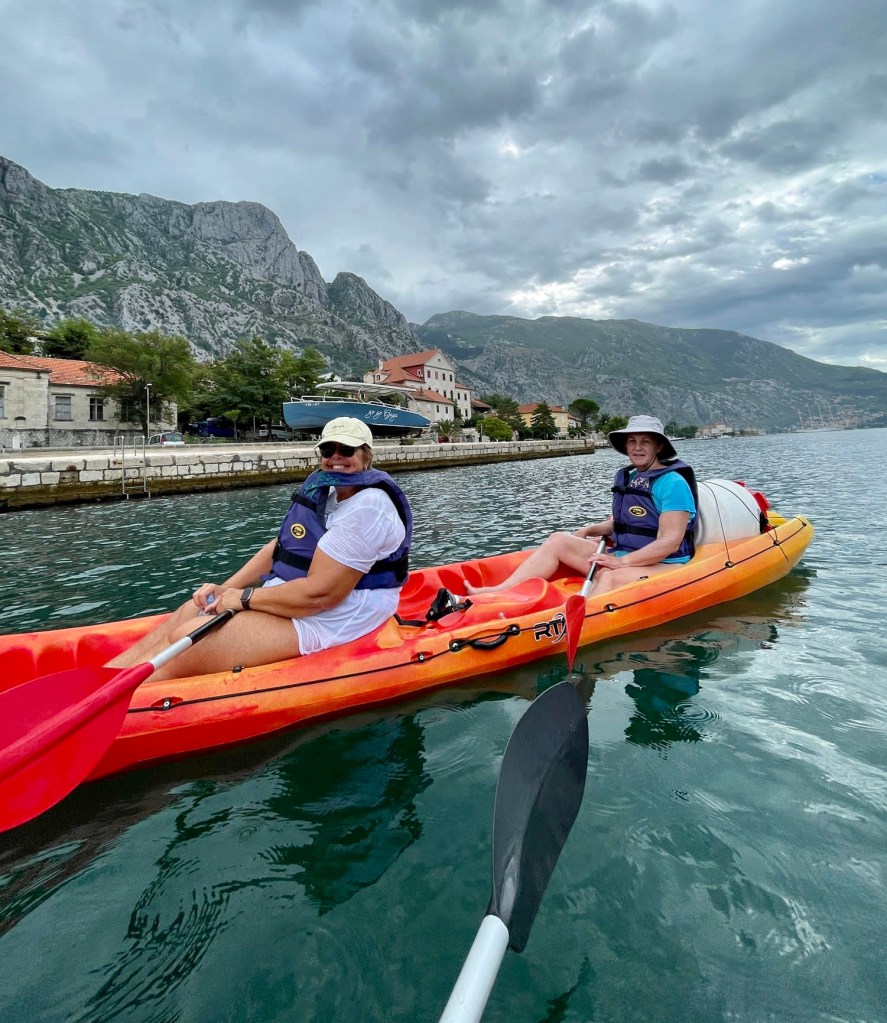
After a nice breakfast, we out for a morning of kayaking in the Bay of Kotor with a quick swim break is the refreshing waters before heading back to the other side. Toni, our guide from yesterday was our leader.

Heading out
Linda and I on a union break!
A quick dip in the Bay
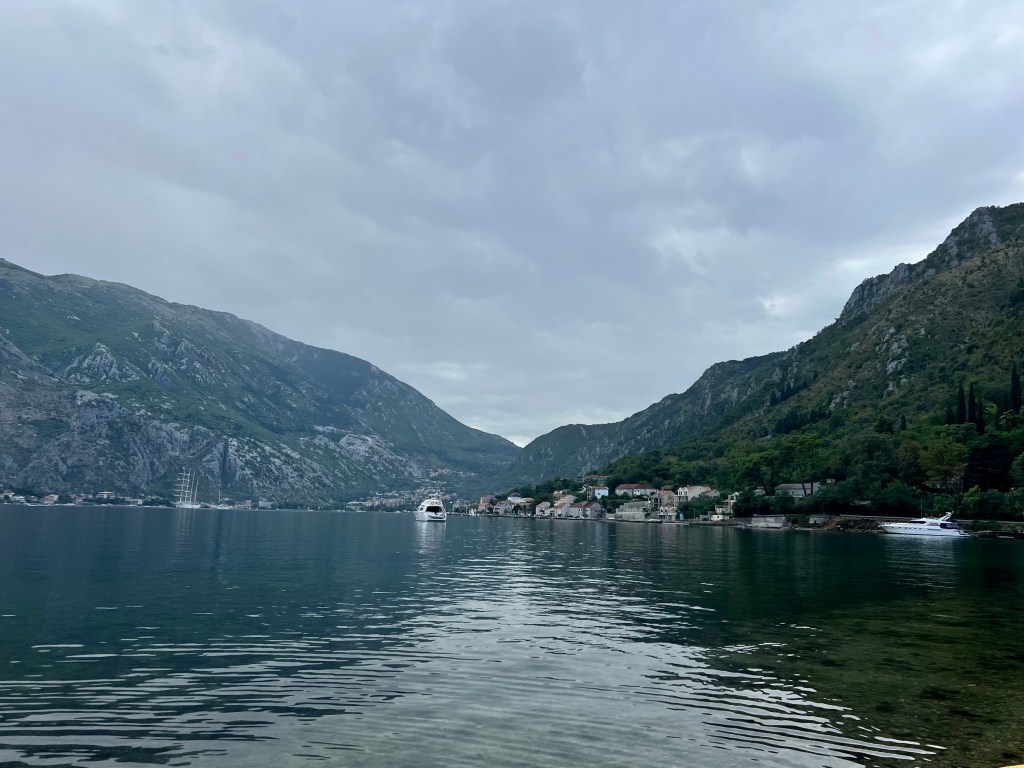
Views from the Bay
Views from the Bay

He regaled us with a few stories, notably the legend of three sisters who fell in love with the same sailor and watched for him from their individual windows for his return. He never did and none of them married. As they died, the other sisters would close the window used by the deceased though there was no one left to close the window when the last of them died. The house, apparently haunted by one or all of the sisters remains vacant.

Three sisters house (middle one)

Back on dry land, we headed back to the hotel to shower and grab a quick bite; pizza for Linda, Jen and I at a café close to the well before meeting at the hotel for an afternoon ride in a speed boat.

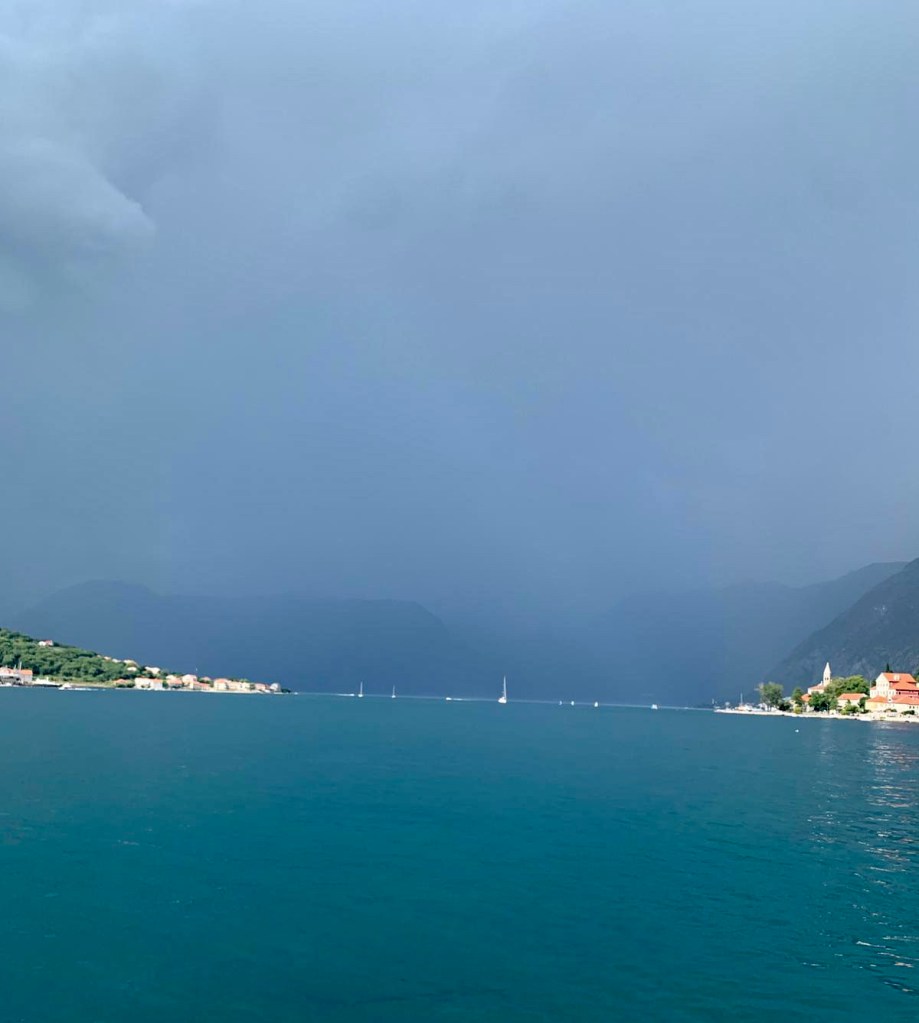
When boarding the boat for our three hour tour, I was reminded of the theme song for Gilligan’s Island and as it turns out we may as well have been on the SS Minnow. The skies were threatening out on the Bay when we took off but the Captain assured us it was a squall that would be short lived. Man, was he wrong! As we were heading out, we passed a number of boats coming back to shore (I guess they were move savvy mariners who had the right idea!).

Heading out into a “squall”

As we skipped across the Bay, the rain came down in torrents and we were soon all soaked to the skin even those of us lucky to be sitting beneath the canopy. At some point, the captain (too late) figured out that it wasn’t going to clear up and, in fact, was getting much worse (think lightning, high winds and precipitation that felt like sleet when it hit you at high speeds) so we turned around. Though never at risk of capsizing, visibility was almost nil and the rods holding the canopy started flapping so it was a scary enough ride back to terra firma.

When we got off the boat, we squished and dripped our way into town passing cruise ship passengers and other tourists who were trying hard to stay dry during the storm. I’m sure they wondered what in the hell had happened to us. Back in the hotel, warm showers for everyone. We didn’t get to see the Blue Cave or the two little islands in the Bay but we did have a funny (now that we were home safe) tale to tell those who hadn’t opted not to take the speed boat tour. Sadly, there was one casualty of the storm – an iPhone owned by one of the women from Canada.

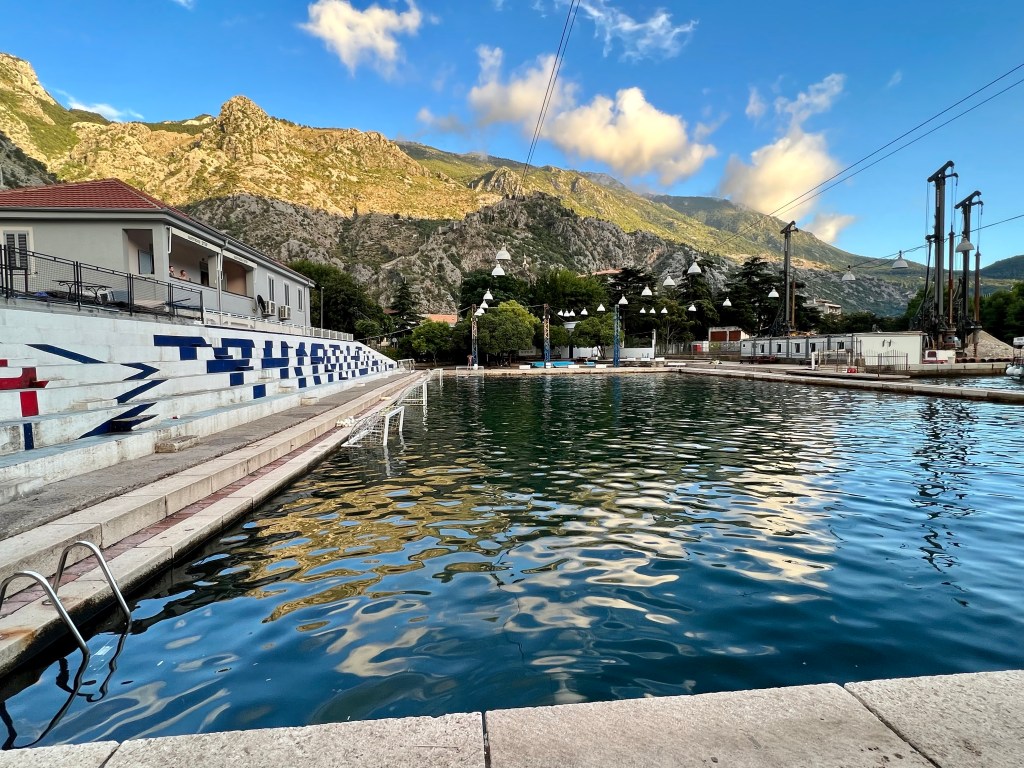
Dry and warm, it was time for a couple glasses of wine at the hotel bar before heading out under clear blue skies to grab a bite at a seaside eatery close to where we’d launched the kayaks that morning.

Water polo pool next to the restaurant
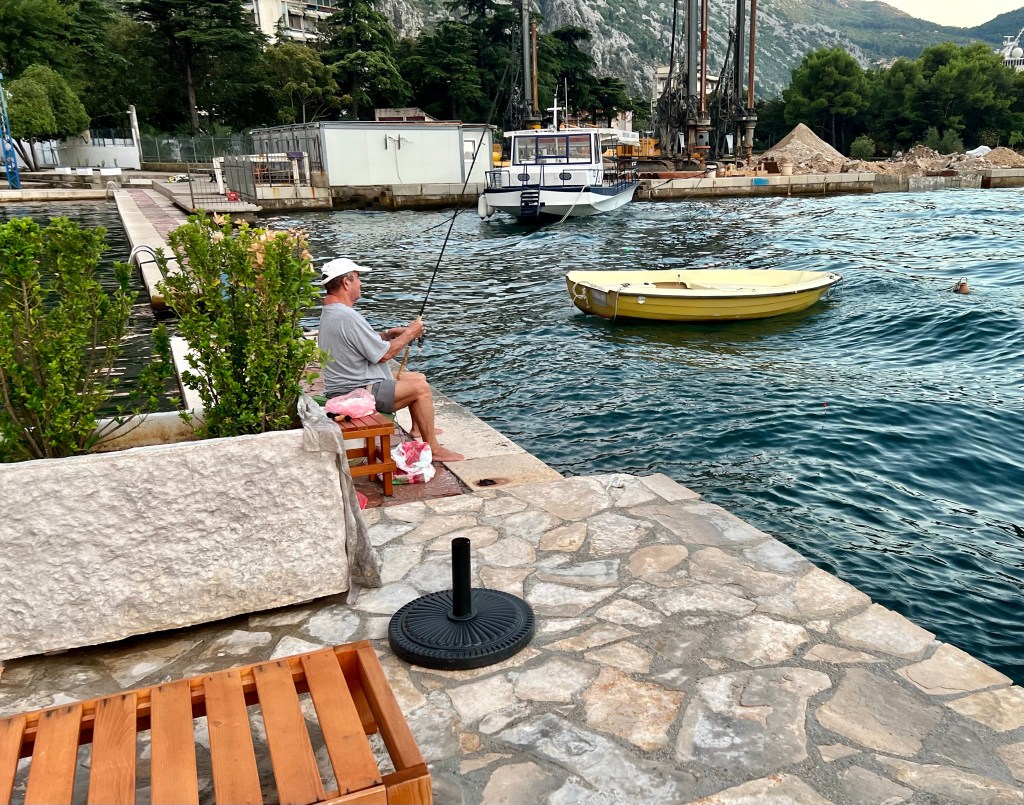
Sitting on a dock in the Bay …
Day is done

Sated, we headed back to the hotel and crashed in a heap.

Tomorrow is another day. Adventures await …
On the Road Again – Buzzing through Bosnia & Herzegovina

September 7, 2022

Today we have a very full day of travel as it’s quite a distance to Sarajevo and we’ll need to clear customs and immigration to exit Serbia and again when we enter Bosnia & Herzegovina en route. After a quick breakfast, we boarded a very luxurious bus with a full seat per person and lots of room for luggage. It was nice to be able to stretch out and do whatever we wanted over the course of a long travel day.

We reached the frontier after the requisite rest stop and a last chance to spend Serbian money. Both border crossings were fairly painless; really just another stamp in the passport!

Soon after crossing into Bosnia we stopped at a fairly swish hotel on the banks of the Drina River with beautiful sweeping vistas of the river valley from the patio out back. I had a lovely steak salad for lunch with a nice glass of rosé and some bubbly water before hopping back on the bus for the remainder of our journey to Sarajevo.

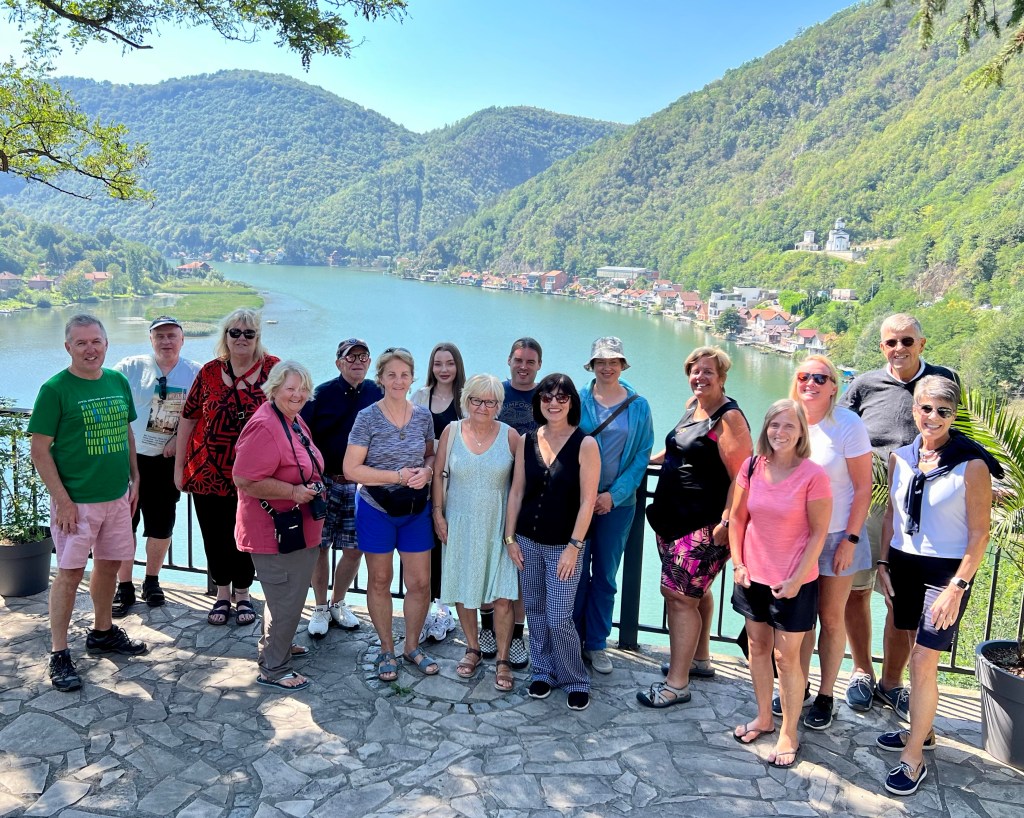
The crew on the lookout over the Drina River
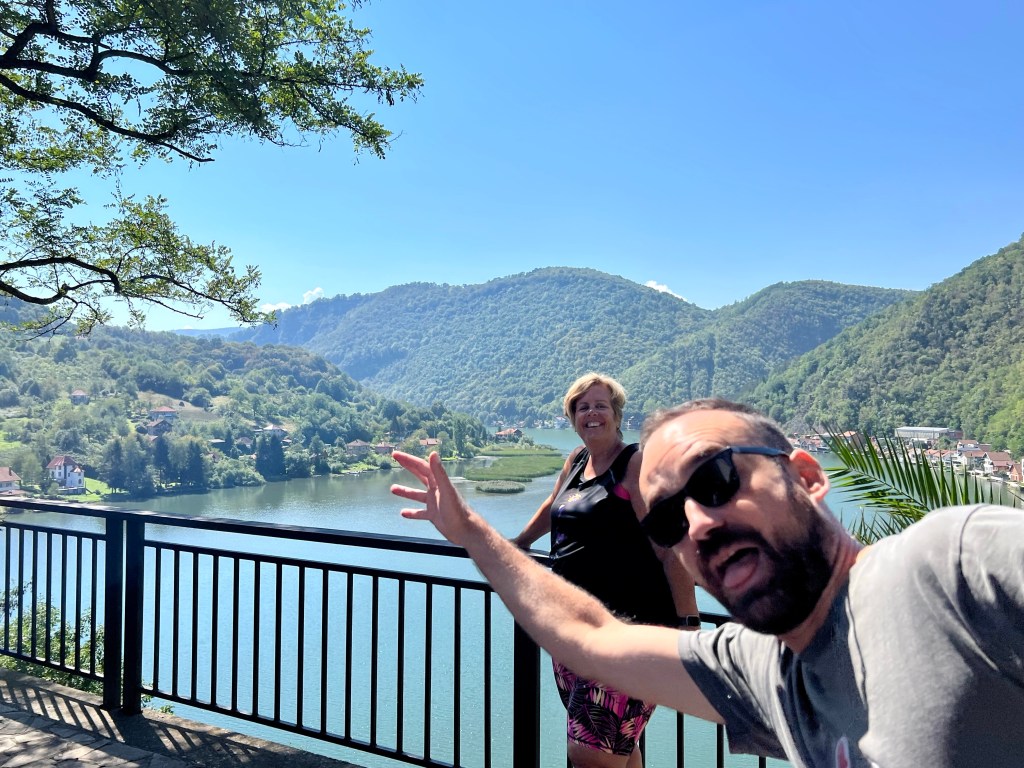
Photo bomb!

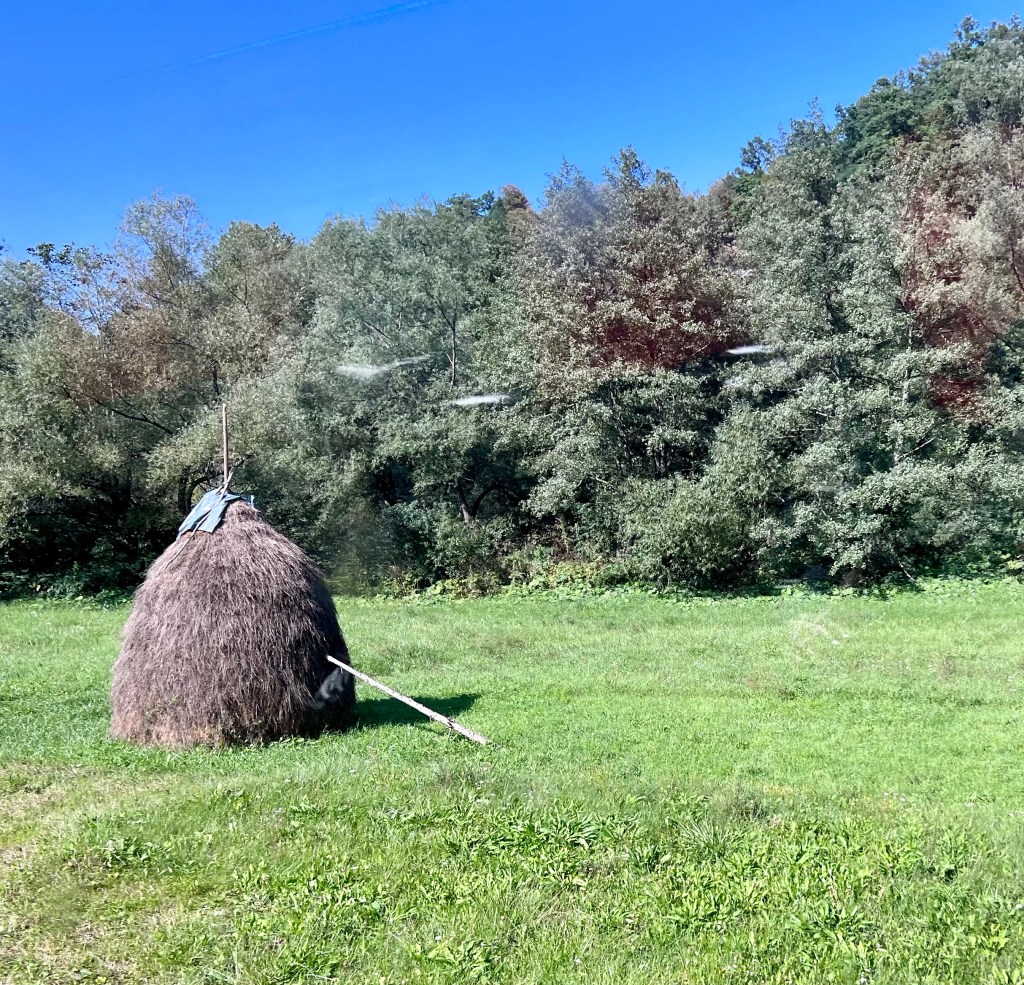
Now that we’d crossed the border into Bosnia, we were in the mountains and the view from the window was a quite a bit more interesting with bubbling mountain streams and scattered farms and villages. One thing that stuck out for me were the conical grey stacks of grass that dotted the countryside. I was told these were made of forage for feeding the livestock over the winter. Filip assured me that the grey material on the outside would be removed to reveal bright green and nutritious fodder but as a livestock nutritionist I’m a bit sceptical.

What self respecting cow would eat this!?

We reached Sarajevo; a city in a valley surrounded by hills, and we’re dropped off at the hotel. This hotel is “special”. It’s a residential building with the hotel reception on the 9th floor serviced by one smallish elevator. The “hotel” rooms are located on the three floors above. While the views from the rooms and the restaurant where we have breakfast are spectacular, hauling steamer trunks up circular staircases is no fun. After a few minutes to catch our breath and freshen up, we’re off to meet our local guide, Mohammed , for a walking tour of the city.

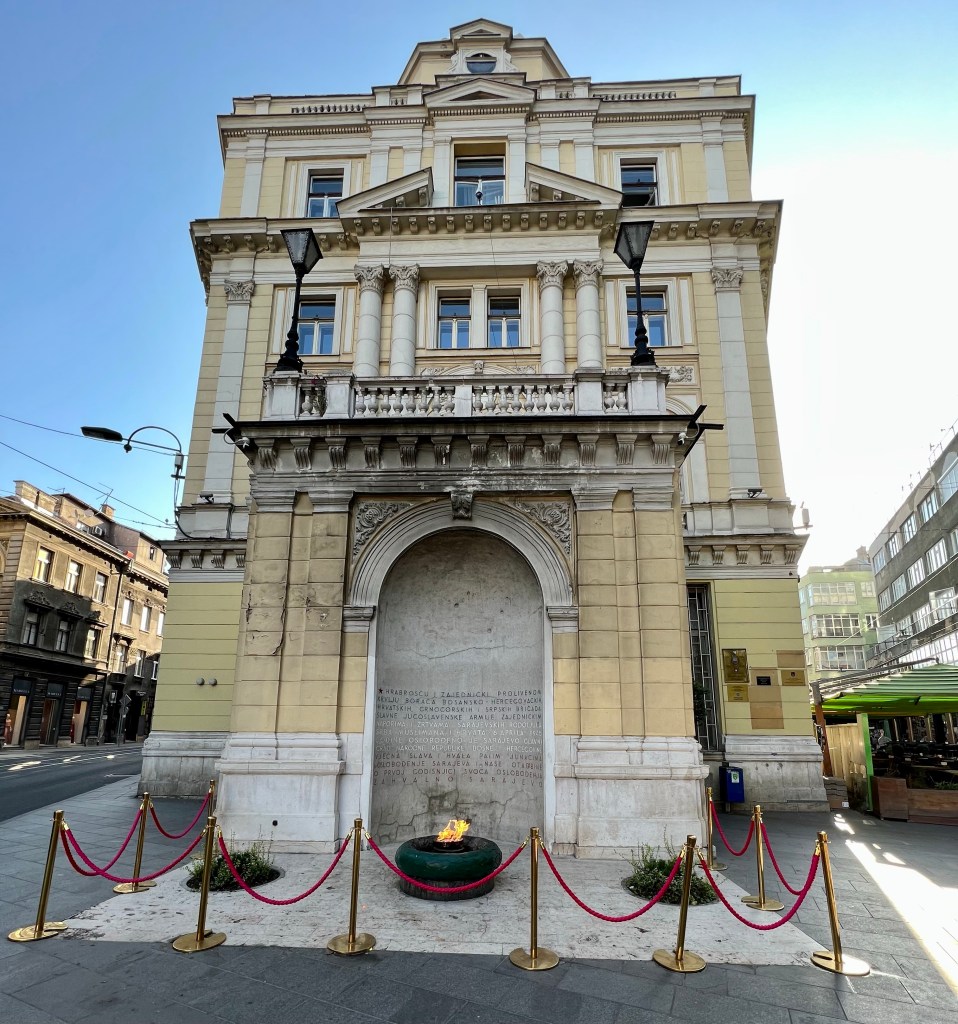
Walking tours are usually a combination of some history of the city/country and some discussion of city landmarks and this one was no exception. As our hotel, is across from the site of the Eternal Flame, we started the tour there.

At the end of Ferhadija where it intersects with the busy Marsala Tita street, you’ll find an Eternal Flame. Located at the base of a beautiful building, the flame is a memorial to the military and civilian victims of World War II who helped liberate Sarajevo. First lit in 1946, it burned continuously until the gas was cut off during the three year siege of Sarajevo. Even then, citizens brought bits of fuel occasionally to keep the idea of the flame alive.

Eternal Flame

Sarajevo is famous/infamous for three events; the June 28,1914 assassination of Grand Duke Franz Ferdinand, the February 1984 Winter Olympics and the three-year long siege of Sarajevo, that cut them off from the rest of the world, that started April 5, 1992.

According to Mohammed, the Sarajevo Winter Olympics are considered one of the best organized games; likely helped by the fact that all the venues were within 35 km of the city. At the time of the Olympics, Sarajevo was a city in Yugoslavia. Yugoslavia had never won a medal in the Winter Olympics and as the host country were hoping to break that drought. Their hopes were pinned on a slalom skier and ski jumper though neither did particularly well and certainly didn’t mount the podium. Luckily, a young Slovakian skier Jure Franko came out of nowhere and won the silver medal in giant slalom. When Jure received the medal 70,000 Yugoslavians were cheering we love Jurek more than Burek (burek is a stuffed pie and a favourite Sarajevo food). https://www.worldfoodstory.co.uk/recipe/burek

We started walking east down the main drag aptly named Marshall Tito Street who ruled Yugoslavia from 1945 through 1980 when he died. It’s important to always walk on the right hand side of the street so you’re not pegged as a tourist; lol, I think the natives still know!

The population of Sarajevo is 360,000 which represents around 10% of Bosnia’s total population. There are of opinions about what happened in 1992 but Serbian aggression started in earnest the very day Bosnia declared independence based on a referendum. The siege of the city was the longest for any capital in the history of modern warfare; lasting 44 months or 1452 days. During this time, Sarajevo was cut off from rest of world with no utilities and supplies. 11,541 citizens including 1601 children were killed and more than 50,000 residents were wounded.

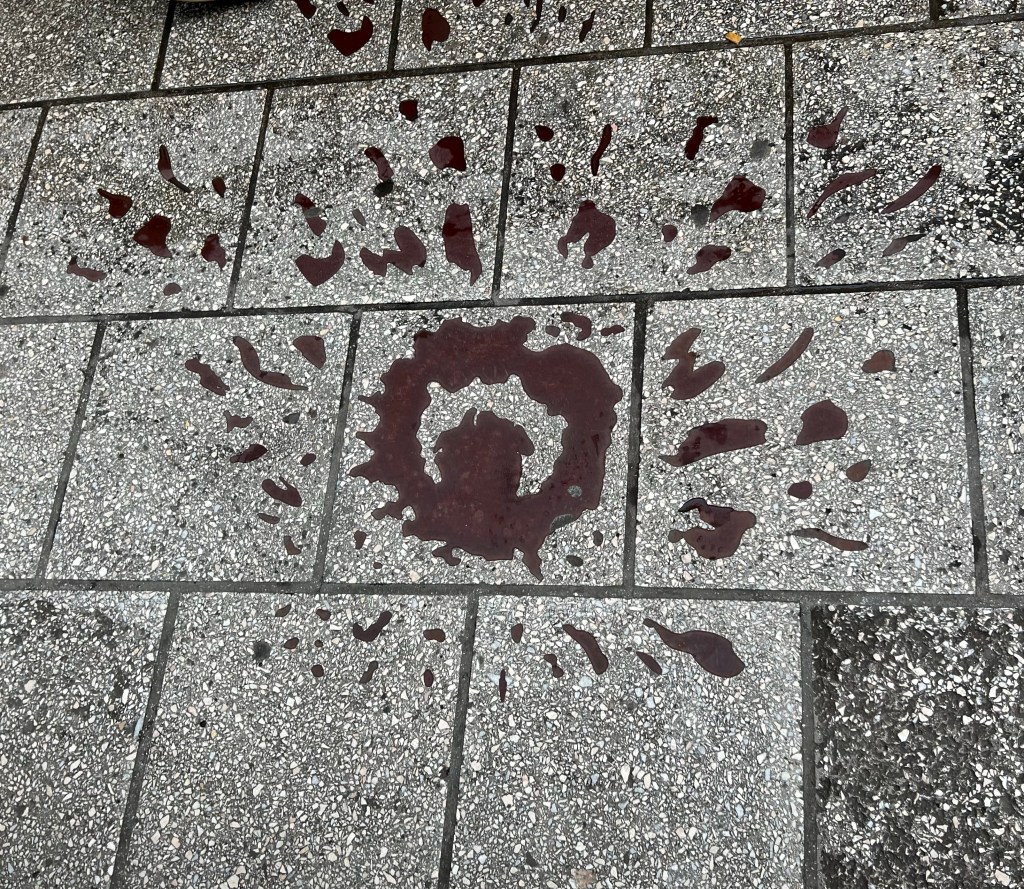
On this street is the site of one of the bombings during the siege that resulted in the death of 26 citizens and wounding of 80 more; a former bakery where people we waiting to buy some bread. The site is marked by a plaque on the wall and a Sarajevo Rose on the street in front of the building where the bomb landed.

Sarajevo Rose

The mortar rounds landing on concrete created a unique fragmentation pattern that looks almost floral in arrangement. A Sarajevo Rose is a type of memorial in Sarajevo where the scar in the concrete caused by a mortar shell’s explosion is filled with red resin. There are around 200 “roses” in the city marking locations where at least three people were killed during the siege of Sarajevo.

After the bombing, Vedran Smailović a famous Yugoslavian cellist (better known as the “Cellist of Sarajevo”) donned his tuxedo and played concerts on the spot for the next 26 days to honour the victims.

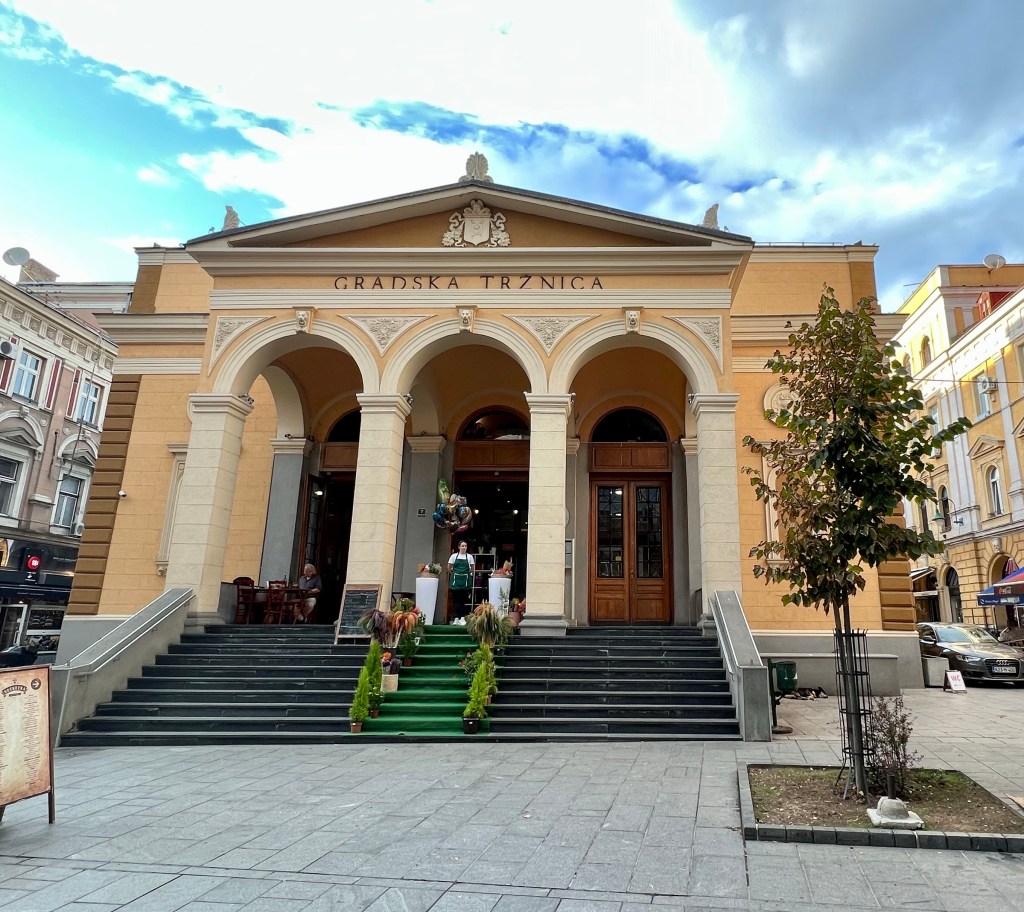
Next up is the neoclassical building housing the City Market Hall (Gradska Tržnica). Inside you will find permanent market stalls selling local produce, meats and dairy products.

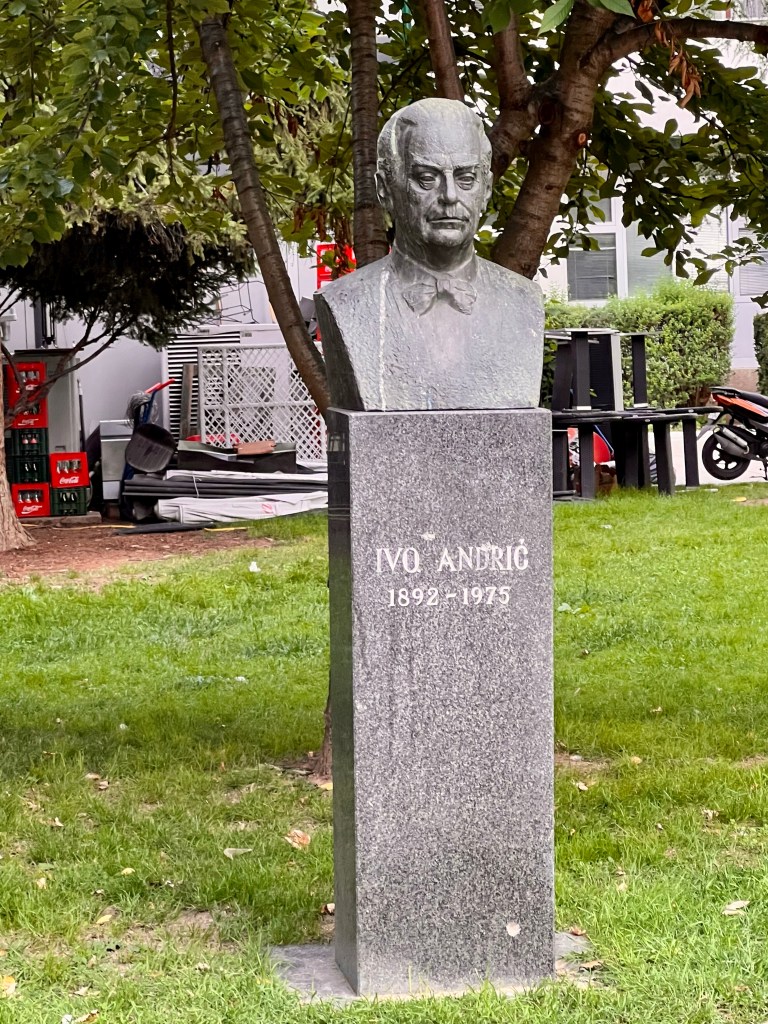
Next we’re off to the Liberation Square dedicated to WWII. In the center of the square is a 1997 statue of Multi-Cultural Man; holding the globe together to represent that without multiculturalism there is no world. There is also a statue to Ivo Andrič, author of Bridge over the Drina River recommended reading from Filip.

Multi-cultural Man

The biggest draw in the square for the locals is the chessboard. Winner stays with the board and takes on challengers. Last winner locks up the board pieces and sets them up the next morning; providing a great opportunity for bragging rights!

The nearby Cathedral Church of the Nativity of the Theotokos (1868) is the largest Serbian Orthodox Church in Sarajevo and one of the largest in the Balkans. According to Mohammed, the Turkish emperor bought the land and gave permission for construction, the Serbians paid for labour, Russia provided building materials and the Macedonians built the church so a very collaborative project. Stained glass makes this one different from most Orthodox Churches as it’s filled with light during the day.

A bit further down the street is the Sacred Heart Cathedral (1899). This Roman Catholic Church has the largest pipe organ in Bosnia and beautiful stained glass windows from Innsbruck, Austria. The stained glass was destroyed during siege along with the rest of the church. Had to go to Innsbruck to find the original archives from the family of the artist to recreate them. There is a shiny statue of Pope John Paul II out front to recognize his efforts to try and let the world know what was going on during the siege and his visit to Sarajevo in In 1997 to call for peace, forgiveness and reconciliation in the aftermath of the war.

Sacred Heart Cathedral
Shiny Pope Statue

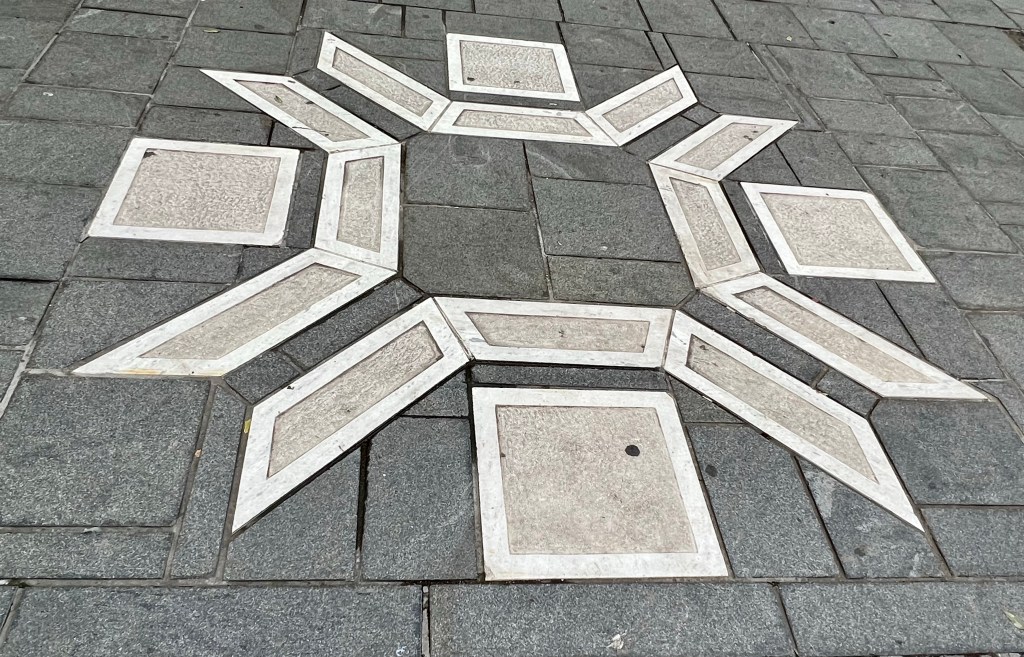
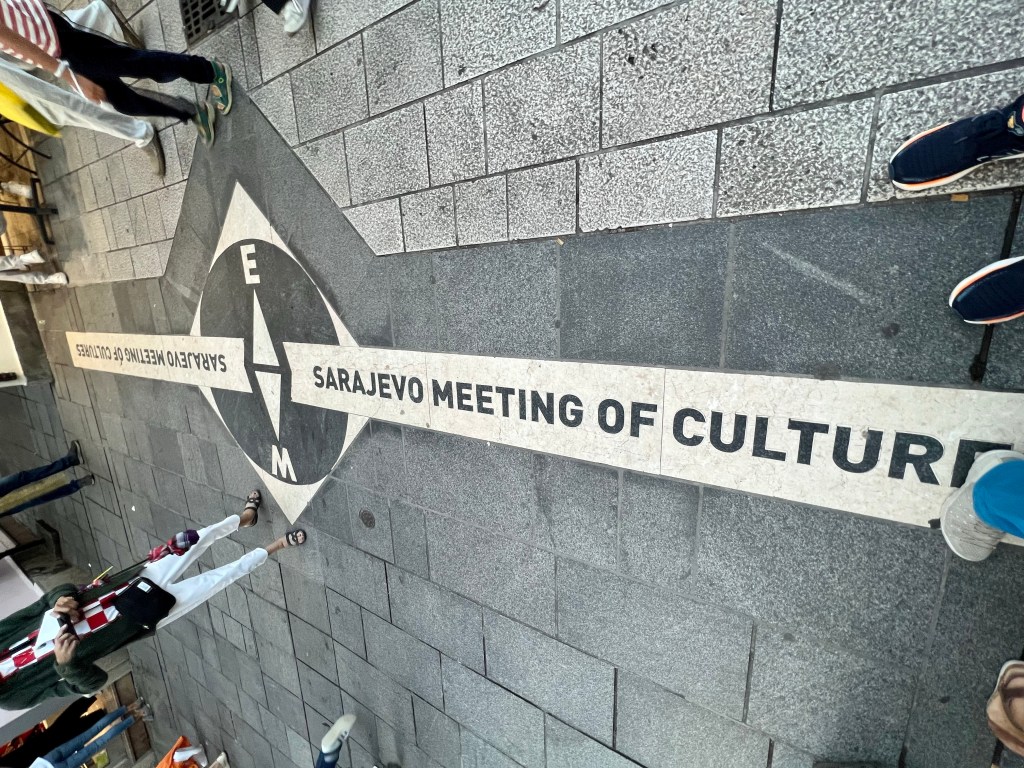
On the city’s main pedestrian street (Ferhadija), you’ll find the “Sarajevo: Meeting of the Cultures” sign underfoot which signals the immediate transition from West to East. Entering “Little Istanbul”, it’s time for a cultural shift as we explore the more ancient part of Sarajevo.

East meets West

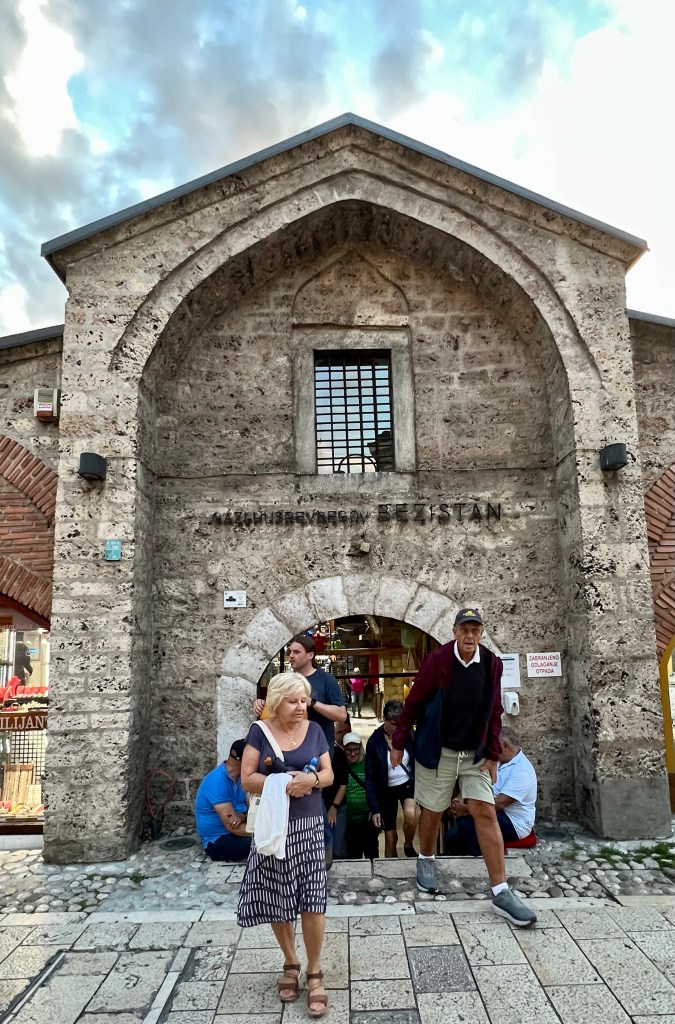
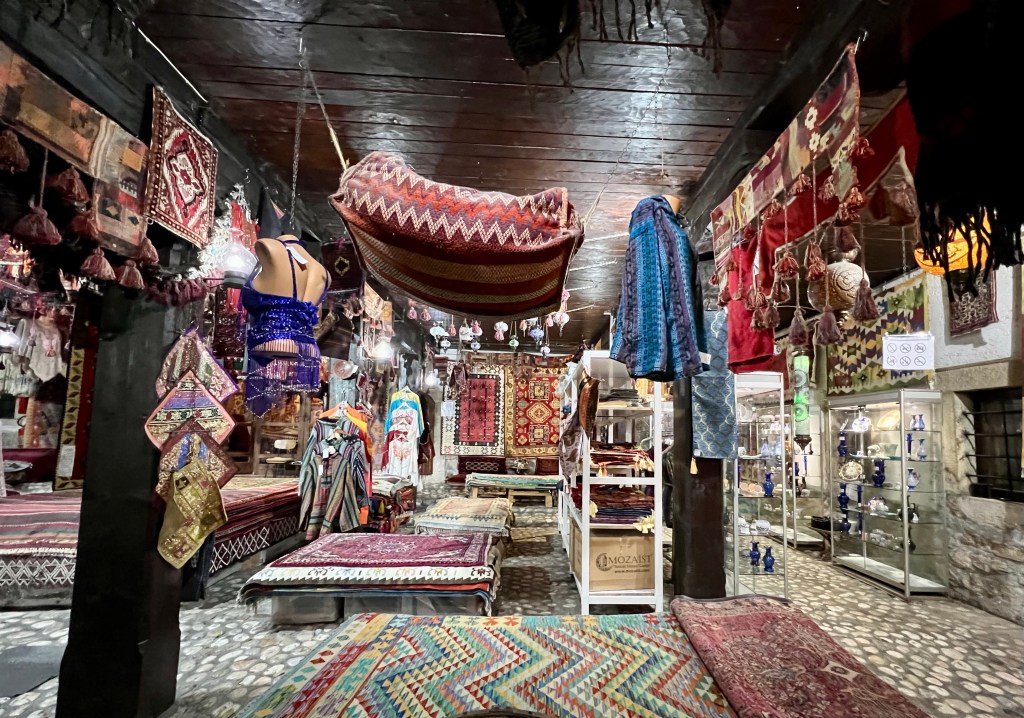
Next we come to the entrance of Bezistan; an indoor market that was originally exclusively for textiles but today focusses on the sale of knockoffs it seems.

Bezistan

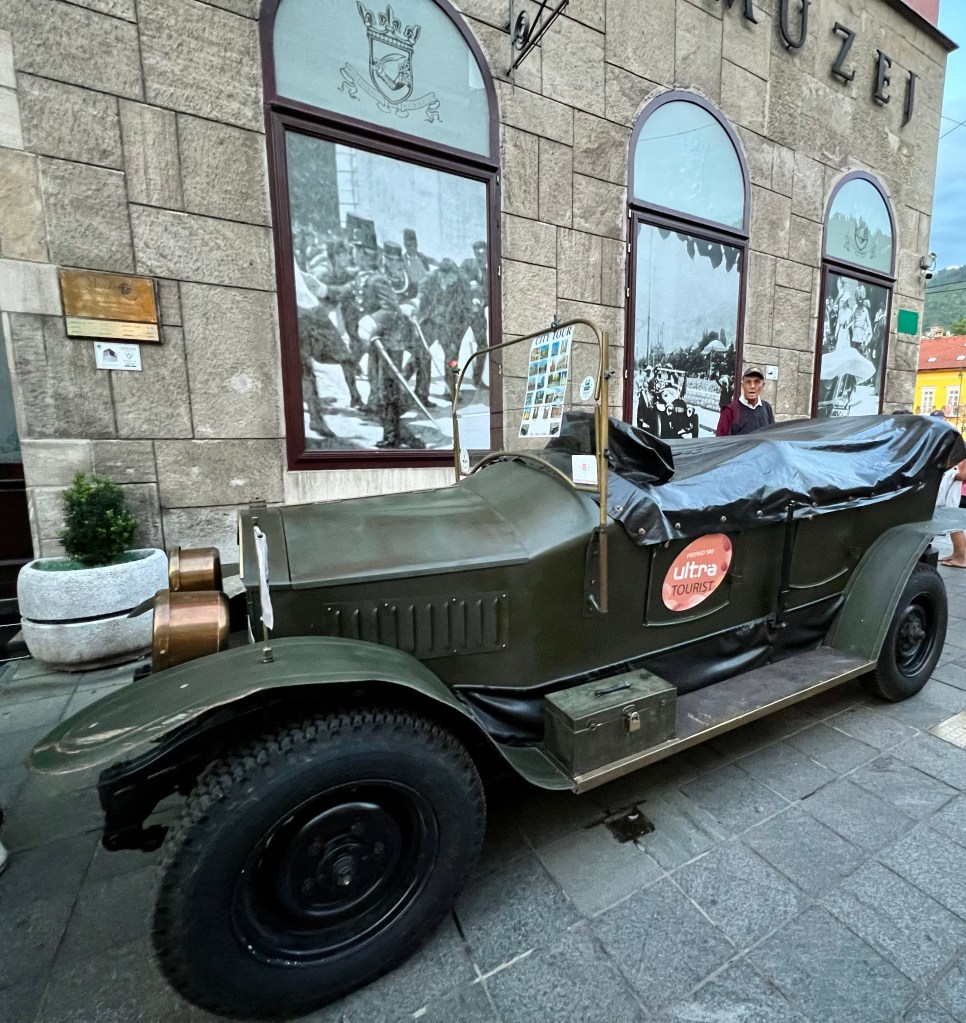
Next we arrive at the street corner by the Latin Bridge where on June 28, 1914, Archduke Franz Ferdinand was assassinated along with his wife Sophie as they were riding in an open top car. His assassin was Gavrilo Princip, a 19-year-old Bosnian Serb separatist (who later died in prison). This event helped spark World War I; setting off a chain reaction of allegiances and grudges that swiftly pulled all of Europe, and much of the world, into a Great War that would end the age of empires and usher in a new era of modern nations.

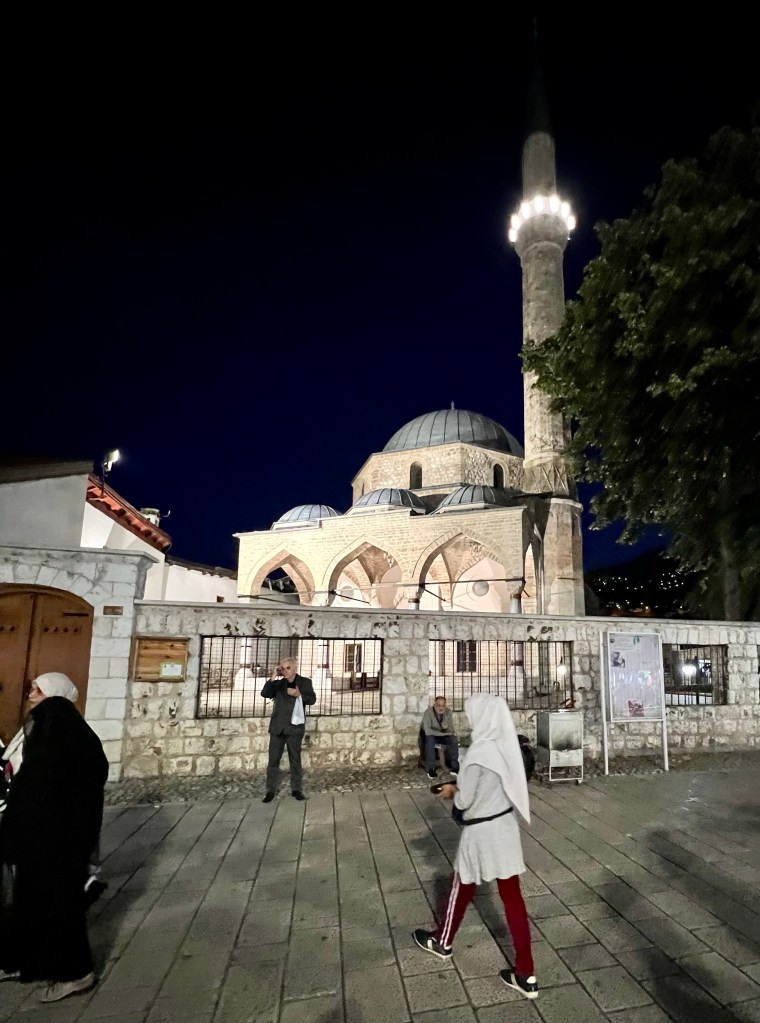
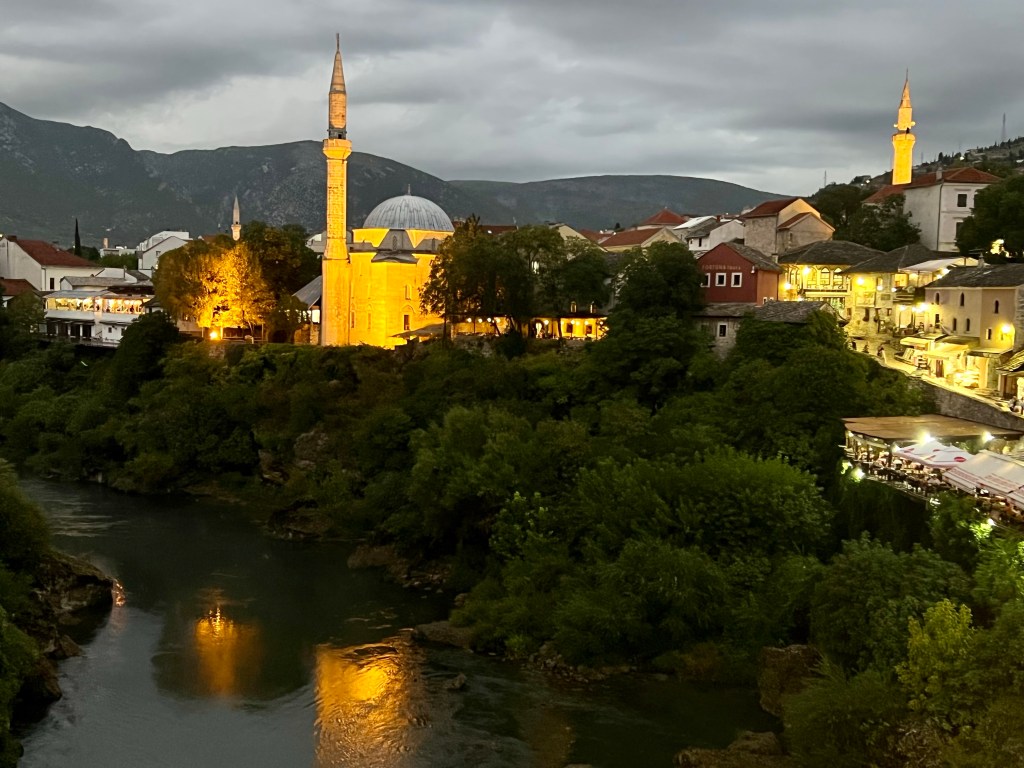
Continuing along, we are arrive at Sarajevo’s most important and historic mosque just in time for evening prayers. Built in 1531, it is named for Gazi Husrev-Bey (1480-1541), a Muslim aristocrat who funded the mosque and many of the other Old Town’s landmarks. The mosque has a large outer courtyard, with a beautiful fountain in the middle for worshippers to wash up before their prayers. The mosque’s tall minaret has 500+ steps which the muezzin has to climb five times daily to call Muslims to prayer; guessing he doesn’t need a stair master.

Mosque at night

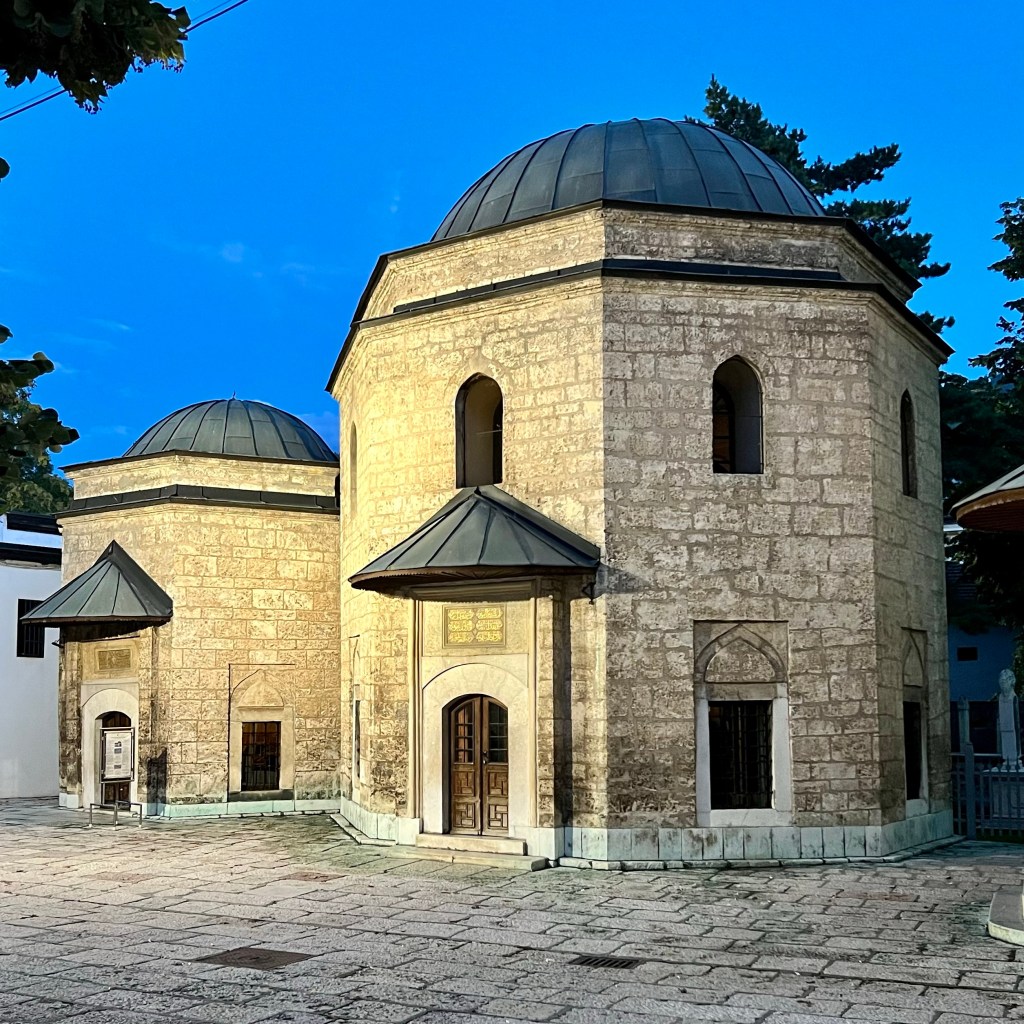
Nearby are Gazi Husrev Bey’s tomb(bigger one) and the tomb for the first Amman.

Our next stop is a Trader’s hotel built in 16th century that allowed traders to stay, trade and eat for three days for free. The hotel had forty rooms with four beds. Also had additional 160 mattresses in the halls if necessary. When the railway started running, it was no longer needed for the original purpose so has been converted to restaurants and shops.

Mohammed explained to us that Bosnia has a coffee culture with three cups of Joe as the norm; the first cup is the welcome coffee, the second cup the talking coffee and when the third is served, it’s the Goodbye coffee – here’s your hat what’s your hurry – Time to go!

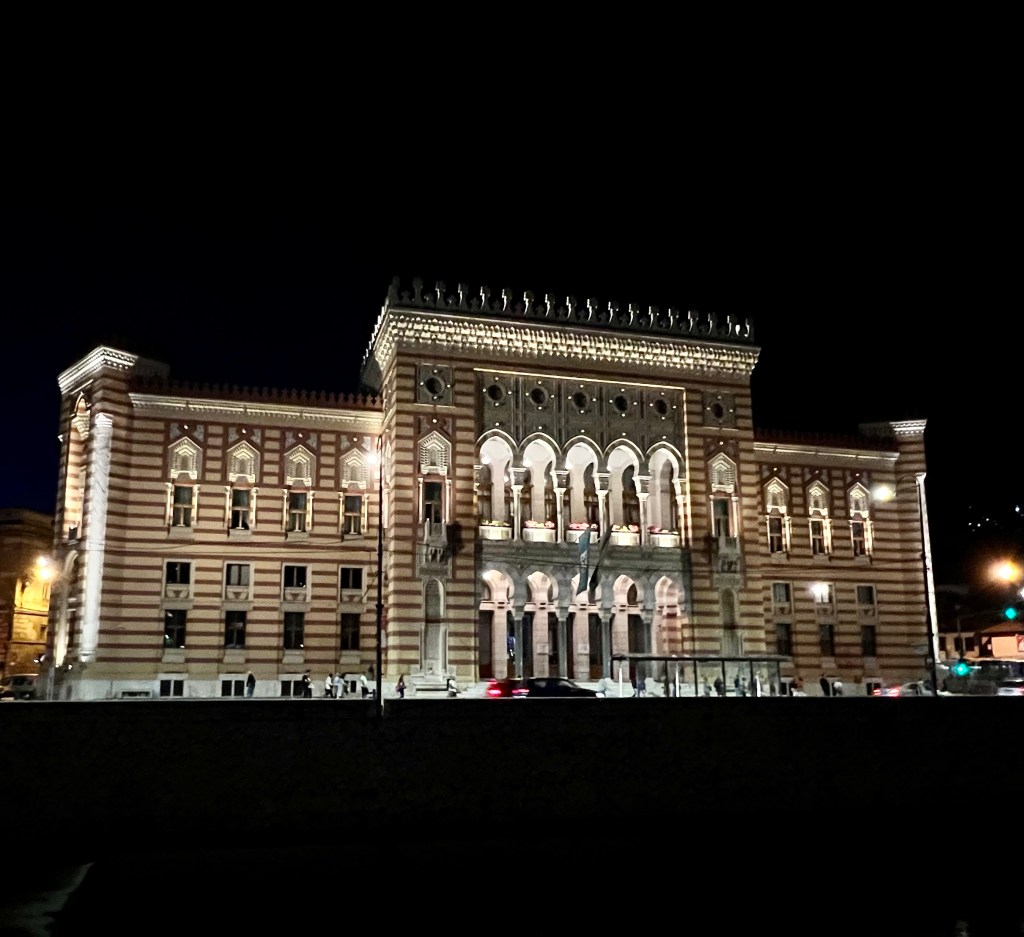
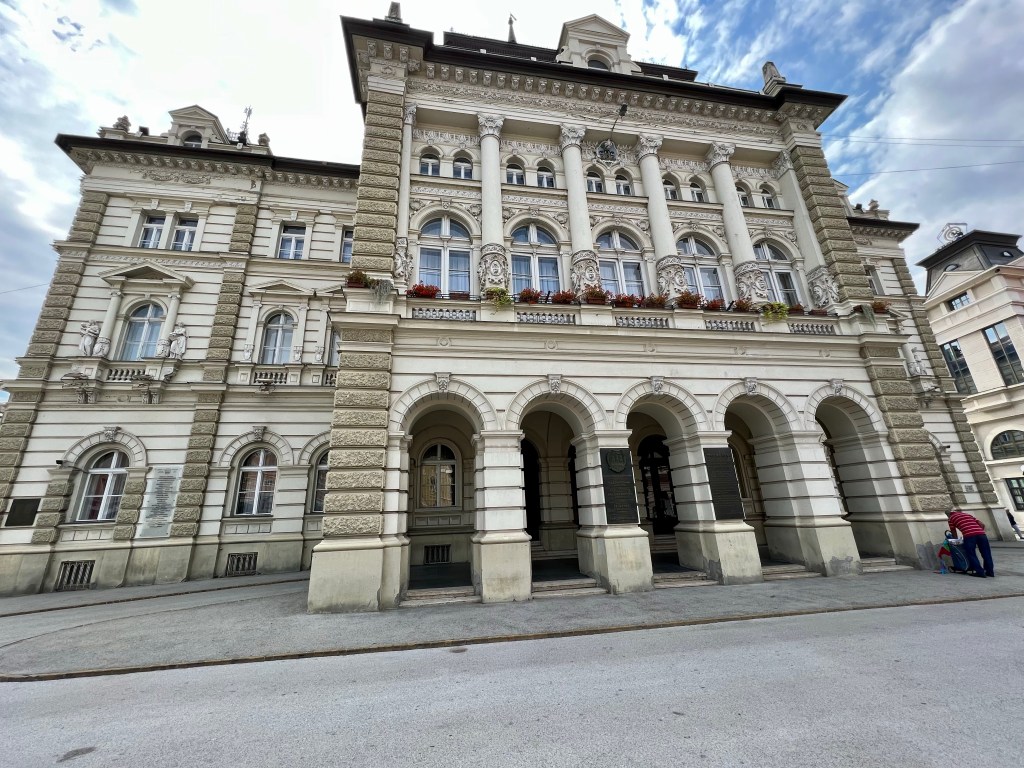
Our next and last stop is Sarajevo’s beautiful former City Hall, built during the Habsburg rule. This is where Archduke Franz Ferdinand began his fateful drive through the city the evening he was assassinated. It now houses the National Library, which was renovated in 2014 after being destroyed during the Bosnian War.

Sarajevo’s former City Hall

From here you can see a tiny white house aka the “spite house” which used to be located where city hall is now. The house is nothing special architecturally. It’s claim to fame is that the original owner rejected offers to tear down the house to make way for the new City Hall through three successfully larger offers. The owner finally agreed he would take less than the original offer if they moved his house to the other side of river – had to tear it down and build back the same house brick by brick. Mohammed said this demonstrates that Bosnians are stubborn.

Our tour was over so we headed to one of the recommended restaurants for dinner. I decide to try ćevapi; a grilled dish of minced meat shaped into tubes considered a national dish of Bosnia. Ćevapi has its origins in the Balkans before the Ottoman period. The dish consisted of ten pieces of meat in a pita with onions. Overall, it was okay but it is sometimes served with a cheese cream and as ordered was a bit dry. Sated, we headed back to to the hotel for some sleep after a long day.

Tomorrow is another day. Adventures await…

September 8, 2022

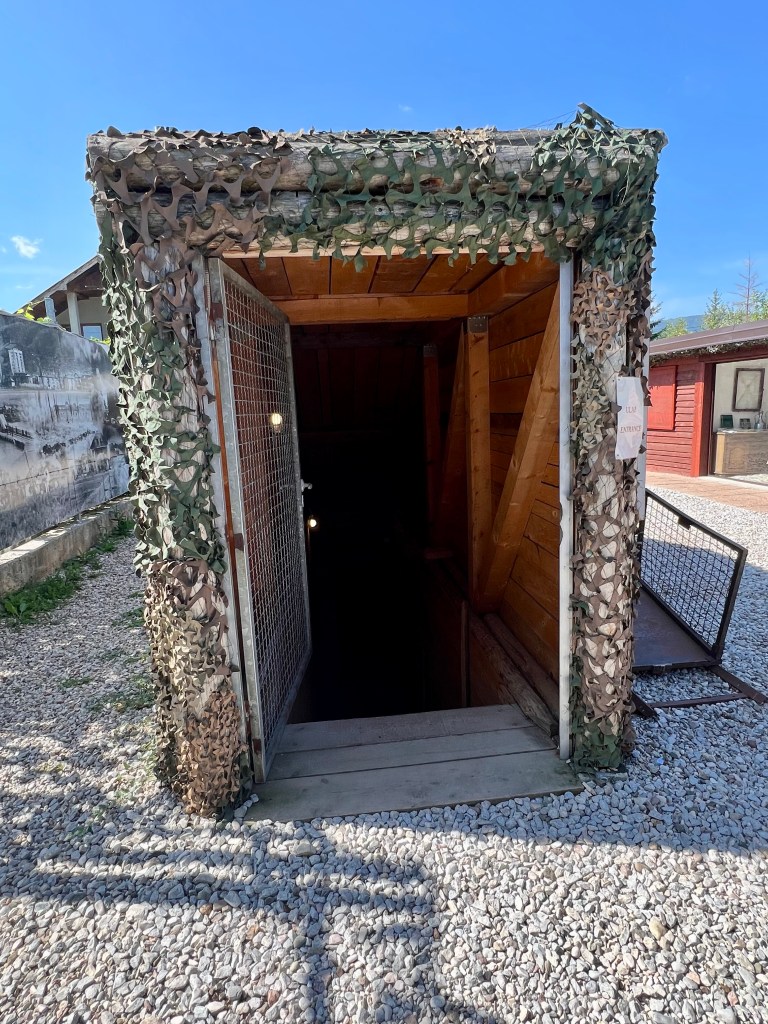
Today we are headed to Sarajevo’s “Tunnel of Hope”; a tunnel constructed between March and June 1993 during the Siege of Sarajevo in the midst of the war in Bosnia. It was built by the Bosnian Army in order to link the city of Sarajevo, which was entirely cut off by Serbian forces, with Bosnian-held territory on the other side of the Sarajevo Airport, an area controlled by the United Nations. Originally intended exclusively for military use, the tunnel soon became a lifeline for Sarajevo residents to access food and supplies to help them survive the Siege.

The tunnel is located near the airport, about a 30-minute drive from our hotel and our guide for the tour, Mustafa, used the time to give us some information regarding the Siege as he and his family were living here at the time.

Yugoslavia was the richest country in the region despite communism. The country broke up up after the Berlin Wall came down and most communist countries wanted their freedom. An independence referendum was held in Bosnia and Herzegovina between February 29 and March 1, 1992. Most of the money went to Belgrade and stayed there so 63% of Bosnians voted to leave Yugoslavia but the minority Serbs didn’t want to leave.

Sarajevo was put under siege and attacked by their own army (former Yugoslavian army) who will still here and who the Bosnians had been paying an 8-10-% salary tax to support. 95% of the Generals in the Army were Serbs so when independence movement started said whoever wants to leave Yugoslavia can leave unless Serbians live there.

When the war broke out, Bosnia was the most mixed ethnicity of the states that had made up Yugoslavia: Bosniaks were Muslims, Serbians were largely Orthodox and the Croatians were mostly Roman Catholics. Serbs said by succeeding from Yugoslavia, the Bosnians were going to form a Muslim state although Slovenia and Croatia had no Muslim population and they were also attacked by the Serbs.

Mustafa suggested that what happened then is similar to what’s happening now in Ukraine and it’s hard to argue. The current Ukraine war is considered Foreign Aggression (by Russia) to help a Russian minority located in another sovereign country (Ukraine). Bosnia was pretty much the same situation but it was considered a civil war so they received no outside help. They were required by the EU Declaration to have a referendum to determine if they wanted to succeed from Yugoslavia and then abandoned when the war started.

Bosnians hoped for help from the west throughout the war/siege. The UN role was to keep statistics. 329 bombs a day on average sometimes as many as 1500-2000. Biggest death tolls at areas where residents went to get food (green markets and bakeries). Weekends were the worse as Serbian volunteers would come after working and every weapon would be firing. Disgustingly, Russian celebrities and other tourists could pay to come and be a sniper; called the Sarajevo Safari.

People could leave the city during the siege, including, males under 18 or over 65 with UN convoys. Men between 18 and 65 were conscripted so we’re obliged to stay. Almost 25% of the population left during the war.

Originally, thought it was short term madness and then once they recognized it was a war thought it would stop or be stopped. Hadn’t done anything wrong and it was their home. Not many guns at beginning of war and it was illegal to buy guns; made guns out of water pipes. West had an embargo on weapons because they didn’t want it to get worse. Bosnians continued asking NATO to take action against Serbs or allow Bosnians to defend themselves by removing the weapons embargo.

Bosnia is largely made up of small towns and villages. When Serb troops went through the countryside they killed all the muslims/nonSerbs (ethnic cleansing) to prepare for addition of territory to Serbia. As a result, many people escaped to Sarajevo and the population tripled. UN wanted to bring Humanitarian Aid (food, etc.) into airport to avoid a human catastrophe and asked Serbs and then threatened them. The Serbs finally agreed but with the proviso that the airport was only used for food distribution.

There was more food and supplies outside Sarajevo in the mountains but couldn’t get there. Sarajevo citizens that decided to run across the airport to get supplies had two enemies; the UN and Serbian snipers.

In Sarajevo four soldiers shared one gun. Needed to defend front lines so the Serbs couldn’t close the loop and totally cut off access to the mountains. In 1993, the Bosnian Army decided to dig a tunnel 800 meters long,under the airport, starting from both sides; luckily they met in the middle as planned. The military kept the tunnel secret for awhile and it only used by the Bosnian army but eventually everyone knew about it even the UN. Serbs also knew but couldn’t bomb it as it was under a UN base. Serbs bombed the areas in the fringes a lot but didn’t know which house was the entry point.

At the beginning, the army let civilians through the tunnel but when everyone in Sarajevo knew you needed to get special permission. At the end of the tunnel on the other side there was a trench to town to avoid snipers on your way to the town. Mustafa and his mom went to pick up a package of food sent by relatives during the war. After a difficult, crazy trip they made it to the village and the shops were all stocked and all open which was a bit of a shock for them. The trip was even more fraught with danger on their return but they did make it back home with their precious supplies with some help from friends.

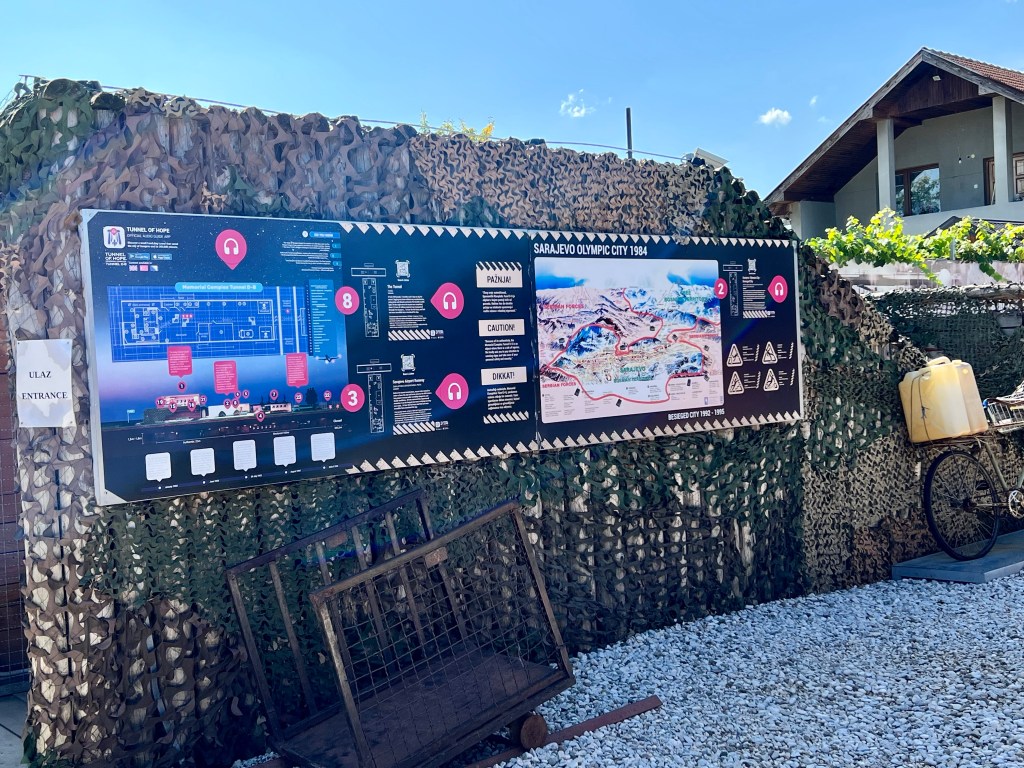
Map of the Tunnel of Hope

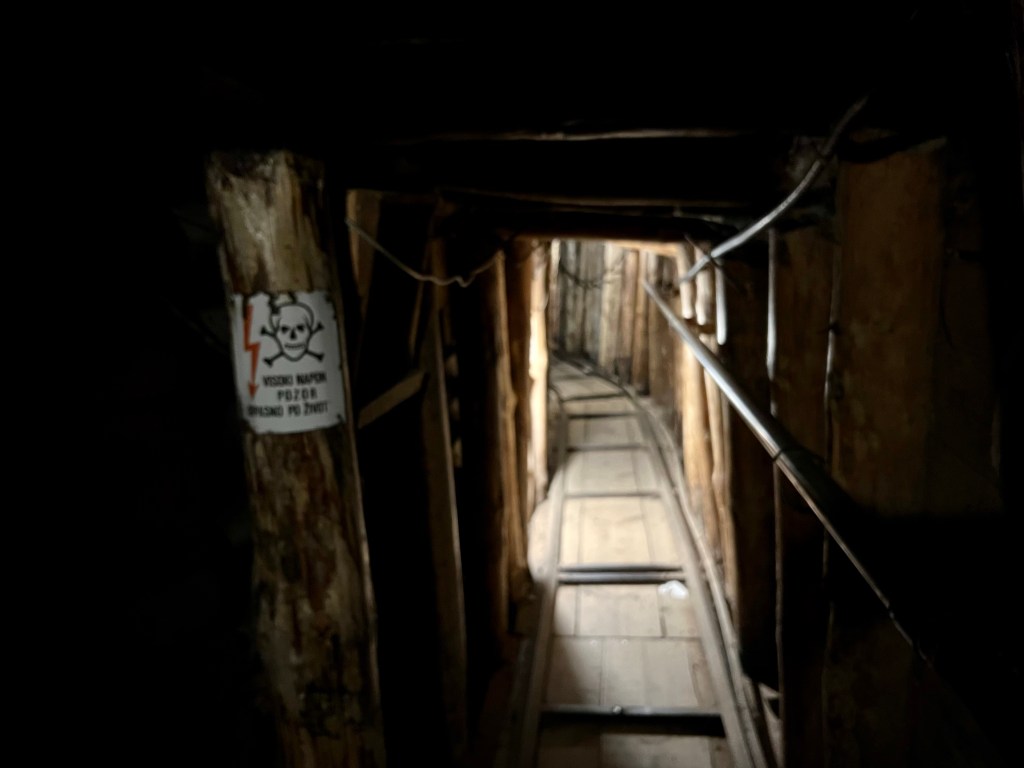
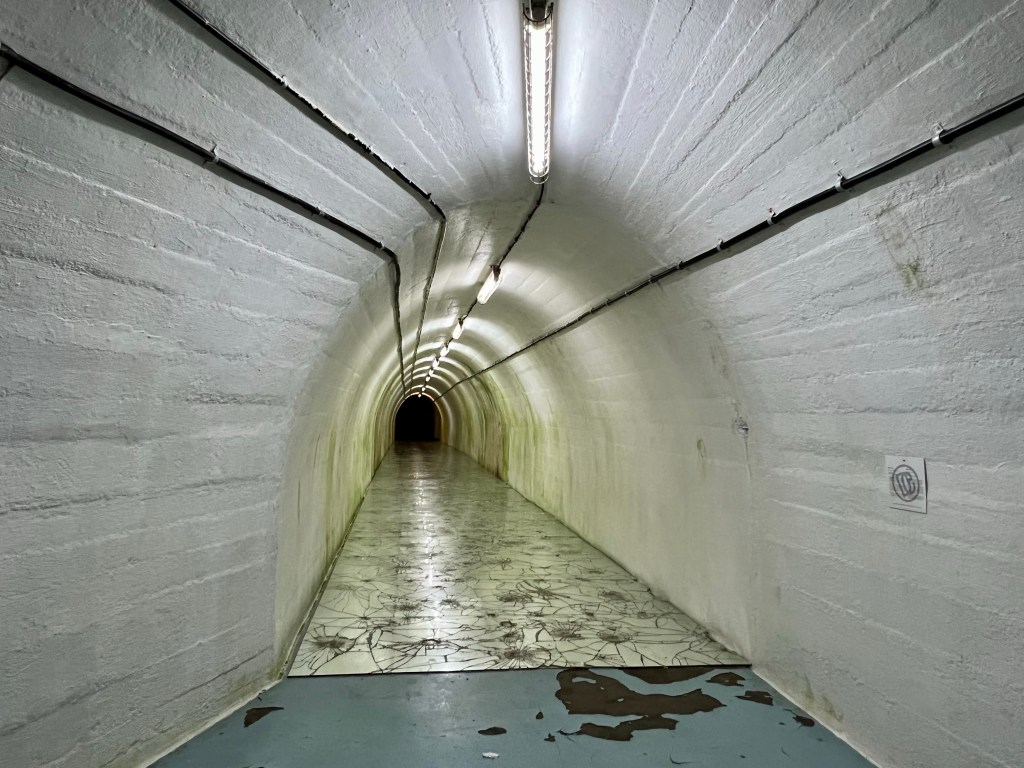
Today, visitors can walk through a small stretch of the tunnel, which of course we did and in that very short section I bumped my head four times. I can only imagine doing the whole trip especially laden down with whatever food you could carry on the return journey.

Entrance to section of Tunnel of Hope
In the tunnel

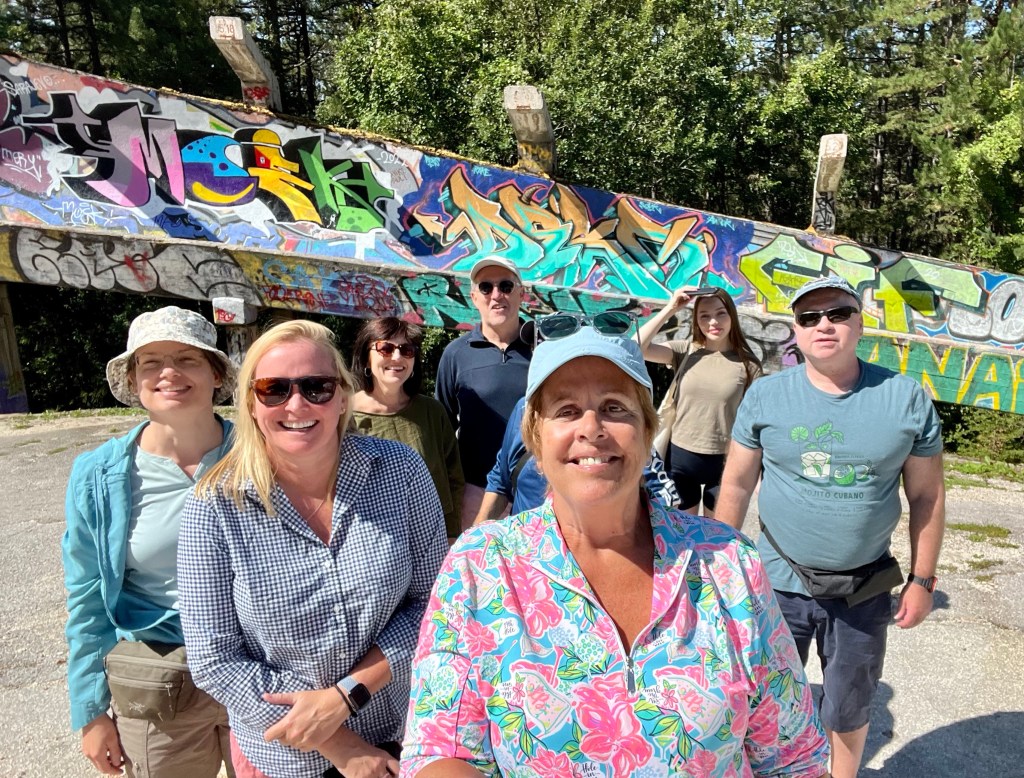
Leaving the tunnel, we headed up into the hills to the Sarajevo Olympic Bobsleigh and Luge Track situated on Trebević mountain overlooking the City of Sarajevo, built for the 1984 Winter Olympics.

Sarajevo Olympic Bobsleigh and Luge Track

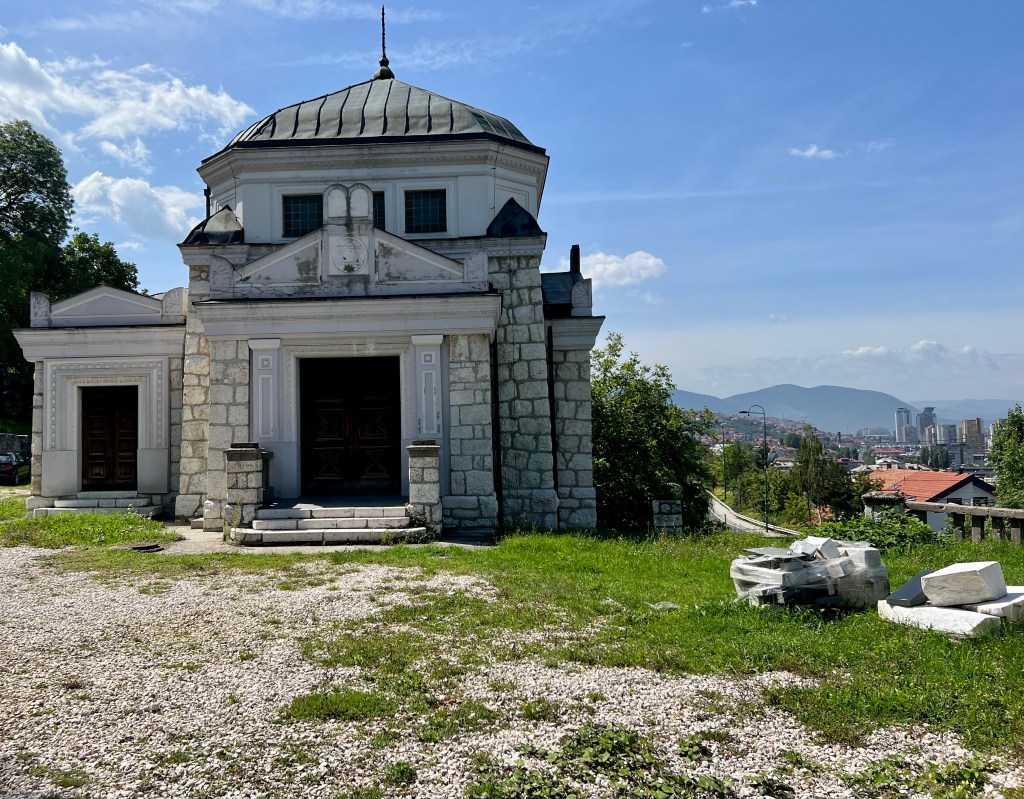
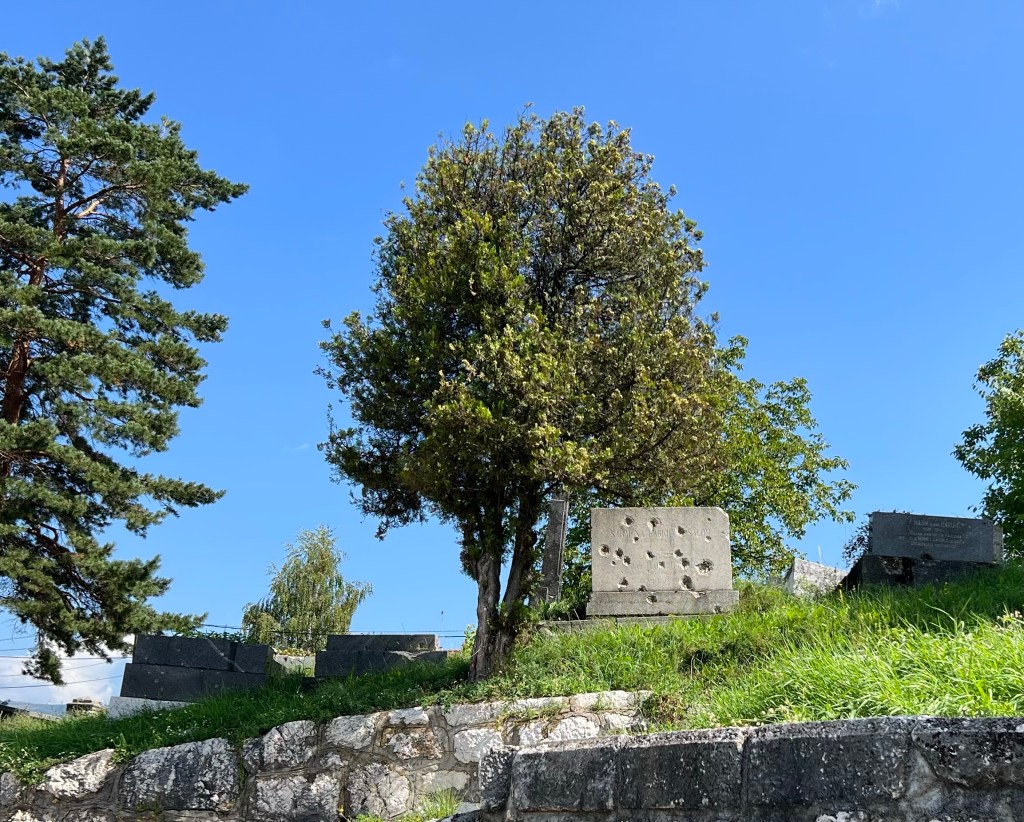
Our penultimate stop was the OId Jewish Cemetery; the largest Jewish cemetery in Southeast Europe and very old. It was sandwiched between the Serbian and Bosnian forces which explains the extensive damage to the headstones.

Entrance to Old Jewish Cemetery

Our last stop was a former cable car stop now known as one of the viewpoints of Trebević with the widest panoramic view over the city of Sarajevo. The views of old town and the outskirts of the city were quite stunning.

View from the top

Back in town we grabbed lunch at a restaurant specializing in ćevapi. The cheese cream transformed an okay dish into something much more delicious. We wandered around for a bit including a quick stop at “Pigeon Square”; officially Bascarsija square. Its centerpiece is a beautiful Ottoman-style wooden fountain with a copper roof (Sebilj), a beloved icon of Sarajevo. It’s a great place for watching people and the large numbers of pigeons who come to be fed by their human friends. It’s said that if you drink from the fountain, you’ll come back to Sarajevo. Time will tell.

Sebilj

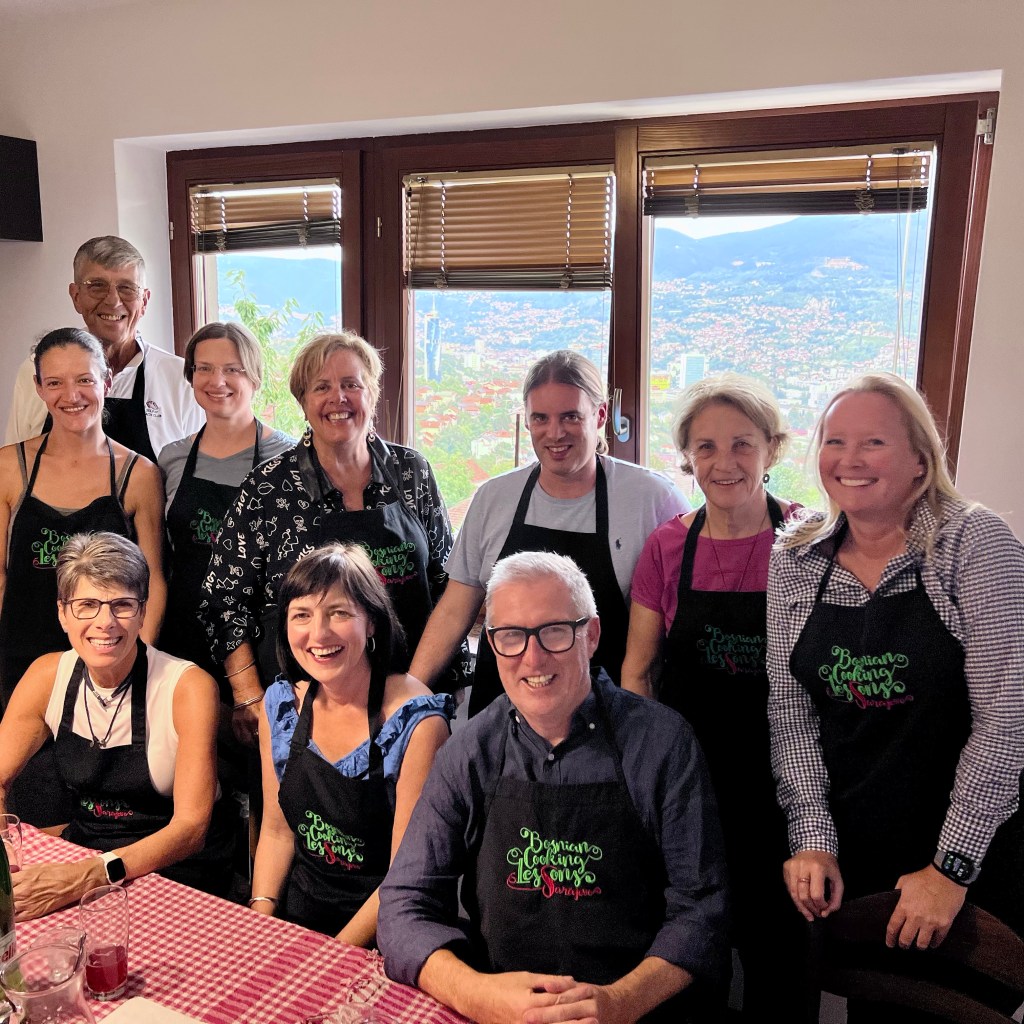
Tonight, some of the group is heading back up the hills around Sarajevo to Mustafa’s home with some of the gang for a cooking class to learn how to make some Bosnian specialties. https://bosniancookinglessons.com/

We are greeted by his lovely wife, Mersiha, and invited into their home. Before getting down to business, we try some cornelian cherry juice and rakia (plum brandy); both were quite delicious.

Highly recommended activity
Ready to cook!

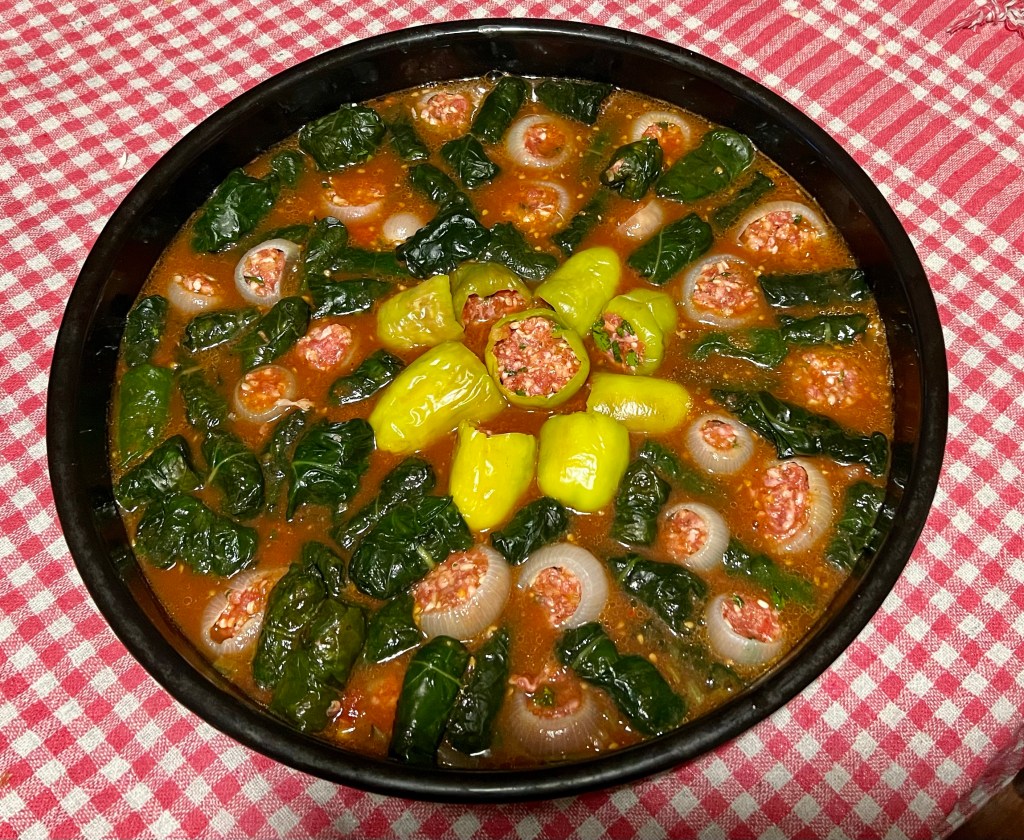
Our first dish is a variety of stuffed vegetables (yoprets); onions, peppers and mangel leaves (similar to Swiss chard) each stuffed with a mixture of ground beef, short grain rice and spices. A sauce with a base of peeled tomatoes, garlic, chilies, onions and the ribs trimmed the mangel leaves made a lovely bath for the stuffed veggies.

To fortify us for the preparation of the next dish, Mersiha, served charcuterie trays with smoked beef sausage, cheese, ajvar (a lovely veggie paste which I will try to make when I get home), cornelian cherry jam and bread.

Fuel to keep us going!

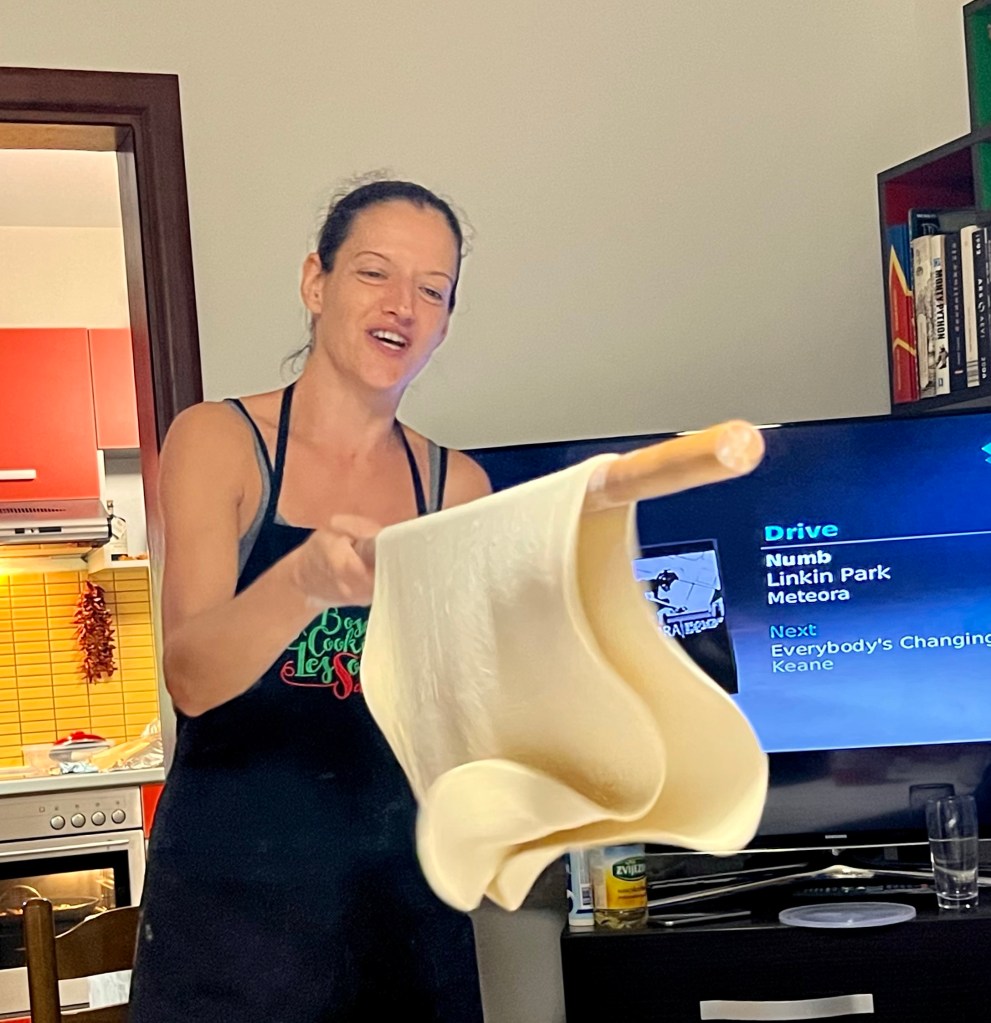
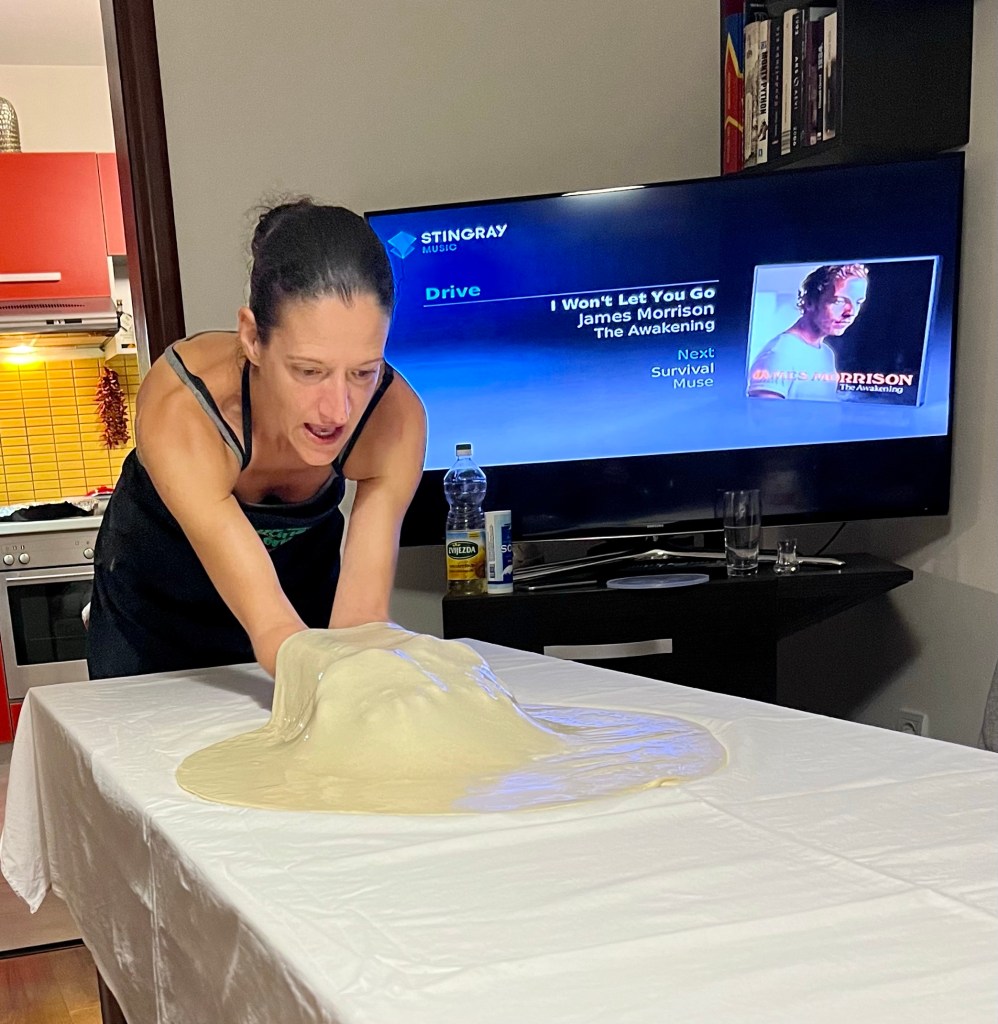
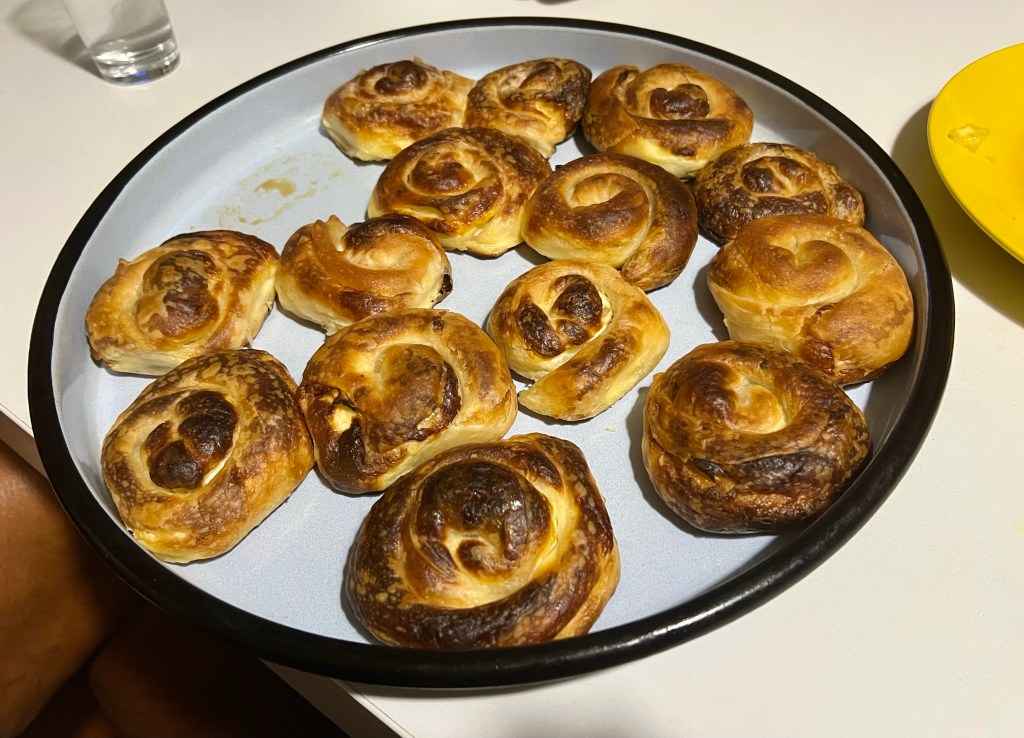
Next up was a lesson in making filo pastry. The whole process was quite complicated and long! Stretching the dough to the requisite thinness is definitely an art and would take years to perfect so might not tackle this one but who knows? The filo, once ready, was used to make three kinds of Burek: cheese, meat and potatoes. My favourite was definitely the cheese! Yummmm!

Burek!

Dinner was very late and washed down with copious amounts of red wine from a Bosnian monastery. It was a lovely evening so we bid adieu to Mustafa and Merisha and headed back to the hotel to crash.

Tomorrow is another day. Adventures await…

September 9, 2022

Another day, another bus and we’re headed to Mostar in Herzegovina, a city of bridges. On the way, we have a tour of Tito’s Bunker (D-O Ark); a Cold War-era nuclear bunker and military command centre located near the town of Konjic in Bosnia and Herzegovina planned.

We entered the bunker with a too large group so it was hard to hear what our guide was saying most of the time but I did pick up a few tidbits. The bunker was built during the Cold War and cost 15 million USD (equivalent to today) to build. It was intended to house up to 350 military and political elite (males only!) for up to six months. Though it was never used for it’s intended purpose, it’s existence was kept secret for many years until the breakup of the former Yugoslavia in the 1990s. The bunker is made up of residential areas, conference rooms, offices, strategic planning rooms, and other functional areas.

The facility is under the authority of the Bosnian Ministry of Defense and is managed by the country’s military. The bunker is preserved more or less intact with all its symbols of the social, economical, political and ideological system of Socialist Yugoslavia. My favourite are the red phones!

Calling Filip for a rescue mission!
Bedroom!

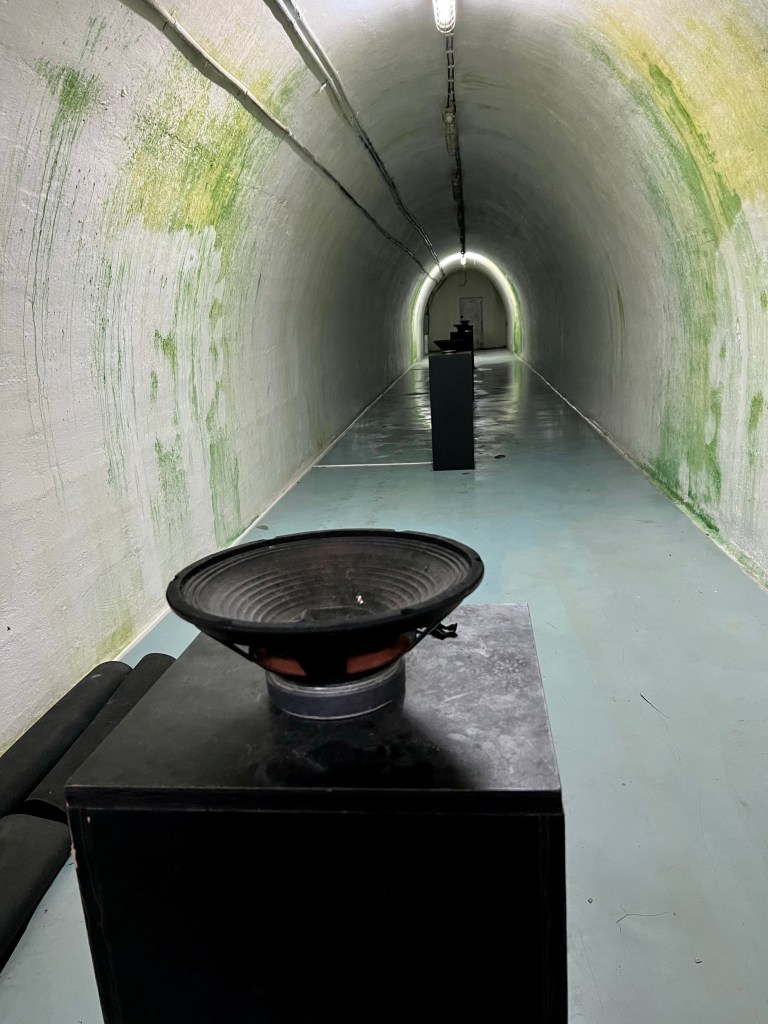
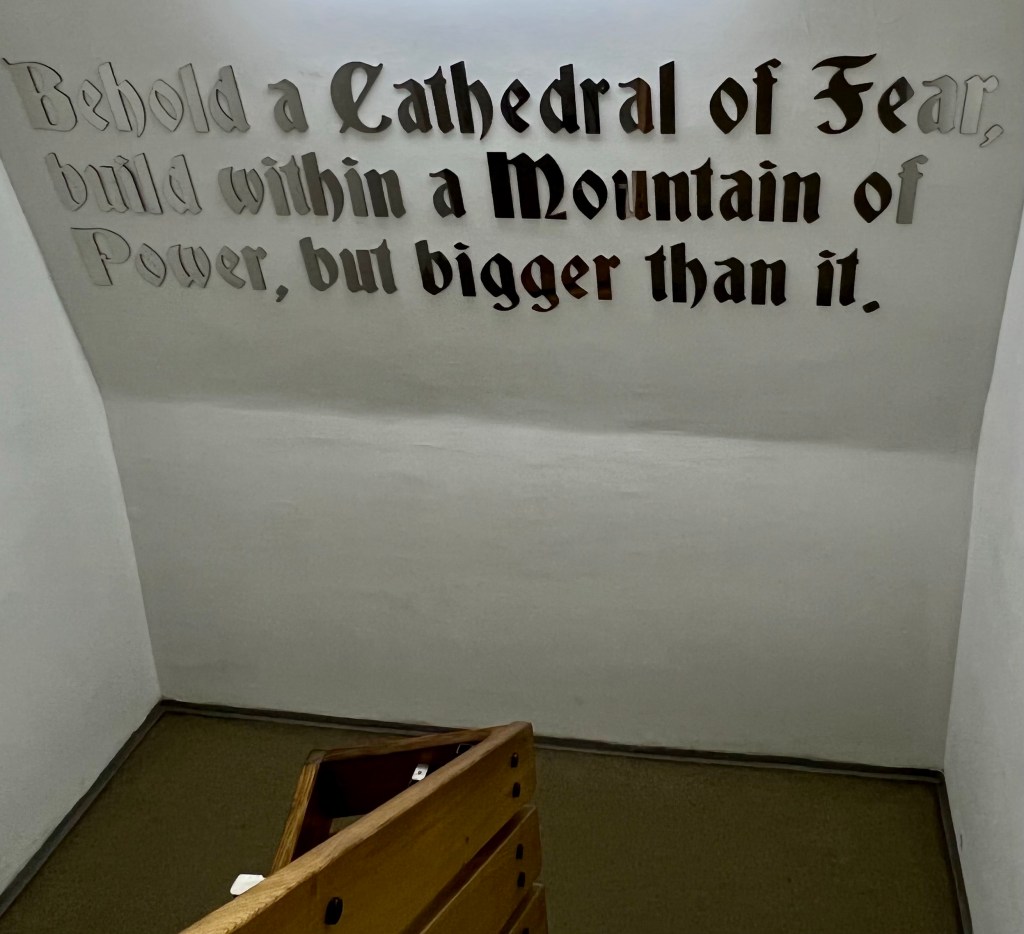
The bunker since 2011 has been home to 110 art installations from artists from across the region, Europe, and the world. They are in various states of repair and reflect a wide range of views of the former administration; some of them quite comical in my opinion. The goal of the Project Biennial of Contemporary Art is to transform a site still officially under military control into a prestigious regional cultural institution at the forefront of emerging artistic trends. Here are some of my faves!

We left the musty facility for the fresh mountain air and then hopped back on the bus for the trip to Mostar; a city in southern Bosnia and Herzegovina, straddling the Neretva River. It’s known for the iconic Stari Most (Old Bridge), a reconstructed medieval arched bridge.

After checking into the hotel and freshening up, we walked toward Mostar’s Old Town where we met our guide for the walking tour, Genin who started with a discussion of the Bosnian war. One thing all the guides in all the cities we’ve visited agree on is that the war wasn’t about religion; it was about power.

When the Ottomans arrived in Mostar it was a village and became a city with their help. The formerly pagan inhabitants became muslims freely as they had invited Ottomans to protect them from the crusaders.

Our meeting spot was in front of Saint Peter and Paul Monastery, a new church located outside the old town. It has the biggest bell tower in the city and it was built in the 90s, after the Balkan War. Close-by, within a 500 m circle, you can also find an Orthodox Church, Synagogue and a Mosque.

Saint Peter and Paul Monastery

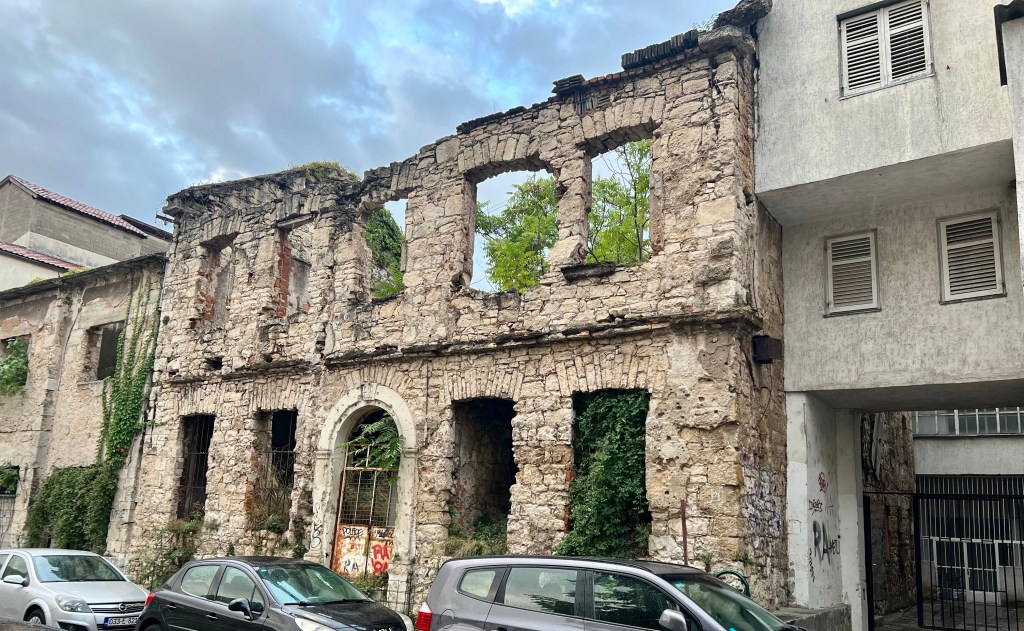
Mostar was the second most destroyed city in Europe in 20th century. The ruined buildings we passed are apparently in better condition than most. Hard to find money to fix and with the left over animosity it is hard for many families with mixed marriages to make decisions about who owns the house (before the war 70% of marriages in Mostar were mixed religions and after the war that dropped to only 1%).

Destroyed homes in Old Town

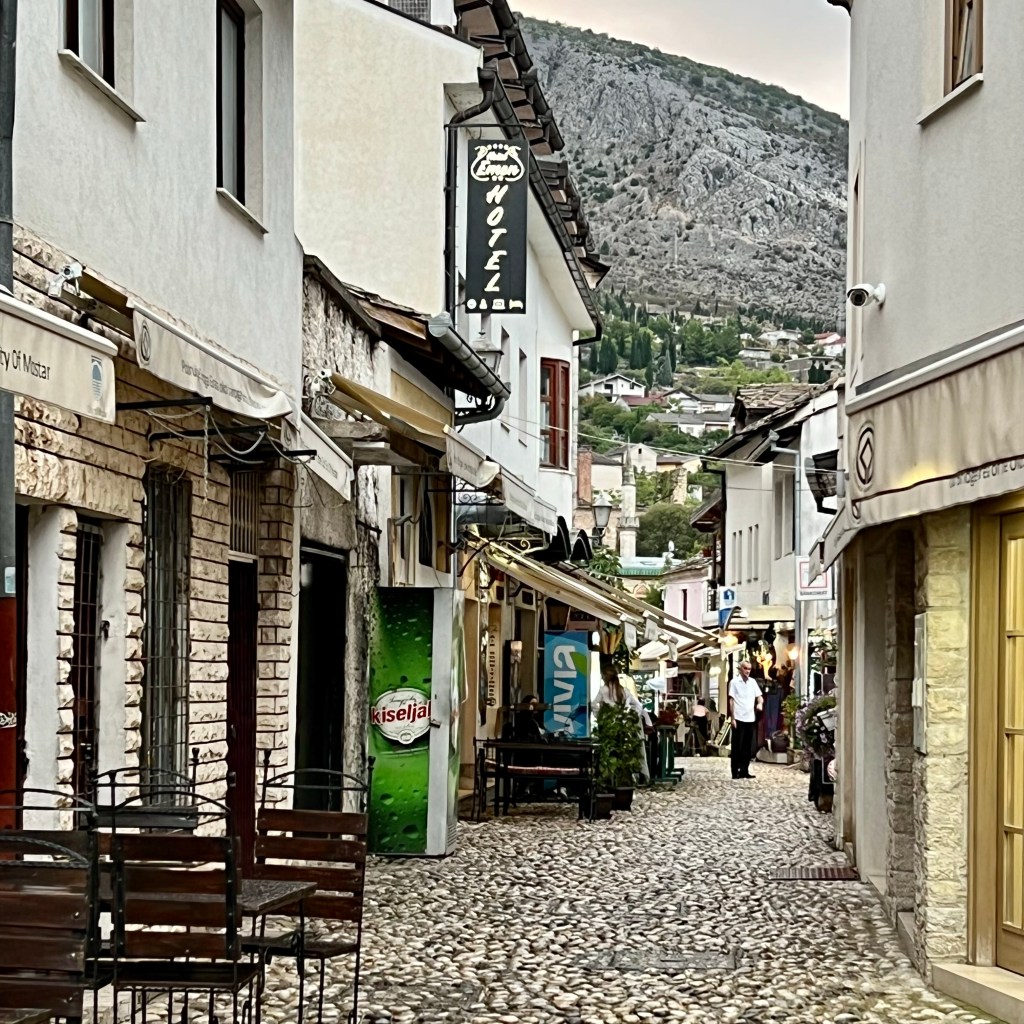
Old town streets are all made of cobblestones so the going is a bit treacherous because they are wet from the recent rain but they do provide a free foot massage !!

Cobblestone streets of Mostar Old Town

Our next stop is the Kriva Cuprija (Crooked Bridge); an ancient bridge in Mostar that crosses the Rabobolja creek, a right-bank affluent of the Neretva River. Built in 1558, eight years prior to the more famous Old Bridge, it is believed to have been built as a trial attempt for the following, more daring, construction.

Kriva cuprija is a stone one-arch bridge of small dimension and closely resembles the Stari Most. The arch is a perfect semicircle 8.56m in width and 4.15m in height. The frontage and vault are made of regular stone cubes incorporated into the horizontal layers all along the vault. The space between vault, frontal walls and footpath is filled with cracked stone. The bridge footpath and the approaching roads are paved with cobblestones, as is the case with the main roads in the town. This bridge was the only one of the twelve bridges in town to survive the war. Sadly, it succumbed to the floods of December 2000 and the original has been replaced with a replica.

Crooked Bridge

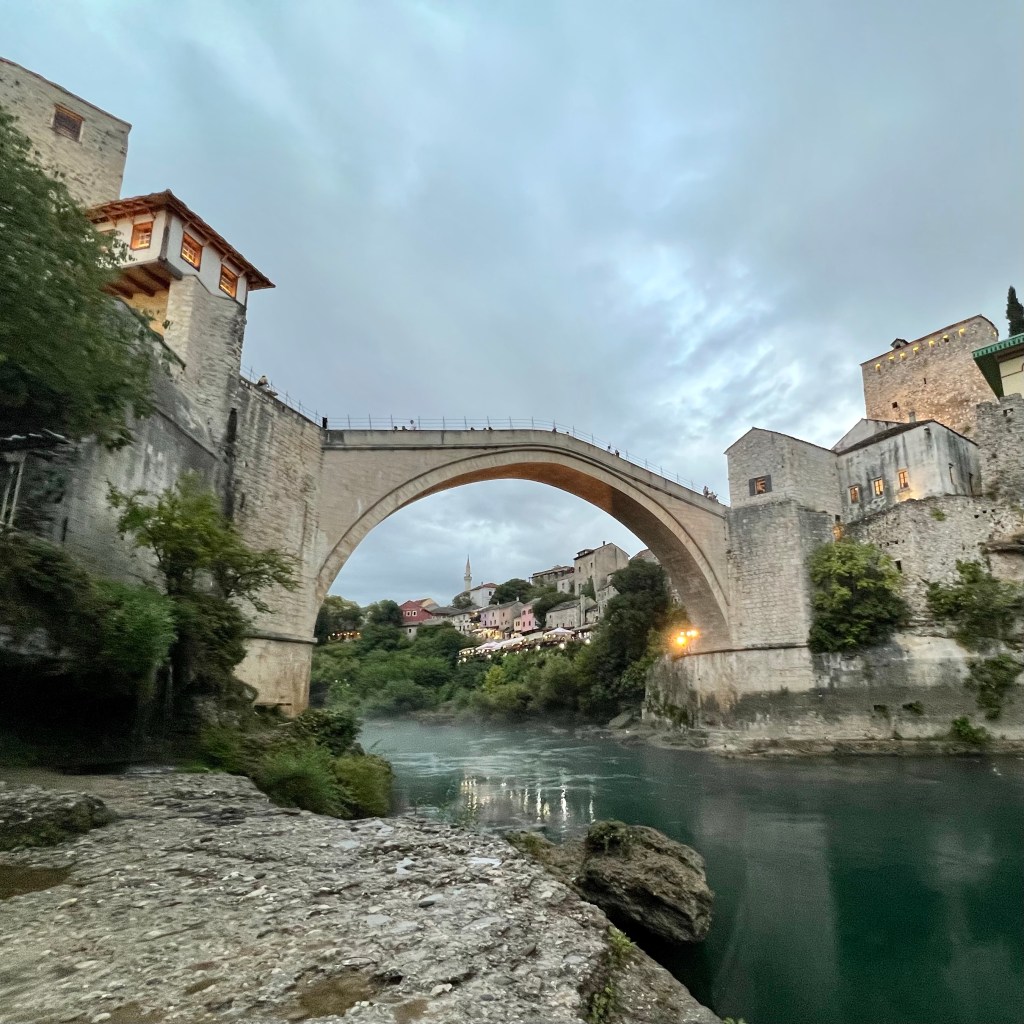
Continuing through town, we head down to the banks of the Neretva River for a look at the crooked bridge’s much larger cousin, the Old Bridge (Stari Bridge); the symbol of Mostar.

Old Bridge aka Mostar Bridge

The current Old Bridge is a rebuilt 16th century bridge that crosses the river Neretva and connects the two parts of the city. The Stari Most is hump-backed, 4 metres wide and 30 metres long, and dominates the river from a height of 24 m. Two fortified towers protect it: the Halebija tower on the northeast and the Tara tower on the southwest.

Construction of the original bridge began in 1557 and took nine years. The builder, Mimar Hayruddin, charged under pain of death by Suleiman the Magnificent to construct a bridge of such unprecedented dimensions, reportedly prepared for his own funeral on the day the scaffolding was finally removed from the completed structure. Upon its completion it was the widest man-made arch in the world.

The Old Bridge stood for 427 years, until it was destroyed on November 9, 1993 during the Croat-Bosniak War. The rebuilt bridge opened on July 23, 2004 and remains the symbol of Mostar.

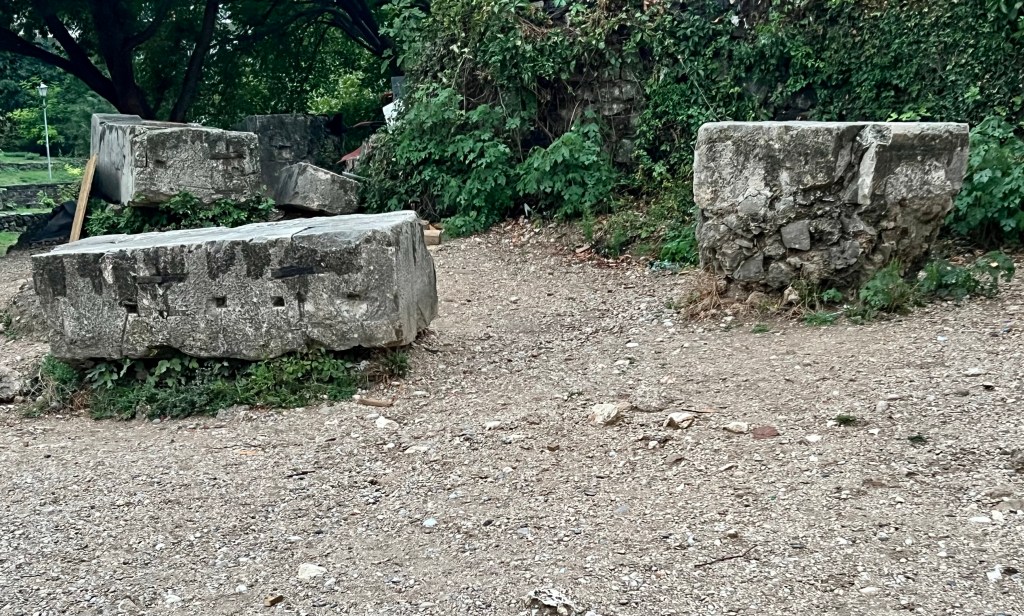
Spanish peacekeepers salvaged some of the original Stones from the bridge.

The Neretva is the coldest river in the world with temperatures as low as 3C in most places but a balmy 10c in Mostar because of local hydroelectricity installations.

Locals need to jump off the bridge and get a tattoo; not allowed to to have a tattoo unless you jumped. The bridge is 24 meters high and the cold water is 5 metres deep. For tourists, we just need to see someone jump. Sadly we weren’t there at the right time of day and Genin had jumped only once when he was young and is now older and wiser!

Next we went up onto the bridge to take a few pics before heading to a local restaurant for dinner washed down with local wine before heading back to the hotel.

View from the top
Our eatery for the night

Tomorrow is another day. Adventures await…

On The Road Again – Scouting Out Serbia

September 4, 2022

Today is the first day of our travels with G Adventure. We are a larger group of sixteen with people currently living in Australia, Germany, England, Ireland, Canada and the USA. Our Chief Experience Officer, Filip, is from Northern Croatia.

Luckily the minibus is hauling a trailer big enough for all our bits and bobs. Anyone that knows me, knows I’m a horrible overpacker. I’ve tried to be more minimalistic with wardrobe choices because it really is easier to travel light but I can still carry and lift a 50 lb suitcase so I do! Some day, I may be more sensible but I’m not counting on it. Anyway, I digress …

Our destination today is Novy Sad; the second largest city in Serbia with a population of around 300,000 and the capital of the autonomous province of Vojvodina. It is located in the southern portion of the Pannonian Plain on the northern bank of the Danube.

The scenery en route is unremarkable for the most part but there are some nicer stretches with fields of corn and other agricultural endeavours.

With the requisite bio breaks, we arrive at the border in a bit more than three hours. The process of presenting our passports at the Hungarian border and again at the Serbian border for inspection is pretty painless so we’re back on the road lickity split. The view out the bus window isn’t changed much (or at all) by the fact we’re in Serbia.

Soon enough we arrive at our destination and grab our bags to head to our accommodations for the night; Hotel Vojvodina. The hotel is a bit tired but good enough for one night. The biggest deficiency is the lack of elevator which gives me a chance to test my resolve to have wardrobe choices as I need to haul my “steamer trunk” and other various “carryon” bags up the sweeping staircase to reception. All I can say is thank God were not staying on the fifth floor, lol!

The crew met Filip outside the hotel for a late lunch/early lunch followed by an orientation walk to get some sense of the city.

Novy Sad was founded in 1694 when Serb merchants formed a colony across the Danube from the Petrovaradin Fortress, a strategic Habsburg Military post. In subsequent centuries, it became an important trading, manufacturing and cultural centre.

The city was heavily damaged in the 1848 Revolution and was subsequently rebuilt and restored. Today, along with the Serbian capital city of Belgrade, Novy Sad is an industrial and financial center important to the Serbian economy. Novy Sad is the most liberal and multicultural city in Serbia with 14 major nationalities; Hungarians and Croatians being most prominent.

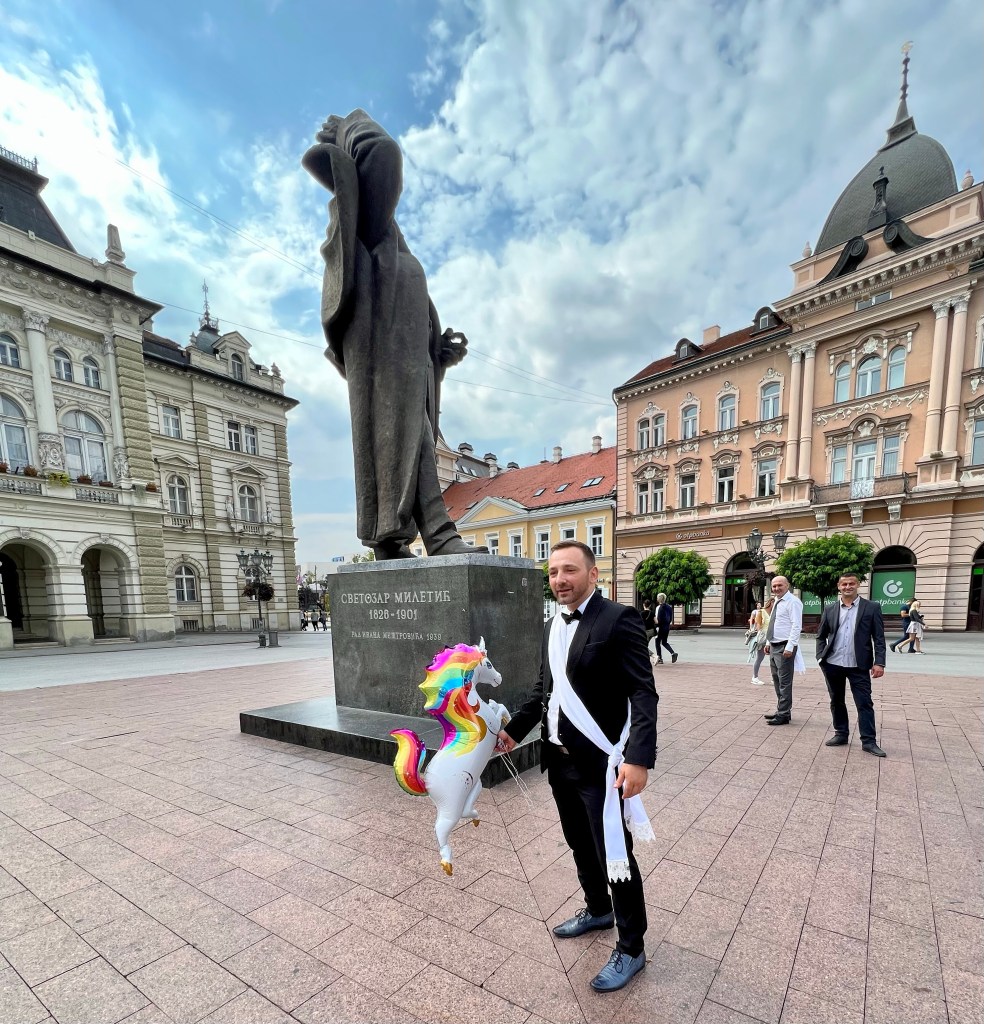
The hotel is perfectly located across from Liberty Square; the main square of the city flanked on one side by the City Hall and the other by the Name of Mary Church with the Svetozar Miletić Monument in the middle.

Name of Mary Church with the Svetozar Miletić Monument
Novy Sad City Hall

The town hall was built in 1895. The beautiful building has a special tower at the top that allowed firefighters to monitor the city. A large bell featuring the image of St. Florian, brave protector from fires for all cities, was added in 1907 to be used to alert the citizenry in case of fire. The bell also rang every day at five in the morning to mark the beginning of the market.

The Svetozar Miletić Monument is dedicated to one of the most significant Serbian politicians of the 19th century. His ideas and political ideology greatly influenced the national movement of the Serbs from Vojvodina during the second half of the 19th century. He was arrested, sentenced and imprisoned many times because of his political activity but was always freed to live another day.

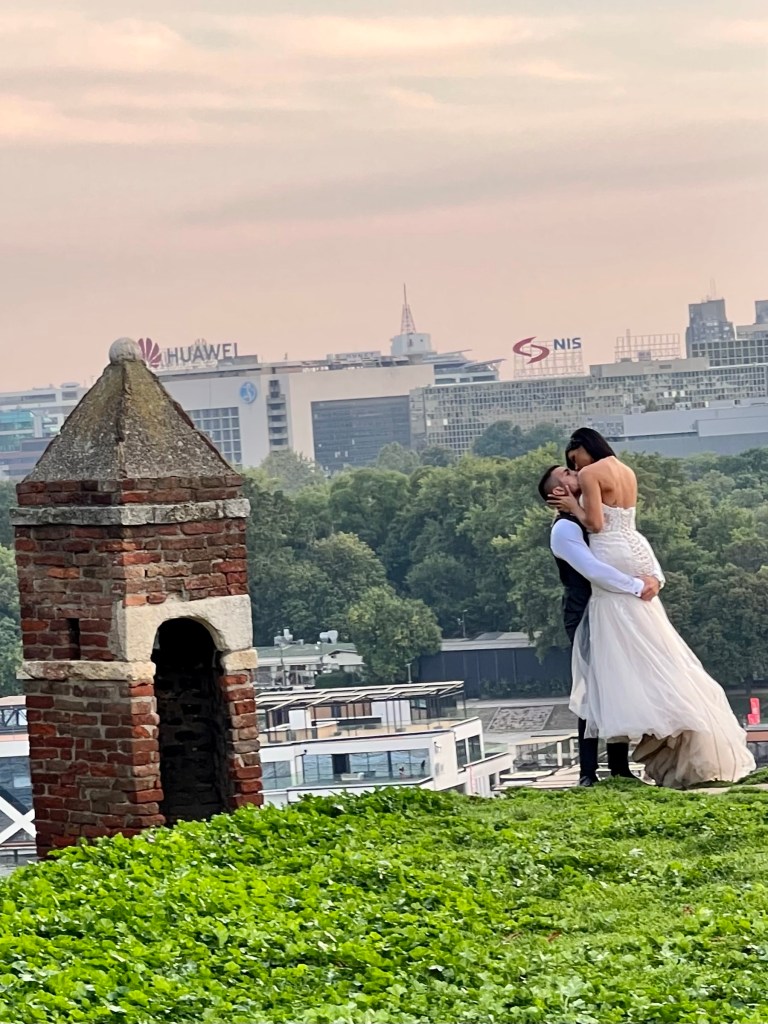
In the Square, we spotted a gentlemen wearing a white sash and carrying a unicorn balloon. Intrigued, we enquired as to the reason and he advised that he was off to his brother’s nuptials.

Off to his brother’s wedding

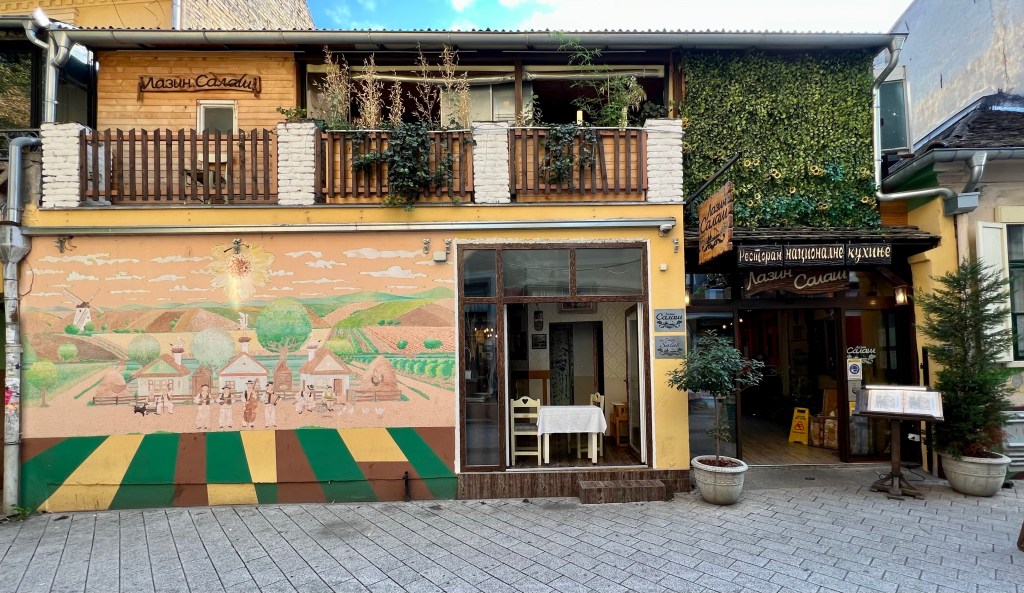
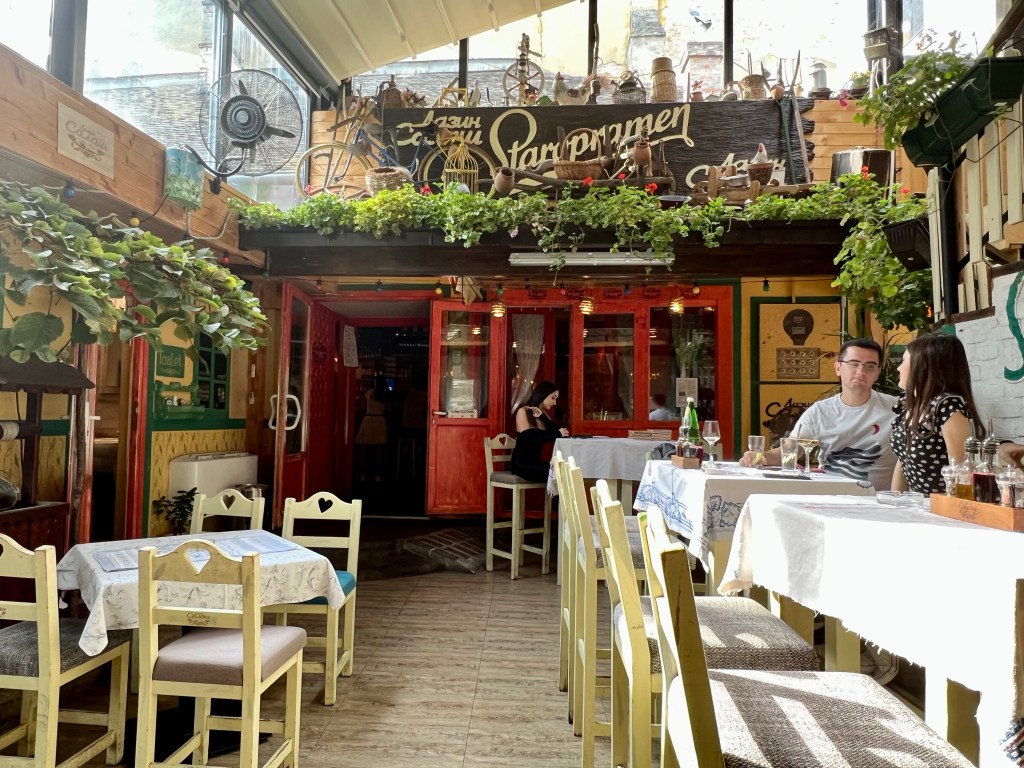
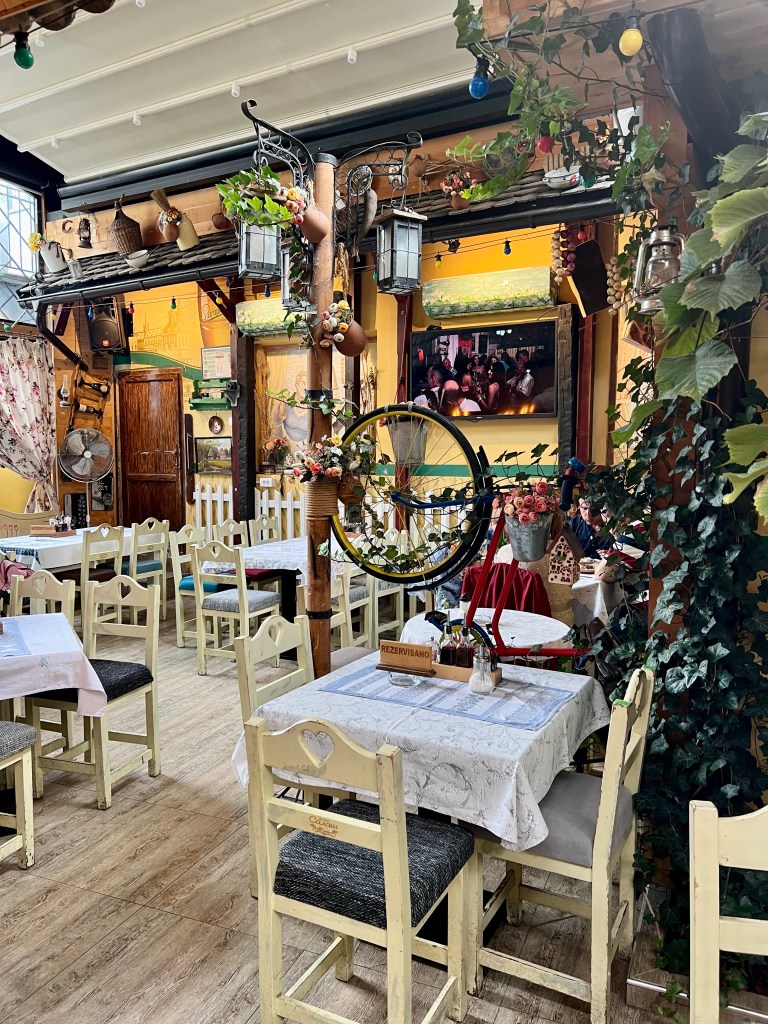
Time to head over to the restaurant which was quite cute and cosy. I wasn’t too hungry so I ordered a cheese plate boasting a variety of cheeses which ended up being enough for four. Many others had either the local sopska salad of fragrant tomatoes, cucumber and onion topped with a generous amount of a local salty cheese reminiscent of feta but made from cow’s milk, beef goulash – a fragrant thick stew served on a bed of mashed potatoes or deep fried pork roulades served with fries.

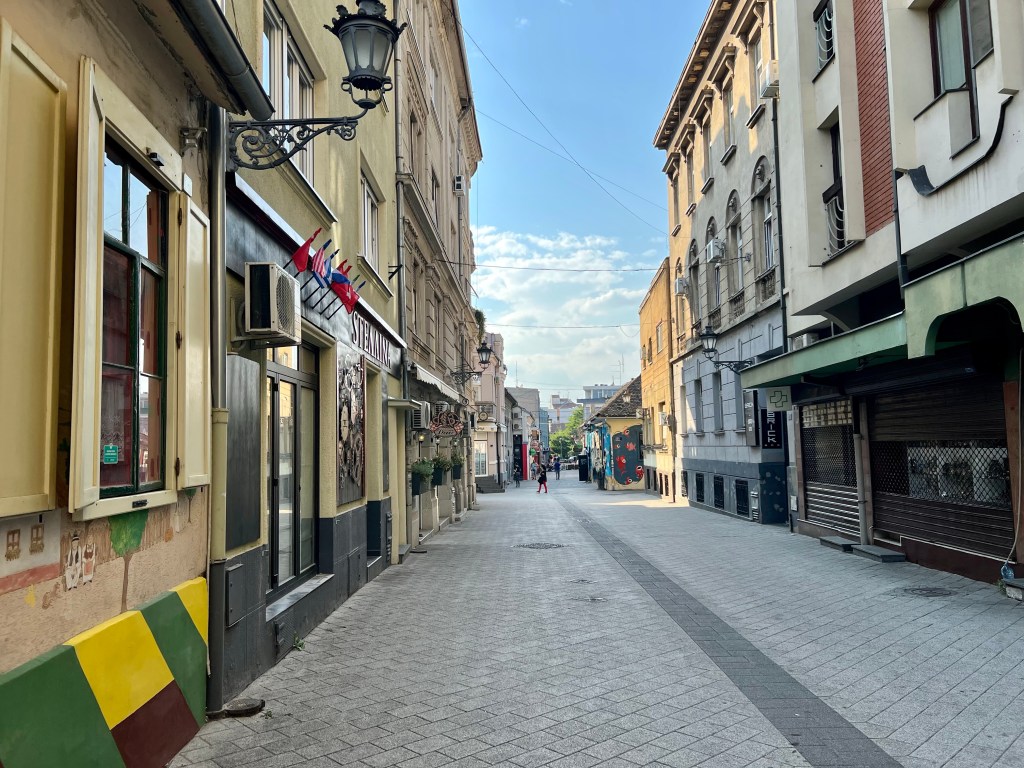
Side Street in Novy Sad

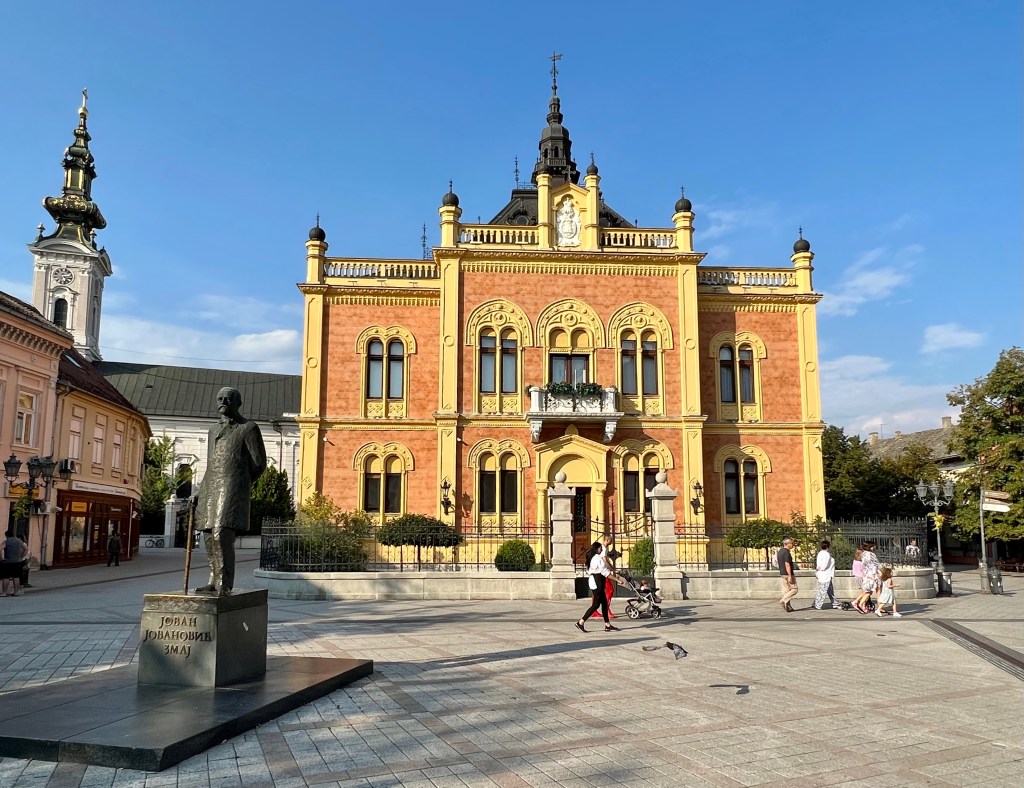
Next we head out to walk off some of our lunch with a brief orientation walk. First stop was the imposing Bishop’s Palace not far from the Serbian Orthodox Church for which the Bishop is responsible. Of interest to me is that one of the steps to become an Orthodox priest is to find a wife (for life as divorce is not recognized) and get married.

Bishop’s Palace

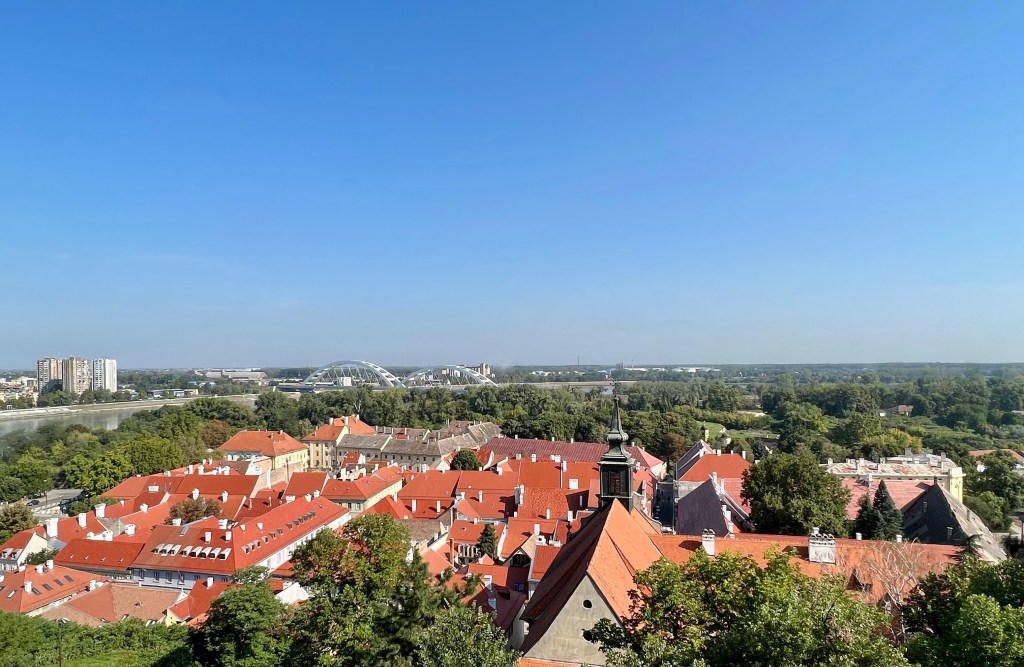
We continued our walk down to the banks of the Danube to catch a view of the the Petrovaradin Fortress perched atop the opposite bank. While there, Filip told us a bit about the 1999 NATO bombing of Yugoslavia which had a significant impact on Novy Sad.

According to NATO press releases, the bombing targeted oil refineries, roads, bridges, and telecommunications relay stations, facilities which had military uses aimed at impairing the Yugoslav Army’s command and control structure. In reality, the NATO bombings left the city without any of its three Danube bridges, communications, water, and electricity, and severely impacted the day to day lives of residents of Novy Sad.

Ironically, at the time, the city was controlled by the local Democratic Opposition which was against the regime in Belgrade which makes it more difficult to understand why the city was targeted heavily for the events in Kosovo. A press release one year after the bombing claimed that NATO encountered complications from Yugoslav military use of civilian buildings and human shields. NATO officials have “expressed deep regret at any civilian casualties it caused”.

It took two years to restore services, with some help from British funding, one of the countries which bombed targets in the city in 1999. All three bridges have been rebuilt as of completion of the Žeželi Bridge in 2018.

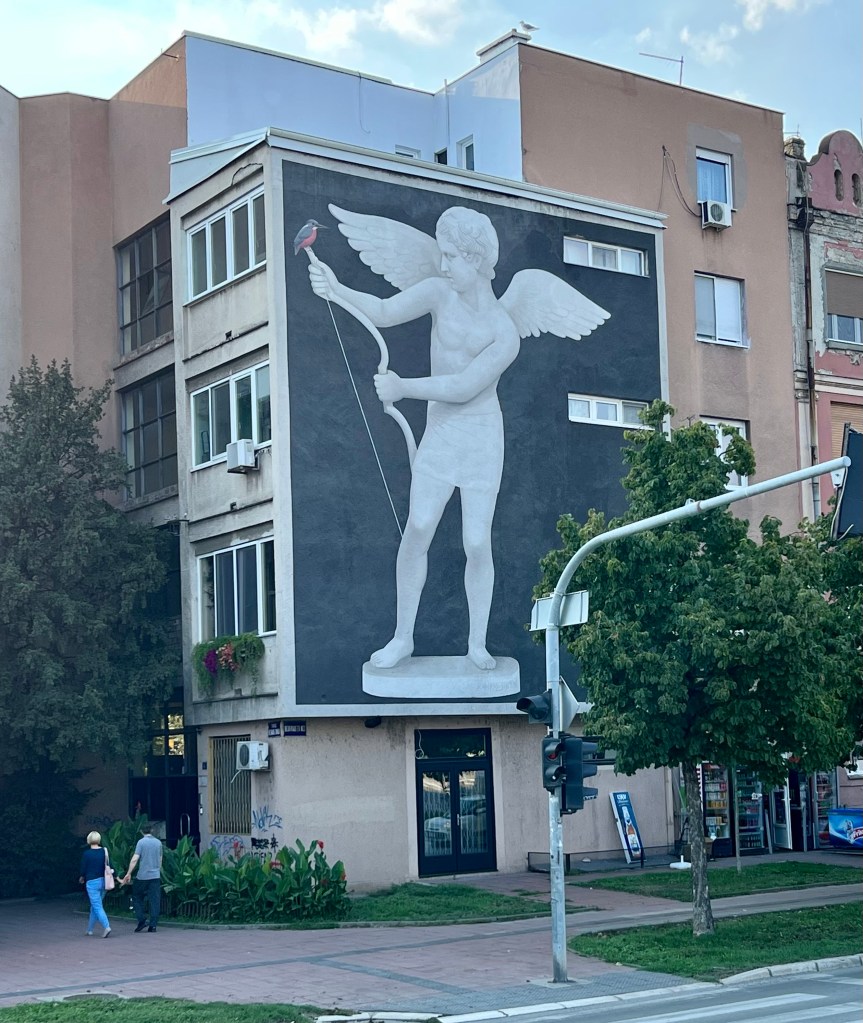
The Mural Alcyone and Eros was created by Greek artist Ficos and stands as a poignant reminder of the bombings.

Alcyone and Eros

Further along the banks of the Danube, we encountered The Family aka The Monument to the Victims of the Raid. The gaunt figures of a mother, a father, and two children symbolize the hardships of the citizenry.

The Family Monument

This memorial commemorates the lives of 1300 Serbs, Romani and Jewish civilians who lost their lives in the massacre undertaken by the Hungarian troops that occupied Novy Sad in 1942 after the Axis invasion of Yugoslavia. Victims were brought to the frozen river Danube, and then the Hungarian soldiers fired until the ice broke and their prisoners drowned.The monument also features bronze plates listing the names of all the victims.

Names of some of the Victims of the Raid
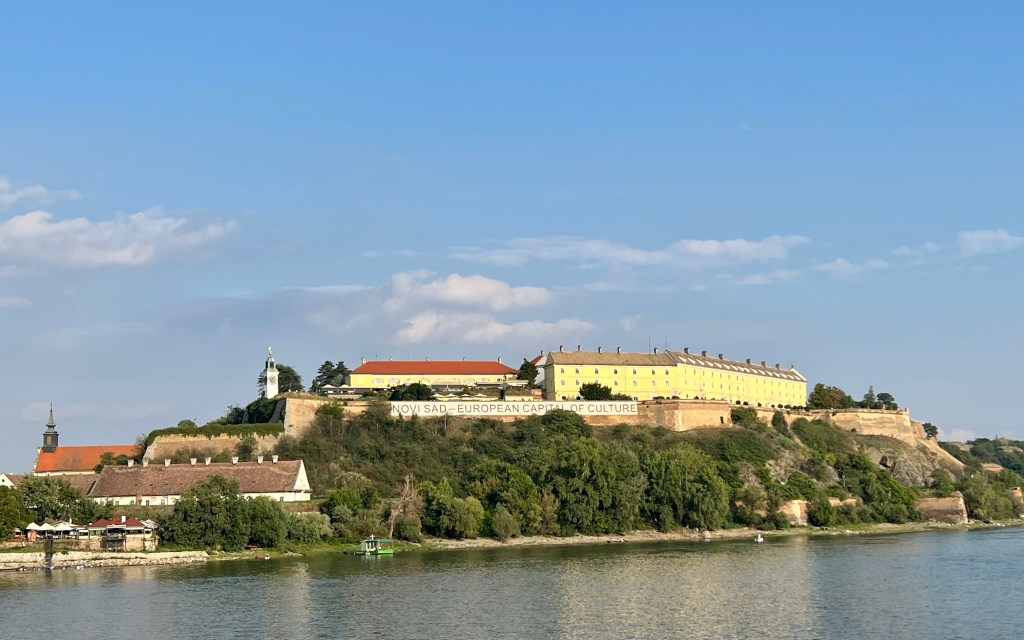
Petrovaradin Fortress

Our orientation walk ended here and most of the group headed back to the hotel. Linda, Jen (Philadelphia), Birte (Berlin) and I decided to continue along the banks of the Danube to check out the Strand which is purported to be the largest and most beautiful beach on the Danube. Unfortunately, I cannot confirm this as the entire area was surrounded by large fences and we didn’t feel like paying the modest entry fee to take a look. Lol, at least it was a beautiful day and the extra steps helped to burn off some of our generously portioned lunch!

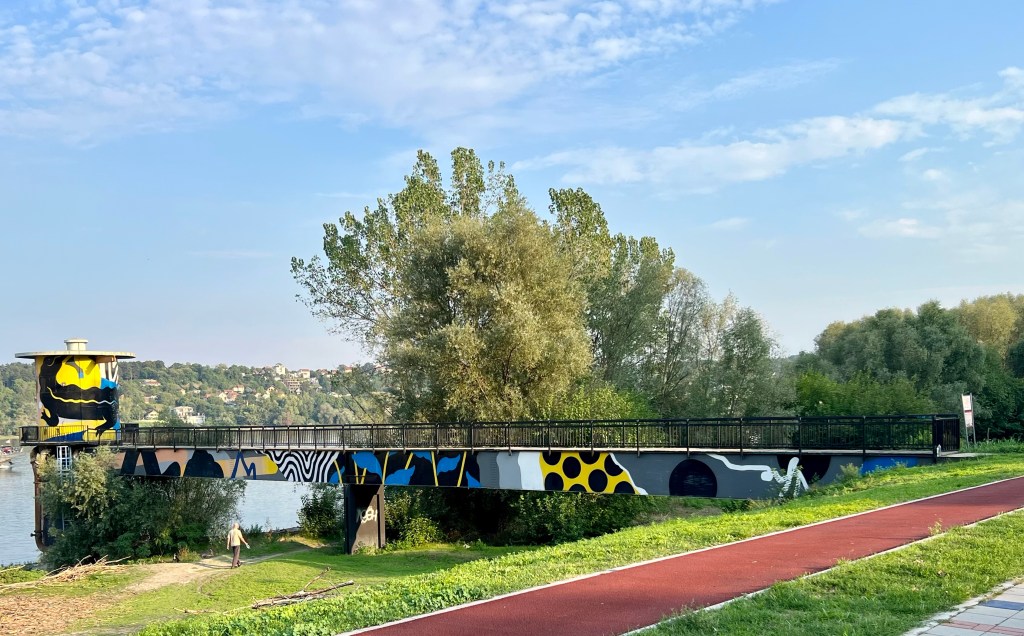
Art installation on the bank of the Danube

Soon enough we reached the new bridge and looped back into town with a quick stop at the Novy Sad Synagogue and Jewish School along the way. The complex is built in recession style with facades of yellow clinker brick, with the façade of the synagogue being more decorative. In 1944, the synagogue was an assembly place for Jews who would later be deported to the death camps.

Novy Sad Synagogue

Soon enough we were back at the hotel and thirsty from our endeavours. Linda, Jen and I grabbed a table at a beautiful café across from Liberty Square where we had a few glasses of chilled, refreshing rosé. A number of the crew popped in for a visit while we were “stationed” there. Time to hit the sheets.

Tomorrow is another day. Adventures await …
September 5, 2022

This morning Filip is leading an exploration of the Petrovaradin Fortress located on the right bank of the Danube river; nicknamed the “Gibratar on the Danube”. After breakfast, the bulk of the group heads off on foot while a few others take a cab to the Fortress awaiting their arrival. While waiting for the walkers to arrive, I took a few pics of the site.

Toute le gang

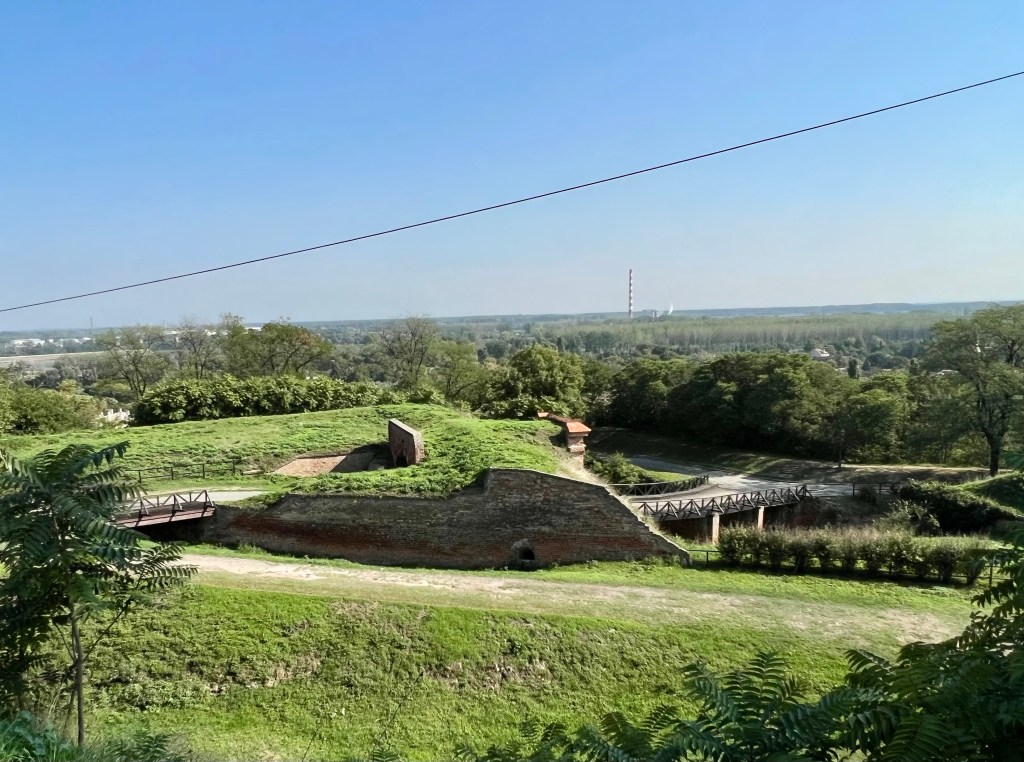
The Fortress lies on a largish hill with views of the surrounding countryside and has been inhabited for a very long time. In the First century BC, Celtic tribes had an installation on the hill followed by the Romans. Starting in the 1300s, the Ottomans would come to try to conquer Europe every fifty years or so. Inevitably they would fail to defeat the Austro-Hungarian empire. The fortress would be burned and rebuilt whence next the Ottomans arrived.

The cornerstone of the present-day southern part of the fortress was laid on 18 October 1692 Charles Eugène de Cröy and the fortress was operational by 1697. The current fortress is star-shaped with many levels in between the high walls providing two lines of defence that were virtually impenetrable. The Fortress has a maze of tunnels underneath. Monday the museum is closed so we didn’t get to explore the portion of the tunnel that remains intact.

The white clock tower is one of the most significant visual symbols of Novy Sad and the Petrovaradin Fortress. This baroque tower has black dials with a Roman numerals on all four sides. Fun fact – the big hand on the clock shows the hours and the small one shows minutes, so the sailors on the river Danube can see what time is it from a greater distance. This was also important for the guards of the fortress when hours were more important than minutes in respect to their shifts.

White clock tower with reversed hands (we were there mid morning)

The Fortress is also home to the Exit Festival; a summer music festival held each year in early July.It started not as a music festival but as protest by students who had lived under sanctions for too long. In 1998, students decided to have some fun and put on a “festival” featuring theatrical shows, music and art that continued that whole summer. It was dubbed the “State of Exit”. The official Exit Festival was founded in 2000 and is recognized as one of the Best Major Festivals in Europe boasting 45-50 Stages and around 50,000 spectators.

The Fortress tour was complete so everyone headed back to the other side of the Danube to grab a quick lunch, do a bit of shopping or have some liquid refreshments before grabbing our luggage and boarding our van (this one was a bit smaller but luckily the luggage and people all fit) for the 90 km drive to the Serbian capital of Belgrade.

In Belgrade, it’s off the bus, check in, freshen up and then head back to the lobby to meet our guide for this afternoon’s walking tour of the city to learn more about the history of Serbia’s capital with Milan; a PhD student and local resident expert.

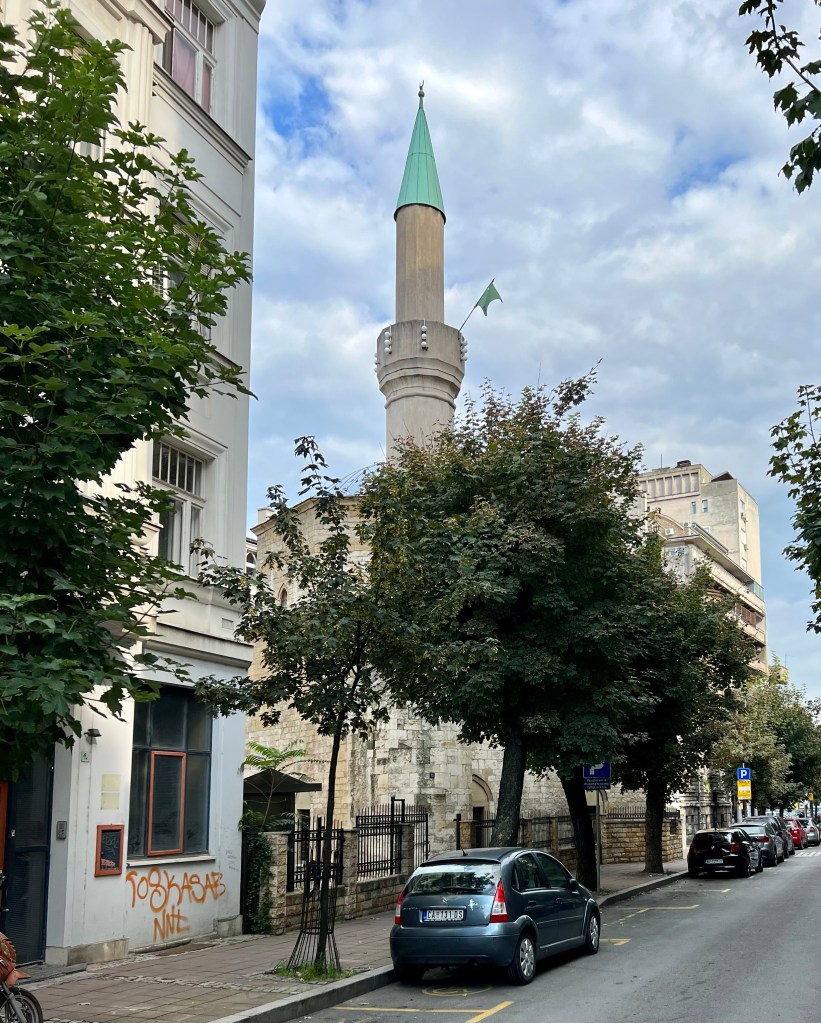
Our first stop is the Barjakli (Flag) Mosque; the largest religious artifact in Belgrade. This Mosque is the largest and oldest in Belgrade; dating back to the 16th Century when it was built by the Ottoman Sultan Suleiman at the center of the city. Belgrade was home to as many as 62 mosques at the peak of the occupation. There was no effort to convert the citizenry to Islam as taxes were paid by non-Muslims.

Barjakli (Flag) Mosque

The Mosque has served many purposes over the years. When the city was invaded by the Austro-Hungarian Empire, it served as a Roman Catholic Church. Later it was a barracks for soldiers and, finally, a warehouse. In 1868, the Serbian Prince officially recognized Islam as a religion in Serbia and prohibited the use of this Mosque for anything other than its originally intended purpose. Additionally, the government provided funding for the Mosque annually which meant that while many of the other (smaller) mosques fell into disrepair and were torn down and replaced with other buildings, the Barjakli Mosque flourished.

The Mosque was heavily damaged in 1944 during the Nazi’s retreat from Belgrade but it was restored even though Yugoslavia was Communist at the time. The Mosque later survived destruction at the hands of the Albanians with the help of their neighbours from the Jewish and Serbian Orthodox communities.

The Barjakli Mosque is called the Flag Mosque as it sets the time and date for other mosques, more or less the Belgrade Muslim equivalent of Greenwich Mean Time.

We walked a bit to a local park and were treated to some of the history and reasons for the break up of the former Yugoslavia. Milan’s informed opinion is that religious differences were not the catalyst for the war. Rather, he listed a number of forces, happening at the same time, that destroyed the peace.

First and foremost was the death of Tito and the leadership vacuum left when he was not replaced for 11 years! Wow, can you imagine a state being headless for that long and surviving?! Another important factor was the need for reforms to the Communist regime that were resisted by the diehard communists. All of this was exacerbated by the economic crisis of 1982 with no solutions on the horizon.

These three factors caused friction between the Serbians and the Croatians but even then the situation could have been calmed if there was one solid leader in place. Instead, there were three lunatics (Milan’s word) hungry for power. To make things worse, no one, including the international community, wanted Yugoslavia to exist anymore so various members of the international community not only armed the different factions but refused aid money to Yugoslavian states that were not independent. Pretty much a recipe for what happened.

Milan gave use a very detailed history lesson that I’ll try a distill to the most interesting/important bits. If you’re not a history buff, skip ahead!

The area was first populated 7500-8000 years ago. The first inhabitants were excellent tradesmen and lived in urbanized settlements in thermoinsulated huts with central heating (clay furnace in the middle which heated clay floors). Everything ended abruptly likely with some catastrophic event but details are unknown. The Celts were the next to arrive in the 4th century BC, driven here by Alexander the Great. The Romans were next and posted a Legion here leaving behind Roman baths, temples (Jupiter and Jicata?) and, of course, a fortress. Seventeen Roman emperors came form this area; second only to Italy. Constantine was the most famous. In the 4th Century, the Visigoths arrived followed by Attila the Hun who destroyed the city and then the Slavs arrived.

Belgrade became part of Serbia when it was gifted to a Serbian King who married a Hungarian Princess in honour of their marriage. Later it was gifted to a Serbian despot. In both these cases, Belgrade reverted to Hungary on their deaths.

The Ottomans and Austro-Hungarian Empire played ping pong with Belgrade for centuries after which the Serbians arrived. Yugoslavia was created after WWI and after being occupied by the Germans for much of WWII, the Russian liberators arrived on their way to Berlin.

The Belgrade fortress, built on a white ridge above the confluence Sava and Danube rivers, destroyed and rebuilt over and over for 16 centuries, still stands as the symbol of Serbia’s capital. The Romans built the first fortification in the 2nd century and later it was home to the Roman legion IV Flaviae which protected the area.

Today the Belgrade fortress comprises of Upper and Lower Town and the vast field in front the very fortress that Turks named “Kalemegdan”, joining the words “kale”, which means city, fortress and “megdan”, the Turkish word for field. The most beautiful and most spacious park in nation’s capital once used to be a field where battles were fought.

Leopold’s Gate is situated in Starrenberg’s Bastion. Both the gate and the Bastion were built during the First Austrian occupation, between 1688 and 1690 and the gate’s baroque facade was finished during their second rule over the town, from 1728 to 1721.

Leopold’s Gate in Starrenberg’s Bastion

The Fortress reflects the various conquerors; the darker part on the bottom remains from the Roman occupation, Ottomans added a level during their time and then a third brick layer was added by the Austrians.

Another “brick” in the wall

The Serbian Orthodox Church in the Fortress was built in 1924 and is called the Army Church. The interior boasts trench art in the form of chandeliers made from cannons, bayonets and bullet cases. I had intended to check this out the next day but didn’t make it so found a few pics on the internet to share.

Army Church

The view of the city from the walls of the Fortress is breathtaking.

Where Danube and Sava Rivers Meet
Despot Gate built 1401-1427.

Also at the Fortress/Central Area of Upper Town is a Turbeh (VIP mausoleum) which contains the remains of Damat Ali Pasha who died in Novy Sad while serving as the Governor. Bad luck to destroy so this is one of the few Turkish buildings preserved in Belgrade.

Turbeh of Damat Ali Pasha

The so-called “Roman Well” was actually built in the early 18th century.

Roman Well

The King Gate with Ravelin was built towards the end of the 17th century, at a time when Belgrade repeatedly changed hands between the Austrians and the Ottomans.

King Gate

Leaving the Fortress, we strolled through the Kalemegdan park. You will see the monumental “Victor” rising above the walls of the city, the symbol of Belgrade and victory over time. The bronze sculpture of a nude man holding a pigeon and a sword, the work of sculptor Ivan Meštrović, was set on occasion of the tenth anniversary of the Salonika Front Breakthrough and “guards” the river banks.

Victor

While in the park, a young bride and groom were having their wedding pictures taken.

We walked on to the St. Michael the Archangel Serbian Orthodox Church. Was built in gothic style to give the finger to Ottomans in the nearby Fortress. Famous folks are buried inside and outside the church so it’s the main Orthodox Church in Belgrade with the Patriarchy across the street.

St. Michael the Archangel Serbian Orthodox Church

Nearby is Princess Ljubica’s Residence Palace; the former home of a Princess who shot two of her philandering husband’s mistresses, killing one and wounding the other before he thought it would be a good idea to take up residence elsewhere.

We had dinner at the ? Restaurant; the oldest functioning tavern in Belgrade. Originally named after the church which was not allowed so he removed the name. Unable to come up with a unique name – there we 600 + taverns in the city at the time, he used a ? and waited for a unique name to come to him. Here, I finally tried Sopska Salad and Beef Goulash washed down with some lovely Serbian wine. Yumm.

? Pub

Stopped on way back to hotel with Linda and a few other folks for another glass of wine before calling it a night. More tomorrow. Adventures await …

September 6, 2022

Today we have a full day to explore Belgrade on our own and at our own pace. After a nice breakfast, we met with Filip to get some recommendations on attractions around the city. Armed with a map with a suggested route outlined in highlighter, I headed back to my room to do a bit of work on my Budapest post (while we were in a hotel with better internet) and relax for a bit. Linda and many of the others headed out to start their explorations right away so I’d be on my own. A dangerous situation for someone as directionally challenged and easily distracted as I often am but I’ve got the hotel card in my wallet for emergency cab rides so it should be safe enough.

I headed out around noon, armed with the map and had fairly good luck for the first half of the loop.

Republic Square is the site of some of Belgrade’s most recognizable public buildings, including the National Museum, the National Theatre and the statue of Prince Michael.

The National Museum of Serbia is the largest and oldest museum in Belgrade; founded in 1844. The National Museum is focused on Serbian history and art; featuring artifacts and artwork highlighting the country’s history and artistic development. The National Theatre was founded in the later half of the 19th century and is the epicentre of culture and history of Serbia

National Museum of Serbia

The Prince Mihailo Monument was erected in 1882 in honor of the liberation of Belgrade from Turks. Prince Mihailo Obrenović III of Serbia was the ruling Prince of Serbia from 1839 to 1842 and again from 1860 to 1868. His first reign ended when he was deposed in 1842, and his second when he was assassinated in 1868. He is considered to be a great reformer and the most enlightened ruler of modern Serbia.

Prince Mihailo Monument
Cool street art

The National Parliament of Serbia, located on Nikola Pašic Square, is the seat of the National Assembly of Serbia. Between its completion in 1936 and 2006, it was the seat of both the Parliament of Yugoslavia and the Parliament of Serbia and Montenegro.

National Parliament of Serbia

Passing parliament there was a brisk business selling schools books out of the trunks of cars and, in the case of these guys, a van organized like a library.

Selling books in front of parliament

St. Mark’s Church is a Serbian Orthodox church located in Tašmajdan park near the Parliament. It was built in the Serbo-Byzantine style by the Krstić brothers, completed in 1940, on the site of a previous church dating back to 1835.

St Mark’ Serbian Orthodox Church

The small Russian Orthodox Church of the Holy Trinity is tucked away behind St. Mark’s.

Russian Orthodox Church of the Holy Trinity

Close to the church is the beautiful Tašmajdan Park dedicated to the children that that

Memorial to Children killed in NATO booming of Serbia

Nikola Tesla was a Serbian-American inventor, electrical engineer, mechanical engineer, and futurist best known for his contributions to the design of the modern alternating current electricity supply system. The Nikola Tesla Museum, dedicated to honoring and displaying the life and work of Nikola Tesla as well as his final resting place, was on Filip’s list but I decided to keep walking.

The next stop was the Temple of Saint Sava; the largest Serbian Orthodox church and by its volume, the largest Orthodox church in the world. It was erected on the location considered to be the place where Koca Sinan Pasha burned the relics of Saint Sava, founder of the Serbian Orthodox church in 1594.

Temple of Saint Sava

The Temple was built in Serbian-Byzantine style, with four 44 meter high bell towers. This church is a prominent landmark on, the Belgrade horizon and visible from all access roads into the city. Hell, even I could find it!

The ornately decorated church can accommodate 10,000, and has three choir galleries which can accommodate 700 choir members each. Beneath the temple floor, is a multi-purpose underground level where the treasury and patriarch’s crypt, as well as the mausoleum of St. Prince Lazar are located.

The Monument to Karadjordje; a bronze sculpture was erected in 1979 in front of the National Library of Serbia and Saint Sava Church in memory of the great leader of the First Serbian Uprising.

The Milankovitch Climate Change Centre occupies the former Serbian Observatory built in 1891 for meteorological and astronomical observations.

Milankovitch Climate Change Centre

I thought I was still following the map, though I did pass through the hospital zone, until I arrived at Canadian Embassy. Always lovely to see the cheery maple leaf but I knew I was waaay off base.

Canadian Embassy – not on the proposed itinerary!

Sure enough I stopped in a pharmacy and the woman was aghast when I asked for directions to Hotel Moscow! She recommended a bus but I decided it was safer to take a cab. That hotel card did come in handy, lol!

On the way, we passed the Hotel Moscow (Hotel Mockba); opened in 1908 and inaugurated by King Petar I Karadjordjevic it outlived two World Wars, eight state systems and became a prominent symbol of Belgrade. Here’s a pic courtesy of Linda!

Hotel Mockba

After a bit of a relax, we headed out to Skadarlija aka the Bohemian Quarter for dinner at one of the restaurants recommended by Filip; Dva Jelena (Two Deer).

I opted for a sopska salad followed by venison goulash and fettuccine in a walnut sauce with the house bread fragrant with garlic as a welcome addition. Dinner was washed down with a liberal quantity of local wine recommended by the waiter. Prokupac is a red wine grape variety indigenous to the former Yugoslavian states, including Serbia. Sadly, this tasty varietal remains largely unknown outside of the area.

During and after our meal we were serenaded by local musicians which are ubiquitous in the evenings in this neighbourhood. Sated, we headed back to the hotel.

The Band!

Tomorrow is an early day. Adventures await …

On The Road Again – Bumbling Through Budapest

After a couple of months in Canada, I’m headed off on another adventure across the pond. This time, Linda Morrison, my favourite Macdonald College bartender, fellow student and former boss is my travelling companion. Our first stop is Budapest for a few days before joining a G Adventures tour of the Balkans and Croatia.

August 30/31, 2022 – Travel Day

The trip started out great. I managed to use my Aeroplan eupgrade credits to upgrade the first two legs of the trip including the flight across the pond – so yay Air Canada! I do love a champagne starter for trips to Europe; makes travelling feel like the celebration that it should be. So, of course, I had a couple glasses to start my adventure! Just as important, our flights were basically on time and our bags arrived at our destination on the same plane as us! All good!!

After picking up said bags, we grabbed a Mini Bud shuttle to the hotel which turned out to be not only a cost effective but a very convenient door to door service. After getting our reservation cleared up with the desk clerk, we headed to the room for a well deserved nap.

When we surfaced, we went out for a quick walk around the ‘hood, passing through Jokai Park and checking out the Hungarian Opera House, before heading to dinner at a local Hungarian restaurant recommended by the hotel.

Mór Jókai, famous Hungarian novelist and supporter of the 1848 revolution in Pest
Gyula Haranagozó, Hungarian dancer, choreographer and ballet master
Miklós Radnóti, Hungarian teacher and poet murdered in the Holocaust
Monument to Géza Hofi – Dance Macabre

The food was tasty and filling; Linda had a beef stew with spatszle and I had a chicken dish with rice, both washed down with a liberal amount of sparkling water though I did have a glass of local red for good measure as well. Back to the hotel to catch up on our sleep. Tomorrow is another day. Adventures await …
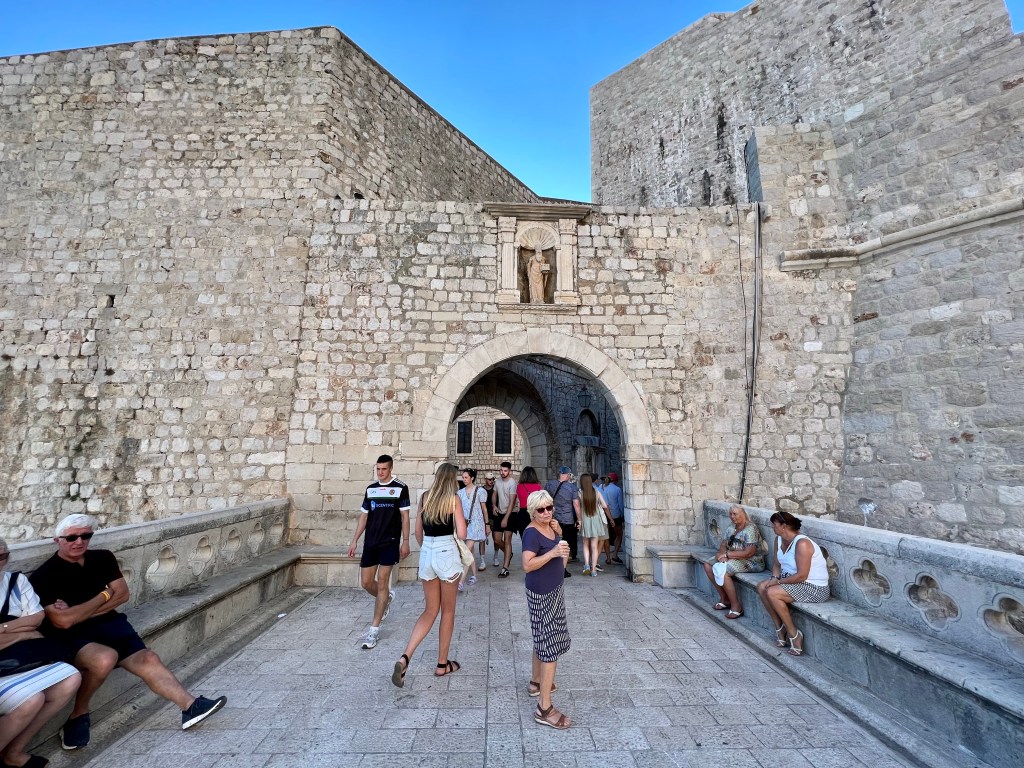
September 1, 2022

Our first full day in Budapest was a bit cloudy with a risk of showers so after a nice breakfast at the sister hotel, we packed our rain gear and headed off on a mission to buy tickets for the Hop On Hop Off Bus. We negotiated a three day pass for the price of two and thought we’d gotten a great deal until we met a lady from the US a few days later who had managed to get a three day pass for the price of a one day pass. Lol, the $7 difference probably won’t change our lives!

We hopped on the bus at the stop across from the Opera House and over the next hour and a bit got a good overview of the sights on both the Buda and Pest sides for future consideration.

View of the Hungarian Parliament Building from the bus, more later …

We opted to get off the bus at St. Stephen’s Basilica for our first in-depth exploration.

St. Stephen’s Basilica/Szent István-bazilika

Eventually, we found the ticket office and had a chance to walk through this amazing structure. There were hundreds of seats set up in the squares surrounding the church that I originally thought were for the organ recital the next day but as we later discovered were actually for a special mass for children starting school.

St. Stephen’s Basilica/Szent István-bazilika is named in honour of Stephen the first King of Hungary, (975-1038) whose incorruptible right hand is housed in the reliquary; that’s another story. The Basilica is the third largest church in Hungary and can accommodate 8000 people.

Standing 96 meters high, it is one of the two tallest buildings in Budapest; equaled only by the Hungarian Parliament Building. These two buildings are the same height intentionally; symbolizing that worldly and spiritual thinking have the same importance. Regulations prohibit the construction of any building taller than 96 metres in the downtown core.

The Basilica took 54 years to build mainly because the first two of three main architects responsible for the design died before their visions were realized and the new architects kept changing the plans to suit their taste. This not only resulted in delays but in structural issues with the building that lead to the total collapse of the dome.

The Basilica is richly decorated with sculptures, paintings and stained glass and boasts a beautiful altar and pipe organ. After snapping a plethora of pics and lighting a candle for my dear old Dad, we headed off to figure where the free walking tour I’d booked was going to start at 2:30.

We found the Sisi Statue across from Deák Ferenc Square with relative ease so used our spare time to explore the area. Along the way we spotted lots of interesting street art with the requisite pics.

On our travels, we passed some interesting street art before arriving at the the Carl Lutz Memorial. Carl Lutz, a Swiss diplomat, saved an estimated 60,000 Hungarian Jews during the Holocaust. As Vice-Consul at the Swiss Embassy of Budapest, he issued protective documents and placed more than 70 buildings under foreign jurisdiction to keep the Nazis away. The bronze memorial honoring Lutz shows an angel descending to help a fallen victim. “Whoever saves a life is considered to have saved an entire world,” reads the caption.

Carl Lutz Memorial

When no guide had arrived by 2:20, I looked at the email again and figured out the tour had actually started at 12:00 and would be 2:30 hours long! Lol, tomorrow is another day! Rather than hang out in the area, we opted to hop on the bus and head to Heroes’ Square at the end of Andrássy Avenue, Budapest’s Champs-Élysées.

Heroes’ Square is one of the major squares in Budapest and home of the iconic Millennium Monument. Construction of the monument began in 1896 to commemorate the thousandth anniversary of the Hungarian conquest of the Carpathian Basin and the foundation of the Hungarian state in 896.

Millennium Monument

The centrepiece of this fabulous Monument is a column depicting the Seven Chieftains of the Magyars lead by Árpád (considered to be the founder of the Hungarian nation). The column is topped by Archangel Gabriel who is holding the Holy Crown of St. Stephen (first King of Hungary) and the apostolic double cross (a symbol awarded to St. Stephen by the Pope in recognition of his efforts to convert Hungary to Christianity) in his hands.

At the front of the monument is the Memorial Stone of Heroes, a large stone cenotaph surrounded by an ornamental iron chain, dedicated “To the memory of the heroes who gave their lives for the freedom of our people and our national independence.” The Memorial Stone of Heroes was originally erected in 1929 but was removed in 1951 as its message was politically unacceptable to the Communist regime. The current cenotaph was built on the same spot in 1956.

The back of the monument consists of two matched colonnades, each with seven statues representing great figures of Hungarian history. Topping the outer (left) edge of the left colonnade is a statue of a man with a scythe and a woman sowing seed, representing Labour and Wealth.

At the inner (right) end of the left colonnade, is a male figure driving a chariot using a snake as a whip and representing War. At the inner (right) end of the right colonnade is a female figure in a chariot holding a palm frond representing Peace. At the outer (left) end of the right colonnade is a double statue of a man holding a small golden statue and a woman with a palm frond, representing Knowledge and Glory.

The Square also hosts the Museum of Fine Arts and the Palace of Art.

Museum of Fine Arts

After checking out the heroes of the Hungarian people, we continued our explorations and ended up in City Park. City Park is a favorite park in Budapest, and there is something for everyone.

We walk toward Vajdahunyad Castle at the Heroes’ Square end of the park.

City Park

This dream-like structure was constructed for the 1896 Millennial Exhibition and is a mixture of several architectural styles (you can’t find two similar style turrets). The Castle Houses the Museum of Agriculture; appropriate for two Aggies.

Wandering through City Park we encountered numerous interesting installations, some which are captured below.

Tourism is thirsty work so we headed back down Andrássy Avenue, this time on foot, to find a nice spot to have a glass of wine or two and a snack since our breakfast was only a faint memory. En route we passed several embassies that had formerly been palaces and a statue or two. Lol, the Hungarians really love their statues and some are really quite beautiful while others are just weird.

One notable stop on this grandiose avenue is the House of Terror. In front of the building, where tales of patriots that were tortured and murdered are brought into the light, there is an installation representing the iron curtain and a piece of the former Berlin Wall erected in Budapest in 2010 on the 21st anniversary of the fall of the Berlin Wall.

Soon enough, we arrived at Jokai Square and went in search of a cafe or restaurant with comfortable chairs serving wine and lighter fare. In the end we decided that comfortable chairs was the most important criteria and we shared a Margarita Pizza and a cold, refreshing bottle of Rosé in cushy comfort. Fortified, we made it back to the hotel for a few hours before heading out for dinner.

In keeping with how the day was going, we had decided on a ”nearby” Turkish restaurant that ended up being cafeteria-style so we headed back to an Indian restaurant across the road from where we’d eaten the night before. The Indian fare was fabulous and well-deserved after walking more than 17 km during the day. Back to the hotel to chill for a bit, rebook the walking tour for tomorrow and an earlyish night while our bodies adapt to the European time zone. Tomorrow is another day. Adventures await …
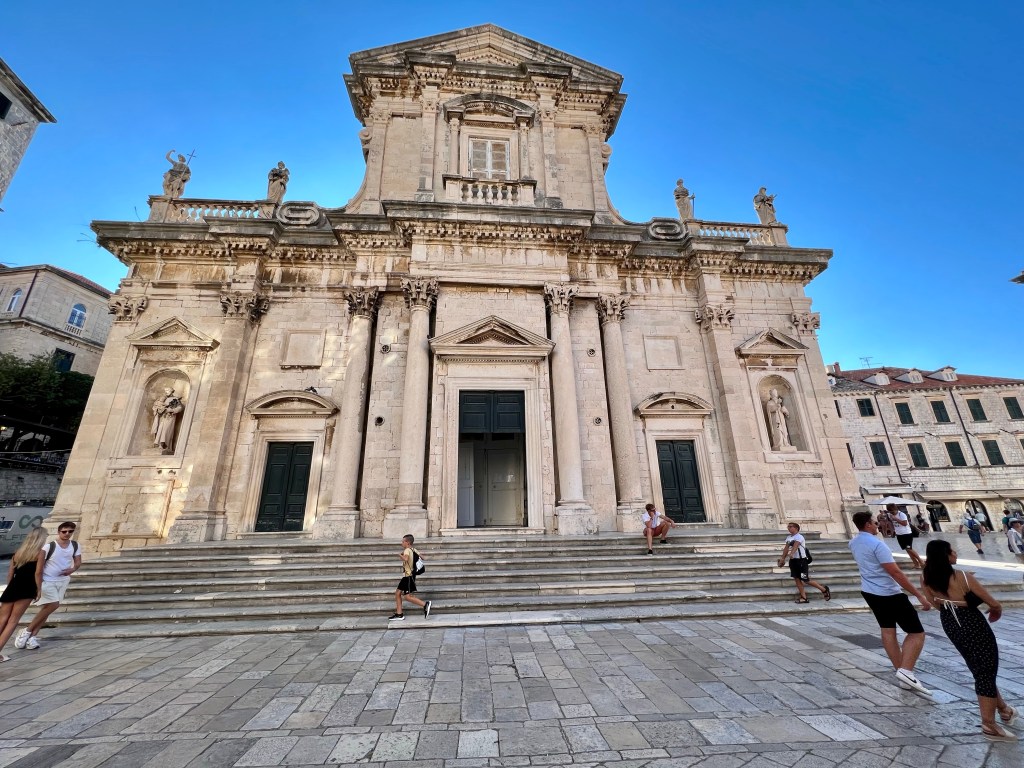
September 2, 2022

After a good breakfast, we hit the bricks with a great plan. As the saying goes, (wo)Man plans and God laughs so let’s say from the outset that the day didn’t go as expected. Lol, when does it ever! We did get off to a good start though and arrived at the Hungarian Parliament Building without any trouble.

The Hungarian Parliament Building, situated in Kossuth Square on the eastern bank of the Danube on the Pest side, is the seat of the National Assembly of Hungary. We had thought to go on a tour but apparently so did all the other tourists in Budapest so we only managed to wander the grounds and have a bio break while we were there. We really didn’t want to miss the walking tour two days in a row so we were quite conscious of time.

Backside of the Hungarian Parliament Building

Budapest was formed through the union of three cities in 1873, namely Buda, Óbuda and Pest. The decision was made to establish a new, representative parliament building, expressing the sovereignty of the nation. An international competition was held, with Imre Steindl as the victor. Construction from the winning plan was started in 1885, and the building was inaugurated on the 1000th anniversary of the country in 1896. Plans submitted by two other competitors were later used to construct the Ethnographic Museum and the Hungarian Ministry of Agriculture; both of which face the Parliament Building.

The Parliament Building is built in the Gothic Revival style and has a symmetrical façade with a central dome. It has been the largest building in Hungary since its completion (96 metres high and two metres longer than British parliament). In fact, it is also the third largest assembly building in the world, after the Parliament of Romania and the National Congress of Argentina.

After wandering around the grounds, and snapping lots of pics of the various monuments, we headed to the Sisi statue once again though for the 12:00 start time.

We met our guide Zoli there and spent an entertaining 2.5 hours touring the downtown being regaled with tidbits of Hungarian history mainly focussed on Budapest.

Sisi Statue

The original Hungarians were nomads in Ural Mountains who wandered into the Carpathian basin in 400 AD. The Empire of Huns were here before they arrived and even when they left the name stuck and everyone calls them Hungarians though they refer to themselves as Magyars.

In 896 AD, the chiefs of seven tribes symbolically entered into a blood brotherhood and through sworn allegiance Hungary became one nation. The numbers 896 have great significance which is why both the Basilica and Parliament Buildings are 96 metres tall.

When Hungary was “founded”, the inhabitants weren’t Christians. Steven asked the pope for a crown and worked hard to earn it by converting the pagans to Christianity. He had no heir and offered the kingdom to the church; specifically the Virgin Mary though in the end Hungary was ruled by his nephew. Not long after he died, his remains were dug up and body parts were sent to various churches across Hungary. His right hand is in the basilica.

Our first stop was St. Stephen’s Basilica which we had toured yesterday.

St. Stephen’s Basilica
Statue of a Magyar Policeman along the way. Looks like people were rubbing his belly for luck. Not a thing according to Zoli.

Next we headed to Renduletenul square to see the beautiful monument there funded by donations including one coin embedded in the statue that was donated by a poor peasant who gave her last coin to the enterprise.

Off to the banks of the Danube to gaze across at Buda Castle and the beautiful Church and fisherman’s bastion with seven towers representing the original seven tribes.

Zoli extolling the beauty of Buda Castle

Continuing our walk along the banks of the Danube, we come across the Little Princess Statue sitting on the railings of the Danube promenade. The statue was inspired by the sculptor’s eldest daughter who often played dress up wearing a princess costume, a crown made out of newspaper by her father with her bathrobe as a mantle. Touch both her knees for good luck and a return trip to Budapest.

Did I say there was a plethora of Street art in Budapest? well here’s a few more …

We next arrived at Széchenyi Square; named after Count Istvan Szechenyi, a Hungarian politician, political theorist, and writer. He is widely considered one of the greatest statesmen in his nation’s history, and, within Hungary he is known to many as “the Greatest Hungarian”. The Square is located on the Pest side, near the embankment and the historic Széchenyi Chain Bridge over the Danube River; the first permanent river crossing over the Danube. The bridge was opened in 1849 and survived assaults from both sides during the second revolution against Hapsburgs but was destroyed by the Nazis fleeing from the Soviets at the end of WWII and later rebuilt. Currently under construction and will open as a pedestrian/ bicycle bridge.

Our next stop was Liberty Square which is home to two competing memorials. The official monument is the Memorial for Victims of the German Occupation erected by the government. This monument featuring an eagle representing Germany and archangel Gabriel representing Hungary was highly controversial as it misrepresented history. Hungarians were already disadvantaging the Jews before WWII and later joined with the Germans to assist in the deportation of 437,000 Jews to extermination camps in 55 days.

“Dead” and Living Memorial for Holocaust Victims

The Living Memorial was created and currently serves a counter-monument to the Memorial to the Victims of German Occupation. People brought stones, candles, photos and personal belongings that express their feelings, and placed them in front of the cordon. The Living Memorial features photos of Jews sent to extermination camps, rocks, shoes and suitcases.

A segment of the Living Memorial

The Soviets “liberated” Hungary after WWII and stayed for 45 years. There is also Soviet monument in Liberty Square where many Russian soldiers were formerly buried. The statue was allowed to remain after separation as there are over 100,000 Hungarians buried near the River Dom in Russia and the Hungarians wanted Russians to continue to tend those graves. The statue is very close to the American Embassy so would also serve as a big f&$k you to them from the former USSR.

Soviet War Memoriall

We finished our tour at the Hungarian Parliament Building where we had started the day. After the tour, we stopped for a mid-afternoon snack and to plot out the rest of our time in Budapest. Little did we know that the synagogue would close minutes before we arrived and that the last tour of the Opera House would also have left before we arrived. We decided to buy our tickets to tour the Opera House for tomorrow to avoid disappointment again. The synagogue will have to wait for another time as the Sabbath had arrived. Hot, sweaty and aggravated we opted for more wine and, then, after a brief respite at the hotel, a burger in a local pub for dinner. Tomorrow is another day. Adventures await …
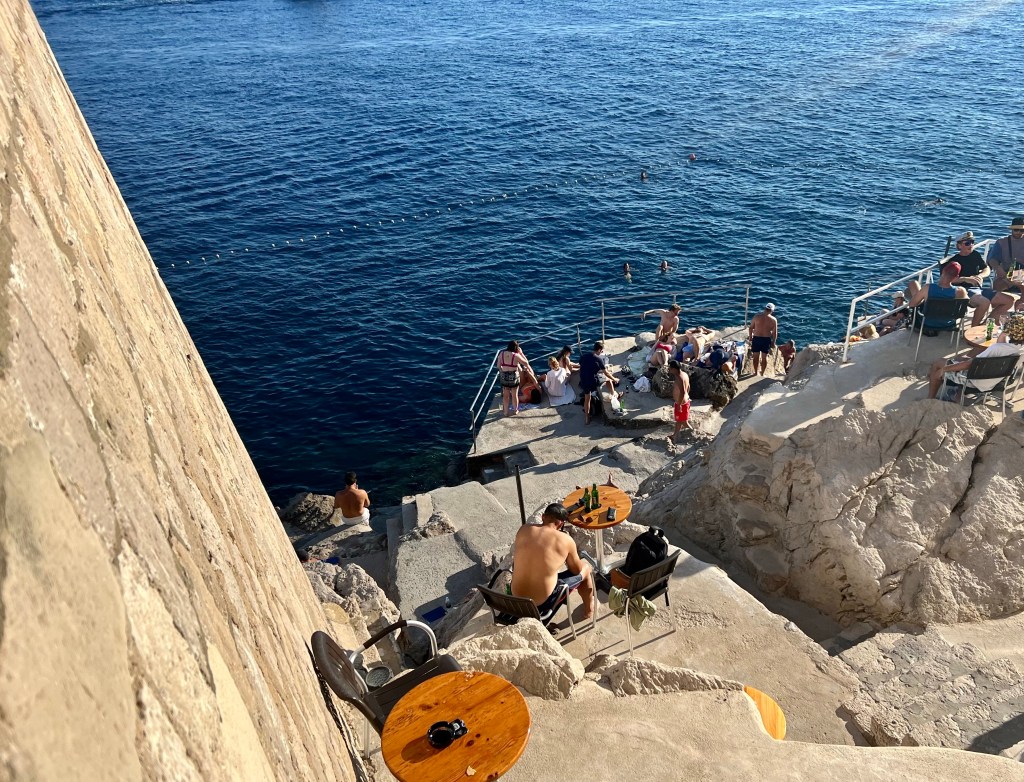
September 3, 2022

Up and at it early this morning as it’s our last day. To gain a bit of time, we grabbed a cab to the Széchenyi Bath; the largest medicinal bath in Europe. Water for the spa is supplied by two thermal springs. The palatial building features 3 outdoor and 15 indoor pools. We stuck to the outside pools as it was a beautiful sunny day. Luckily we were in an out before it became too crowded or dirty.

After dropping our wet suits and towels off at the hotel, we hoofed it to the Opera House for our tour. The magnificent building, built between 1875 and 1884, was funded largely by Emperor Franz Joseph I of Austria-Hungary with one condition, that it should not be larger than the Vienna State Opera House. When he attended the inaugural performance, he was shocked that the building was so beautiful and opined that he should have specified that the building be not only smaller but also not more beautiful.

Opera House

Wrought-iron lamps illuminate the wide stone staircase and the main entrance. Going to the opera was a great social occasion in the 19th century and still is today. The vast, sweeping staircase is an important element of the opera house as it allows ladies to show off their new gowns and jewelry. The foyer has marble columns and its vaulted ceiling is covered in murals.

Opera House Grand Staircase

The richly decorated building is considered one of the architect’s masterpieces.

Ornamentation includes paintings and sculptures by leading figures of Hungarian art. Although in size and capacity it is not among the greatest, in beauty and the quality of acoustics the Budapest Opera House is considered to be amongst the finest opera houses in the world. The main hall is horseshoe-shaped with a bronze chandelier weighing 3050 kg illuminating a fresco depicting the Greek gods on Olympus. The sumptuous interior is adorned with 2 kg of gold. The royal box is located centrally in the three-storey circle. It is decorated with sculptures symbolizing the four operatic voices – soprano, alto, tenor and bass.

According to measurements done in the 1970s by a group of international engineers – has the third best acoustics in Europe after La Scalia in Milan and the Palais Garnier in Paris.

The icing on the cake for the tour was a fifteen minute performance of two of the Opera’s principals.

Next up is the bus to Buda to grab the funicular up to Buda Castle. Buda Castle, once home of Hapsburg kings, is now the Hungarian National Gallery, the Szechenyi National Library and the Budapest History Museum.

The castle grounds had to wait as the view of the Pest side was stunning though we did find some interesting sites on the Buda side as w

Chain Bridge being restored
Hungarian Parliament Buildings
Fountain of King Matthias

After a brief tour of the castle grounds, we hopped a bus back to the hotel to meet with our tour group for a welcome meeting and then headed to Jokai Street for one last dinner in Budapest before hitting the road to Serbia. Tomorrow is another day. Adventures await …
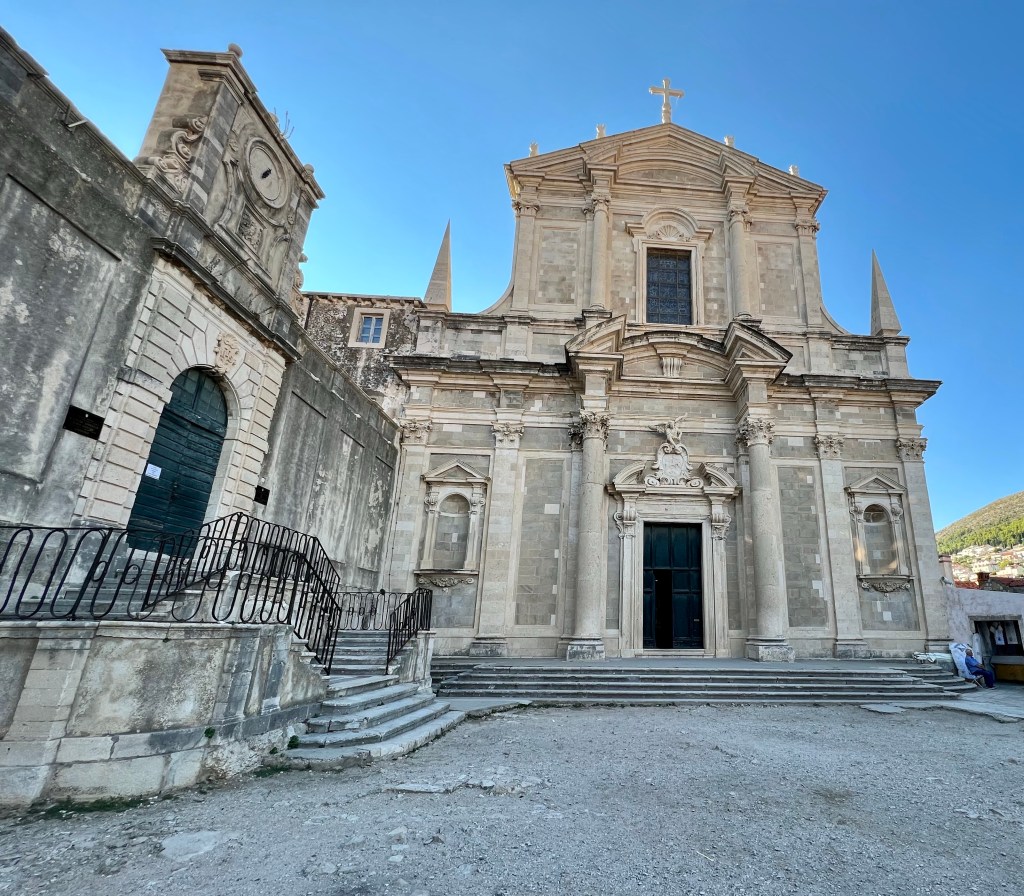
Wandering Through Northern Europe – Exploring Oslo with Ken Take 2

June 27

After a hearty breakfast at our hotel, we set off towards the Oslo Opera House to experience firsthand the stunning views from the top. 

Love the little vehicles in Europe
Similar to Amsterdam – Former residences of Jews that were murdered in the Holocaust are identified in Oslo in memorium
Kirsten Flagstad (1895–1962) was a renowned Norwegian opera singer. Her life-sized bronze statue stands in front of the Oslo Opera House.
View from the top
View from the top – She Lies
View from the top – MUNCH

It looked like rain so we headed off to our next stop the new Munch Museum and arrived just as the skies opened; our luck is holding up.

World-famous painter Edvard Munch willed all of his works still in his possession to the municipality of Oslo. With a total of 13 floors and 11 gallery spaces, the MUNCH offers a wide range of approaches to Edvard Munch and his art. The museum is one of the largest single-artist museum’s in the world and is home to 26,000 works by Edvard Munch, including 1183 paintings. I really didn’t know much about Munch other than The Scream and I was blown away by the beauty and emotion of his work. 

Vampire (1895)
Madonna (1894)
The Girls On The Bridge (1927)
The Death of Marat (1907)
Summer Night, The Voice (1896)
The Scream (1893)
Despair (1894)
Self-Portrait With A Bottle Of Wine (1906)

I especially enjoyed the Monumental exhibition which features versions of the paintings made by Munch for the University of Oslo’s Ceremonial Hall in connection with the university’s centenary in 1911. Munch and several other artists were invited to compete for the commission and Munch worked tirelessly for years, producing several hundred preparatory works and sketches. In order to work on this massive scale, he built a series of outdoor studios at his home where he created several versions of each motif in different sizes.

The Sun (1911)
The Human Mountain
The Researchers (1911)

After a couple of hours wandering through the exhibit halls, our senses were overloaded so we decided it was time to try a Norwegian sauna in the fjord. We changed into our bathing suits and headed to the ”cooler” of the two saunas where we met two regulars from Oslo that were very friendly and provided some helpful advice. They were complaining that the fjord was too warm for them – a balmy 19C and that they preferred the winter days when they needed to chip off the ice. I don’t mind cold water but I’m thinking today’s temps are more to my liking. After spending a bit of time warming up in the sauna, it was time to take a leap of faith and get in the fjord. It was cool and refreshing but each time we went in, it felt less cold!

Our sauna on the fjord
In the Fjord!
Refreshing!
Ken’s diving in!
It’s not as cold as the Algarve

After about an hour and a half, we’d had enough and headed back to the hotel to drop off our wet suits and towels before heading to City Hall. 

Chess anyone?
Superman still has places to change in Oslo!

Oslo City Hall is a commanding building on the outside but inside is spectacularly beautiful. One of the guides on the —- room lead us through the artwork on the walls of the —- which is rife with history and symbolism. We managed to tour all the rooms before closing. 

Inaugurated in 1950, Oslo City Hall is the city’s administrative body and the seat of the City Council. The building has been decorated by great Norwegian art from 1900-1950, with motifs from Norwegian history, culture and working life. Various events and ceremonies take place in the building, notably the Nobel Peace Prize ceremony that takes place every December.

The decoration in «Rädhushallen» features the artistry of Alf Rolfsen and Henrik Sorensen.

Saint Hallvard
Rolfsen’s 265 square meter fresco above the entrance depicts Norwegian industry
The east wall features the “Occupation Frieze”

The City Hall is open to everyone and definitely worth a visit. The Munch Room, named after Norway’s most famous painter, Edvard Munch (1863 – 1944), is used for wedding ceremonies, press conferences and small receptions. Edvard Munch’s oil painting Life (1910) depicting the young and the elderly surrounding the tree of life dominates the room. It’s a favourite spot to get married with some 2000 weddings a year. The civil wedding ceremony lasts for 10-15 minutes and is carried out by the mayor, deputy mayor or municipal employees appointed by the city council. Weddings performed on Wednesdays, Thursdays or Fridays are free and if you want to get married on Saturday there’s a small fee. 

Life in Munch Room
The Festival Gallery is used as a venue for an array of diverse events and receptions.
The decorations are inspired by the history of Oslo and Norway.
Beautiful art in Festival Gallery
The Banquet Hall is the grandest of all the functions rooms at the City Hall.
The north wall is covered by an oil painting by Willi Midelfart, featuring scenes of summer on the Oslo Fjord.
Artwork covers the walls in The Krogh Room
City Council Chamber
The Storstein Room – Norwegian wall featuring various motifs from Norwegian history.
The Storstein Room – the French wall depicting the birth of the idea of freedom in the French Revolution

Parched, we dropped into our cafe from yesterday for a couple of glasses of Rosé before heading to the hotel for a bit of down time. We shared a few glasses of wine and then headed out for dinner and more wine! I’m sensing a pattern here …

Tomorrow we’re switching hotels, so steamer trunks are packed and we’re ready for more adventures …

Wandering Through Northern Europe – Exploring Oslo with Ken

June 26

We arrived in Oslo last night, dropped our stuff off at the hotel and then headed out for a glass of wine before calling it a night. 

We’re staying in a hotel in downtown Oslo so this morning we had a nice breakfast to fortify us for the day. We’re heading to the Tiger statue close to the railway station for our Free Walking Tour but we’ve got some time so we headed out to explore a bit on our own first.

The Mother
Beach in Fjord in front of Munch Museum
Packs like a girl, lol!
Found a new friend!

At about noon, the skies opened and it started pouring so we found shelter and laid low until it stopped right around the time our tour was to start.

We found our guide, Gabriella from Poland, in the old town square. She has a degree in Scandinavian Studies and is currently working on her Master Thesis on Peace and Conflict here in Oslo.  There’s a mixed bag of Americans and Europeans in our group and everyone seems pretty nice. 

As always there’s a bit of history before we set out to see the sites. Oslo was 1048 founded and we are meeting in the original city square. The Vikings at the time loved their mead and had 14 fires, the biggest in 1624 resulted in some big changes. Rather than rebuild again, King Christian IV of Denmark decided the city should move across the fjord and be rebuilt closer to the Akershus Fortress. The new site was outside of the limits of the city of Oslo and so Oslo was no longer. Instead King Christian decided the city would be called Christiania – clearly a humble fellow!

Gabriella also explained the significance of the tiger statue in the square Oslo has a population of 650,000 give or take and is very different from the rest of the country and has always been.  A wild urban place versus the wilderness and smaller centres in the east of Norway. The name seems to go back to a poem by Bjørnstjerne Bjørnson depicting a battle between a horse (Bjørnson himself) and a tiger (the city of Oslo, or Christiania as it was called at the time). The name caught on and although it was originally used in a derogatory way, sentiments among residents of Oslo seemed to have shifted and there is now a sculpture of a giant tiger outside Oslo Central Station in what was the original City Square.

Tiger

There’s also a statue of a big hammer nearby. Not Thor’s Hammer mind you but a memorial to the WWII resistance organization known as Osvaldgruppen (The Osvald Group) who helped liberate Norway from the Nazi German occupation. The group was one of the first and most active armed civilian groups resisting the Nazi German invasion of Norway, and known for its members’ daring acts of sabotage against German installations and the Norwegian industry that served them throughout the war.

Resistance Memorial

Next we’re off to the to get a good look at the Opera House which is supposed to resemble an iceberg. Despite the modern exterior, the inside Is mostly made of oak. The roof top is open all year long and provides panoramic views of the fjord. No time today but it’s added to the list for the next few days. 

Oslo Opera House

We can also see the new Edward Munch museum. Edward Munch’s painting The Scream is his mot famous painting and there are actually four versions. Norwegians say the worst version is in NYC, there are two versions at the Munch Museum but they are not shown not at the same time and the fourth is on display at the National Museum. We’re going to hit both of those museums in the next couple of days so we should see at least two versions. 

There is also a floaty glass thing in the water that’s a sculpture intended to resemble an iceberg. The floating stainless steel and glass sculpture named She Lies was designed and created by Italian artist Monica Bonvicini. While it’s anchored to the bottom with a long chain, it floats on the fjord on a concrete platform and turns on its axis with tide and wind so it isn’t stationary. If it’s not where you remember it’s likely not because you’ve been drinking!

She Lies

Along the fjord there are also beaches and a number of saunas. Oslo’s fjordside saunas are located along the harbour promenade, right in the heart of the city centre. The idea is to heat up in the wood-fired sauna first (80+ degrees C) and then jump in to the frigid water. Also added to the list for the next few days. 

Sauna Time?!

From the pier, we head to the old town hall which is now a restaurant. On the way, we pass an Orange reddish building that’s more than slightly off kilter which was the old old town hall. 

The Radhusgata historic square features the Old Town Hall, Gamle Raadhus. There is also the oldest brick apartment building and a small yellow house that used to be the executioner’s house as well as a medical research facility where they studied the corpses of newly executed folks. It’s now a restaurant and is said to be haunted so don’t go to the bathroom alone. We’re planning to have dinner there, lol!  It’s centrepiece is one of the best known statues in the city, the Hand of King Christian IV, marking the spot where modern Oslo began.

Executioner’s House
Hand of King Christian IV

Oslo (then Christiania) was rebuilt by King Christian so no more wood for buildings. Dutch workers built the new buildings as the Norwegians didn’t know how to build other than with wood. 

The Norwegian constitution was passed unanimously by the Eidsvoll Assembly on 16 May 1814 and signed the next day so May 17 is a big day in Norway- Constitution Day. The Constitution was written in Danish as there was no written Norwegian at the time. Norway was given to Sweden but had much more freedom. Full independence came in 1925. 

Our next whistle stop is the Akershus Fortress. The building of Akershus Castle and Fortress was commenced in 1299 under King Håkon V. The medieval castle, which was completed in the 1300s, had a strategic location at the very end of the headland, and withstood a number of sieges throughout the ages. King Christian IV (1588-1648) had the castle modernised and converted into a Renaissance castle and royal residence. It was also important during WWII. 

With the outbreak of hostilities in 1939, Norway declared itself neutral. On April 9, 1940, German troops invaded Norway and quickly occupied Oslo, Bergen, Trondheim and Narvik but the Norwegian government rejected the German ultimatum to surrender. The leader of Norwegian Nazi Party, Vidkun Quisling, announced himself the new president of Norway and then gave it to Hitler. Norwegians say Oslo was never taken but once given. 

Hitler wanted Norway for two reasons: control of the North Sea and heavy water water for nuclear reactors. The resistance sent ten people to the heavy water factory and, without firing a bullet, destroyed the equipment in the factory and 1.5 times of heavy water. The rest of the heavy water was loaded on a ship by the Nazis which was sunk by the Allies. Thank God and Norway that the Nazis didn’t have nuclear weapons!!

The Norwegians also tried to protect their Jewish citizens but were not successful. There are plaques, similar to those in Amsterdam, commemorating the homes of the former Jewish inhabitants. 

The monarchy is much beloved and respected in Norway – King Harald and Queen Sonja met as volunteers and started to date secretly. She was a commoner so a big no no. When his father approached him and saw it was time to marry, Harold said he’d marry Sonja or no one.  The Royal family took a vote and allowed her in. Royal palace changing of guard 1:30 every day has been added to our growing to do list for Oslo. 

After a brief stop to admire the harbour we went on to the current City Hall (Rådhuset), a spectacular building which is also on our to do list! The rear of the building features a rendering of Saint Hallvard, the patron saint of Oslo depicted with three arrows. He is considered a martyr because of his defence of an innocent thrall woman. There are also statues of the various tradesfolk who built the city hall. 

Oslo Harbour
Back of Oslo City Hall

The next stop is the National Theatre where Gabriella fills us in on the development of the written Norwegian language.

Our last stop was the Norwegian Parliament Building (The Storting) which houses the  supreme legislature of Norway, established in 1814 by the Constitution of Norway. There is a second Parliament (The Sámi Parliament of Norway) for people of Sámi heritage in Norway. It acts as an institution of cultural autonomy for the Sami people of Norway. The Parliament was opened on 9 October 1989. The seat is in the village of Kárášjohka in Northern Norway. 

We bid adieu to our tour and wandered around until it started to rain again and we dropped into a cafe for a couple of glasses of Rosé and snacks before we headed back to City Hall for a tour. Sadly, we were a bit late so we walked around a bit more and headed to the hotel when the skies opened up again. 

The Storting – Statue of mom with incurable breast cancer in front
Oslo City Hall
Cool building near National Theatre
Nobel Peace Centre
Pied Piper

After a bit of down time, we shared a few glasses of wine and then headed out for dinner and more wine with some yummy pizza.

The Palace at ”Night”
Our hood
I’m sleepy!I

Our to do list is long and our time is limited so it’s an early night so we’re ready for tomorrow. Adventures await …

Wandering Through Northern Europe – Riding the Rails on the Bergen Line

June 25

The Bergen Railway was built in 1909 and the Bergen Line (Bergensbanen)runs over the highlands between Bergen and Oslo; the two largest cities in Norway. The Bergen Line is Northern Europe’s highest railway line, reaching 1,222 metres above sea level at Finse train station. 

A trip on the Bergen Line offers one of the most spectacular scenic experiences in Europe. The journey of 371 km takes around seven hours and the scenery is stunning. The train follows a scenic mountain track from the fjords crossing Hardangervidda National Park, and Hardangervidda plateau, Europe’s largest high mountain plateau.

We packed a lunch including two bottles of red wine. We limited ourselves to only one bottle after last nights debauchery, lol!

Here are some pics through the window; I’ll let you judge for yourself. 

We made it to Oslo, checked into the hotel, grabbed a couples glasses of Rosé at a nearbt Brasserie and hit the sheets. Tomorrow adventures await in Oslo …
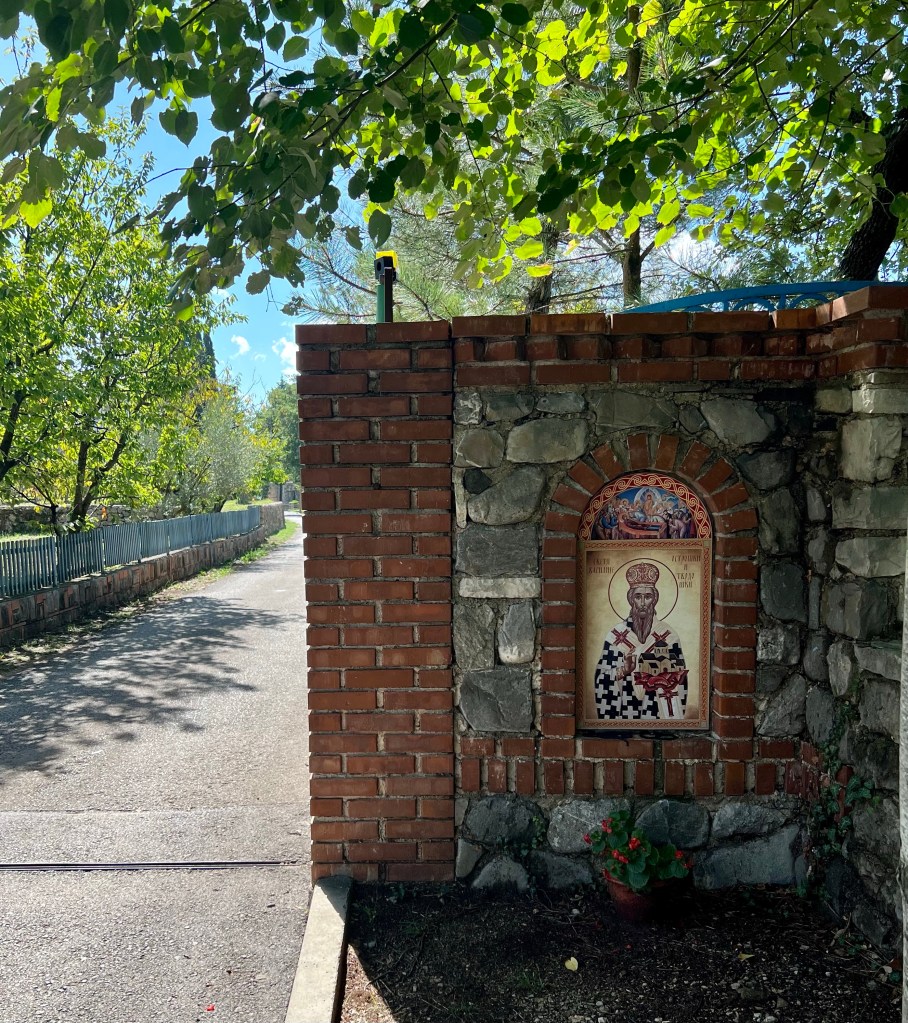
Wandering Through Northern Europe – Discovering Bergen with Ken

June 22-25

Wednesday

Our Airbnb in Bergen has a couple of characteristics in common with our previous palatial residence in Stockholm; it’s centrally located and up a couple flights of stairs with no elevator! After hauling our steamer trunks up to flights of stairs, we figured out where everything was in our apartment before setting out on a reconnaissance walk to stretch our legs. It was an easy walk to the “downtown” core before the forecasted rain started. 

Securing a spot to have dinner was a bit more complicated as the nicer restaurants were reservations only. Tomorrow is Midsummers Day and Bergen is hopping. We found a nice covered patio with heaters to keep out the rain and the cold. A bottle of wine and a couple burgers later, we head back to the Airbnb for another bottle of wine to recover from what had been a long enough travel day. 

View from Airbhb #1
View from Airbhb #2

Thursday 

The next day, we had a very slow morning especially Ken! What an amateur! Luckily our fjord cruise isn’t until 2 pm, so there’s time for a little walk around our hood and grab some lunch beforehand.

Bergen
Canon Ball!
Salmon!
So much seafood so little time!

We decided to try some fish at the first market on the pier; Ken had halibut which he said was good but a bit bony and I had some of the largest, plumpest mussels I’ve ever seen cooked in a lovely wine sauce. Yummmmm.

Just for the halibut!
Mussels for my muscles!

The weather for the boat cruise was cool but we’d brought heavier gear for that excursion and at least it wasn’t raining. 

Ready for our three hour tour – cue Gilligan’s Island Music!

Sailing out from the city center gives us a great view of Bryggen in Bergen, which is on UNESCO’s world heritage list. From there, we sail through magnificent scenery in Osterfjorden; a fjord in Vestland county. The fjord is one of three fjords surrounding the island of Osterøy. The Osterfjorden is generally about 1 to 3 kilometres wide and the deepest point in the fjord reaches a depth of 639 metres below sea level.

Bergen from the boat

Our cruise passes Modalen, Norway’s second smallest municipality. The further into the fjord we venture, the steeper and more powerful the mountain landscape becomes. We pass several cascading waterfalls. 

Small village with white school house
Wilderness
Coming into Modalen
Modalen

The crew takes us safely through powerful currents of the shallow and narrow  Mostraumen straits. Mostraumen was canalized (dredged) about 1913 and is The about 600 metres long and between 50 and 60 meters wide at the most narrow place.

Runoff

We shared a table with a nice young man from Luxembourg and enjoyed the spectacular scenery from the comfort of the cabin with frequent forays to the upper deck to get a better view of some of the villages perched precariously on the side of the fjord and take pics. 

At the halfway/turnaround point, the captain steered us so close to a waterfall that you risk can feel the refreshing spray on your face or your ass if you’re taking a selfie! What we won’t do for a “perfect” picture!!

Getting closer
Smiling in the mist!
Hurry up my ass is getting wet!

After the cruise, we head home to change into dryer clothes and fortify ourselves with a bottle of wine before heading off to a local cafe for dinner (Pygmalion Cafe & Galleri) shrimp and chicken stir fries and more wine of course! Tomorrow is another day so home to relax after dinner. 

Friday

Today we’ve got a walking tour this afternoon so we take the funicular up to the top in the morning for a panoramic view of Bergen. It’s a beautiful sunny day and quite warm.

Entrance to Fløibanen funicular – Going up!

The Fløibanen funicular in Bergen takes you from Bergen to Fløyen (320 m above sea level) in less than 10 minutes. At the top of Fløibanen there are shops, a cafè, a restaurant, activities for kids including a cool tree house and of course a viewing platform with fantastic panoramic views. We wandered around for a bit before grabbing the front seats for a bird’s-eye view on the return trip.  

View from the top!
Where to next?
Not so wild life!
Living on the edge?!
Pine cone tree house
It’s all downhill from here!

Before heading downtown we had a quick lunch at the hot dog stand across from our Airbnb – Trekroneren.  this modest stand has been in business for 75 years or so and specializes in high-quality sausages made by a local butcher. Ken had a Frankfurter and me Bratwurst and they hit the spot

Hot dog stand – 3-Kroneren

Time to head downtown to meet our tour. We’ve got some time even with a few side trips so we stop for a couple glasses of rosé before meeting our tour. 

Our tour guide is a youngish Irish fella who came to Bergen three years ago and fell in love with the city so stayed on. 

Our guide with the impossible Irish name

We started our tour in Byparken, a large park in the city centre meant to be a firebreak. The park’s centerpiece is the lovely cast-iron Music Pavilion with Moorish details. Nearby there is a life-size bronze statue of Edvard Grieg. This native of Bergen was a successful classical piano composer during the late 19th century.

Edvard Grieg

As we strolled along our guide gave us a short primer on Bergen’s history. Bergen was founded in 1070 by King Olaf III Haraldsson. Shortly afterwards,  a castle was built on the northern edge of Vågen harbour, and Bergen became commercially and politically important; it was Norway’s capital in the 12th and 13th centuries. In the 14th century, German Hanseatic merchants acquired control over the city’s trade; their influence lasted into the 17th century. Bergen has remained the most important port on the west coast of Norway, despite its repeated destruction by fire (most notably in 1702 and 1916); wider streets and buildings of brick and stone have been built in response to these disasters.

Today Bergen is the second largest city in Norway after Oslo and has around 16,000 university students. There are four art museums in the city centre. 

We headed up Ole Bulls Plass from Byparken to the National Theatre.  Ole Bull was a 19th century virtuoso violinist, strong proponent for Norwegian theatre, founder of the National Theatre and one of Bergen’s most acclaimed citizens.

Ole Bull Fountain
National Theatre
Wild eyed Henrik Ibsen – Famous Norwegian Playwright

From the National Theatre, we strolled down the main drag to the which was also built as a fire break.

On the main drag

In the center of Torgallmenningen, the main square in Bergen, is a 7-meter high monument to Norwegian sailors through the ages – Sailor’s Monument (Sjøfartsmonumentet). Each side of the square-shaped monument represents a different age of sailing.

Sailor’s Monument
Sailor’s Monument

Apparently, the monument was the subject of controversy when it was unveiled for a number of reasons. Firstly, it is dedicated to seafaring folks but you can’t see the sea from where it is located. A pool was added later so the sailors would be more comfortable. Additionally, big chunks of history are missing and there is no recognition of the role of women. For all its flaws, it is still a striking monument.

Next stop on the tour is Bergen’s famous fish market. Norway is the second largest exporter of fish after China. In the 1950s the five countries bordering The North Sea agreed to divide the North Sea based on the percentage of coastline to the total. Norway made out like a bandit with fish but also natural gas. Norway has vast reserves of natural gas and used earnings to set up the Petroleum Fund which is worth more than 3 trillion!

Random fact that makes Ken like Norway even more! Norway has the highest per capita pizza consumption in the world which explains the plethora of Italian restaurants.

From the fish market we’re off to the Floibanen that Ken and I took to the top this morning and then a quick look at Bergen’s oldest building – St. Mary’s Church on our way to Bryggen, also known as Tyskebryggen.  The row of houses on the wharf is among Bergen’s most iconic attractions. Red, yellow and white, the photogenic yet slightly crooked wooden houses, on the eastern side of the Vågen harbour, date back to Hanseatic days. This series of Hanseatic heritage commercial buildings has been on the UNESCO list for World Cultural Heritage sites since 1979.

Narrow alleys in Bryggen
Iconic colourful buildings in Bryggen

The last stop on the tour is Bergenhus Fortress; one of Norway’s oldest and best preserved fortifications. The Fortress has a long history as a royal seat, episcopal see and military seat of power.

Tower at the Fortress
Inside the Fortress

I wanted to check out St Mary’s Church a bit more closely so we stopped there before heading back to the Airbnb.

St. Mary’s Church
Beautiful Catholic Altar in a Lutheran Church
Put your prayer in the jar – Peace in Ukraine
Snorri Sturluson – Icelandic historian, poet, and politician.

I opted to lounge about while Ken headed to Starbucks. After a rest, it was time to shower and get ready for our late dinner at the restaurant we’d been turned away from a couple days ago. Our reservation is for 9 pm which is late but since it doesn’t get dark it’s not a problem. Plus, we have wine to drink! Apparently a lot of wine!!

After enjoying a yummy bottle of Cava at home, we head out for a quick drink and end up with another bottle and then, of course, we needed a bottle with dinner!!

Bottle two!

Funnily enough, we had made our reservation at a different restaurant than we thought though luckily they fit us in. Ken had the best fish and chips he’d ever eaten and I had moules and frites. The mussels weren’t as plump at those from the fish market a couple days ago but they were very fresh and tasty nonetheless. After dinner, it was home to crash!!

A man and his fish!
Moules et frites!

Tomorrow we’re heading to Oslo by train and more adventures.